Posted in Book reviews by Joseph, Book reviews by kids

Book review: The Nelly Gang

   The Adventures of Nelly Nolan: The Nelly Gang by Stephen Axelsen,   ISBN 9781921977916, Walker Books Australia

A review copy of this book was provided by the publisher.

Reviewed by Joseph, 9, WA
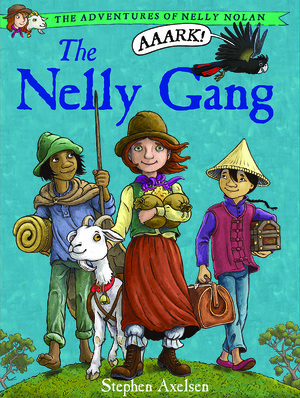
The Nelly Gang (cover)

This book is a graphic novel — it’s a bit like a comic book with lots of picture frames but it tells one long story through the whole book.

Nelly’s gang are Nelly and her friends Miro, Jin, plus Nelly’s goat. Nelly lives in Christmastown in Victoria in 1860 with her Pa who is looking for gold. When he finds gold (lots of gold!) they decide to go back to Sydney to find Nelly’s Ma. But someone knows about their gold and bushrangers are everywhere — like Captain Sunbeam and also Captain Moonshine. (The title of the book made me think of Ned Kelly, but Ned Kelly is not in this book.) The Nelly Gang have to fight the bushrangers.

The pictures in The Nelly Gang have interesting things to look at in the backgrounds. In a normal book you would have lots of description in words but the comic-style pictures do that in a graphic novel. I like the message tree — the posters on it made me laugh. Nelly’s goat (Queen Victoria) also makes me laugh. That’s my favourite character. And I liked funny lines like ‘as rich as pigs in a parsnip patch’ which is what Pa says to Nelly when they are weighing his gold.

Boys and girls age 8+ would thoroughly enjoy this. You learn a bit of history like what clothes are like in 1860, what school was like (the kids used slates instead of books and pencils), what money they used, how people lived in the goldfields, how they weighed gold and what their transport was like (horses and carriages).

When I got to the end I wondered what will happen to Nelly next so I would like to read a sequel. I would rate this book 9.5 out of 10.

Posted in Book reviews by Rebecca

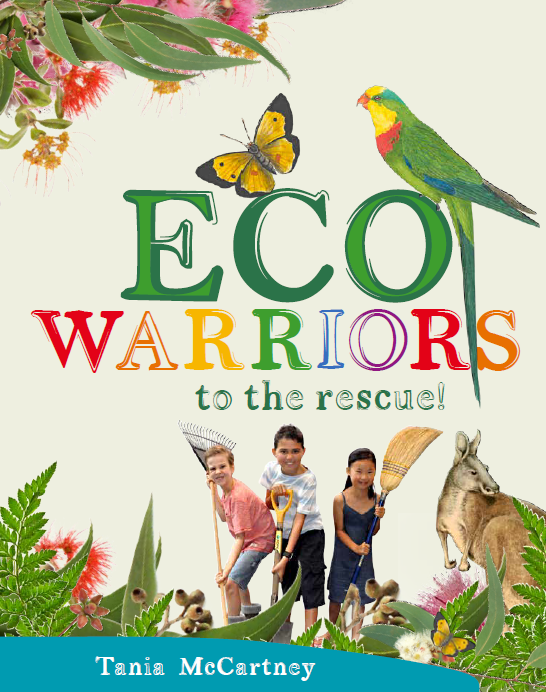
Book review: Eco Warriors to the Rescue!

Eco Warriors to the Rescue! by Tania McCartney, ISBN 9780642277800, National Library of Australia

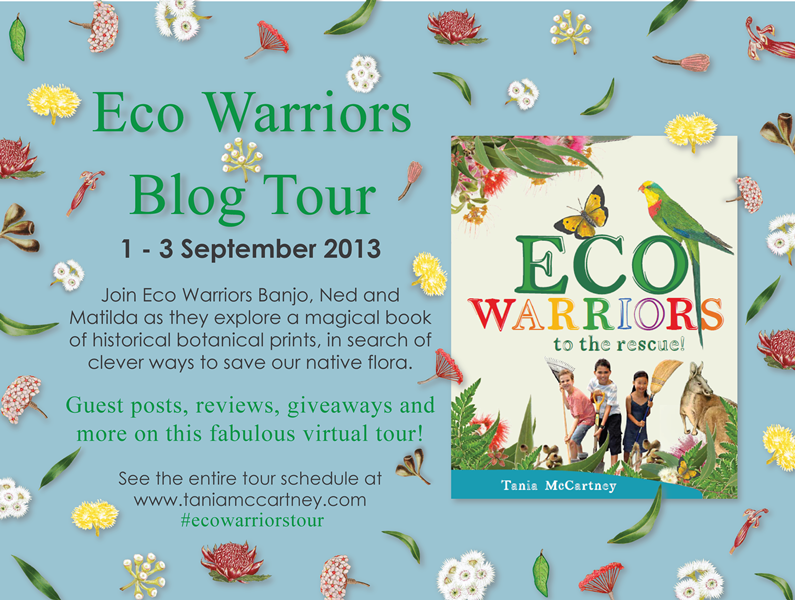
Reviewed by Rebecca Newman. (A review copy of this book was provided by the publisher.) This post is part of a Blog Tour celebrating the publication of Eco Warriors to the Rescue! You’ll find other stops on the tour here

eco warriors to the rescue!

Take a sneak peek at some of the pages inside the book, over at the author’s blog.

Banjo, Ned and Matilda are eco warriors looking for the best ways to care for Australia’s native plants. They consult their favourite book on the subject, and then find themselves falling into the book. (Now they can take us on a tour of Australia’s native plants!)

The pages of Eco Warriors feature photos of the children popping into, through and out of historical botanical paintings sourced from the archives of the National Library of Australia. Would you recognise a Kangaroo Paw, a Wattle or a Flame Tree? The three friends point out favourite plants and share tips on protecting Australian flora. There’s also a green moth to search for on every page. (Test your observation skills!)

At the back of the book you’ll find Flower Facts and a map of Australia showing the Australian floral emblem, and the floral emblem for each state/territory. Over the page you’ll find a chart with the native flower assigned to each month so you can learn what your birthday flower is — Alphabet Soup’s birthday is in October and we discovered that the native flower for that month is the Red Bottlebrush. (Excellent! We love the Red Bottlebrush!)

The artwork is bright and fun to look at and when you’ve finished following these three eco warriors, you’ll look at the plantlife in your neighbourhood with new eyes. (Follow the tips in the book and become an eco warrior too — Australia needs more eco warriors.)

Would you love to own this picture book? We have some good news — we have one copy of Eco Warriors to the Rescue to give away — thanks to the National Library of Australia. Here’s what you need to do to enter the giveaway:

  • email our editor with three details —  your first name, postal address and your state’s floral emblem
  • Put ECOWARRIORS in the subject line of your email
  • Get your entry in by 9am EST on Monday 9 September 2013.

We will put all the entries into a hat and draw one winner on Monday 9 September 2013, and announce it here on the blog.

Some fine print:

  • Entries must be emailed by 9am EST on 9 September 2013.
  • We will announce the winner (first name and state only) here on the blog on 9 September 2013.
  • We will email the winner on 9 September 2013 and post the book to them by the end of September.
  • We will post the book to the winner even if we have no response to the email.
  • Entries that do not include a postal address will not be eligible for the draw.
  • Entries that do not include the correct floral emblem of the entrant’s state will not be eligible for the draw. (Double check!)
  • We will not pass your details on to any third party except when required by law.
  • This giveaway is open to Australian residents only. Schools are welcome to submit an entry.
  • You may only send one entry in per person for this giveaway.

ATTEND THE LAUNCH OF THE BOOK!

If you live in Canberra, you can Join Tania McCartney and her three real-life eco warriors — Banjo (Riley), Ned (Andrew) and Matilda (Claire) — as they launch Eco Warriors to the Rescue! at Canberra’s National Arboretum Gift Shop, Saturday 5 October 2013, at 11am.

Posted in poetry, Soup Blog Poetry Festival

Time for a poem – Mulga Bill’s Bicycle

Today is the LAST day of the Soup Blog Poetry Festival.

Thanks to everyone who stopped by the blog to read and listen to poems and meet some of Australia’s amazing children’s poets.

We thought we’d close the festival with one of our favourite poems — ‘Mulga Bill’s Bicycle’ by AB (Banjo) Paterson.

What’s your favourite poet or poem?

Posted in poetry, Soup Blog Poetry Festival

Visiting poet – Lorraine Marwood

Lorraine Marwood
Lorraine Marwood

Today we welcome Lorraine Marwood to the blog — Lorraine writes verse novels and poetry and you would have read several of her poems in Alphabet Soup!

note on the door (cover)

Stary Jumps (cover)

When did you first start writing poetry?

I began as a teenager, so probably 15 years old, but before that I was writing down ideas and little stories for many years.

What sort of poetry do you like writing best of all?

Poetry that doesn’t rhyme but shows in different ways a moment in time or an emotion, and still has all the strong features of poetry, like rhythm, strongest words, images, sensory details, emotion.

What sort of poetry do you like reading?

Contemporary poetry written by Australians; poems in The School Magazine, NSW; anthologies like 100 Australian poets, so I read many poets in the one book. Also poetry by young writers and I enjoy reading the results of the Dorothea Mackellar poetry competition.

Where can we read your poetry?

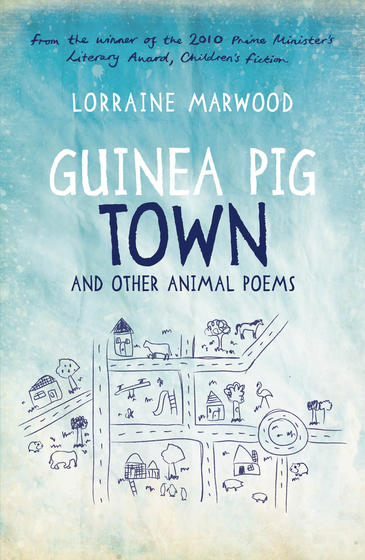
I have had six collections of poems published — the most recent one is Guinea Pig town and other animal poems with Walker Books Australia. I’ve had lots of poems published in magazines, here in Australia, UK, USA and Canada. And I always love to be published in The School Magazine and of course Alphabet Soup — well, I wish that was still going.

guinea pig town

Here’s one of the poems from Guinea Pig town and other animal poems:

A peek inside Guinea Pig Town and other animal poems

[click on the image to enlarge it]

How often do you write?

I’d like to say everyday — well I do write but some days its emails, administration or reworking a piece, then other days it’s intense writing, but always I’m thinking about my poems, an idea, a story, what happens next …

Do you prefer to write with a pen and paper or straight onto the computer?

That’s a good question. I like to write poetry with a pen in one of my current notebooks. I often write when traveling or out for the day. I can jot down ideas I see or an idea that strikes. Poetry to me needs this special touch, but for stories I type right onto my laptop.

What’s your number one tip for budding poets?

Keep a notebook you can take with you.  Jot down anything that catches your eye. Train yourself to be observant, because the strongest writing uses those details that others skim over.

Lorraine’s Poetry Prescription

IF YOU’RE HAVING A RUSHING, BUSTLING DAY — read the following poem:

‘Wilderness’ by Carl Sandburg.

To find out more about Lorraine Marwood and her books and poetry, check out her website and read an earlier post featuring Lorraine.

Interview with Lorraine Marwood © 2013 Lorraine Marwood and Rebecca Newman https://soupblog.wordpress.com


Posted in poetry, Soup Blog Poetry Festival

Tuesday Challenge – haiku

It’s Tuesday and you know what that means? It’s time for this week’s Tuesday Challenge. And this is one we know you’ve probably been expecting ever since we announced that there would be a tiny poem challenge every Tuesday …

Write a haiku.

A haiku is a short poem, usually inspired by nature. At school you might have been taught that a haiku is a 3-line poem with 5 syllables in the first line, 7 syllables in the second line and five syllables in the third line. That’s one way to write a haiku. Modern writers of haiku (in English) don’t always worry about the syllable count — they just keep their poem very, very short. Some say that it should be able to be read in a single breath.

A haiku is like a brief snapshot or image. Like a word-photograph. It doesn’t rhyme.

Here’s one I wrote a few days ago:

Weary crickets creak

A light floats in the pond —

August moon rising

If you write a haiku — will you share it with us in the comments below? (Check with a parent or teacher first.) Grownups are also welcome to post a haiku but please note that we are G-rated!

~ Rebecca

Until the end of August, we’ll have a new poetry challenge every Tuesday.

Read these earlier Poetry Challenges from the 2013 Soup Blog Poetry Festival. (You can still add your poems in the comments at each post if you like!)

Poetry Challenge & haiku © 2013 Rebecca Newman https://soupblog.wordpress.com