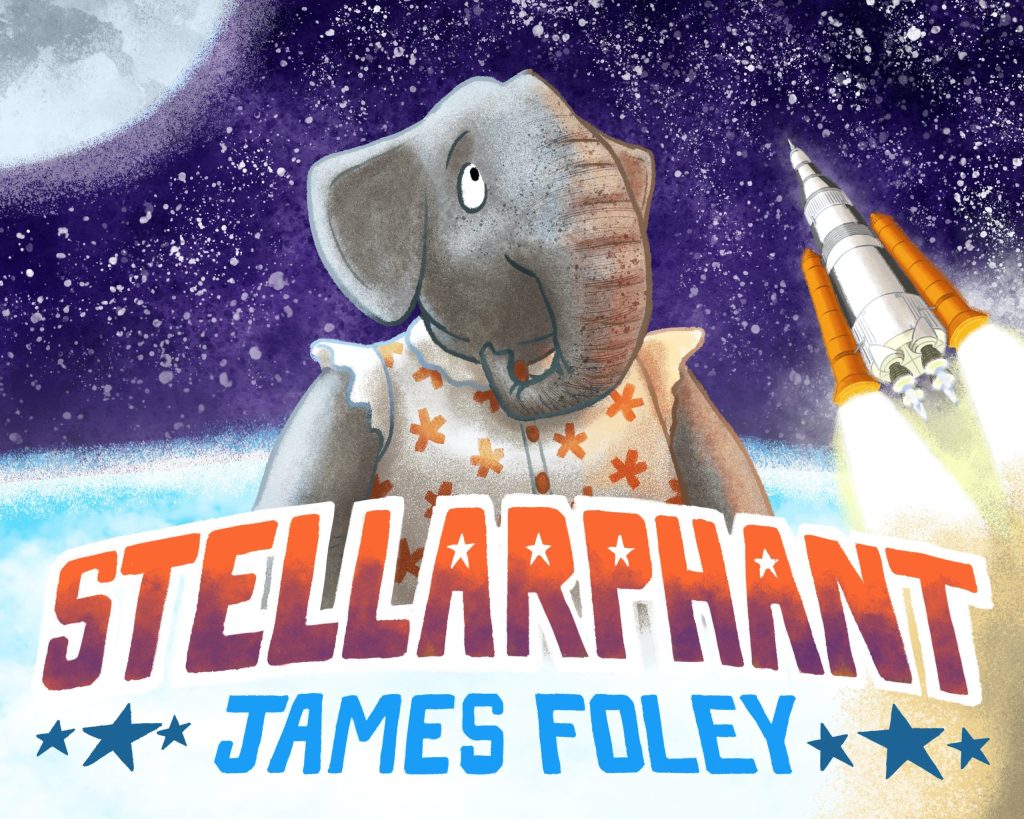
Stellarphant is an inspiring story to teach young children about persisting. Stella the elephant wants to become an astronaut but there are many things that hold her back such as she needs a spacesuit, a rocket, space education and crew!
It’s an ordinary Monday at 9am when suddenly an elephant bursts into Space Command asking to be an astronaut! Stella doesn’t understand when the recruiter says she can’t. Stella then sets to work trying to become an astronaut but along the way she faces many challenges. Once again, she asks the recruiter one more time to get his response …
My favourite part in Stellarphant is when Stella is determined to become an astronaut by working hard because if you work hard, you can get anything! Also, I liked the timeline at the end of the book listing all the animal things that have been into space. Did you know that in my birthyear (2011) a bobtail squid was sent into space! Also, the weirdest one I read was in 1989 fertilised chicken eggs were sent into space!
Overall, I’d rate Stellarphant ten out of ten because it’s inspiring, funny and reaching for the stars!
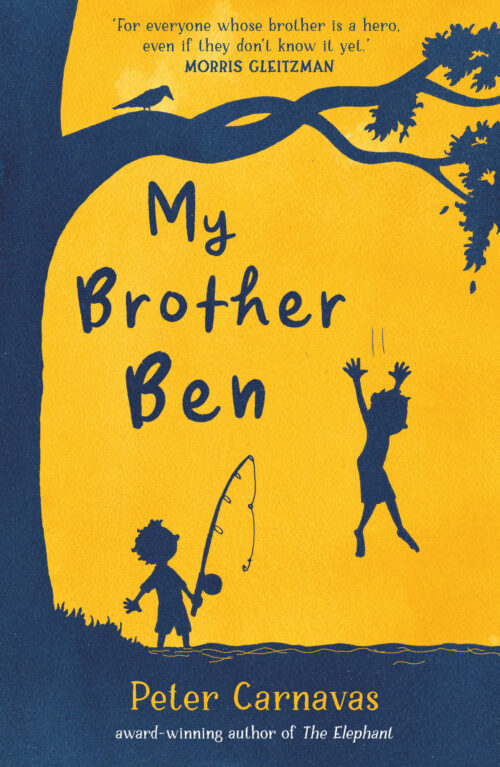
My Brother Ben is a timeless story of two brothers and a magpie.
Luke is a quiet boy who loves and is very knowledgeable about birds. Ben is starting high school, is adventurous, and both brothers share a dream about exploring Cabbage Tree Creek in a boat of their very own. When Ben starts sneaking out at night, Luke decides to follow him.
This book is a tale of brotherly love, birds and boats. I would recommend this beautiful book to 10 to 110-year-olds who enjoy a book about the bond of family and a tiny bit of mystery.
James Foley makes picture books, middle grade novels and comics for kids. His work has been published as books, in anthologies, and in magazines and newspapers. Today we are thrilled to chat to James about his latest book, Stellarphant.
From the publisher:
Stella wants to be an astronaut. There is only one problem – Stella is an elephant. Every time she applies to Space Command, they come with a new reason she can’t join. But where there’s a will, there’s a way and Stella is determined to reach for the stars.
What sparked the idea for this story?
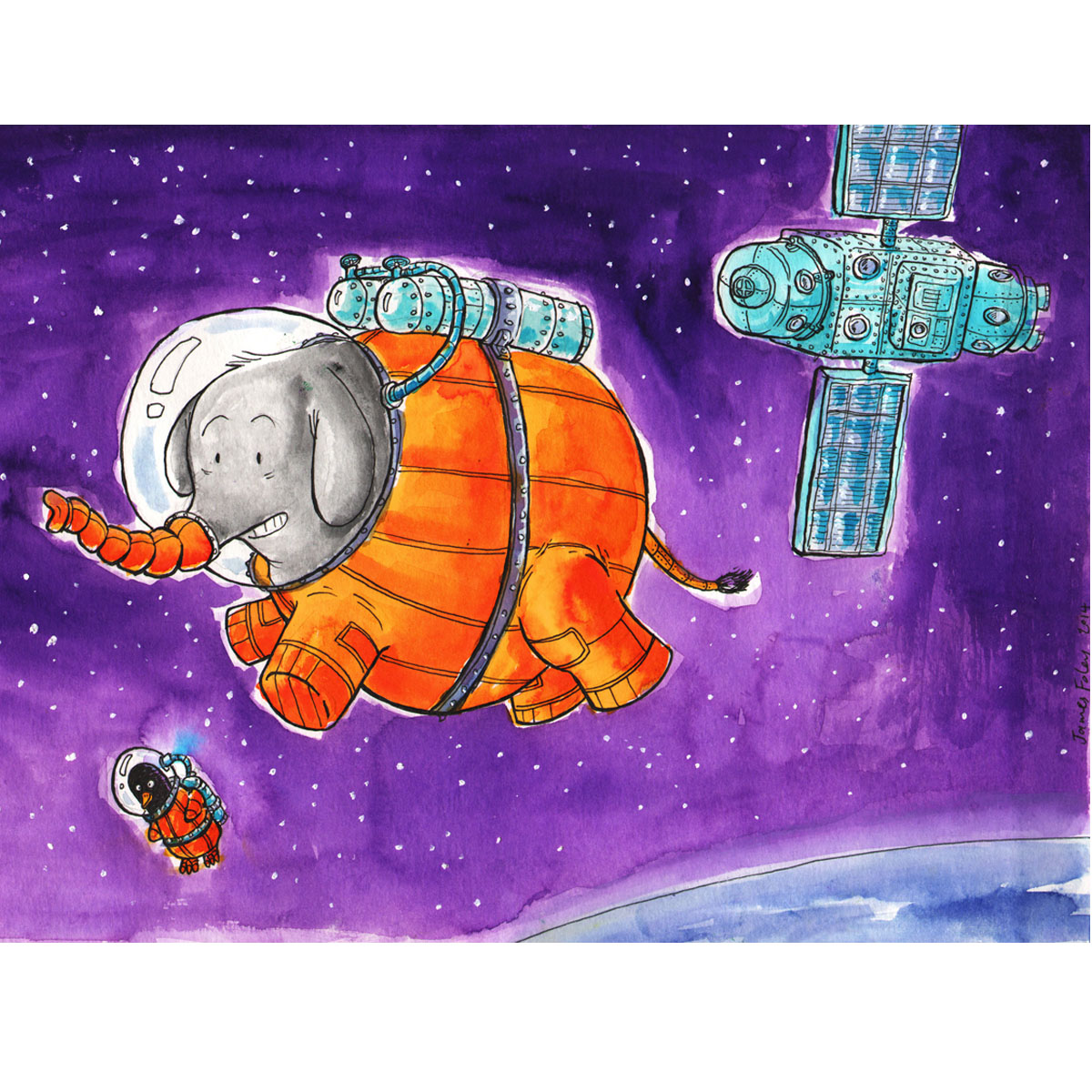
I was at our annual SCBWI (Society of Children’s Book Writers and Illustrators) Rottnest Retreat, June 2014. Sitting around in the cottage with my friends and we were all sketching and scribing away. I made this random pen and watercolour sketch of an elephant and penguin as astronauts. Elephants had turned up in my sketchbooks regularly over the years, but never as an astronaut. The story that became Stellarphant grew from there.
I’m also a massive nerd who loves learning things, and I was reading about all the species that have been to space. The back endpapers of the book were another early image I couldn’t get out of my head.
The endpapers showcase the huge number of animals sent to space since 1947. Was there a particular animal you were surprised to discover had been to space?
I was most surprised that the first earthlings to circumnavigate the moon were not humans; it was some tortoises, mealworms and wineflies, sent by the Soviets! I also loved that there was an experiment that sent fertilised chicken eggs to space – it was called ‘Chix in Space’ and was sponsored by KFC.
The endpapers in Stellarphant aren’t even the full number of animals that have been to space, they were just a bunch of the most fascinating ones.
Stella shows resilience, persistence and creative problem solving skills in the face of repeated ‘no’s. Have you ever been told it’s not possible to do something and persisted anyway?
I was really lucky that when I was younger, and being a writer/illustrator was still just a dream, I didn’t have anyone tell me I couldn’t do it. My parents and siblings and friends were all very supportive of my creativity. Though I can be incredibly stubborn, so maybe they knew that they couldn’t stop me if I really wanted to try.
Sometimes it’s your own head that is telling you no; that often happens to me when I’m in the earliest stages of a new project, or even just starting a new page. The little doubting voice flares up, and I wonder if I’ll be able to finish the task ahead. When that happens, I find that my fear of not meeting my deadline usually trumps the fear of failure, haha! I know that I just have to get the work done.
The book is definitely about determination, but for me it’s also about discrimination, and diversity, and equity, and feminism. And it’s also about learning to let go of what other people think of you; to stop looking for approval from others, and to realise that you are good enough the way you are.
Can you tell us a bit about how you went about creating the book? Words or illustrations first?
The whole story grew from that image of the elephant and penguin spacewalking.
This is the original sketch that started it all.
Final artwork in Stellarphant.
That’s how it goes with my stories, most of the time; they start with an image (either in a sketchbook or in my head), then the plot grows from there.
When I first started trying to write the text for Stellarphant I was pretty inexperienced at writing. The manuscript was, uh, not great, haha! It took me a while, and it took writing a bunch of other stories, to figure out how to make Stellarphant click.
Now I’ve learned from experience that it’s best for me to hold off on writing down a new idea until I’ve thought about it for a really long time; I need to let the ideas percolate and simmer in my head until I’ve got all the plot beats. I’m definitely a planner; I need to know the beginning, middle and end of the story. I won’t start writing unless I know where it’s going.
As I’m brainstorming and writing, I’ll get pictures in my head. So once I have the story completely written out, it doesn’t usually take too long to scribble out a sketchy little storyboard for the whole thing. From there I can edit, improve, rearrange, until the words and pictures are fitting together just so.
That’s how it worked with Stellarphant. I did one scribbly little version of the storyboard; then maybe two full-size black and white rough versions of the book. Then I figured out the colour scheme and did a colour rough for the book. Then I did the finals. It was a fairly straightforward process compared to my first book, where I made 13 different storyboards!
Can you tell us a bit about what you’re working on next?
I’ve got two projects on the go – the first is a comic short story which will be published in 2022.
The other is a MASSIVE project that I’d love to talk about, but it’s still super secret! It’ll come out in early 2023.
Stellarphantis out now! Ask for it at your favourite bookstore or local library.
AWESOME EXTRAS:
Meet James Foley: Come to a free book signing + drawing workshop! 13 November 2021 [WA event]
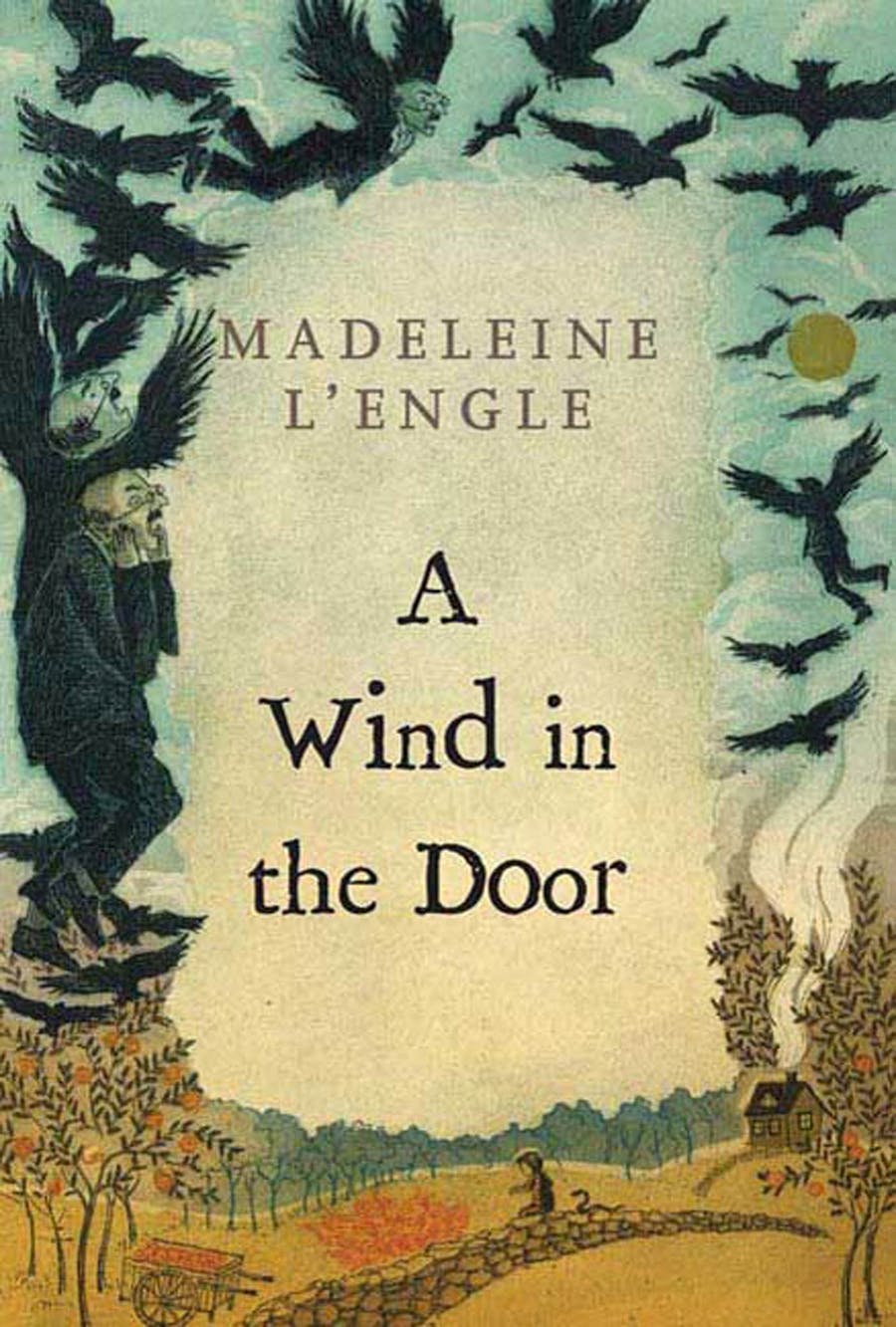
A Wind in the Door by Madeleine L’Engle, St Martins Press, ISBN 9780312368548
Jon reviewed his own copy of this book.
This is an adventure-fantasy novel where a child named Charles Wallace is sick, because he is infected with the Echthroi, who are the antagonists of the book. The Echthroi are evil beings trying to erase creation. A teacher by the name of Blajeny comes to Meg and Calvin. Meg is the main character and Calvin is her best friend. The teacher says that Meg’s brother Charles Wallace is sick and that Meg, Calvin, and Progo will try to save him. The book has the adventure you would want to read because they travel to other dimensions.
I like adventure-fantasy novels. I enjoyed the book because the impossible was real. I liked that the book had no pictures so the reader can imagine the characters. I wonder if they will make a movie?
Kids who love adventure fantasy will love this book.
This is Jon’s first book review for Alphabet Soup.To send us YOUR story, poem, artwork or book review, check out our submission guidelines. Happy reading!
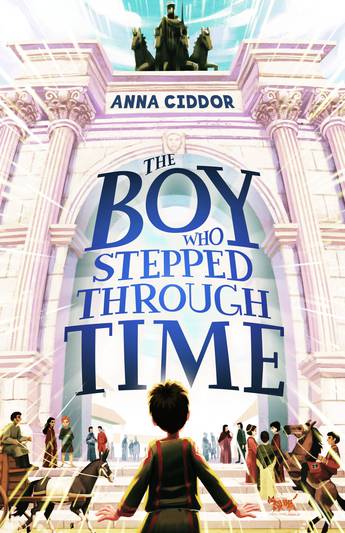
This fantastic book is about Perry, a boy who travels back through time to Ancient Rome. Perry learns many interesting things about the Romans such as they drizzle honey over all their meals. He learns to like different things and makes many friends. However, some of his new friends question where he came from. What should he answer?
After a while, Perry wants to return to the modern days. But Perry knows something about his new Roman mistress and friend that she doesn’t know. He obtained this piece of knowledge from the future. Should he try to help her with the risk of never going back to his time?
I rate this book nine out of ten because the author based it on actual facts to show how the lives of the Romans’ masters and their slaves’ lives played out. I like it a lot because there is good character development. Anna Ciddor also must have done a lot of research on Ancient Roman facts and buildings.
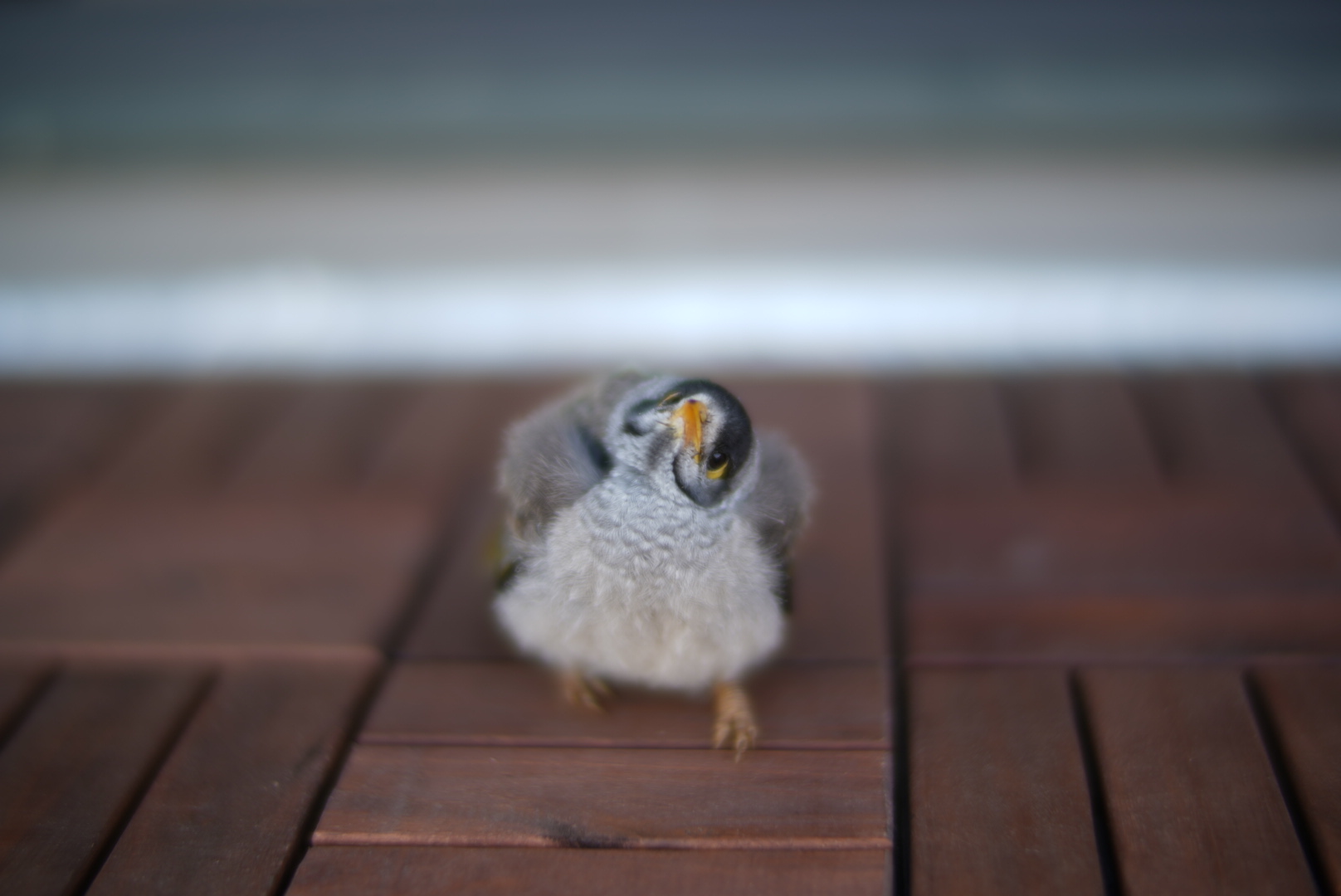
“My wings grew!” I thought as I looked at my fluffy feathers. I wanted to take flight so I went outside and tried. As I jumped I hovered in the air for a second, suddenly I started plummeting to the ground. I closed my eyes, ready for impact. I landed on a tall, black pole with a yellow top. I looked around hoping to be near my house. But instead of my house I was in front of a massive white wall with weird animals inside. One of them noticed me.
“ Oh no.” I thought. But instead of yelling at me it brought out a box and put me inside it. I chirped desperately hoping my mum would hear me. A second later another weird animal was standing near me. It stared at me fascinated by how I looked.
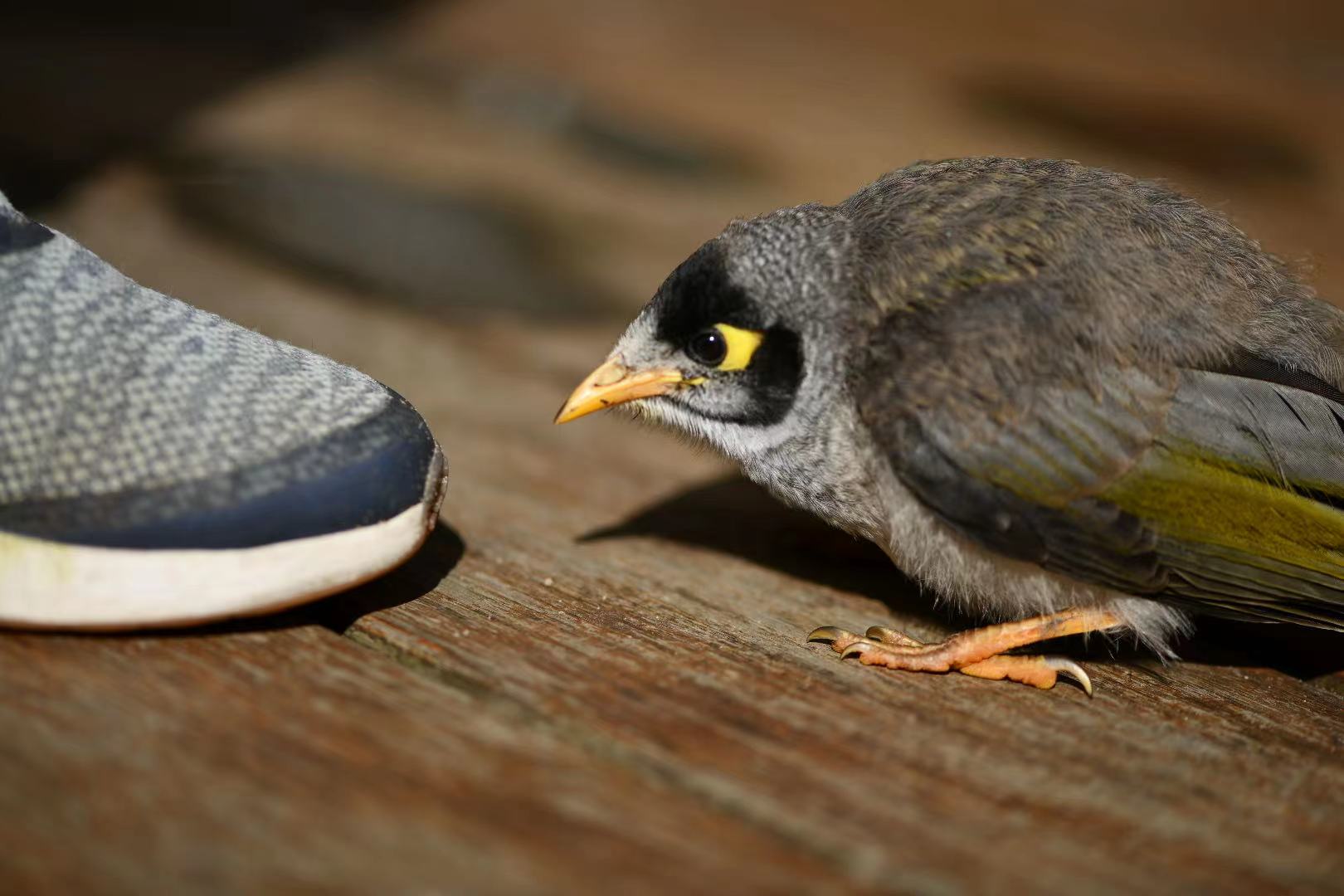
The weird animals were outside. They seemed kind though. My mum fed me some worms then she left. The smallest animal bent a blade of grass towards me. I nibbled at it then sniffed the smallest animal’s shoe. She seemed to like me. Then the animals left. They went up and away from me. I didn’t want to be left behind! I tried to fly up, higher and higher, and I landed on the edge of a big platform with a cover on top. They saw me again! I felt special with all these animals around me. One even sat down near me.
My mum came back and said it was time to go back home. I reluctantly flew back with my mum. What an adventure that was. I hope to see you again, weird animals.
The photos in this post were provided by Donna Wu.
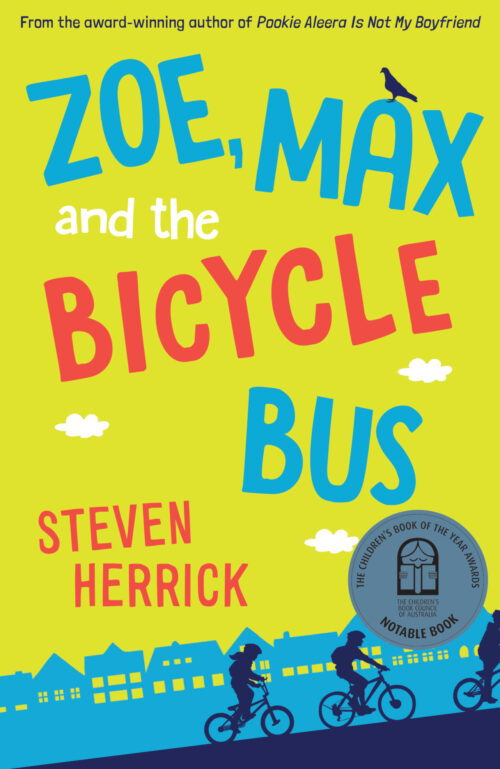
Zoe, Max and the Bicycle Bus is a book written in different people’s points of view as well as it’s written in verse
which means the writing
is like a big poem
that goes for the entire book.

It's like the writing above.
Zoe, Max and the Bicycle Bus is a book about eight kids and one teacher (and also a crossing guard, but he doesn’t ride his bike to school) who all love to ride their bikes to school, but each day when they ride to school the cars on the side of the road get closer and closer to the bike lane they all ride in. Can they all stop the cars getting closer in time or is it too late?
My favourite part in the book is when they decide to ride their bikes to school, rather than a car, because cars can pollute the environment.
My favourite character is actually all of them since they work together all the time! Overall, I’d recommend this book to anyone age 9+. I’d rate it nine out of ten, just because with 10 people it’s a bit hard to keep track of the characters!
Zoe, Max and the Bicycle Bus is a funny and inspiring story that I strongly recommend.
George’s Secret Key to the Universe by Lucy & Stephen Hawking, Simon & Schuster, ISBN 9781416985846
Ayaan reviewed his own copy of this book
George’s Secret Key to the Universe is the first of six books in the George’s Secret Key to the Universe series.
The series is written by Stephen Hawking and his daughter, Lucy Hawking. The first three books are written by both of them but then Stephen Hawking died. Lucy Hawking wrote the last three books in the series and used lots more of her father’s ideas.
The story features George who meets Annie and her father named Eric through a pig investigation. They have a supercomputer named Cosmos and he can open a portal that can take you anywhere in the universe. But before George can view or work with Cosmos, he has to take the Oath of the Scientist.
The next day, George goes to school and Eric’s enemy, Dr Reeper, tries to take Cosmos by leading Eric into a black hole. George goes to Annie and they track down Cosmos. But can they get to Eric in time?
I would rate this book five stars. It is action-packed and is full of amazing science facts. I would recommend this book to anyone who loves science, just like me!
Note about Stephen Hawking: He was a world-famous cosmologist and physicist who has written many famous books. He was diagnosed motor neurone disease when in his early 20s and was told that he would only live for a few more years but he lived until he was 75 through pure determination to live!
Jane Eyre (Usborne Young Reading series), retold by Mary Sebag-Montefiore, illustrated by Alan Marks, Usborne, ISBN 9781409539643
Aashi reviewed her own copy of this book.
Jane Eyre is a classic book about love and friendship. The original book was written by Charlotte Bronte, who was a teacher who loved writing along with her siblings. When Charlotte Bronte died her house was turned into a museum.
She wrote Jane Eyre in 1847. The copy I read was written by Mary Sebag-Montefiore and illustrated by Alan Marks.
Like Charlotte Bronte, Jane Eyre was a teacher. She became a teacher after abandoning her supposed husband. Jane Eyre’s life flipped and wobbled as kind Jane moved around her home country and all this time she read lots of her favourite books.
Jane was an orphan who lived with her stubborn aunty and her mean cousin. Her aunty always punished her without a reason and not one hour was spent without punishments. One day Jane’s stubborn aunty sent her to a boarding school that made the pupils (students) shiver and whacked canes and rods on their necks and chests. Until one winter day most kids caught bad diseases and most kids in the school died.
This all sounds very sad but the book has a happy ending with lots of kindness. I would encourage reading this book as this gives a view of olden days.
I would rate this book 4 out of 5 stars as it is sometimes scary. I would recommend this book for 7-9 year olds.
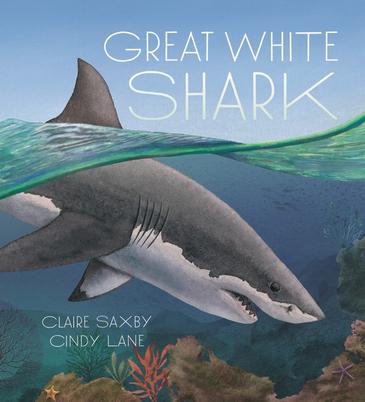
(L) Great White Shark by Claire Saxby & Cindy Lane. (R) Cindy Lane and a Megalodon.
Cindy Lane is an award-winning artist and illustrator who loves the ocean. She was born and grew up by the sea in Sydney, lived by the Great Barrier Reef in FNQ, and now has her studio by the Indian Ocean in Perth. Cindy loves to make her own paints with materials she finds in nature, and collects waters from all over the world to use in her paintings. Seawaters from across Australia were used in Great White Shark, her first picture book, written by Claire Saxby.
In Great White Shark we follow a female shark on her way to warmer waters to give her pups the best chance of survival. Set in a stunning underwater world, Claire Saxby’s signature poetic prose and Cindy Lane’s sublime illustrations showcase the grace, majesty and power of one of the ocean’s top predators.
Can you tell us a bit about how you created the illustrations for Great White Shark?
It all starts with a sketch – pencil on paper. I like the scratchy feel of graphite on a surface, with sound and feel for feedback as you create. I do also draw digitally, but it can be quite a clinical process, not what I want at this stage. It can be all too easy to erase the less-than-perfect lines when drawing on a tablet – a double tap of your fingers and it’s gone! I like seeing the messy, roundabout road maps of initial sketches, the sparks of ideas, and where they led.
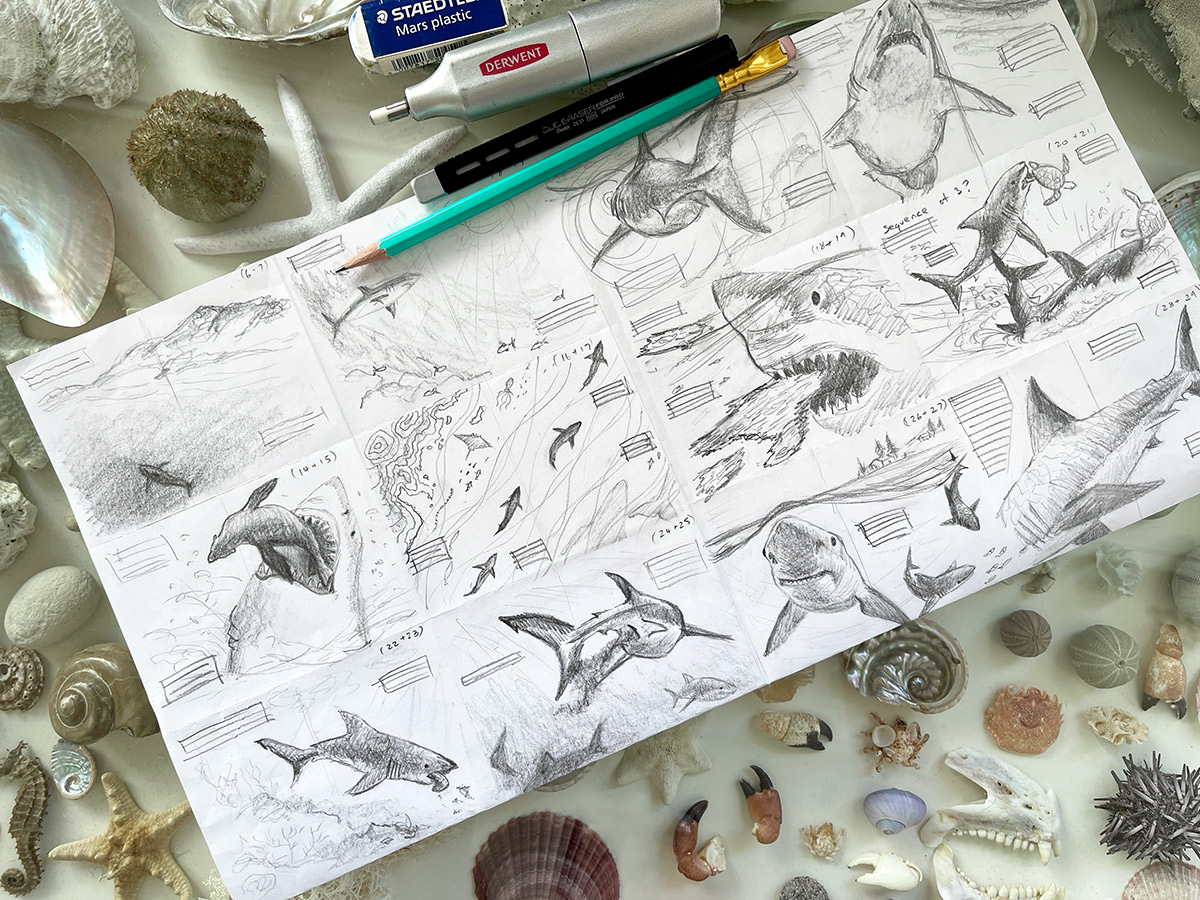
From pencils sketches to a pencil thumbnail sheet! Once this was approved by the art director I went on to do some sample colour illustrations from the text, just to determine a style that the publisher, author and I were all happy with. This was a combination of pastel on sanded paper and watercolours on cotton paper, both with digital sketching over the top.
Thumbnail sketches by Cindy Lane for the picture book Great White Shark
Once these were approved, I was let loose on the double page spreads, cover, title, index pages and the endpapers. There was still lots of research to be done, and luckily the PLANET SHARK exhibition was visiting Fremantle. I got to see so many sharks, including multiple Great White models up close, the preserved body of the massive Megamouth shark, plus the HUGE Megalodon jaws!
Using sea waters from my collection, I started watercolour painting the backgrounds and creatures that feature in the book. They were then photographed or scanned individually, then collaged together digitally to create the scenes.
Did you discuss the story/illustrations with the author (Claire Saxby) while illustrating the book?
No, I had no direct contact with the author during the illustration process. Claire Saxby’s feedback was always via the editor and art director.
How long did it take you (from signing the contract to going to print) to illustrate Great White Shark?
14 months.
Were you already interested in sharks before you were asked to illustrate the book?
Definitely! I’ve always had a love for the ocean and all of its inhabitants. Even those that get bad press. Especially those ones!
Great White Shark is out now! Ask for it at your favourite bookstore or local library.






 alphabetsoup.net.au