If you receive our e-newsletter*, you will know that we recently moved to a new office. We now have a NEW ADDRESS!
We do love opening mail! So please send all your poems, stories, book reviews and artwork to:
Alphabet Soup Magazine PO Box 3099 BROADWAY NEDLANDS WA 6009
(And, YES, Broadway Nedlands is the correct suburb. Don’t shorten it to Nedlands or your mail will be delayed.)
Don’t panic if you’ve just posted something to our old post office address in Willetton—mail to our old address will be forwarded on to the new address for a month or so.
We’re still selecting kids’ writing for our last issue of the year, so send us your best work! And we’ll keep an eye on the new post office box …
~ Rebecca
Editor, Alphabet Soup Magazine
—
* If you don’t receive our e-newsletter but you’d like to, ask a parent (or teacher) to send us an email with ‘subscribe e-news’ in the subject line. Our e-newsletters are sent about 5 times a year and include news, interesting links to writing or illustrating sites, writing prompts for your journal, and other writing-related bits and pieces.
It’s Fabulous First Line Friday! And here is this week’s Fabulous First Line*:
Twelve pairs of eyes widened in unison, awaiting Miss Ophelia Grimm’s next move.
Do you want to read on? The title of the book is at the end of this post …
*For the purposes of Fabulous First Line Friday, we’re counting the first line as the first line of chapter 1 in any book. So if there is an introduction or an author’s note or something before chapter 1, we don’t count that bit …
The book is Alice Miranda Takes the Lead by Jacqueline Harvey.
To celebrate the National Year of Reading, we are sharing some fabulous first lines from the books on our bookshelves. Every Friday you’ll find another fabulous first line here on Soup Blog.
Now for today’s Fabulous First Line*:
Most guinea pigs would be scared diving down into the mouth of a volcano, in a homemade jet with two kids and a three-legged wolf pup.
Do you want to read on? The title of the book is at the end of this post …
*For the purposes of Fabulous First Line Friday, we’re counting the first line as the first line of chapter 1 in any book. So if there is an introduction or an author’s note or something before chapter 1, we don’t count that bit …
The book is Animal Rescue: Shark Attack by Jackie French.
To celebrate the National Year of Reading, we are sharing some fabulous first lines from the books on our bookshelves. Every Friday you’ll find another fabulous first line here on Soup Blog.
Now for today’s Fabulous First Line*:
Billy Broccoli wasn’t getting out of the car.
Do you want to read on? The title of the book is at the end of this post …
*For the purposes of Fabulous First Line Friday, we’re counting the first line as the first line of chapter 1 in any book. So if there is an introduction or an author’s note or something before chapter 1, we don’t count that bit …
The book is Ghost Buddy: Zero to Hero by Henry Winkler and Lin Oliver.
To celebrate the National Year of Reading, we are sharing some fabulous first lines from the books on our bookshelves. Every Friday you’ll find another fabulous first line here on Soup Blog.
Now for today’s Fabulous First Line*:
Pollo di Nozi crouched behind a tombstone, watching the stranger swish through the grass.
Do you want to read on? The title of the book is at the end of this post …
*For the purposes of Fabulous First Line Friday, we’re counting the first line as the first line of chapter 1 in any book. So if there is an introduction or an author’s note or something before chapter 1, we don’t count that bit …
The book is Mystery at Riddle Gully by Jen Banyard.
Today’s guest reviewer is 9-year-old Julia. Over to you, Julia!
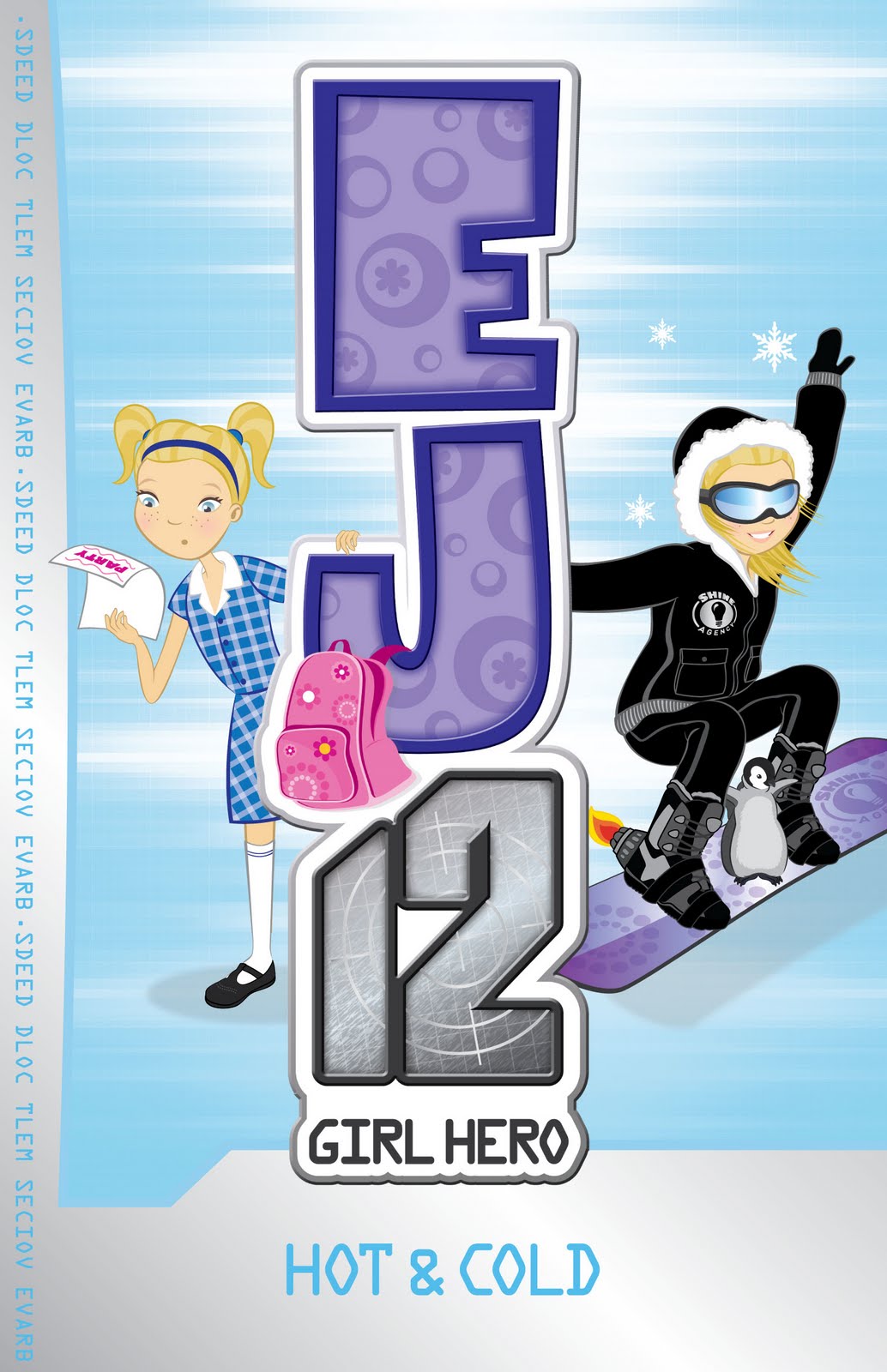
EJ12 Hot and Cold by Susannah McFarlane, ISBN 9781865043616, Scholastic Australia
Reviewed by Julia, 9, QLD
—
This book is about an everyday girl who is a secret agent for the SHINE agency. As agent EJ12, Emma Jacks is unbeatable.
In the book EJ12 Hot & Cold, Emma (EJ12) must stop Dr Caterina Hill from making Global Warming worse and save the animals at the South Pole.
She must crack codes, and then defeat the SHADOW agency.
I would recommend this book to children from ages 8 to 10 or years 2 to 4 to read this book. And if you want to find out what happens in EJ12 Hot & Cold then you’ll have to read the book!
The book reviewed here is the reviewer’s own copy.
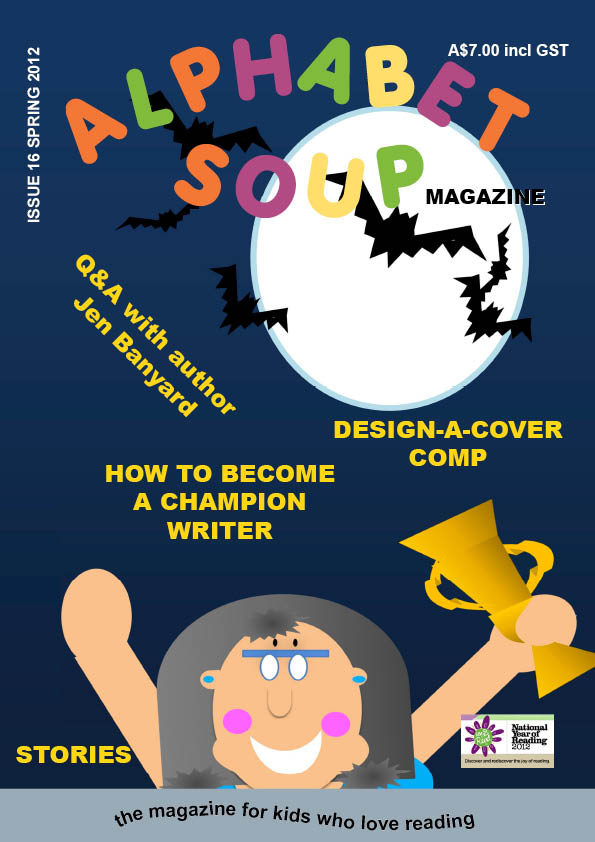
In every issue of Alphabet Soup magazine, you’ll meet an Australian writer or illustrator. In the spring issue we talk to Jen Banyard about being a writer and about her books—Spider Lies, and Mystery at Riddle Gully. We can’t fit everything into the magazine (so many interesting answers!) so we’ve posted the whole interview here on the blog. Read on!
—
Where do you live?
I live in Floreat (in WA), which makes it nice and easy to go walking on the Bold Park bush trails (I love going after dark!) or to swim at City Beach. Until last year we had a Kelpie-cross dog but she died of old age; now we just have a tabby cat and a noisy family of possums in the roof.
Where do you get your inspiration?
I usually carry a small notepad with me and jot down interesting things about people (not while they’re looking!), funny names or phrases, or quirky ways of looking at things. I keep an ‘ideas box’ and fill it with ideas I’ve written on bits of paper, newspaper and magazine clippings (articles and photographs)—anything that might kick off or spark up a story. A story is usually a combination of a few ideas.
I like to read magazines or books about the craft of writing, too. Sharing the experiences and advice of successful writers keeps me keen.
How did you come to be a writer?
I used to write and edit pretty staid stuff for government departments, universities and such. Eventually, I decided to do what I’d wanted to do for ages—write fun, lively stories. I guess that’s how I ‘came to be a writer’—by deciding to do it and giving myself a chance. (I wasn’t all that good at first … but I’m learning!)
Was it easy to get your first book published?
Yes and no (mainly no). I sent quite a few things to publishers before anything was accepted. But I wasn’t doing my research and sending the right piece to the right publisher (they all want or like different things). Also, adults played too big a role in my work. The first time I got both those things right, a major children’s magazine in NSW bought my story. That opened doors which led to the publication of Spider Lies.
How long does it take you to write a book?
The first draft is usually pretty quick (and fun), but the fine-tuning can go on forever—until the editor says ‘Enough!’ and drags the manuscript from under your hand. Spider Lies (21,000 words) took nine months or so, spread over about 18 months. Mystery at Riddle Gully (38,000 words) took about 15 months, spread over two-and-a-half years. The long time spans are partly because there’s a lot of to-ing and fro-ing with the editors and publisher, and things don’t always happen quickly with those busy people. So between bursts of working on one story, you go on with something else. I know someone who wrote a novel in a weekend. I’m not like him!
Do you prefer to write with pen & paper, or on the computer?
Pen and paper wins hands-down for the first draft. I scribble away (trying to stay in ‘the zone’), crossing out and adding in all over the place. Then I type what I’ve written into a computer, usually a few chapters at a time. The tinkering after that is mostly on my laptop. Before I submit a manuscript to a publisher, I print out the whole thing and read it through, ideally aloud. Doing that, I usually find a heap of things to change that had looked fine on the screen.
What did you like to read when you were growing up?
I ate up the Famous Five mystery series by Enid Blyton (all those smugglers and treacherous tides) and, later, Rider Haggard’s African adventures, King Solomon’s Mines and She. I remember being very moved (another way of saying that I cried like a baby) by Jack London’s The Call of the Wild and James Fenimore Cooper’s The Last of the Mohicans.
Are you working on a book at the moment?
A quarter-length version of Mystery at Riddle Gully is being serialised in The West Australian newspaper’s ‘Ed!’ section at the moment. There’s also a shorter novel starring a terrorising cat that’s probably ready to be sent into the big, wide world. I’m busy at the moment with my PhD project for university—a historical novel for adults and an academic study—but I’m also mustering ideas for a sequel to Mystery at Riddle Gully.
Do you have any advice for young writers?
Collect ideas like a magpie.
Write little and often.
Be yourself (aim to sound like ‘you’, not a ‘proper writer’, whatever that is)
Push on when you’re feeling a bit flat and you think you’ll never finish your story—it’s just a rough patch, and who said writing was all a bowl of M&Ms anyway?
Don’t aim for perfection in the first draft—it’s way too inhibiting. Be happy to throw out some (or a lot) of what you’ve written if you have to.
Lastly, read a lot. Bit by bit, some of the good writing will rub off on you.
Oh, and lastly-lastly, don’t beat yourself up if something you send to a competition or a publisher gets rejected. It means you can call yourself a real writer!
What do you like to do when you are not writing?
Jen Banyard playing the ukelele at the launch of Mystery at Riddle Gully.
I love anything to do with the water, especially the ocean—swimming or snorkelling in it, kayaking or sailing on top of it or watching it. With the rest of the family, I’m into the sport of lacrosse. When there’s no-one around to laugh or groan, I sing and play my ukulele (but don’t tell anyone!)
Is your writing influenced by any writers in particular?
Hmmm … that’s a toughie. I know by whom I’d like my writing to look like it was influenced, but whether it does is another thing entirely! Ideally, my stories would be a mind-blowing mix of the styles of Dav Pilkey, Sonya Hartnett, Andy Griffiths, Tim Winton, Paul Jennings … and me.
To celebrate the National Year of Reading, we are sharing some fabulous first lines from the books on our bookshelves. (Every Friday you’ll find another fabulous first line here on Soup Blog. Try to guess the book it’s from. Would you read on? Perhaps you can use it as a writing prompt … if it were your own first line, where would your story go from here?)
Now for today’s Fabulous First Line*:
Mrs Paul clapped her hands three times.
Do you want to read on? The title of the book is at the end of this post …
*For the purposes of Fabulous First Line Friday, we’re counting the first line as the first line of chapter 1 in any book. So if there is an introduction or an author’s note or something before chapter 1, we don’t count that bit …
The book is Jake’s Concert Horror, by Ken Spillman, ill. Chris Nixon.
 Alphabet Soup Magazine


 alphabetsoup.net.au