Posted in authors, info, teachers' resources

Interview with Sandy Fussell, author of the Samurai Kids series

Author, Sandy Fussell. Photo courtesy of the author. Artwork by Sarah Davis

Our author Q&A in issue 7 features Sandy Fussell, author of the Samurai Kids series, Polar Boy, and Jaguar Warrior. We could only include a selection of questions in the magazine, so we thought we’d post the full interview on Soup Blog. Enjoy!

Where do you live?

I live on the south coast of New South Wales, on the escarpment, which means I live between the mountains and the sea. What I like best is the wildlife we find in our backyard – possums, pythons, parrots, blue tongues, tree frogs, water dragons, a wallaby and once, even an echidna.

What made you become a writer?

My 10 year-old-son stopped reading overnight. One day he was an avid reader and the next day he was insisting ‘all books are boring’. Nothing I tried would change his mind so I suggested he write a story that wasn’t boring. It was my job to write his words down. I found that by the time the story was finished, I really wanted to write one of my own.

What do you do when not writing?

I love reading. Being a reader is an important part of being a writer. I also like to do puzzles like crosswords and sodoku. At the moment I am learning to draw manga. I never get bored because there are so many things I want to do that I will never even get close to starting.

Was it easy to get your first book published?

I was lucky. A commissioning editor at Walker Books heard me read a few pages at a workshop and she liked it enough to ask to see the complete manuscript. Two months later it was accepted and I was on the way to becoming a published author. I did however have wait two years before the book was finally available. Part of the reason for the delay was the beautiful illustrations by Rhian Nest-James. Definitely worth waiting for!

What was your favourite book as a child?

I didn’t really have a favourite as a child although I have many favourite children’s books now. As a kid, I spent a lot of time in the library but I didn’t own many books. The only ones I had were birthday and Christmas presents. When I was nine I was given a set of two books for my birthday – one was stories about wizards and the other stories about witches. I don’t remember the titles but I remember how magical it felt to be reading them.

My current favourite children’s books are The Tale of Despereaux (although I didn’t think the movie was half as good as the book), The Graveyard Book, The Ranger’s Apprentice series and The Dragonkeeper series.

Where do you get your inspiration?

Everywhere. Sometimes it’s a strange word I hear, like ‘snizzle’ (I used that one in Polar Boy), sometimes it’s an overheard snatch of conversation, a picture or a snippet of history. When something sparks my interest I think about it for a while and the story starts to tell itself. In the beginning, the only idea I had for White Crane was one sentence: My name is Niya Moto and I’m the only one-legged samurai kid in Japan. But I loved that sentence because it asked so many questions: about samurai, about Niya and about being a kid with one leg. And when I started to answer the questions, I found a story I really wanted to tell.

Do you have any advice for young writers?

(1)  Read a lot. It’s no co-incidence that successful writers are keen readers. Not only do you learn from the work of other authors, reading encourages you to dream and imagine.

(2)  Write a lot. Being a successful writer is like being a soccer player or a netballer – you have to practise.

(3)  Have a go. Now, more than ever, with the help of the Internet and some wonderful recent books by teenagers, there are opportunities for early publication. Magazines. Websites. Blogs,

Of your own books, which is your favourite?

That’s a bit like asking me which of my children is my favourite *smile* I would say something different every day of the week but in the end, I love them equally. Same with my books. With the Samurai Kids series and it is wonderful to be able to spend so much time getting to know my characters and to take them on so many different adventures. But I also like to explore in a completely different direction and am looking forward to writing a story idea I have about Africa.

What are your hobbies?

I like scrapbooking. I often joke and say the most useful skills I learned were in kindergarten – cutting and pasting. But those same skills give me hours of fun sorting family and holiday photos and organising them with a few words to hold the memories in place. I try lots of new things even though I’m not very good at most of them. When I was researching Samurai Kids I went to sword fighting classes and I was hopeless at that. Still had a lot of fun and now I have a practice sword I take on school visits. My newest hobby is manga art and the next item on my wish list is learning computer animation.

Do you have any pets?

Our family has two Burmese cats. One is a huge sook and launches himself from the top of furniture to get a cuddle. The other is very affectionate but not quite so acrobatic. We also have a snake, frogs and tropical fish. In the past we’ve had mice, deerhounds, parrots, a cockatoo, lovebirds, budgies and guinea pigs. Soon we’re getting a rabbit. I belong to a family of animal lovers.

Are there any writers who influence your work?

I am influenced by everything I read in one way or another. That’s why writers need to be avid readers.

I have also been lucky to have had the support of a number of excellent writers for children and young adults. Di Bates, who wrote Crossing the Line which was shortlisted for the NSW Premier’s Award for Young Adult Literature in 2009, was my mentor for many years. I am in a writer’s workshop group which includes twice CBCA Honour book author Bill Condon. I could easily write a list a page long of writers and aspiring authors who have helped and encouraged me.

Have you been to all the places where your books are set?

Only in my head! I haven’t travelled much at all. People are always surprised to find I wrote Polar Boy having only been to the snow for a few days. But I have a good imagination. I watch documentaries, read books, look at pictures and then I close my eyes. I write historical fiction. I can’t go back in time but that doesn’t stop me writing about hundreds of years ago. In the same way it doesn’t matter to me whether I’ve been to the places I write about either. In my imagination I can go anywhere. Any time.

What are you working on now?

My newest book is Jaguar Warrior. It’s the story of Atl, a young Aztec slave boy, waiting to be sacrificed. Atl is a fast runner so when the Spanish invade and messenger is needed to take a plea for help to the nearest city, Atl is released. It’s about choices. Will Atl run for himself or the city who wanted to kill him? Or will he just hide from the Captain who hunts him? It’s an adventure but a very dangerous one.

I am currently editing Samurai Kids 5: Fire Lizard which will be released in September 2010. Yesterday I saw some wonderful illustrations for the first few chapters. And I am writing Book 6, which might be called Bat Wings. In my To Do pile is the manuscript for my first picture book, Sad the Dog. It’s a busy time for me but I feel very lucky to be working at something I love.

If a young writer or reader wanted to contact you, where could they find you?

I can be contacted by email at samuraikids@people.net.au I always respond and love to get emails from young people. I am also in the Samurai Kids forum every day, so anyone interested can talk to me there about writing, my books, ninjas, samurai and all sorts of things. Sometimes we have competitions and members get a coloured belt and samurai (or ninja) weapon based on the number of posts they make.

You can find out more about Sandy Fussell’s books by visiting her website: http://www.sandyfussell.com.

Posted in info, teachers' resources

Issue 7 out May 17!

Inside the winter 2010 issue of Alphabet Soup:

  • Meet Sandy Fussell, author of the Samurai Kids series, Polar Boy, and Jaguar Warrior
  • stories and poems by adults and children
  • inside a hotel made of ice
  • writing tips for kids, from The Book Chook
  • book reviews
  • writing competition – win a $20 book voucher!

We’ll also have details of the 2010 design-a-cover competition. The winner will have their artwork featured on the cover of our summer 2010 issue (out in November 2010). For details, check inside issue 7, or visit the competitions page on the Alphabet Soup website on Monday 17 May 2010.

Are you a subscriber? Subscribers are entered into a draw every season – this season’s winner receives a $200 book pack from Walker Books! (Books may differ from those pictured.)

Visit the Alphabet Soup website to subscribe online.

Posted in info, poetry, teachers' resources

Meet children’s poet, Jackie Hosking

Jackie Hosking photo
Poet, Jackie Hosking

Today is ‘Poem in Your Pocket Day’! And we’re thrilled to have a wonderful poet visiting the blog today: Jackie Hosking. You can find one of her poems in the current issue of Alphabet Soup magazine (issue 6).

Welcome, Jackie! Can you tell us a bit about yourself?

I am a Nigerian born, Cornish, Australian. How can that be? Well, my parents are Cornish, they were living in Nigeria when I was born, they moved to Victoria, Australia when I was ten where I became an Australian Citizen. I left my parents’ home with my kitten, Gizzy when I was 18 years old. Gizzy lived to be 21 years old and I wrote a poem, ‘My Cat,’ in her memory. Now I live in a beautiful seaside town with my puppy Rex. Rex is a Blue Staffy and he wrecks (Rex) everything. I love walking by the sea and in the bush and discover many of my poems this way. I also love to read.

How long have you been writing poetry?

I have been writing poetry for about 25 years. I wrote my very first poem when I was 17. I have been writing for children for about 5 years.

You seem to love rhyming poetry in particular. Can you tell us why?

I grew up reading poems by A.A. Milne. He wrote the ‘Winnie The Pooh’ books, and I always enjoyed discovering when a poem rhymed. I thought it was really clever and so doubly satisfying. Even though I love rhyme, I like the rhyme to be incidental, a bonus, not the whole focus but the icing on the cake.

Do you prefer writing poems to writing stories?

I much prefer to write a poem. I think it might be because I have a short attention span. I love how a poem can condense thoughts, feelings and descriptions into a powerful piece of writing. Poems are bite sized stories to be consumed greedily.

Why do you like writing poems for children?

I think because I never really grew up. Also I think when I write a poem, I try to write with a fresh eye, a child’s eye. Instead of having a bird’s eye view, I write with a child’s eye view. I have also written poems for adults, a few serious ones but mostly funny ones for parents with small children.

Did you like poetry as a child?

I didn’t really enjoy reading adult poetry as a child but I always enjoyed the children’s poets. I’ve mentioned A.A. Milne and there’s also C.J. Dennis, Dr. Seuss, C.S. Lewis and Roald Dahl.

Who are some children’s poets you admire today?

Of course, all of those mentioned above, as well as – Lorraine Marwood, Meredith Costain, Claire Saxby, Sally Murphy, Janeen Brian, Stephen Whiteside, Sherryl Clark and Edel Wignell, just to name a few.

Do you have a favourite style of poem when you are writing?

I like to think about my poetry as an artist might think of a painting. Poetry, to me, is painting with words. I’ve written all types of poetry, funny, sad, pretty, long, short, limericks but what is most important, for me, is the rhythm or the meter. It has to be perfect and I enjoy the challenge of getting it that way.

Have you ever done anything unusual with one of your poems? (e.g. purposely left one on a train … )

Funny that you should mention a train. Two of my poems are travelling around Melbourne on the trains as part of the ‘Moving Galleries’ project. It’s such fun when someone contacts me to let me know that they’ve seen one. I also entered a very personal (and a little bit rude!) valentine’s poem into a competition where it ended up being included in the anthology.

Do you have any advice for kids who want to write poetry?

Think of poetry like making gravy – it needs to be reduced. It needs to be the essence of what you want to say. Less is always more where poetry is concerned. Use strong, sparkly words, become friends with metaphor and simile and don’t be afraid to be unique. Never use clichés – never say that something was ‘as cold as ice’. Find a new way like … the water was as cold as money.

Where can kids find your poems?

Many of my poems have been published in The School Magazine.

Alphabet Soup has published ‘The Moon’ and ‘A Raindrop Race’.

The Poem a Week Project – ‘To Catch a Dewdrop’.

I also have a blog! http://www.versatilityrhymeandrhythm.blogspot.com

How do you get ideas/inspiration?

Ideas can come from anywhere. Walking stirs up lots of ideas, as do my pets. Nature is a favourite, the flowers, the birds, the beach. I love to capture all of these things and display them on the page.

Today is ‘Poem in Your Pocket Day’. Would you share one of your poems with us today?

Here’s one I prepared earlier …

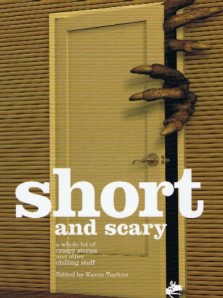
Short and Scary cover‘I had a little poem’

I had a little poem
I held it in my hand
It whispered muffled secrets
Only I could understand

I had a little poem
I kept it in a locket
And every time I went outside
I popped it in my pocket

© Jackie Hosking

You can find out more about Jackie Hosking at her website: www.jackiehoskingpio.wordpress.com. Her most recent publication – ‘At the end of the Street’ is included in the anthology, Short & Scary.

Posted in poetry, teachers' resources

A Kick in the Head: An Everyday Guide to Poetic Forms

As we mentioned earlier, April is National Poetry Month in the US, and we’ve borrowed the idea because we rather like poetry. Later in the week we hope to have a real live poet visiting the blog, so be sure to check back!

In the meantime, here is a fantastic book by Paul B. Janeczko (illustrated by Chris Raschka).

A Kick in the Head (cover)

This book is a collection of poems with a brief explanation about the rules for each form included. 29 forms are covered – some of them are ones you might already recognise, like Haiku, Tanka, Cinquain, Villanelle and List Poem. Perhaps you can find a copy of A Kick in the Head at your library. Be inspired to write your own poem, and then you can carry it around with you on Thursday for Poem In Your Pocket Day! (Or leave a short poem in our comments, and we’ll pretend it’s an online pocket!)

Here’s a couplet I wrote after reading A Kick in the Head:

I wish that it were chocolate cake –
but CAULIFLOWER is in to bake.*

*Actually, I love cauliflower cheese. It’s just that sometimes I’d rather have cake …

This book was selected for review from the Editor’s own collection.

Posted in competitions, poetry, teachers' resources

Dorothea Mackellar Poetry Awards 2010

While you’re in the mood for poetry (April being [Inter]National Poetry month and all), you might like to think about sending your best poem in to the Dorothea Mackellar Poetry Awards.

The theme is ‘I hear music.’ There are categories for lower primary and upper primary. And prizes from $300, plus a trophy!

You can find out more by visiting the website. Entries close 9 July 2010.

Posted in authors, illustrator, teachers' resources

BOOKWIZ – family event

The WA branch of the Children’s Book Council of  Australia (CBCA)  is holding a fun book-based quiz in the style of the hit ABC show Spicks & Specks.

Bring your family and friends! Meet local authors and illustrators!

When: 2 – 4pm, Sunday 27 June 2010
Where: St Mary’s Anglican Girls’ School, Karrinyup WA
Cost: $10 adults $5 children/school students
Bookings: Jan Nicholls (jnicholls@stmarys.wa.edu.au)

For more info, see the website of the CBCA (WA).

Posted in Book reviews by Rebecca, poetry, teachers' resources

Big Book of Verse for Aussie Kids

Big Book of Verse for Aussie Kids cover

This book is so much fun! The Editor, Jim Haynes, has collected over SIX HUNDRED poems in it, including a mix of old favourites (see if your parents and grandparents know them!) and more modern verse including games and chants, limericks, nonsense verse, poems about animals and birds, gross and gruesome poems … and more!

Here are a few of our favourites (but with over 600 poems, there are many more to choose from):

Fancy Dress (Anonymous)

There once was a fellow named Paul
Who went to a fancy dress ball.
He thought he would risk it
And go as a biscuit,
And a dog ate him up in the hall.

The Drovers by CJ Dennis

Out across the spinifex, out across the sand,
Out across the saltbush to Never Never land
That’s the way the drovers go, jogging down the track,
That’s the way the drovers go. But how do they come back?
Back across the saltbush from Never Never land.
Back across the spinifex, back across the sand.

Why? (Anonymous)

Why does a clock face not have a nose?
Why do foothills not have toes?
Do all-day laundries close at night?
Will the teeth on a garden rake ever bite?
Why can’t a needle wink its eye?
Why can’t the wings of a building fly?
What is the sound of a gum tree’s bark?
Can you leave your car in a national park?

I’m pretending not to notice the poem by Hilaire Belloc on page 334 called ‘Rebecca (Who Slammed Doors For Fun And Perished Miserably)’. Do you know it?

Tell us your favourite poem, and we can celebrate [Inter]national Poetry Month together!

~ Rebecca, Editor, Alphabet Soup magazine

Big Book of Verse for Aussie Kids, edited by Jim Haynes, Allen & Unwin, 2009

Our review copy was sent to us by Allen & Unwin