This post was added by Rebecca Newman. Rebecca is a children's writer and poet, and the editor of the Australian children's literary blog, Alphabet Soup.
For more about Rebecca visit: rebeccanewman.net.au.
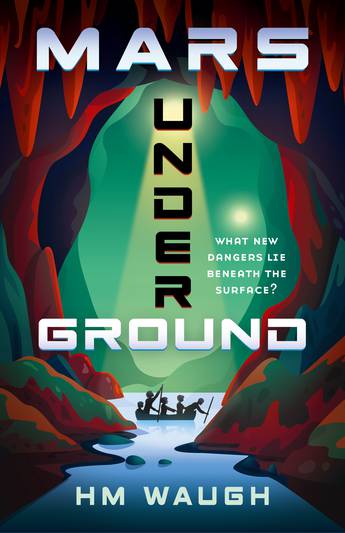
Mars Underground by HM Waugh, A&U Children’s, ISBN 9781761067105
Gabriel received a review copy of this book.
Mars Underground is a sequel to Mars Awakens written by HM Waugh. The main characters Dee, Holt and Chayse live in the Davinci colony on Mars. The colony will soon die out due to radiation-tainted genetics. However, there is hope. Holt has a set of special genetics untainted by radiation. Half a separate colony carries these genetics – the Newtonians, where Holt and Chayse originally came from in the first book. The only problem is the Newtonians are halfway around the world. Distance is the least of their concerns though. Others block the way. The Others are mutated bacteria that cause human bodies to malfunction. On top of that, no one has tried to contact the Newtonians for a long time. Unfortunately, Holt and Chayse are kept by the Davicians for their genes in “capture”. This is because Holt is an X and Chayse’s genes have no trace of radiation. It’s almost like Mars is trying to stop them, still Holt, Dee and Chase embark on this quest. In a world full of enemies can they survive the complex web of tunnels in order to travel and escape?
Will Dee, Holt and Chayse reach the Newtonians in time to save the Davinci colony? Can they escape the tight grasp of the Davinci? Why is there an age-old vendetta between the two settlements? Why have they been trained to hate each other? Will the Newtonians help the Davincians who are seen to be taller, have better senses, and breathe the air of Mars without a “Dome”?
Challenge after challenge is loaded into this action-packed novel. I recommend this book for children ages 8–14 who love suspense, Sci-Fi and dystopian books. I would rate this book highly as there is a complex story and subject that is engaging. I couldn’t put the book down until I finished it up late in the night. You can buy a hard copy book or download an ebook.
Winterkill by Marsha Forchuk Skrypuch, Scholastic, ISBN 9781338831412
Qiao reviews her own copy of this book.
In 1930 an attack strike on Kharkiv, Ukraine, brings the bitter wind of early winter. It is a battle not only against famine but also against the Soviet Union’s dictatorship.
Twelve-year-old Nyl, a courageous and intrepid boy, lived on a farm in Ukraine with his parents, aunt, uncle, brother and sister. Everything was peaceful and tranquil until the advent of Stalin, the Soviet Union’s dictator, desiring to take over the farms of Ukrainian families. His lies to the civilians promising a better-off life and a surge of crop yields, if the farmers were willing to spare their farms, were just the beginning of his reigning plot. Nyl’s family depended on the yearly harvest season for food. Without the farm, their life barely scraped by. Even worse, the Soviet Russian soldiers were compelling the villagers to hand in their food by threatening and killing them. Nyl and his family were desperate to flee and embarked on an escape journey from the village to a safer place. It sounded like a fabulous plan but not everyone was lucky enough to make it out of Stalin’s grip.
An encounter with a Canadian girl called Alice altered Nyl’s life. Alice’s first intention in coming to Ukraine with her father was to work for Stalin. She later realized that Stalin was starving people in Ukraine instead of alleviating farmers’ work by providing them with modern tractors. It was a nightmare for her and her father, so they decided to help Nyl escape from this tragic place. Alice’s father was determined to expose Stalin’s lie to the world, hoping to gain help from other countries. Would it be a success, or would it be an act of death?
Marsha Forchuk Skrypuch, a Ukrainian Canadian author, presents the word Holodomor “A murder by hunger” through a story for children. When I read Winterkill, my eyes were glued to the book, reluctant to miss any detail. It was as if every page was the climax, building up the tension and making my heart thump. With ingenious language, her writings about the historical event prompted more than a dozen countries to acknowledge the Holodomor as a genocide. It was as if the book was magical. It gifted me with powers and strength. As Nyl has said in the book, “Stalin hadn’t killed me, he just made me stronger.”
Wendy Orr is an award-winning author with 40 books for children, teenagers and adults Her books have been published in 29 languages and her Nim’s Island books were made into movies. We’re thrilled to be talking to Wendy about her latest book – Honey and the Valley of Horses.
From the publisher:
When Honey was four and her brother Rumi was a tiny baby, her family loaded up their converted ice-cream-van-camper and drove away from all they knew, as an illness swept the sad wide world. High in the mountains, they crossed a bridge to follow a mysterious herd of enchanted horses into a sheltered valley. The bridge and the track disappeared behind them – and now they are trapped in paradise.
The magical horses are the stars of the book. Is Moongold based on a horse you’ve known?
He’s a combination of our family’s first horse, Biddy, who was an American quarter horse with a touch of Thoroughbred, and my father in law’s palomino Australian stock horse, Pancho. Biddy was over 12 when we got her; I was ten, my sister eight and my brother three, and she behaved differently with each of us, deciding just how much she had to look after us. So she was always completely trustworthy with my little brother, but once I’d learned to ride she’d test me quite a bit – and when we did a paper route for a while, she got bored with doing the same ride every day and started throwing me every time! Pancho was probably the best trained horse I’ve ever ridden, an absolute delight to ride though a very spirited stallion. He had a fantastically smooth gallop, which was as wonderful to watch as to ride, and when he was galloping loose in his paddock, loved to race towards something and stop dead or spin around just before he hit it. And there’s a bit of my own horse Tala, who I got when I was fourteen. She was an enormous mostly Standardbred, who was quite neurotic and very flighty, but always tuned in to my moods and would be very affectionate and gentle if I was upset.
Honey’s family are living in a sort of paradise, but the catch is that they also face isolation and have to find their own way to survive. Was your storytelling influenced by Australia’s recent lockdowns?
Absolutely. Although we live in a rural area, we were classified as metropolitan Melbourne for the purpose of lockdowns, so it was very strict and long. My son and his wife and toddlers lived with us for the first year, but when they moved out they were more than 5 km away so for long periods we weren’t able to see them, or my daughter and her toddlers, who were on the other side of Melbourne. My parents and siblings were in Canada, and with the borders closed for so long I was very aware that I might never see my parents again – which in fact happened, as my dad became ill and died during 2021. So the isolation, the sense of not being able to see people we loved, and also the general fear and anxiety during this time were a crucial part of forming this book. The good thing is that it meant it was all the more important to create a fun and adventurous paradise for the family to escape to. It was certainly very important to me to escape to it while I was writing! And I hope that the reader will enjoy that escape too. We all need special places in our lives and our minds.
What did your editor think about you sending the editor in the book (Mum) off in an ice-cream van to the unfindable Valley of Horses?
She loved it! At first she was worried that no one would know what an editor does, so I hope I explained that during the book. But she loved escaping to the valley too, which made life easier for me.
Can you tell us a bit about what you’re working on next?
I have several things which range from already in a first draft, to an idea I’m quite excited about but don’t know very much about yet. All I can say right now is that I love thinking about how many thousands of people we’re all descended from. Each one of them had their own story – which is quite mindblowing when you think about it!
Do you have a tip for young writers who’d like to write stories with a touch of magic?
If you’re going to use a touch of magic, you need to have clues that something strange could happen, right from the start. It doesn’t need to be much: in Honey and the Valley of Horses I start with the sentence, ‘In the mountains there was a valley, and in the valley were the horses.’
The rhythm of that sentence suggests that this is a story-telling type of story, not a realistic ‘kids going to school’ type of story. Even saying, ‘the horses’ suggests something different than if I’d said, ‘There was a valley in the mountains, and lots of horses lived there.’ Those could be any horses, but saying ‘the horses’ suggests there’s something special.
Making up a world that has a bit of magic means that you can do anything you like – but it doesn’t mean that there are no rules. You need to work out what the rules are for your magic. In this book, the horses certainly have some kind of mysterious magic, and are stronger and faster than other horses – but they are still horses. For example, they can’t talk or fly. You could write it so they do talk or fly, but you would need to show that from the start, or if you didn’t want them to do it until the end, you could have a detail early in the story so that it made sense if they flew when they absolutely needed to. For example there might be a certain grass that people said would make horses fly if they ate it, or there might be old stories about a horse that flew, and people have noticed that this horse looks just like her ancestor, with the white snip above the left fetlock… Just some little hints.
Everything that isn’t magic has to make sense. Unless it’s part of the magic, water can’t run uphill, the sun rises in the east, people and animals need food, water and sleep…
Any touches of fantasy need to be significant for the story. They need to show the reader something important about a character, whether good or bad; or about the place; or they need to move the plot along. If you have a scene you really want to write – a purple sun that shines at night; birds standing still while dogs sing, whatever your imagination has built for you – you can use it as long as you work out why it belongs in the story. Working out the reason might take your story in a different direction, but that’s okay too.
If you roll all these tips into one, it would be, ‘Your story has to make sense right through. If magic is going to help resolve the problems, it needs to be hinted at from the beginning. And it should always be your character who actually solves the problem, whether it’s by being brave enough to dare to use a power, or by passing a test that makes a power appears, or by harnessing a power to do the right thing. But definitely try to avoid having a realistic character in a difficult but realistic situation, when suddenly at the end of the story, Abracadabra! everything is magically solved.
Also, don’t forget that good stories usually have many drafts. If you really liked that Abracadabra! scene you can keep it. You just need to go back and weave in some hints earlier in the story.
But don’t forget the most important writing tip of all, no matter what genre: Have fun, play with your story, and see what happens!
Honey and the Valley of Horses is out now! Ask for it at your favourite bookshop or local library.
Are you in Melbourne? You can meet the author and hear her talking about Honey and the Valley of Horses! 2pm, Saturday, 26 August 2023 at Readings Kids in Carlton. Tickets are free but bookings are essential.
The Kane Chronicles: The Red Pyramid by Rick Riordan, Penguin UK, ISBN 9780141325507
Olivia reviews her own copy of this title.
The Red Pyramid is a fascinating and enchanting book about two siblings who have their lives turned upside down as they embark on an adventure of Egyptian gods, magicians, and magic. Sadie and Carter Kane, siblings nothing alike, shape the future of the world they know. Accompanied by striking cat goddess Bast, and prickly magician Zia, the quartet only have a couple of days to stop Set, god of evil, from the destroying the whole of Earth. Will Set prevail and destroy the Earth? Or will Sadie, Carter, Bast and Zia succeed and stop Set?
My favourite part of this novel is when Sadie, Carter Bast, and Zia fight off the scorpion goddess Serqet. Zia places Sadie and Carter in a magic force field while she and Bast fight off the scorpions. I like this part because it demonstrates intriguing forms of magic, and shows that weak things can be strong, as Zia fights with ribbons.
I would give this book a 10 out of 10 and would especially recommend this volume to readers ages 10 and above. The Kane Chronicles will blow Percy Jackson fans away. Move over Harry Potter, here comes The Kane Chronicles!
Skye Blackburn-Lang: Eating bugs for the planet by Dianne Wolfer, Wild Dingo Press, ISBN 9781925893694
The publisher provided a review copy of this book.
Have you ever eaten a bug cookie? Well, Skye Blackburn-Lang has.
As the oldest child, Skye was curious about animals that when she was younger she even tried to eat a snail! She lived in Port Macquarie and Sydney where she took home insects to investigate and observe. Skye went to a museum on insects where she found jars of insects and spiders stacked to the ceiling. That’s when she knew that she wanted to be an entomologist. She was so interested in insects and spiders that she had a pet tarantula called Fluffy and she even kept its exoskeleton mounted in a frame!
This book is interesting because it is about Skye’s childhood and how she mixes food science and bugs to make sustainable food. Unlike the other books in this series this book is colourful, has photographs of insects and spiders and has two insect recipes at the end. I thought it was lovely.
I rate this book 10/10. I recommend this for children above 7 years old and those who like bugs.
REVIEWED BY OLIVIA, 9, WINNIPEG, MANNITOBA, CANADA
Percy Jackson and the Lightning Thief by Rick Riordan, Penguin, ISBN 9780141329994
Olivia reviewed her own copy of this book.
Percy Jackson and the Lightning Thief is an interesting, intriguing, and exciting book about two demigods (kids with one godly parent and one mortal parent) and a satyr (half human, half goat) Percy, Annabeth, and Grover, who embark on a journey to get back Zeus’s lightning bolt. Zeus, the god of the sky, has had his master lightning bolt stolen. Zeus blames his brother, Poseidon, god of the sea, Percy’s dad. Can Zeus get his lightning bolt back? Is Poseidon responsible for Zeus’s missing bolt?
My favorite part of this story is when Percy meets Annabeth, where Annabeth tells Percy that he drools when he sleeps. This is my favorite part because it’s hilarious and hysterical.
My favourite character is Annabeth, because she is prepared for anything, and she is very smart. I’d rate this a 20 out of 20 because it is comedic, exciting, and makes you want to read it. I’d recommend it to ages ten and up.
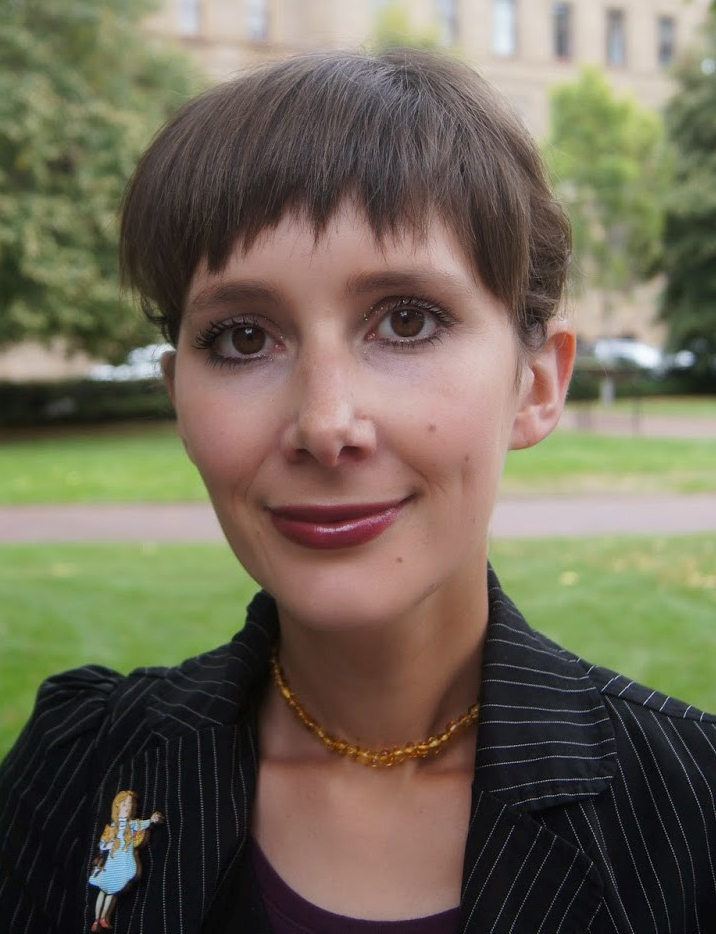
HM Waugh is the author of books for children and young adults. She’s also an environmental scientist and an educator with a love of wild places and high mountains. This has led to icy feet and sunburnt cheeks in magical countries like New Zealand, Nepal, Bolivia and Switzerland! Her latest book is book 2 of a duology: Mars Underground, the page-turning sequel to Mars Awakens.
From the publisher:
Dee, Holt and Chayse set out to cross the planet via a network of subterranean tunnels. Can they reach it without encountering the Others – the sinister biocloud they’ve been running from? And if they make it, can they convince the Newtonians to work with Davinci – those they’ve been trained to hate?
Did you set out to write these books as a duology or did the idea for a second book come after you’d finished writing Mars Awakens?
I am not what you’d call an awesome planner – I start a project by thinking up a character or two, and the details of their world, and I have a basic idea of what the plot might be, but I work the rest out as I write. If you’ve heard of plotters (who plot everything out before) and pantsers (who plan nothing and write ‘by the seat of their pants’), I’m a hybrid of the two, a plantser. So I was happily plantsing along, still writing Mars Awakens, when one day it hit me: there needed to be two books to finish this properly. So the duology was born.
This is your first published series. How did you find writing a sequel as compared to writing Book 1?
Completely different! In some ways it was easier, and in other ways: much harder!
The easier bits were things like the characters and the world – they were already there in my head, fully formed. I knew the main characters like they were my mates. I knew what they’d say, how they’d act. Sometimes, when I’m starting on a new idea, I might get a big way through a first draft and have to rewrite it because the characters finally come alive for me (this happened about 20,000 words into the first draft of Mars Awakens!). But I didn’t have that sort of issue with Mars Underground. Also, all the nitty gritty work of world building had already been done (thanks, Past Me!) so I just got to have super fun expanding it to places I hadn’t been yet. That was all awesome.
Some things were definitely harder, though. I felt this expectation that I’d never really felt before. There were all these readers who had connected with Dee and Holt’s story and were keen to see how it ended. Aaah! I didn’t want to let them down! Plus, I had a deadline! For all my other books I’d already written a full manuscript before signing a contract. But suddenly I had to write an entire sequel by a certain date? Double aaah!
I actually wrote 50,000 words of the sequel before Mars Awakens had been released, but when I picked it up again months later I knew it wasn’t right. And I’m not saying that like, ‘This isn’t quite right, I need to work on it a lot.’ I mean I archived the whole thing. Gone. Fresh document page. Start again from scratch. I re-read Mars Awakens to remind myself of the voice, and then launched into writing an entirely new sequel. And that became Mars Underground. I loved the draft so much, but I was still terrified there would be something missing. So I did multiple happy dances when my publisher came back with several big thumbs up! Yay!
Mars Underground involves your characters travelling via tunnels and caves on Mars, were their adventures inspired by caving adventures of your own?
I love pulling inspiration from real life, so their adventures were like a mix of my own, and the sort of caving and rafting adventures I’d love to have!
I remember going caving on a school holiday camp when I was in my early teens, shuffling on my stomach, so tight to the ground, to get to this special crystal cave. My helmet kept getting jammed, the ceiling was so low. And the crystals were protected behind this mouldering underground gate, so rusty the key could barely work. It was amazing! But once we’d crawled back out, we realised our camp leaders had already decided to leave. Without us. Everyone had climbed up and out, we could see them up by the pinprick of daylight that was the entrance, about to lock the main gates! I’m sure they would’ve realised we were missing before starting the bus, but what an adrenaline hit to be almost left behind in that deep wintry place, our torches running low!
Another experience I drew on was rafting what they call the God River, in Peru. Once we’d got onto the river, the gorge walls rose so high the only way out was through days of rafting. Changed your mind about going? Too bad! It was tough and it was amazing and I loved it! We got to one huge rapid, and the guide told me a girl had been lost there the previous year. I was like, ‘Did they find her again?’ and he looked at me and said, ‘Lost, like dead.’ That definitely made me realise exactly what I’d signed up to do.
So I tried to inject some of that danger and beauty and excitement into my characters’ adventures.
You ran a writing competition for young writers in 2022 and the winner had a character named after them in Mars Underground (Alice!). Did you already have a character ready and waiting to be named, or did you write the character into the plot while you were finishing writing the novel?
I had a few characters I knew I could change the names for, but I waited to see who’d won and what they’d written before I chose which character I’d use. And during editing I changed that character around to be even more awesome!
Can you tell us a bit about what you’re working on next?
As I write this, it’s halfway through July which means I’m deep in writing a project during Camp NaNoWriMo. I love writing with NaNoWriMo (the National Novel Writing Month) because it really gets me into the flow of my writing. Plus, I LOVE a good graph, and NaNo track my progress and give me badges and pep talks too! Normally I’d try to write 50,000 words in the month, but this month I’m aiming for 30,000 because I was on holiday for the first week.
Anyway, I’m loving this project so much. Dangerous new planet. Kids in a competition. Everyone watching their every move. A new friendship based on deception. And then something goes really wrong (of course!) and everything comes to the surface. How are they going to get out of this? It’s so. Much. Fun!
Mars Underground is out now! Ask for it at your favourite bookshop or local library.
Kate Gordon grew up in a very booky house, in a small town by the sea in Tasmania. Now she writes novels and picture books from a cottage overlooking the river and the mountain, on the Eastern Shore of Hobart. Today we’re chatting about Kate’s latest novel, Indigo in the Storm.
From the publisher:
Indigo Michael isn’t like other kids. And her mum isn’t like other mums. Life for people like them isn’t meant to have meaning – it’s just something to survive in whatever way you can. When her mum abandons her, Aster’s Aunt Noni becomes her foster parent. Suddenly Indigo has a new ‘family’ –one she didn’t ask for and isn’t even sure she wants. This is a companion novel to the CBCA Award-winning Aster’s Good, Right Things.
Indigo in the Storm is a companion book to Aster’s Good, Right Things and Xavier in the Meantime. Did you set out with a plan to write multiple books set in the same community or did the idea for the next book come to you as each book was finished?
I’m not the most organised of writers! I’m whatever it’s called when a pantser doesn’t even have any pants! Characters just tend to pop into my head and I see where they take me. Aster popped into my head fully formed and she introduced me to her friends and I fell in love with them and the town where they lived. Once I met Xavier, Indigo, Esme (and later Erika and Armelle), I just knew I had to keep “chatting” with them until their stories came too. All of which makes me sound deeply odd and like I’m trying to say that I have some preternatural spiritual talent for writing. I don’t. I just have a very active imagination and a complete lack of any planning skills!
The characters in each of these three books face big life issues and mental health challenges. Could you talk a bit about how you came to write Indigo’s story in this latest novel?
I grew up in a little town in Tassie, not unlike the one where these characters live. I went to a school in a low socioeconomic rural area. I didn’t go through the foster system myself but my school was full of kids who did and I was good friends with many of them and always wanted to help to tell their stories. I did grow up in a complicated family and I did grow up struggling to find my place in the world, something to believe in and my voice. I also grew up with undiagnosed neurodivergence, which Indigo also lives with. All of which percolated in my head like one of Esme’s marvellous creations when it came with telling Indigo’s story. I hope I’ve done it – and her, and the kids I grew up with – justice.
Your book titles suit the books so well. How do you come up with the perfect title for a book?
Oh gosh, I wish I had a good answer for that. I’m actually really terrible at titles. My working title for Aster’s Good, Right Things was Petal. Which is, obviously, terrible and would not make anyone want to read the book! I’m so lucky to have such beautiful, clever publishers who help me come up with better titles. Usually, they’re called something like Xavier Book or Indigo Book, until the last minute. Then, when I start to panic, my publishers will say something like, “Kate, have you actually read your own book? Obviously, it should be called …” And it’s spot on, every time. I’m sorry to ruin the magic! I’m basically a publishing doofus.
Alphabet Soup Interview – Indigo KG June 2023
Do you have a book you’ve read recently that you would recommend for our readers?
Anything at all by Kate Foster. She’s honestly, in my opinion, the next Australian publishing superstar. Her books grab me in a way that reminds me of how I was captivated by books when I was a kid – like Robin Klein and John Marsden. She’s got humour and depth and heart and I am in awe of her talent. There is also a new writer on the scene called Helen Edwards who blows me away with her words. Her first book comes out with Riveted Press soon and I implore everyone to get their hands on it. She’s a true talent.
Can you tell us a bit about what you’re working on now that Indigo in the Storm is out in the world?
Well, there is another book in the universe coming out next year, featuring milk bar superstar, Esme, and then a final book in the Aster cycle, featuring Aster herself in a story that brings everyone full circle. I also have a stand-alone called My Brother, Finch, which is a mystery story set in Gothic southern Tasmania. And I am working on a book about thylacines and secret covens of girls and women in the Tasmanian bush. That one is very much a work in progress but fingers crossed it finds its place in the world. I’m just grateful to be doing what I’m doing, with the support of so many beautiful, clever people. Aside from that, I am deep in mother land, with a fiercely smart, bookish eleven-year-old and a chaos maven fourteen-month old keeping me on my toes, alongside a grumpy elderly black cat and a very silly teenage labradoodle. It really is all happening!
Indigo in the Storm is out now! Ask for it at your favourite bookstore or local library.
AWESOME EXTRAS:
Read previous interviews with Kate Gordon here and here
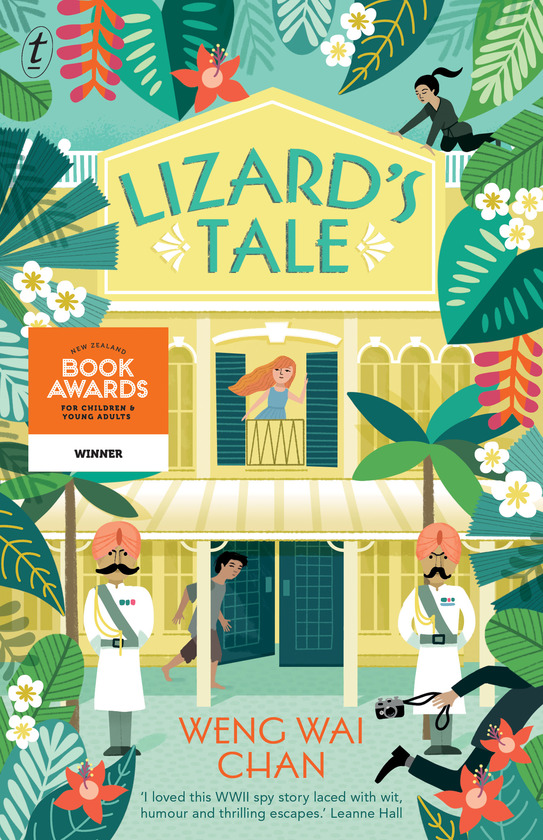
Lizard’s Tale by Weng Wai Chan, Text Publishing, ISBN 9781925603910
Gabriel received a copy of this book to review.
Lizard’s Tale is written by Weng Wai Chan and is set before WWII in Singapore, featuring a young boy named Lizard and his best friend, Lili. Lizard’s guardian, Uncle Archie, disappears without explanation. As an orphan, Lizard barely scrapes by as he has to buy food and rent a tiny apartment, so he does odd jobs for random people and theft for Boss Man Beng.
Lizard had almost choked on his noodles. One hundred dollars! Nearly one year’s worth of rent and food.
Lizard had just got himself the dream job. All he had to do was to steal a teak box from the Raffles Hotel which belonged to a British army visitor and deliver it to the train station at 10pm. Otherwise, he would expect the worst. It couldn’t be that hard, could it?
Lizard soon dives into a world where conspiracies and secret codes thrive, buzzing around concerning the next war. How will Lizard deal with all these problems, especially since his best friend isn’t who he thought she was? Can Lizard reveal the plot in time and save his friends and other people he loves? Will he be able to succeed in foiling his enemy’s plan by himself?
I recommend this book for preteens or young kids who love history and exciting adventures. I would rate this book 9/10 as there are great themes and it’s also a family friendly book. You can find this book online on Amazon as a kindle copy or a paperback, or even in your local bookstore. Have fun reading!
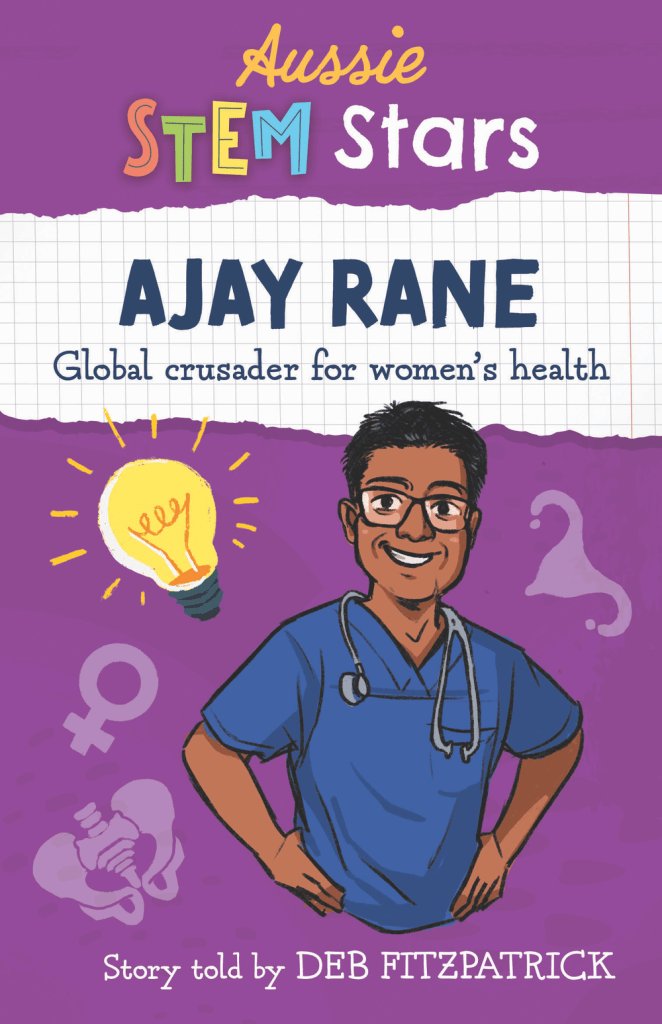
Ajay Rane: Global crusader for women’s health by Deb Fitzpatrick, Wild Dingo Press, ISBN 9781925893595
The publisher provided a review copy of this book.
‘Who is Ajay Rane and why should Australians know him?’ I hear you ask curiously. He is Dr Rane and he is an advocate for women’s health. He saves women’s lives by helping women who suffer from fistula after giving birth.
It all started with Ajay’s paternal grandmother. She told Murli, Ajay’s father, to remember the work he learnt at school. Murli tried his hardest and eventually became a doctor. Then he started a hospital in his home town. This is when Ajay comes into the story. Ajay followed his dad’s footsteps and became a doctor.
One of Ajay’s patients made me cry. She was a nurse until she had a baby and she could not go to work because she had fistula after giving birth. Then her husband kicked her out of the family. What will happen to her now?
I love this extraordinary book because it takes us back to Ajay’s ancestry. I have learnt so much about Ajay Rane and his family, like when Ajay was younger he celebrated the Diwali Festival with his family. Another section that was funny was when Ajay’s brother went to the toilet in his grandmother’s place in India only to find a pig in the toilet pit.



 alphabetsoup.net.au