This post was added by Rebecca Newman. Rebecca is a children's writer and poet, and the editor of the Australian children's literary blog, Alphabet Soup.
For more about Rebecca visit: rebeccanewman.net.au.
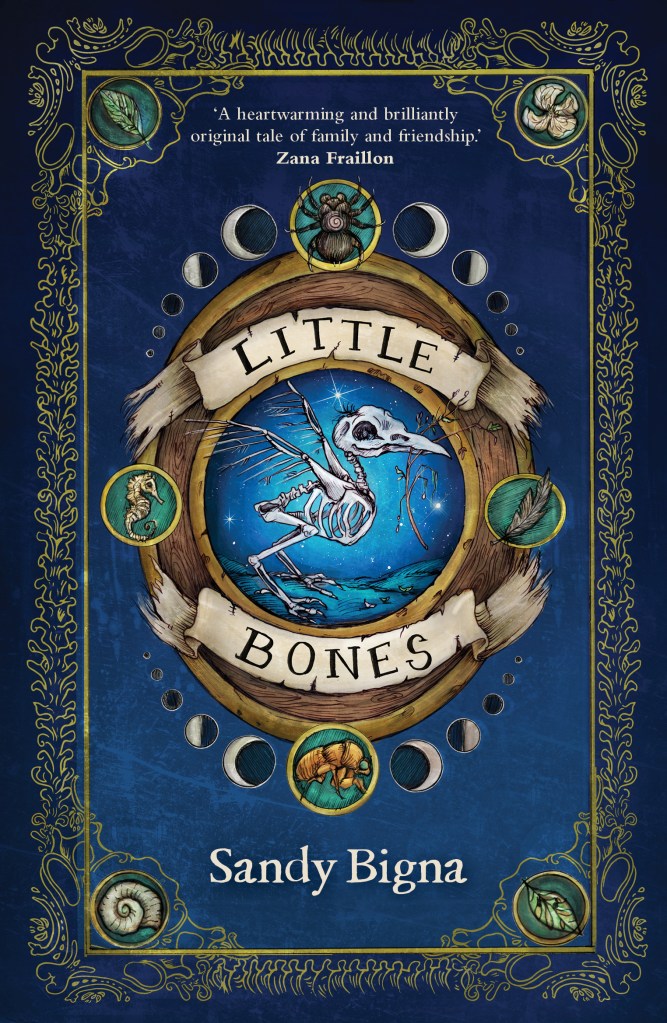
Little Bones by Sandy Bigna, illustrations by Tamlyn Teow, UQP, ISBN 9780702268878
REVIEWED BY MARLEY, 9, WA
The publisher provided a review copy of this book.
Little Bones is about a girl called Bones and she loves collecting animal bones for her collection. She doesn’t have many friends at school and people think she’s a freak. She ends up finding a little skeleton of a bird at the wetlands, she brings it back to her house and wishes the bird would come alive again. And guess what? He came alive.
The book is very different to other books I’ve read. It’s way more heart-warming and has different formatting. And I love the front cover.
I liked how there was always a cliff hanger and you could never stop reading the book without finding out what happened next.
My favourite character was Tenny, because Tenny is really sweet and kind. They are the perfect match for Bones as they are kind of Bones’ happy shadow. I liked the inclusion of diverse characters.
I liked the setting because it has very big home cosy vibes and it makes it feel more realistic.
I found the story very interesting because there aren’t many stories about people dying in kids books, but i think more should because you can’t just hide away what’s sensitive from kids. I didn’t find myself being sad, but intrigued to see how Bones would overcome her own sadness and regret.
I think people that are not super sensitive would enjoy this book. Its a mix between fantasy and adventure and about overcoming your fears. Also people that don’t feel like they belong might be intrigued to find out what’s in this book.
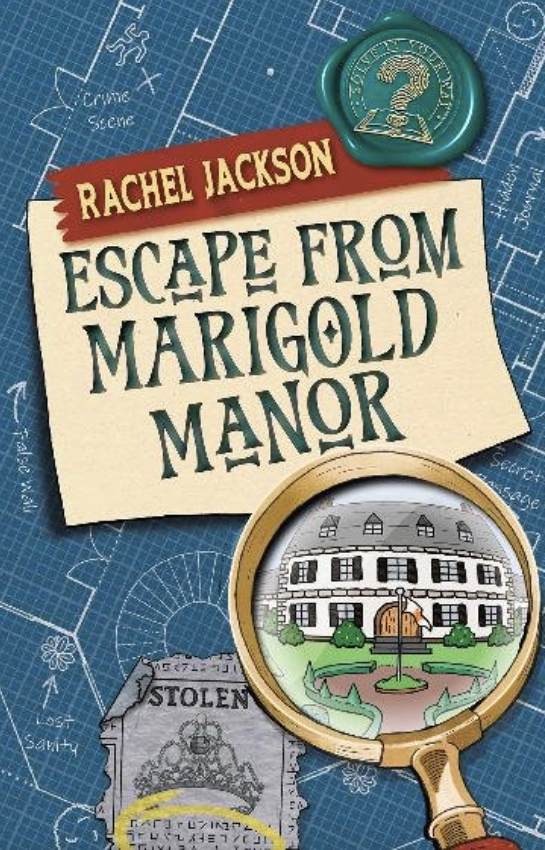
Rachel Jackson draws on her extensive experience as an intelligence specialist to create twisty branching plotlines. She’s also a sucker for good puzzles and bad jokes – subject matter that she shares generously with her readers in the Solve It Your Way series published by Riveted Press. Today we’re chatting to Rachel about her latest book in the series: Escape from Marigold Manor.
The publisher provided a review copy of Escape From Marigold Manor.
From the publisher:
You are the greatest detective in the land and you’re facing your biggest mystery yet. It turns out there is more than one way to leave Marigold Manor … You’ll find thirty-two unique endings in Escape from Marigold Manor. Each mystery requires you to complete a series of interviews and brainteasers in order to identify the culprit. The challenges include puzzles that you must crack in order to unlock safes, read secret messages and locate hidden clues. The casefiles at the back of the book will help you keep track of which cases you’ve sold, and which cases still await you in the mansion. Can you solve them all?
Escape from Marigold Manor has 32 mysteries in one book, with the reader’s choices affecting the path each mystery takes. As the writer, is it tricky to keep track of all those story paths?
I always joke that my brain is all over the place, and the Solve It Your Way books are just a reflection of my brain! Truth is, when I’m writing an interactive fiction like this, I use a spreadsheet to create a visual chart of the book’s structure. If you’ve ever done mind-mapping – with the ideas in little bubbles and lines branching out from there to more idea bubbles – it’s a lot like that.
The tricky part can be finding the right puzzle for a specific part of the story. This is particularly true in the case of Escape from Marigold Manor – where there are puzzles inside of puzzles as you navigate crime scenes and suspects.
When you read interactive stories like these, are you the kind of reader who picks a path and forges on – or do you keep a finger bookmarking the various pathways so you can try a different path if you don’t like the outcome of your first choice?
Oh, finger bookmarking – definitely! And I would run out of fingers. In fact, this is the exact reason that Escape from Marigold Manor has a checklist at the back with page numbers so you can reinsert yourself into the story at key junctions, without having to start all over again. Now, fingers are free for tearing out hair, biting fingernails or otherwise immersing yourself in the dastardly world of Marigold Manor.
In real life you have experience solving mysteries, and in Escape from Marigold Manor, the reader is the detective. When there’s a mystery to be solved, what makes a great detective?
Firstly, kindness. Because the whole point of trying to solve the mystery is that you want to help someone – the victim, their family, the community and even the offender.
Once you’re knee deep in clues and suspects you need to have enough attention to detail to gather all the information surrounding the mystery, but then you need to be able to decide which information is actually useful. If you find yourself faced with a mystery (say, your pencil is gone), start by asking small questions that you can answer (such as – when did you see it last? Two days ago, on your bookshelf!). This will lead you to bigger questions that you can’t answer – yet! (Who had access to my bookshelf in the last two days?). That knowledge gap is where you need to focus your investigation. You might want to interview suspects (your little brother?) to identify motive (he was looking for a pencil last week!) and opportunity (but he was camping with Dad the whole time, so he couldn’t have taken the pencil). Keep asking questions and chasing up new leads. Even the ones that don’t seem important at first (mum did the shopping yesterday), might turn out to be the key to solving the mystery! (Mum borrowed your pencil to write the shopping list.)
Do you have a tip for young writers who want to write a mystery story of their own?
Do it! Honestly, it’s so much fun. The key to a good mystery, in my opinion, is that more than one character should have good reason to have committed the crime. So, make your characters really interesting, with shades of good and bad. That way, whoever your villain turns out to be, it will make sense to the reader!
Can you tell us a bit about what you’re working on next?
The most wonderful thing about the Solve It Your Way Series is that I get to build these puzzle-filled interactive storylines in a brand new setting each time. First was a swashbuckling pirate adventure in Escape from Cuttlefish Cove, then came the detective who-dunnit in Escape from Marigold Manor. Up next – dragons! Oodles of dragons for the reader to collect and interact with. Sleep with one eye open – Escape from Firestone Fortress is coming!
Escape from Marigold Manor is out now! Ask for it at your favourite bookshop or local library.
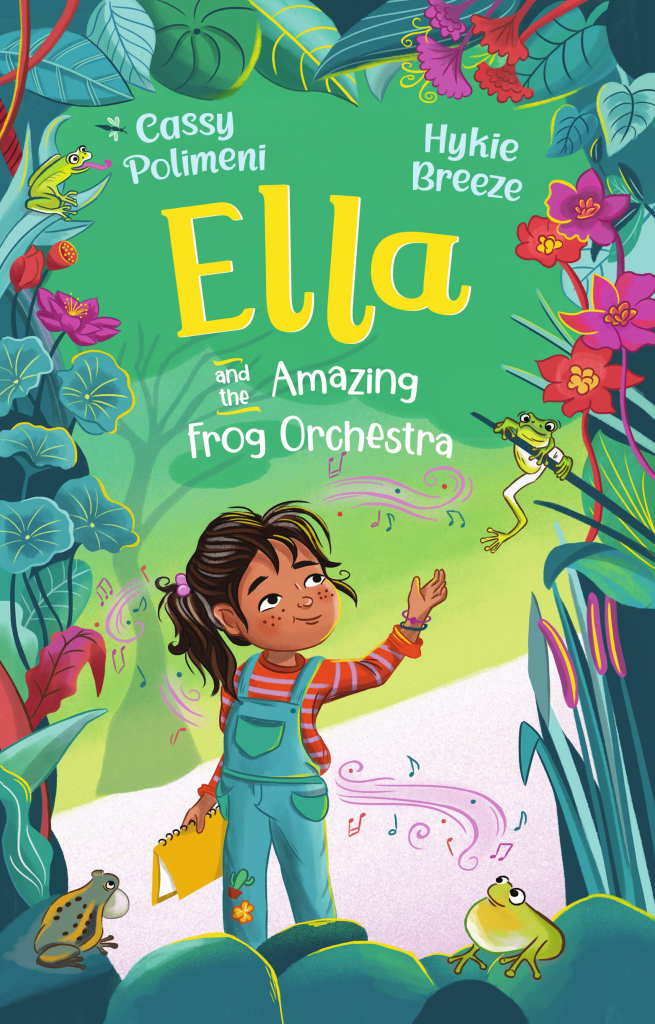
Ella and the Amazing Frog Orchestra by Cassy Polimeni, illustrated by Hykie Breeze, UWA Publishing, ISBN 9781760802899
REVIEWED BY ELLA, 9, WA
The publisher provided a review copy of this book.
Ella and the Amazing Frog Orchestra is a fiction book with lots of facts about frogs. The story is about Ella, who moves house and finds frogs near her new home.
I really liked the author’s descriptions of all the details in the book, and all the onomatopoeia, that made me feel like I was actually there. I thought Ella was a fun and likeable main character. The illustrations were really good, I just wish they had more colour in the book.
I think that anyone aged 5-9 would enjoy this book. Anyone who likes frogs or wants to learn about frogs, would love this book.
Funny, scary, a dash of magic – Rise of the Witch is the first book in the new Everglade series by Kitty Black, with illustrations by Rebecca Crane. Kitty is already the author of numerous picture books and today we’re chatting about the creation of her first novel.
The publisher provided Alphabet Soup with a reading copy of Rise of the Witch.
From the publisher:
Everglade loves to hate witches. And as the daughter of the last witch, Wren Westerly is the most hated person in town. She can only imagine what would happen if the townspeople found out she can actually see magic … even if she has no idea how to use it.
Rise of the Witch is funny, and a bit scary in parts, with a large dash of magic. Often authors say they set out to write the sort of book they always wanted to read when they were growing up, what were your go-to books as a young reader?
Ha! This was exactly my motivation! My favourite book as a young child was The Magic Faraway Tree by Enid Blyton, and once I was older, I was basically obsessed with all of Terry Pratchett’s books. I also remember being thrillingly frightened by Emily Rodda’s Rowan of Rin and learning sections off by heart. Fantasy/Adventure has always been my favourite genre, and if it’s funny or a little bit scary (or both!) then so much the better.
What makes the perfect villain?
I love a villain with a backstory. I think there has to be some scariness initially, but then as you get to know the character you learn more about their motivations. The perfect villain might be one where their behaviour becomes the tiniest bit understandable – but, of course, they take it to a terrifying extreme. I also love a hidden villain (spoilers!).
This is book one of a series. Did you plot out the entire series before you began writing book 1? Or will you tackle each book as you get to it?
I had no idea what I was doing when I started writing Book 1. I was 50,000 words into the first book when I realised that there was no way that everything I wanted to happen was going to happen in a single book. Thus, a series was born! I know the major plot points for each book, but I like to keep some room for creativity and surprises (for both myself, and the reader!).
Do you have a tip for young writers who would like to write stories set in a magical world?
Magical worlds are so much fun! I have two tips. The first is to chuck whatever you love into your magical world, and that way you’ll love your story. I have a soft spot for big, beautiful trees, and I’ve always wanted to be able to talk to animals, so both of those feature in Everglade. My second tip is to make sure that whatever magic you use in your world has a cost associated with it – whether that’s physical, emotional, or in unforeseen consequences.
Can you tell us a bit about what you’re working on next?
At the moment I’m deep into working on the second Everglade book, and I cannot wait for everyone to read it. I can’t say more, or I’ll give away all my secrets!
Rise of the Witch is out now! Ask for it at your favourite bookshop or local library.
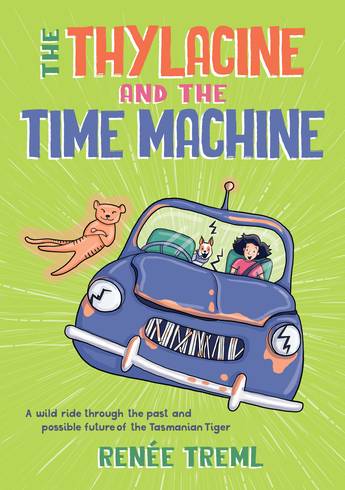
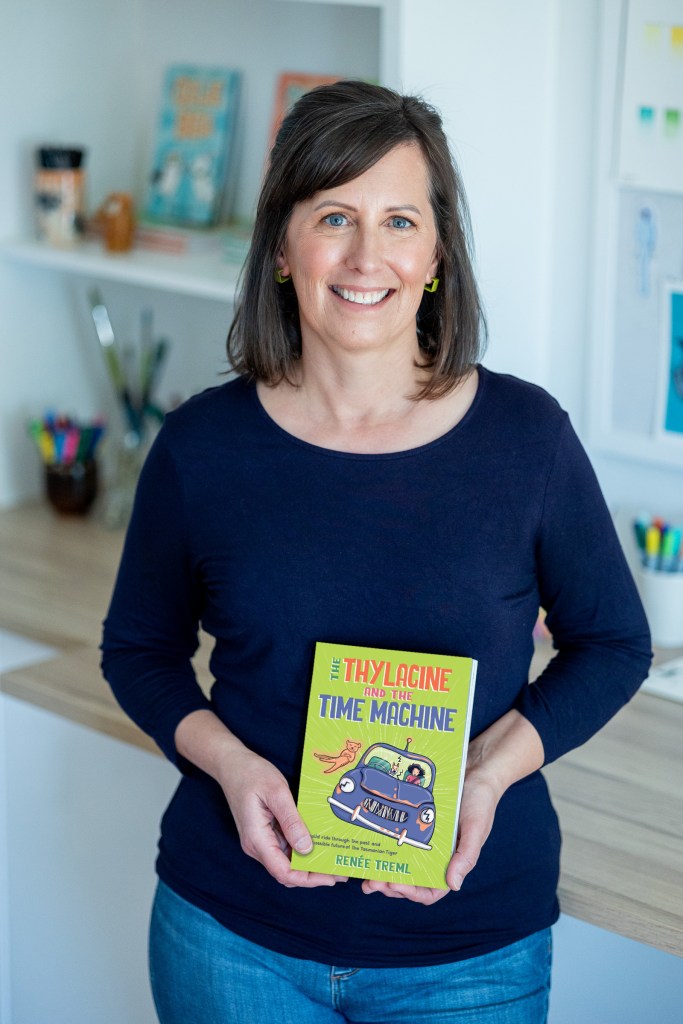
Renée Treml is an award-winning writer and illustrator based in Fremantle, WA. She has written and illustrated several picture books including the award-winning Once I Heard a Little Wombat, and Wombat Big, Puggle Small, which was read on ABC’s Play School. Renée is also the creator of the hilarious graphic novels featuring Sherlock Bones and Ollie and Bea. Today we’re thrilled to be chatting with Renée about her latest graphic novel: The Thylacine and the Time Machine.
From the publisher:
Buckle up! The time-machine awaits! Join twelve-year-old Violet, her dog Tassie and her new friend Thyla – the ghost of the last Tasmanian tiger – on a wild ride to learn all about the legendary, elusive and extinct thylacines. Packed full of fascinating facts about the terrible past and (potentially) exciting future of the Tassie tiger.
What brought you to create a graphic novel about the de-extinction of the thylacine?
I am fascinated by the idea that scientists can bring an animal that no longer exists back to life. It’s like science-fiction except in real life!
Do you have a favourite thylacine fact?
Is it okay if I include a few? Thylacines are fascinating (and very misunderstood) creatures.
Until about 4,000 years ago, thylacines roamed all of Australia … so calling them a ‘Tasmanian tiger’ is a bit limiting. Plus, they are a marsupial, and we humans are more closely related to tigers than thylacines are.
European colonists on Tasmania believed the thylacines were killing their sheep, so they hunted the thylacine to extinction. It turns out bad farming practices, wild dogs, and other humans (thieves!) were to blame. Now we know that thylacines hunted alone and were not big or strong enough to take down an adult sheep.
How do you approach the first draft of a graphic novel? (Do you write the text as prose or a playscript?)
For this graphic novel, I first wrote a summary of what would happen in each chapter, then I drafted the story as a script. My next step was to create the sketches that would accompany the words.
What is the editing process like for a graphic novel? Is the artwork edited as well as the text?
For a graphic novel, we edit both the text and the artwork – and the process is very intertwined (and sometimes messy!) because the words influence the pictures, and the pictures influence the words. We edited The Thylacine and the Time Machine at several stages. Our goal was to catch any major problems in the scripting or sketching stages because that’s when it’s easiest to make changes. We saved the nit-picky grammar and punctuation edits until the very end because I often change and edit the text while I’m drawing.
Can you tell us a bit about what you’re working on next?
I am working on my first collaborative graphic novel mystery series with author Nova Weetman titled Mystery Beach. (Aside note: it is so much fun to co-write with another person!) We were inspired by our beloved childhood series Trixie Belden, Girl Detective, and our stories are set in current-day Australia. The first book will be out in 2026.
The Thylacine and the Time Machine is out now! Ask for it at your favourite bookshop or local library.
Crunch by Kayla Miller, Walker Books Australia, ISBN 9781760655181
REVIEWED BY AASHI, 10, VIC
Aashi reviewed her own copy of this book.
I recently read Crunch and I LOVED it! It is a must read for any avid readers from the age 8 to 12. This graphic novel is part of the Click series. The whole Click series is about Olive, a smart and kind sixth grader.
Olive loves to try new things with a positive attitude, so she signs up for many things. Between film making, homework, scouts and even a fashion show, Olive feels overwhelmed. Olive begins to wonder if she really can juggle all of her actives or will she fail at everything?
One of the best things about Crunch is the pictures. They are full of colour and pop. It makes you want to keep reading. The pictures look really good and make you feel like you are in the book.
Olive is not perfect, no-one is, and this made me really like her. She is really brave and outgoing. By the end of the book she learns how to say No and how to juggle her life.
I think that anyone who loves friendship and school stories will enjoy Crunch. Be sure to check out the rest of the Click series.
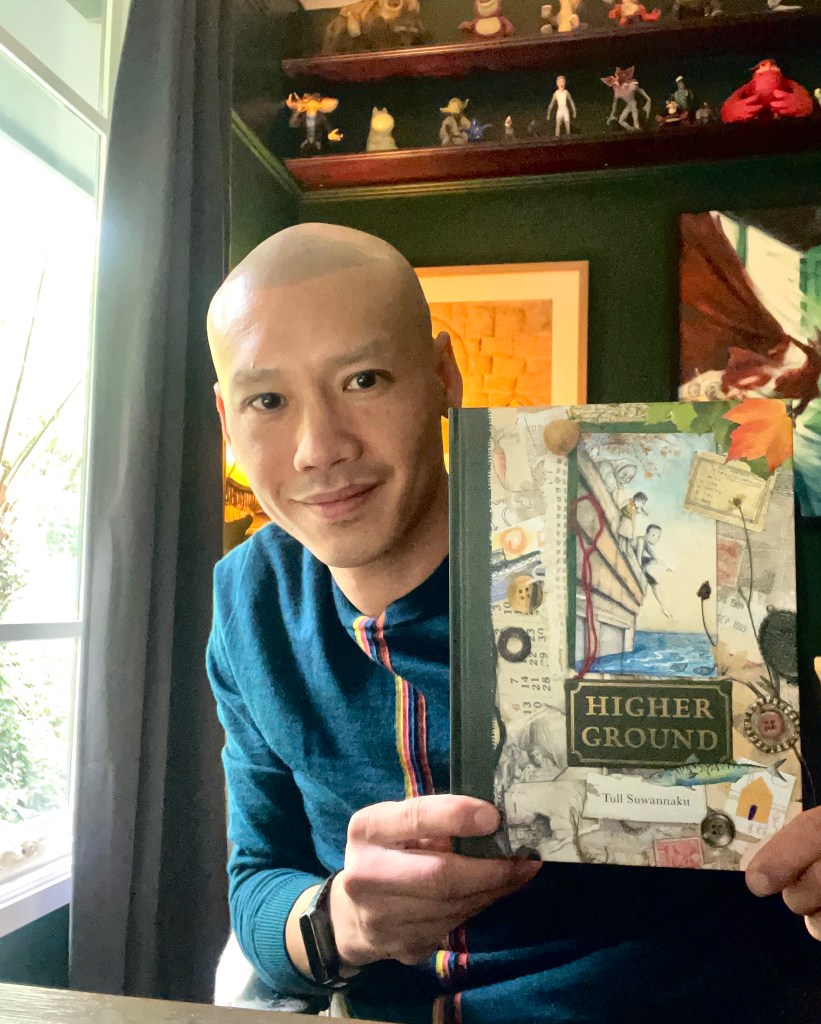
Tull Suwannakit is an award-winning illustrator and author with a background in animation and fine art. When Tull is not writing and illustrating, he runs art classes and workshops for children and adults at his art school in Melbourne. Today we’re excited to hear from Tull about his latest book: Higher Ground.
The publisher provided Alphabet Soup with a reading copy of Higher Ground.
From the publisher:
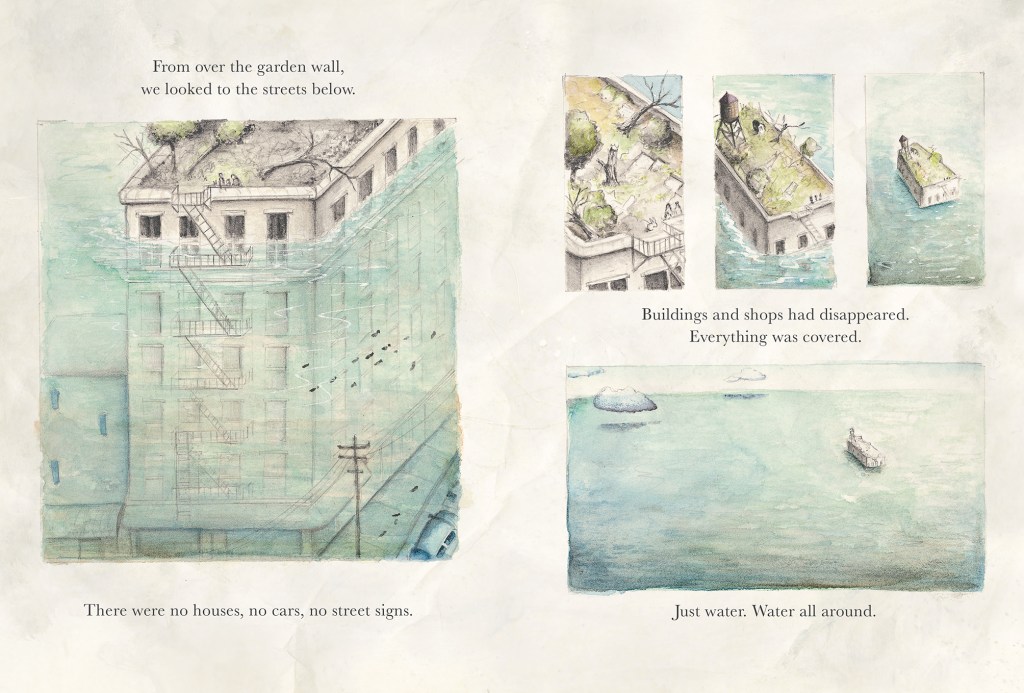
After a great flood, a grandmother, her two grandchildren and their pet rabbit must learn to survive living on their rooftop garden, relying on scarce resources and limited space. Days turn into weeks, and weeks into months, but through life lessons and words of wisdom, hope emerges.
Higher Ground is illustrated with watercolour, graphite powder, gouache and acrylic paints. Can you tell us a bit about your approach to illustrating the book?
After I am happy with how the storyboard looks, I transfer each rough sketch onto a final piece of watercolour paper. Multiple layers of transparent sepia-toned washes are applied to give the illustration a base tint of light and dark. Additional mediums are used in order for me to capture a particular mood and tone of each scene. For instance, soluble graphite powder helps with muting down the scene, and giving it a dystopian feel. For dynamic scenes, I will add in a thick application of gouache and acrylic paints. In contrast, luscious and lively scenes are injected with a dab of bright coloured pigments using a combination of watercolour, gouache and/ or ink.
From Higher Ground by Tull Suwannakit.
Higher Ground is a dystopian tale, with a small family – Grandma and her two grandchildren – isolated following a natural disaster. Thanks to Grandma’s wise, calm guidance, the characters maintain hope and a focus on doing what they can do to survive and thrive in this new challenging environment. The book in our hands becomes a sort of stand-in for Grandma when we come to the end of the story – we can hold onto her instructions for survival skills, food preserving and preparation, and seasonal information. Is the Grandma character based on someone in your life – did you have someone who hands on life skills, family recipes and other knowledge?
Although the time spent with my grandma was brief, her teachings left an everlasting imprint on me. I learned a thing or two from her about how to go about preserving fruits and vegetables, and how to take care of the garden. Growing up and living away from home at the young age of nine to attend boarding school, I learned early on valuable life lessons and skills from the wonderful people that I met along the way. I learned to cook for myself and others, I mastered a handful of essential skills and gained many words of wisdom, all of which manifested into the character of Grandma in Higher Ground.
The main characters aren’t named. Was there a reason you decided not to share their names with readers?
This has always been my debate right from the start – whether or not they should be given names. In the end, by not giving the characters names, I think it allows readers to be a part of the journey in a more immersive and empathetic way.
The younger sister sketches and take notes about their everyday activities. Were you also a diary or journal-keeper when you were growing up?
I was more of a visual oriented child, and expressed much of my feelings through pictures. So, when I first moved from Thailand to Singapore, there were huge cultural and language barriers. I found journaling, through simple writing to accompany my pictures, helped me understand and connect with myself and the world around me. This practice continues to this day.
Can you tell us a bit about what’s next for you?
I have just wrapped up an anthology of Australian Poems, which I did the illustrations for. It is a collaboration with The National Library of Australia with Libby Hathorn and Jude Fell and will be out later in 2025.
Higher Ground is out now! Ask for it at your favourite bookshop or local library!
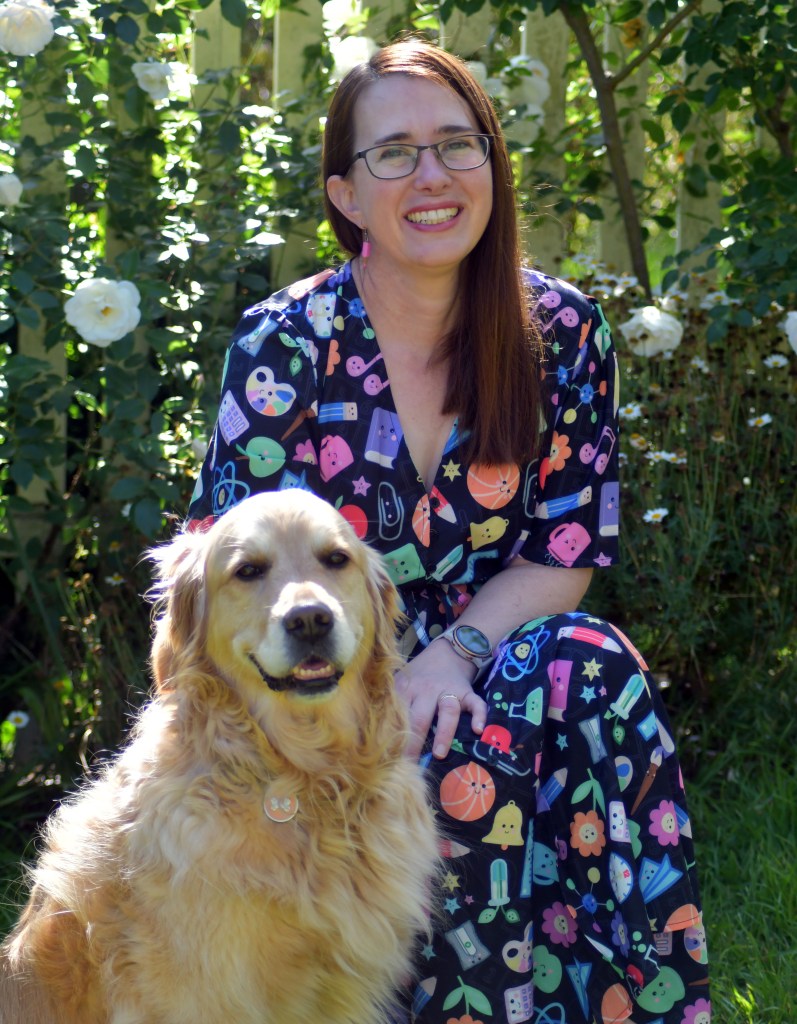
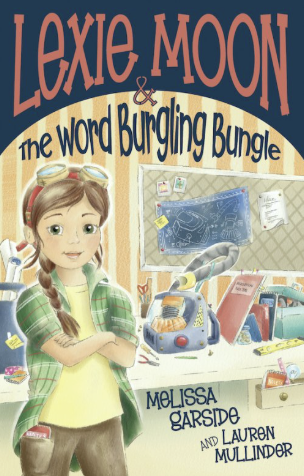
Melissa Garside lives south of Sydney with her family, their hilarious golden retriever and some entertaining free-ranging chooks. When she’s not writing or teaching, she enjoys getting her hands dirty in the garden, immersing herself in nature and using her family as guinea pigs for her recipe-free kitchen experiments. Today we’re chatting to Melissa about her debut junior fiction novel: Lexie Moon and the Word Burgling Bungle, illustrated by Lauren Mullinder.
The publisher provided Alphabet Soup with a reading copy of Lexie Moon and the Word Burgling Bungle.
From the publisher:
Lexie Moon built her latest invention, The Vocabuliser, to help people learn to say tricky words, like spaghetti and Worcestershire. But the device is stolen by infamous gadget thief, Gizmo Lightfinger, who sees other people’s inventions as his ticket to glory. With Grandad’s help, Lexie devises a plan to catch the gadget thief and get her invention back.
Lexie Moon is an enthusiastic inventor – did you try your hand at inventing gadgets when you were growing up?
I didn’t think of myself as an inventor as a child – although I did do a fair bit of inventing in the kitchen, coming up with many recipe-free, experimental dishes, and I’ve always played with different forms of design, including drawing fantastical house and garden plans. Dad was an electronics technician which meant that I was surrounded by a lot of gadgets, components and parts, and spent many hours in places like Sparky’s Electronics. Among my ‘toys’ were empty photographic film canisters and an egg-beater drill. I also used to imagine that the printed circuit boards Dad used were city streets and the various components were skyscrapers and vehicles.
I wanted Lexie Moon to be an inventor partly because I needed a way for the villain to steal people’s words, and also because I really love books that have things that are slightly outrageous or impossible. I think most of Lexie’s inventions are both!
Lexie is a courageous kid who isn’t afraid to race into danger. Are you like this yourself?
No way! I wish I was more like Lexie. To her, it’s more important to do the right thing than worry about being scared, and once she decides what she needs to do, almost nothing can stop her. I’d like to think that I would always do the brave thing, and there have been one or two occasions in which I’ve had to face a snake or spider, but to be honest I’m usually much more of the scream-if-I-see-a-mouse sort of person.
If Lexie’s Vocabuliser could help you pronounce a particular tricky word, which word would you choose?
Well, these days I teach English to migrants from around the world. I must say I probably find the Vietnamese pronunciation the trickiest of all, so I would quite like The Vocabuliser to help me say some tricky Vietnamese words. If we’re talking about English words, I would like some help with words I read in books but don’t know how to say properly. Words like isthmus (a narrow strip of land), interlocutor (someone you talk to) and sphygmomanometer (a blood pressure machine)! That last one really is a tongue-twister!
Lexie Moon and the Word Burgling Bungle has lots of twists as the reader hurtles through the story! Do you have a tip for young writers who would like to add some extra excitement to their storytelling?
The advice that I’ve been given is that to make your story extra exciting, you need to put your character in danger or put them in a very tricky situation. Once you’ve done that, you can make your story even more exciting, by making the danger even more dangerous or making the tricky situation even trickier.
I recommend thinking about the situation that your character is in and brainstorming all the different ways things can go wrong. Choose one or two things from that list and make them happen in your story. Then your character’s job is to find a way out of the tricky situation and get everything back to normal. That part of writing can be a lot of fun!
Can you tell us a bit about your next Work/s-in-Progress?
I’m very excited to be able to tell you that the next book in the Lexie Moon series, Lexie Moon and the Space Day Disaster, is planned for publication in August this year! I really enjoyed writing it and I can’t wait to share it with everyone.
If all goes well, I have a few ideas for other Lexie Moon titles. I’m also currently working on a portal adventure story and have lots of ideas for other books.
Lexie Moon and the Word Burgling Bungle is out now! Ask for it at your favourite bookshop or local library.
Act by Kayla Miller, Walker Books Australia, ISBN 9781760654931
REVIEWED BY AASHI, 10, VIC
Aashi reviewed her own copy of this title.
You should always stand up for what you believe, right? Olive thinks that it is unfair that kids have to miss out on field trips just because they are expensive. She knows she has to fix this problem but she doesn’t know how.
Olive knows she has to act and change the problem (this is why the book is called Act). She decides to run for the school council. She works really hard and makes really cool posters, speeches and talks to her peers about why the problem matters.
Olive is running against two of her best friends. She did not tell them that she was going to run and they felt betrayed. This makes things awkward between her friends and she gets discouraged but does not stop trying.
I really liked Act because it shows you that you do not have to be an adult to lead. You may be a child but you have a powerful voice that you can use. It also shows perseverance and determination.
I would rate the book 5 out of 5 stars. It is so good and is suitable for all young readers between the ages 9 to 13.
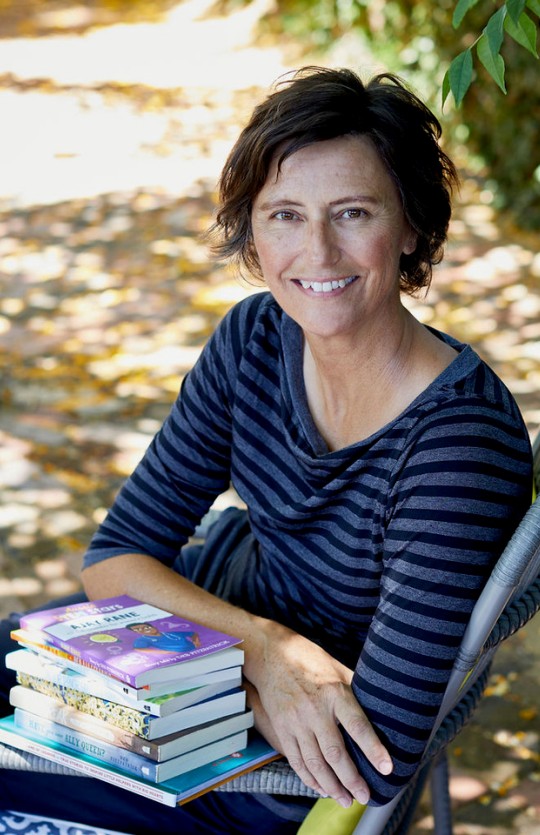
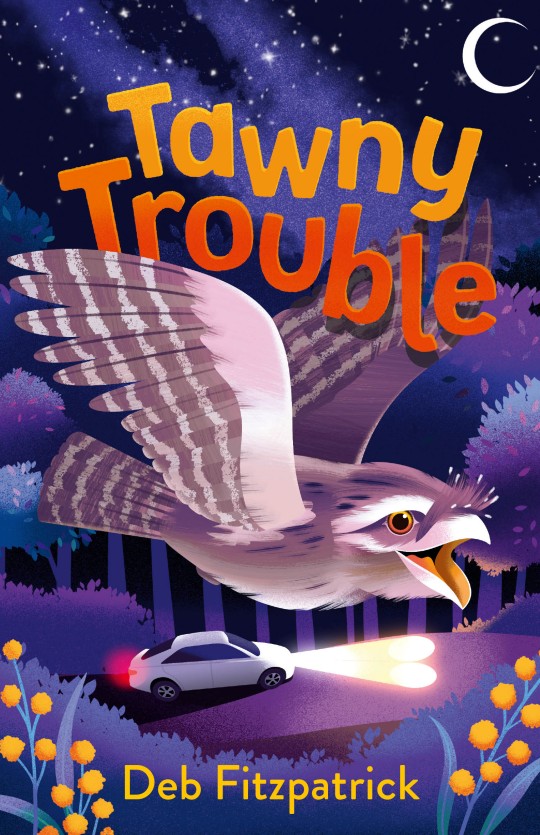
Deb Fitzpatrick writes for adults, young adults and children. She loves using stories from real life in her novels and regularly teaches creative writing to people of all ages. Deb loves bushwalking with her family. When she can, she sneaks away to a shack in the karri forest of the south-west of Western Australia. Today we’re thrilled to be chatting to Deb about her latest book: Tawny Trouble.
The publisher provided Alphabet Soup with a reading copy of Tawny Trouble.
From the publisher:
When Tessa’s family accidentally hit a Tawny Frogmouth while driving through the bush at night, they feel terrible. But the tawny is alive and needs their help. What Tessa doesn’t know is where that help will lead … Deb Fitzpatrick’s new novel is perfect for nature-loving readers who have a soft spot for animals.
How did a Tawny Frogmouth end up as the focus of your new book?
My family goes to the Nannup Music Festival every year and on the midnight drive home through the forest we always dodge Tawny Frogmouths, which feed on moths and insects attracted to the lights of cars. One year we came horribly close to hitting a tawny and it made me think: WHAT IF?? That question — what if? — is often the catalyst for my writing.
What’s your favourite Tawny Frogmouth fact?
I can’t just share one wonderful Tawny Frogmouth fact! I beg your indulgence, Alphabet Soup readers!
The most important fact we need to know about Tawny Frogmouths is that while they are nocturnal and as such are often confused for owls, they’re not owls. They’re closer to the nightjar.
Tawny Frogmouth feathers are soft, allowing for stealthy, silent flight. And their mottled grey, brown and black colouring helps them mimic tree branches — this is why Tawny Frogmouths are often referred to as the ‘masters of camouflage’.
You’re the author of many books. What do you find to be the hardest part of writing a book for you? (from the spark of the idea through to the book heading off to the printer?)
The spark of the idea is probably the easiest part for me, and the most exciting, and I think that’s true for a lot of writers. Reaching the end of a first draft is a huge relief, because for me the hardest part of writing any novel is getting through THE MIDDLE. Novel-writing is a sort of long-distance event; keeping positive, focused and confident in your abilities during that long middle phase can make or break the project. To maintain the sporting metaphor, that middle phase is about your creative stamina, your mental fitness, your willingness to go all the way. You really have to back yourself and your project, and it helps enormously to have the support of others during this time. I share my works-in-progress with another published children’s writer, and she sends me her work. We offer each other detailed editorial feedback including suggestions for improvement, observations on what’s working, and a solid dose of encouragement. I find this exchange really keeps me on track and lifts my motivation when I’m flagging.
Do you have a tip for young writers who’d also like to write adventure stories?
I would suggest incorporating a topic you’re fascinated by and want to know more about (I love native animals, for example, and love to write about them). Do some research (I had to do quite a bit to write Tawny Trouble as I didn’t know a lot about these beautiful birds) and weave a few facts into the story here and there. Before you know it, you’re engaging your readers while completely immersing yourself in research and writing — and it works because it’s something you care about.
Can you tell us a bit about what’s next for you?
I’m currently writing a novel for middle readers set on Penguin Island off the WA coast. It’s about 11-year-old Mitch, who gets caught up in an environmental adventure with the island’s Little Penguin population. Little Penguins are the only penguins that are native to Australia, and they’re the smallest of the 18 species of penguin in the world. This book is for readers who love nature and adventure, and perfect for fans of Kelpie Chaos and Tawny Trouble!
Tawny Trouble is out now! Ask for it at your favourite bookshop or local library.





 alphabetsoup.net.au