This post was added by Rebecca Newman. Rebecca is a children's writer and poet, and the editor of the Australian children's literary blog, Alphabet Soup.
For more about Rebecca visit: rebeccanewman.net.au.
January brings the snow,
makes our feet and fingers glow.
February brings the rain,
Thaws the frozen lake again.
March brings breezes loud and shrill,
To stir the dancing daffodil.
April brings the primrose sweet,
Scatters daises at our feet.
May brings flocks of pretty lambs,
Skipping by their fleecy dams.
June brings tulips, lilies, roses,
Fills the children’s hands with posies.
Hot July brings cooling showers,
Apricots and gillyflowers.
August brings the sheaves of corn,
Then the harvest home is borne.
Warm September brings the fruit,
Sportsmen then begin to shoot.
Fresh October brings the pheasant,
Then to gather nuts is pleasant.
Dull November brings the blast,
Then the leaves are whirling fast.
Chill December brings the sleet,
Blazing fire, and Christmas treat.
—————————————————————
Sara Coleridge lived in the northern hemisphere in the nineteenth century — snow in January sounds strange to us! We’re sharing this poem as part of the Soup Blog Poetry Festival. Until the end of August we’ll be posting poems, interviews with children’s poets, tips for reading and writing poetry, and Poetry Prescriptions (poetry is good for the soul!).
Today we have pressed the pause button on our Poetry Festival to take time out for a celebration! We are very happy to have Tania McCartney visiting as part of her Riley and the Jumpy Kangaroo Book Launch Blog Tour — A Very Jumpy Tour. This is the fifth book in the Riley series, so we asked Tania some questions about how she goes about writing picture books in a series.
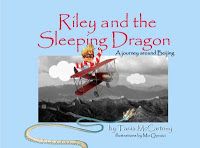
This is the fifth book in your Riley the Little Aviator series. When you wrote the first book, did you plan to write a series or did Riley and the Sleeping Dragon enter the world as a standalone picture book?
I wrote Riley and the Sleeping Dragon while living in Beijing — and I never dreamed the book idea would become a series. As this book was just a little personal project of mine, I was surprised when the book did well in China and I was even more surprised when the book did well in Australia, when we returned home in 2009. These kinds of surprises are very nice!
Because it did so well, I wondered if another title might work. And it did! so I just kept going. So far Riley has visited Beijing, Hong Kong, Sydney, Melbourne and Canberra.
Each book in the series is set in a different part of the world. How do you choose where to send Riley next?
I had originally planned for Riley to travel to Asian cities, but kids in Australia were desperate to have Riley visit their home town, so I quickly changed that concept to Australian cities. Sydney came first because it has the largest population, followed by Melbourne.
I wanted to send Riley to Canberra this year because it’s where I’m currently living, and the Riley books have a bit of a cult following here. I also wanted to help celebrate Canberra’s Centenary Year — 100 years old in 2013!
I choose the place depending on where we’ve visited as a family because all the photos used in the Riley books are taken by me. I have a lot of photos up my sleeve including Tasmania (we spent two weeks touring the island in 2010; it’s SUCH a cool place and I’m actually a Hobart girl), New Zealand, the west coast of the United States, and several Asian and European countries/cities.
I’d actually love to send Riley overseas again. I’ve even had thoughts of sending Riley to the North Pole. Shall have to rug up for that visit!
Is there anything different about each new title, or do you try to keep all the Riley books as much the same as possible (apart from the plot)?
It’s important to tie a book series together and this is usually done with the way the books look, and the same kind of plot structure/theme. I also think it’s important to add extra elements that make new books in a series feel fresh and exciting.
For the Riley series, I changed up the way I did each book — just so I could add that freshness.
In Riley and the Sleeping Dragon, the dragon isn’t seen in any of the photos … until right at the very end. This helps make the ending more of a surprise.
In Riley and the Dancing Lion, there are lions all through the book, but they’re never the one Riley is looking for. This makes kids wonder what the ‘right’ dragon will look like, and helps build suspense.
In Riley and the Curious Koala, the koala is hiding on the pages, sometimes in different forms, like a cloud or an umbrella. Kids LOVE to hunt for koalas in every photo (though he doesn’t appear on the page featuring Luna Park — so don’t break your eyes looking for him!).
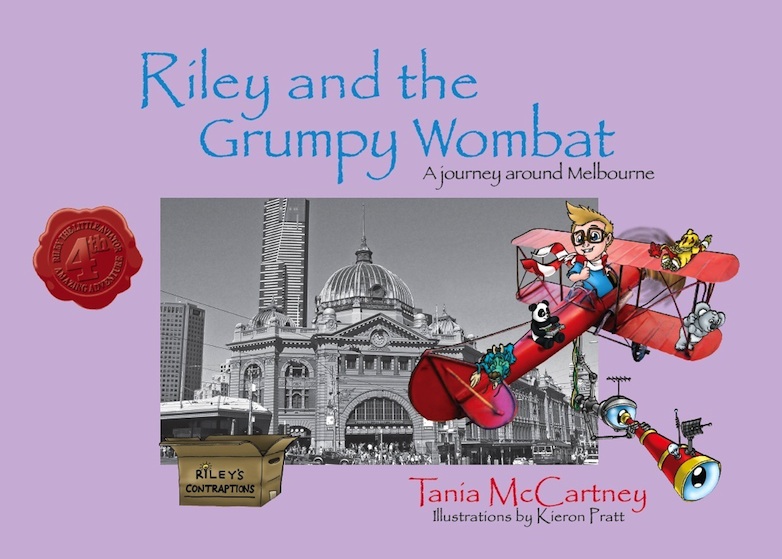
In Riley and the Grumpy Wombat, the wombat isn’t revealed until the end, but I gave Riley a series of amazing ‘contraptions’ he can use to help find her (because the wombat travels underground and Riley would have found it hard to spot her while flying a plane!).
In Riley and the Jumpy Kangaroo, I decided to change things up by adding colour to the photographs for the first time. As the story unfolds, more and more colour creeps into the images — and when you see the very last photograph over a double page spread, you’ll understand why!
Is there anything you need to keep in mind each time you start writing a new book in the Riley series?
Yes — I need to make sure we include the animal from the last book! Each time Riley starts a new adventure, a little toy version of the critter from the previous book joins the entire crew. Eventually, Riley will have an entire zoo of creatures accompanying him. Kieron and I have joked about attaching a hot air balloon to Riley’s plane so all the creatures can sit in it.
I also need to ensure I keep the style and ‘voice’ of the book the same as the others. This is what ties it to a series. Sometimes this is difficult to do because as you grow as an author, your voice and style changes and (hopefully!) improves. I would actually love the opportunity to do the Riley books a little differently now but I can’t alter the look of an established series.
Have you decided in advance how many titles will be in the Riley series? How do you decide on the right number of books for a series?
I was hoping to release a Riley book every year, forever! But my work on other books has become so busy, Jumpy Roo took two years to produce. The next one may even be three years away. This is upsetting because I adore the books and I have kids asking for them all the time. I will try to make them more frequent!!
Where to next for Riley?
I’m thinking maybe Tassie or New Zealand. I’d love to visit Tassie again soon, so that may sway me. Or maybe I could ask the kids of Australia to nominate Riley’s next destination. Perhaps I’ll send him to the city where kids make the loudest noise!
Is there anything else you’d like to add?
The Jumpy Roo book launch is being held at Floriade this year! Anyone living in or visiting Canberra on 15 September is invited along, but RSVPs are essential if you want a goodie bag and balloon! You can find out more here.
You can also visit the Riley the Little Aviator website to see updates, learn more about the places Riley visits, and see behind-the-scenes work. There are also some fun activities for kids.
This post is just one stop in the Riley and the Jumpy Kangaroo blog tour. For the full Blog Tour schedule, jump in your little red plane and head right here.
Last week we talked to Sally Murphy about writing poetry and she mentioned that she likes playing with magnetic words to write poetry. Today’s challenge is to use magnetic words to write your own short poem.
Here are some ways you could go about it:
If you have your own set of magnetic words — use them on a fridge or table top to write a short poem. (Or try this extra challenge — scoop a large handful of words and only select words from this handful when writing your poem!)
Try an online magnetic words site like Magnetic Poetry. This site gives you the equivalent of scooping a large handful of magnetic words. You can choose words from that handful to write your poem. Note: check with a parent or teacher first to get permission to visit the website.
If you have an iPad, ask your parents’ permission and check out the free Word Mover app (recommended by The Book Chook!)
If you don’t own magnetic words and you don’t want to use an app or an online site — ask family or friends to call out words and write them down on slips of paper. When you have a small pile, use these like magnetic words to write your poem.
You might make some extra rules for yourself — will you limit yourself to the words in front of you? Will you be allowed to change words slightly (like adding an ‘s’ or ‘ed’ to a word)? Can you add conjunctions (like ‘and’ or ‘because’) if they are not already in your pile of words? You decide!
Here’s one I wrote, using words at the Magnetic Poetry site. I didn’t allow myself to change or add words when I wrote my poem.
Under tiger sun
they go
balloon in hand
whispering
—
Your turn! If you write a poem using magnetic words, we’d love you to leave it in the comments. (Grownups are welcome to take part too, but please note we are G-rated!)
Today is National Tree Day in Australia — community groups and schools get together to plant and care for native trees and shrubs to help the environment and the planet.
We’ve gathered some tree-themed poems in honour of National Tree Day. (Make sure you ask a parent before you visit these websites!) Do you know any other tree poems?
If you want to know how you can be a part of National Tree Day, visit the official website (you can take part at a later date if you’ve only heard about National Tree Day today … ).
We’ll have Tania McCartney visiting on Thursday 1 August 2013 as part of her blog tour to celebrate the launch of Riley and the Jumpy Kangaroo. She’ll be talking about how she writes picture books when they belong to a series. See you then!
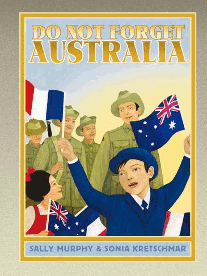
Today have a talented visitor — Sally Murphy, writer of children’s books and poetry. You might have read some of her poems in Alphabet Soup magazine and she also has two verse novels published. Her latest books include Meet Mary MacKillop and Do Not Forget Australia (these aren’t poetry books but they are good reads!). Sally is visiting today as part of our Poetry Festival.
—
When did you first start writing poetry?
I don’t remember — it feels like I always wrote poetry. I loved playing with words and making up stories from when I was really little, and as soon as I learnt to write I wrote them down. In primary school I wrote poetry in class, and also entered writing competitions and wrote poems for my family. My first published poetry was in school magazines and I remember also being published in the local paper as part of writing competitions.
What sort of poetry do you like writing?
Most of my poetry is what you would call free verse — unrhymed, almost narrative poems. But I also love playing with rhyme.
What sort of poetry do you like reading?
Good poetry. I don’t care what the structure is, I just like to read a poem that makes me go “ooooooh”. Usually it does that by saying something almost perfectly in a way that makes me think.
Where can we find your poetry?
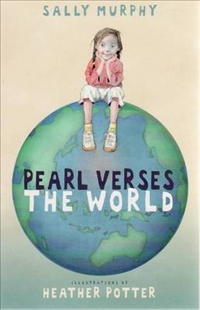
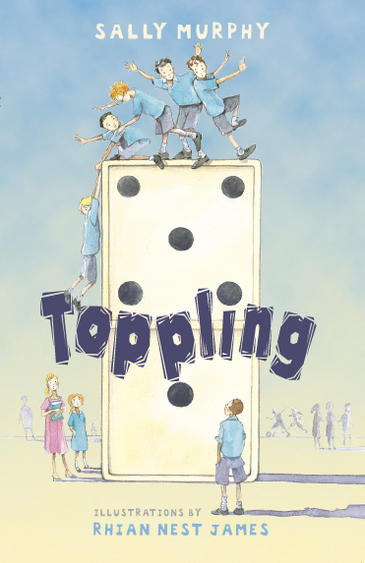
In books — I’ve had two verse novels published by Walker Books (Pearl Verses the World and Toppling), a rhyming picture book (Pemberthy Bear) and a collection of performance poetry (Assembly). I’ve also been published in magazines including TheSchool Magazine and the wonderful Alphabet Soup.
I try to write every day, though I will confess it doesn’t always happen. But I carry a notebook wherever I go, and try to snatch even just five minutes to write whenever I can.
Do you prefer to write with a pen and paper or straight onto the computer?
Pen and paper, when writing poetry. I think it helps to connect with my creative side, and allows me freedom to just write it all down without worrying about spelling or anything. Then I can cross out and rearrange and experiment. I also have sets of magnetic words which I like to play with to create poems.
Your number one tip for budding poets?
Write a lot. Don’t worry if it isn’t all perfect — have fun messing about with words. The more you write the better your writing will get. Oh, and I know you only asked for one tip, but it goes hand in hand: read a lot. If you want to write poetry, read a lot of poetry.
Sally’s Poetry Prescription
IF YOU’RE HAVING A CRANKY DAY — read the following poem:
I WANDERED LONELY AS A CLOUD by William Wordsworth
I wandered lonely as a cloud
That floats on high o’er vales and hills,
When all at once I saw a crowd,
A host, of golden daffodils;
Beside the lake, beneath the trees,
Fluttering and dancing in the breeze.
Continuous as the stars that shine
And twinkle on the milky way,
They stretched in never-ending line
Along the margin of a bay:
Ten thousand saw I at a glance,
Tossing their heads in sprightly dance.
The waves beside them danced; but they
Out-did the sparkling waves in glee:
A poet could not but be gay,
In such a jocund company:
I gazed — and gazed — but little thought
What wealth the show to me had brought:
For oft, when on my couch I lie
In vacant or in pensive mood,
They flash upon that inward eye
Which is the bliss of solitude;
And then my heart with pleasure fills,
And dances with the daffodils.
—
The language is a little old fashioned (it was written in the nineteenth century!) but the image of thousands of daffodils always makes me smile.
Today’s challenge is to write a list poem. A list poem can be rhymed or unrhymed and usually involves a list (of course!) of items or activities linked to a theme or the title. I like list poems with a twist at the end and I also love the ones that include repetition (maybe each line of the poem begins the same way).
Here’s a site with some ideas for writing list poems. It even includes a ‘fill in the box’ method for writing your own poem. I tried it out and here’s what I came up with. (Mine rhymes but yours doesn’t have to!).
What’s in my head? by Rebecca Newman
Ideas for my project on Captain Cook
Places to search for my library book
Multiple strategies for tough maths questions
A list of birthday gift suggestions
The quickest way to pass Level 4
Directions to get to the lolly store
Twenty two quotes from Pencil of Doom!
(Too much to remember to clean my room.)
—
What would you write a list poem about? We’d love to read yours — if it’s OK with your parents/teacher, post your list poems in the comments below!*
~ Rebecca (Soup Blog’s editor)
*G-rated poems by grownups also welcome, so ask your teacher or your grandma to join in …
Oh! hush thee, my baby, the night is behind us
And black are the waters that sparkled so green.
The moon, o’er the combers, looks downward to find us
At rest in the hollows that rustle between.
—
Where billow meets billow, there soft be thy pillow.
Oh, weary wee flipperling, curl at thy ease!
The storm shall not wake thee, nor shark overtake thee
Asleep in the arms of the slow-swinging seas.
—————————————————————
We’re sharing this poem as part of the Soup Blog Poetry Festival — until the end of August we’ll be posting poems, interviews with children’s poets, tips for reading and writing poetry, and Poetry Prescriptions (poetry is good for the soul!).
Today’s challenge is to write a 5-line poem using your five senses — sight, hearing, taste, smell, touch. You might like to write a poem describing apples, a season, or your favourite colour (or your least favourite colour!).
Today we welcome Jackie Hosking who is visiting as part of the Soup Blog Poetry Festival. We’re big fans of Jackie’s poetry and you might remember reading some of her poems in Alphabet Soup magazine — like ‘Paperwork’, ‘The Moon’, ‘Butterfly Kisses’, and ‘I Wish I Were a Dragon’.
—
I wrote my first poem when I was 17 years old. It was called ‘Consequence’, a rhyming nonsense poem that made the use of opposites. It began …
A Christmas tree stood on the beach
Within my grasp but out of reach
What sort of poetry do you like writing?
Best of all I like writing rhyming and rhythmical poetry. I’ve tried to write free verse poems and I’ve enjoyed the process but rhyme and meter suit me best of all.
What sort of poetry do you like reading?
I like to ready any poems that make me go aaaahhhhh …
Where could a reader find your poetry?
My poetry has been published in magazines, anthologies, websites, on a train, educational texts and next year in a picture book titled The Croc and the Platypus.
Not as often as I should probably — but when I do I’m so absorbed that many hours can pass without me realising it. It’s really exciting when this happens.
Do you prefer to write with a pen and paper or straight onto the computer?
Straight onto the computer, though I will record ideas if I’m out on a walk with no computer in site. Love my phone for this!
Your number one tip for budding poets?
Write about what moves YOU. There is nothing more compelling than reading a piece that was written with passion.
Jackie’s Poetry Prescription:
IF YOU’RE HAVING A GRUMPY DAY — read the following poem! (I wrote ‘The Quarrel’ as it’s perfect for stamping your grumpies out.)
 April brings the primrose sweet,







 alphabetsoup.net.au