Posted in competitions, info, teachers' resources

Autumn 2011 writing comp: THE WINNERS (Part II)

"Boy writing © Greg Mitchell"Here is the winning Under 9s story from our autumn 2011 writing competition. You were asked to write a story about something to do with cooking.

A reminder: always check the rules of the competition. If you don’t stick to the rules, we have to disqualify your entry and that makes us sad!

Under 9s winner: G Oakley (WA)

THE MAGIC STEW

Once upon a time there lived a girl named Misty. Misty lived with only her mother.

One day Misty’s mum was making a stew.

But then all of a sudden there was a cry from the kitchen. It was Misty’s mum. Misty ran to the kitchen as fast as she could. And there right in front of her mum was the stew, but the stew didn’t look like a stew it looked like a monster.

Misty asked her mum what she did to the stew but her mum just said ‘I just put this sauce in that a stranger gave me’ said her mum.

After Misty’s mum said this Misty was just about to ask her mum about the stranger but before she could say anything the stew monster tried to jump on her. All of a sudden Misty found herself being chased by the stew monster.

As Misty was running very fast she had an idea. Misty remembered that stew goes rotten in the sun so Misty made the stew monster chase her outside into the bright sun then Misty quickly ran inside and locked the doors. As soon as Misty locked the doors she sat down and asked her mum about the stranger her mum had met. Her mum said she had a big wart on her nose.

Misty started to laugh, ‘Oh mum’ she said, ‘you bought something off the witch who lives outside of town.’

Misty and her mum both looked outside to find the monster but all they found was a puddle of stew.

Enter our winter writing competition. Entries close 29 July 2011.

Posted in competitions, info, teachers' resources

Autumn 2011 story comp: THE WINNERS (Part I)

"Boy writing © Greg Mitchell"Here is the winning Under 12s story from our autumn 2011 writing competition. You were asked to write a story about something to do with cooking.

A reminder: always check the rules of the competition. If you don’t stick to the rules, we have to disqualify your entry and that makes us sad!

Under 12s winner: R Mukherjee (NSW)

JUST BELIEVE IN YOURSELF

No, Amanda!” Kathleen groaned to her friend, “I am not entering!”

“Oh, Kath! Everyone is entering. It’s just for fun, after all!”

Kathleen watched her brown hair ripple out in the breeze. After a moment she replied quietly, “I’m hopeless at cooking.”


Amanda had piercing green eyes and she fixed them determinedly on Kathleen. “You are not! It’s just a Cupcake Competition, Kathy! C’mon, we are entering!”

She leapt out of the pool, grabbed her towel and strode away. Before she left she yelled over her shoulder, “Just believe in yourself!”


Two weeks later, Kathleen and Amanda were ascending the steps to Harrow Hall, where the Cupcake Competition was to be held. Kathleen was so reluctant Amanda practically had to drag her along. Amanda loved cooking and decorating, but Kathleen was different. She loved reading. Her favourite genre was crime fiction and she adored puzzling out mysteries! As a result, she’d become exceptional at finding lost things! But reading couldn’t help her now. This was a cooking competition. Kathleen knew she couldn’t do it. She was about to let her team down—and embarrass herself. Oh, what was she doing here?!


Jeanie and Maria, who went to school with Amanda and Kathleen, joined the girls at a bench. The workbench was full of icing, sprinkles and flour. It was a mess!

“Ladies and gentlemen!” the announcer cried, “Are you ready?!”


No, I’m not! Kathleen whined to herself. She spied Tom Wright at another bench. They were school enemies. Great! This really would give him something to snigger about! “You have fifteen minutes to make a batch of four cupcakes,” the announcer continued, “so manage time effectively! On your marks, get set … go!”


It was eight minutes into the competition. Everyone except Kathleen was enjoying themselves and working hard. Kathleen stood to one side, eyeing the mess of supplies. Suddenly someone cried, “The ladle!” It was Jeanie.


“What’s wrong?” asked Amanda, impatiently.

“The ladle’s gone! It’s not here!” At this, everyone made a frantic search for it—but it was truly gone. Kathleen snapped into action. A minute later she returned, smiling, with the large wooden spoon.

“Kath,” Amanda breathed, “you’re a life saver! But … where was it?”

Kathleen nodded towards Tom Wright’s group with a wry smile. “Kath, you didn’t want to come—and now you’ve saved the group!”

Kathleen shrugged, “You’re the one who told me to believe in myself!”

Enter our winter writing competition. Entries close 29 July 2011.

Posted in competitions, info, poetry, teachers' resources

Winter 2011 Alphabet Soup — out now!

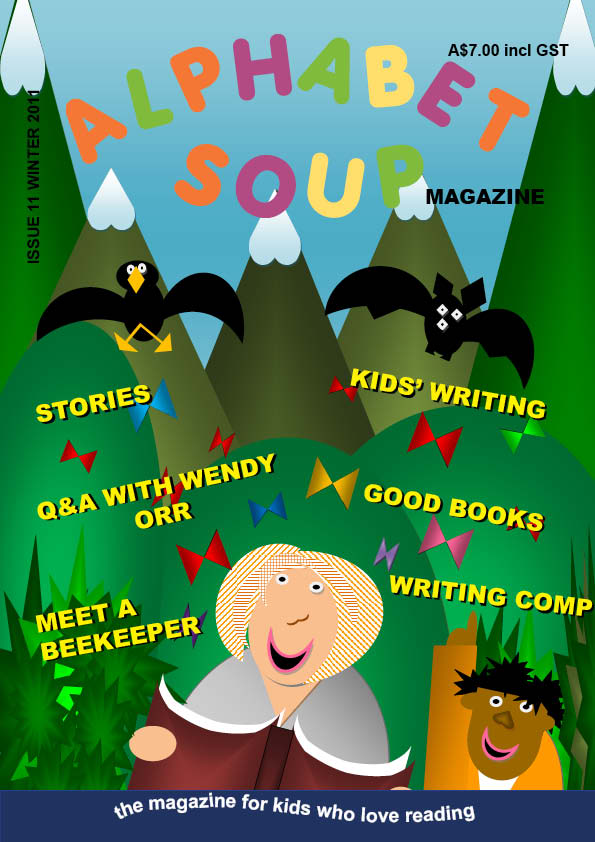
Issue 11 cover, Alphabet Soup magazineThe eleventh issue of Alphabet Soup magazine (yay! yay!) was posted yesterday. If you are a subscriber, keep an eye on your letterbox.

Here’s what you’ll find inside the winter issue:

  • Q&A with author, Wendy Orr
  • Meet a beekeeper
  • Writing tips for kids from The Book Chook
  • Stories by Michele Purcell and Emma Cameron
  • Poetry by Edel Wignell, Jackie Hosking and Lorraine Marwood
  • Stories, poems and book reviews by kids
  • Crossword
  • Our winter writing competition
  • Our annual design-a-cover competition

and more!

Later today we’ll be posting the Q&A with Wendy Orr and on Monday we’ll be posting the winning stories from our recent story-writing competition. So stay tuned!

Subscribe to Alphabet Soup magazine

Posted in info, teachers' resources

Send us your writing & artwork!

In every issue of Alphabet Soup, we include 6 pages of kids’ work—your stories, poems, letters-to-the-Editor, book reviews and artwork. Issue 11 is coming up. We still have a few spaces left for a poem or a story (or two) and some artwork.

If you’d like to see your work published, read our submission guidelines and send us something! (If it doesn’t arrive in time for issue 11, we can include it in a later issue. So if you can’t send something until next week, don’t panic.)

Remember, you don’t have to subscribe to the magazine to send us your work or to enter our writing competitions.

"Walker Books 2011 titles"

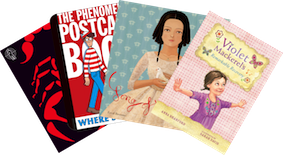
For those of you who DO subscribe, subscribers are automatically entered in a Subscribers’ Draw every issue. The winner of the issue 11 Subscribers’ Draw will receive a $200 book pack from Walker Books Australia. (See some of their books above. Books in the winner’s pack might differ though.)

Now I’m going to sit by our post office box to wait for your writing and artwork. (Give that postman something to do and send me some mail!)

Rebecca Newman, Editor

Posted in info

Issue 10 activities: mad scientists!

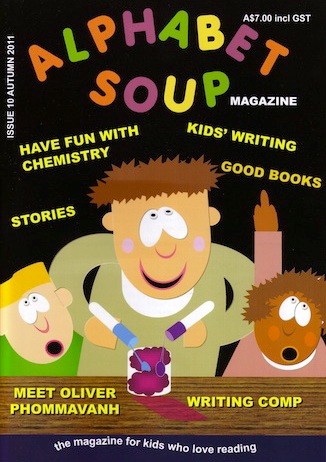
"Issue 10 cover Alphabet Soup"We’ve updated the ‘Activities’ page! (You’ll find the page on the menu across the top of the blog, under the header picture).

ISSUE 10—AUTUMN 2011

ACTIVITIES

1. PLAY with chemistry online. Check out ChemiCroc—a cool website for primary school kids, with online activities.

2. Check out the International Year of Chemistry 2011: Australia website. There are some chemistry-related word searches and activities.

3. HANDS-ON CHEMISTRY: Visit the CSIRO website to see how you can make your own bath bombs. (Give as gifts, or drop one in your own bath and watch it FIZZ!)

4. TRY a YUMMY EXPERIMENT: experiment with reactions—visit the Science Wizard’s website to find out how to make your own sherbet. Yum! (You’ll find citric acid in the grocery store,  near tartaric acid.)

5. READ some chemistry-themed books! We like George’s Marvellous Medicine by Roald Dahl. Can you think of any others? Click here to tell us your favourites, and we’ll add them to the list!

MUSIC LISTENING LIST

Our listening list is compiled by Danielle Joynt, from Cantaris. Danielle has also included comments for some of these pieces. (Tip: Ask about CDs at your public library—libraries often have a good collection of CDs for loan if you prefer not to buy.)

1. MUSIC FOR THE ROYAL FIREWORKS—GEORGE FREDERIC HANDEL

"Music for the Royal Fireworks cover"This is a suite—originally for wind-band and later re-scored for orchestra—composed by George Frederic Handel in 1749. The music was commissioned by King George ll of Great Britain to celebrate the end of the War Of Austrian Succession and the signing of the treaty of Aix-la-Chapelle in 1748.

The music was first publicly performed in rehearsal on 21st April 1749 in Vauxhall Gardens, London. Over twelve thousand people attended the rehearsal, causing a three hour traffic jam of carriages, after the central arch  on the newly built London Bridge collapsed.

During the actual concert on the 27th April, the musicians were housed in a purpose-built theatre which caught fire after the collapse of a bas-relief scultpure of King George during the fireworks!

2. VOLCANIC ERUPTIONS SCORED INTO MELODIES

In 2003, researchers in Italy began transforming the low-frequency seismic rumblings of volcanoes into musical scores in an effort to predict when the volcanoes would erupt. Researchers created a concerto from the underground movements of Mount Etna in Sicily and created melodies from Tungurahua in Ecuador. By correlating music with precise volcanic activity, researchers hope to learn the signature tune of an imminent eruption.

3. CARL PHILIPP EMMANUEL BACH (1714-88) compared the music of his father’s generation with “overly-spiced cooking”.

Erik Satie likened the chromaticism of Wagner’s music to sauerkraut!

Sergei Prokofiev compared the cloyingly sweet berries he sampled on a visit to the country with Chopin’s “effete” nocturnes.

4. POPULAR MUSIC

Love Potion Number 9 is a classic popular song written in 1959 by Jerry Leiber and Mike Stoller. It was originally performed by The Clovers that year. The well-known version was recorded by The Searchers in 1963.

5. THE ENGLISH COMPOSER EDWARD ELGAR is said to have believed that the tune of the first of his “Pomp and Circumstance” marches would “knock ‘em flat”. As an amateur chemist, he proved that literally …

"Pomp and Circumstance cover"His friend, the conductor and composer William Henry Reed, tells how Elgar delighted in making a ‘phosphoric concoction’ which would explode spontaneously when dry—possibly Armstrong’s mixture, red phosphorus and potassium chlorate, used in toy cap guns. One day, Reed says, Elgar made a batch of the stuff but then musical inspiration struck. He put the mixture into a metal basin and dumped it in the water butt before returning to the house.

‘Just as he was getting on famously,’ wrote Reed, ‘writing in horn and trumpet parts, and mapping out wood-wind, a sudden and unexpected crash, as of all the percussion in all the orchestras on earth, shook the room … The water-butt had blown up: the hoops were rent: the staves flew in all directions; and the liberated water went down the drive in a solid wall. Silence reigned for a few seconds. Then all the dogs in Herefordshire gave tongue.’


See the activities and the themed listening list for issue 9 (summer 2010).

See the activities and the themed listening list for issue 8 (spring 2010).

See the activities and the themed listening list for issue 7 (winter 2010).

Posted in competitions, info, poetry, teachers' resources

Summer ’10 poetry comp: THE WINNERS (Part III)

"Boy writing by Greg Mitchell"
© Greg Mitchell

Here is the winning Under 12s poem from our summer 2010 writing competition. You were asked to write a poem incorporating the word ‘snap.’

A reminder: always check the rules of the competition. If you don’t stick to the rules, we have to disqualify your entry and that makes us sad!

Under 12s winner: B Apel (QLD)

Timber!

Vrooooom … vroom

The big tree falls,
smashing through the canopy
severing branches with a snap!
creating a chain-reaction;
like dominoes
they fall
until petering out
with a final …

Whump.

Enter our autumn writing competition. Entries close 29 April 2011.

Posted in competitions, info, poetry, teachers' resources

Summer ’10 poetry comp: THE WINNERS (Part II)

"Boy writing by Greg Mitchell"
© Greg Mitchell

Here is the winning Under 9s poem from our summer 2010 writing competition. You were asked to write a poem incorporating the word ‘snap.’

A reminder: always check the rules of the competition. If you don’t stick to the rules, we have to disqualify your entry and that makes us sad!

Under 9s winner: T Arthur (NSW)

Hearing Snap

Snap is the sound that you hear when the elastic in
your underpants goes.
Snap is the sound of crocodiles’ teeth.
Snap is the sound of …
Who knows!

Congratulations! The winners of our writing competitions receive a $20 book voucher.

Enter our autumn writing competition. Entries close 29 April 2011.

Posted in competitions, info, poetry, teachers' resources

Summer ’10 poetry comp: THE WINNERS

"Boy writing by Greg Mitchell"
© Greg Mitchell

Here is the winning Under 7s poem from our summer 2010 writing competition. You were asked to write a poem incorporating the word ‘snap.’

A reminder: always check the rules of the competition. If you don’t stick to the rules, we have to disqualify your entry and that makes us sad!

Under 7s winner: P Burstow (QLD)

Secret Handshake

Once there were two friends
And they had a special handshake
And the special handshake was
Click, Knuckle-Punch, SNAP!

Congratulations! The winners of our writing competitions receive a $20 book voucher.

Enter our autumn writing competition. Entries close 29 April 2011.

Posted in competitions, info, poetry, teachers' resources

Summer 2010 writing comp!

Win a $20 book voucher!

"Writing a poem"Write a poem up to 10 lines long (shorter is fine). Your poem must include the word ‘snap.’ Include a competition entry form—you can print one from Alphabet Soup‘s website.

ENTRIES CLOSE 7 JANUARY 2011. (We’ll accept entries postmarked 7 January.)

This writing competition is open to children aged 12 and under. Entries are judged in 3 age categories.

Posted in info, teachers' resources

Activities page for issue 9

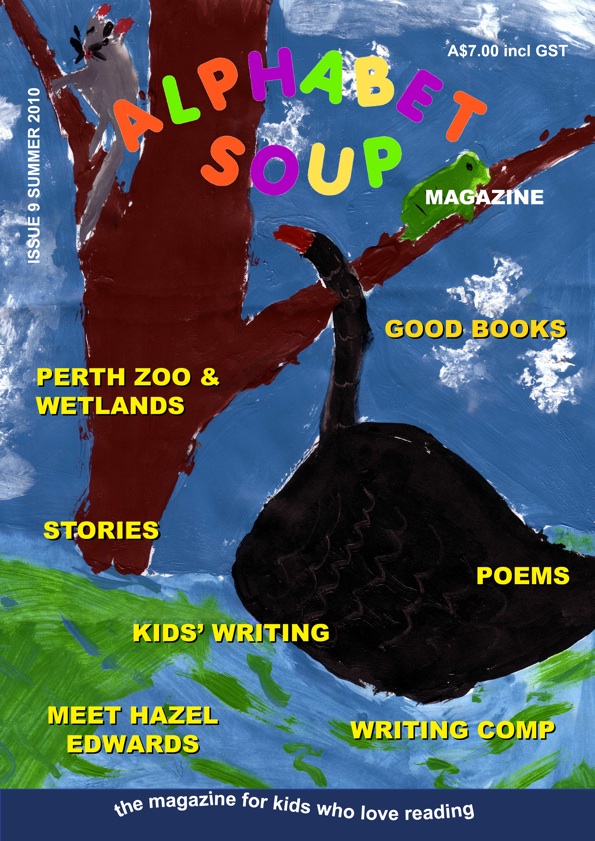
"Alphabet Soup magazine issue 9 cover"We’ve updated the ‘Activities’ page! (You can find it on the menu across the top of the blog, under the header picture). If you click on it, you will find a list of activities to go with the theme of each issue (starting from issue 7), and a music listening list—compiled by Danielle Joynt of Cantaris.

For each issue of the magazine (starting with issue 7), we will add activities and a themed listening list to this page. Enjoy!

ISSUE 9 – SUMMER 2010

ACTIVITIES

1. PLAY wetlands-themed games, like ‘Leap Frog’, or ‘Duck, Duck Goose’.

2. PLAY online games and quizzes and learn at the same time—visit the Water Corporation’s website.

3. FIND OUT about frogs in your local area. Research to find out what you can do to protect them. Some frogs in Australia are under threat. To identify frogs (and their calls) visit the WA Museum website, or the Frogs Australia website.

4. ADOPT a local wetlands area—visit it regularly with family or friends to collect rubbish to keep it healthy.

5. MAKE FROGS-IN-A-POND!

You will need: 1 packet green jelly, 1 chocolate frog per person, 1 clear plastic cup per person.

What to do: make the jelly according to the directions on the packet. Put it in the fridge. When cooled, but not set, add a chocolate frog to each cup. Return to fridge until jelly is set. EAT! Yum.

If you’d like to make a feature pond for a party table, use two or more packets of green jelly and use a large clear glass bowl. Add some of the chocolate frogs to the cooled jelly (before it sets). ‘Float’ some nasturtium leaves (to be lily pads) on the top of the jelly once it has set. Sit the remaining chocolate frogs on the lily pads. Give everyone a spoon and eat!

MUSIC LISTENING LIST

Our listening list is compiled by Danielle Joynt, from Cantaris. Danielle has also included comments for some of these pieces. (Tip: Ask about CDs at your public library—libraries often have a good collection of CDs for loan if you prefer not to buy.)

1. PETER SCULTHORPE"sculthorpe---songs of sea and sky (cd cover)"
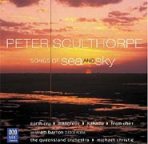
Peter Sculthorpe is an Australian composer (1929 –   ) whose music often evokes the sound and feeling of the Australian bush and outback. His works “Kakadu” “Mangrove” and “Earth Cry” reflect the vastness of the Australian landscape and the sounds of Australian wildlife. He often uses the Aboriginal chant—Djiilili—in his works. Djilili means “whistling duck on a billabong”.

2. FROG ROUND

Hear a Frog Round for three voices (see the free mp3 at bottom right of the Cantaris site)

3. ANATOLY LIADOV—RUSSIAN FOLK SONGS

The Russian composer  and teacher Anatoly Liadov (1855-1914)  arranged eight Russian folk songs for orchestra, including his famous wok “The Enchanted Lake” and “Last Night I Danced With A Mosquito”. Liadov was a wonderful  but very strict music teacher, and taught theory to the young Prokofiev.

"carnival of the animals (cd cover)"4. CAMILLE SAINT-SAENS-–CARNIVAL OF THE ANIMALS

Camillle Saint-Saëns (1835-1921) is the French composer of Carnival Of The Animals (1886).
Saint-Saëns wrote Carnival Of The Animals as a musical jest, and after the piece’s first private premiere, Saint-Saëns forbade it to be played in public—feeling it might damage his reputation as a serious composer.
He only allowed one movement—”Le cygne” (“The Swan”) to be published during his lifetime.

Carnival Of The Animals was only published as a whole after the composer’s death, and has since become one of the world’s most famous and best-loved pieces of music.

5. PYOTR ILYICH TCHAIKOVSKY—SWAN LAKE

The music for the ballet “Swan Lake”was composed over twelve months in 1875 and 1876 by the Russian composer Pyotr Ilyich Tchaikovsky (1840-1893). When the ballet premiered in St Petersburg in 1877 it was a  dreadful failure, due to the very poor stage production. Most critics considered Tchaikovsky’s music far too complicated for ballet! The production was revised several times, and the musical score was revised after Tchaikovsky’s death by the Italian composer Riccardo Drigo. It is his revision of Tchaikovsky’s orignial score which is most often performed to the Swan Lake ballet today.

6. GEORGE FREDERIC HANDEL—WATER MUSIC

The “Water Music” is a collection of orchestral movements composed by George Frederic Handel. It premiered on the 17th July 1717 after King George 1 requested a concert on the River Thames. The piece was performed by fifty musicians on a barge near the Royal Barge from which the King listened with his close friends. King George I loved the music so much that he asked the exhausted musicians to play the whole work three times!

7. FRANZ SCHUBERT—TROUT QUINTET

“The Trout Quintet” is the name given to the Piano Quintet in A Major by Franz Schubert (1797-1828). The quintet was composed in 1819, when Schubert was 22 years old, but was not published until 1829, a year after he had died. The usual instrumentation of a piano quintet is for piano, two violins, viola and cello; however, Schubert wrote his Trout Quintet for piano, violin, viola, cello and double bass.

The Quintet is called “The Trout” because the fourth movement is a set of variations on Schubert’s earlier Lied (the German word for “song”) “Die Forelle”(“The Trout”).

8. HOW DOTH THE LITTLE CROCODILE

Several songs are based on the poem “How Doth The Little Crocodile” by Lewis Carroll, which appears in his book “Alice’s Adventures In Wonderland”

“The Little Crocodile” by Gary Buchland (1991) from Alice Songs
“The Little Crocodile” from “Five Lewis Carroll Poems” No 3 by John Woods Duke (1899 – 1984)
“How Doth The Little Crocodile” (1908) by Liza Lehmann (1862 – 1918)

See the activities and the themed listening list for issue 8 (spring 2010).

See the activities and the themed listening list for issue 7 (winter 2010).