Posted in authors, illustrator, interviews

Tull Suwannakit on Higher Ground

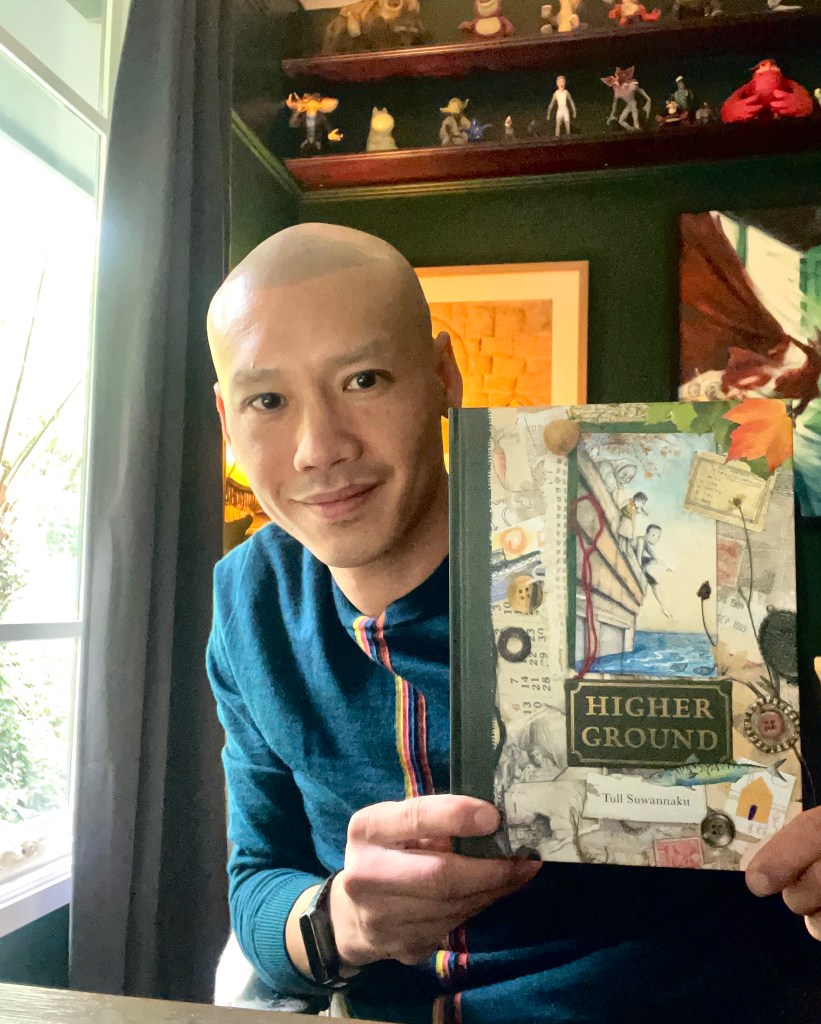
Tull Suwannakit holds up a copy of Higher Ground

Tull Suwannakit is an award-winning illustrator and author with a background in animation and fine art. When Tull is not writing and illustrating, he runs art classes and workshops for children and adults at his art school in Melbourne. Today we’re excited to hear from Tull about his latest book: Higher Ground.

The publisher provided Alphabet Soup with a reading copy of Higher Ground.

From the publisher:


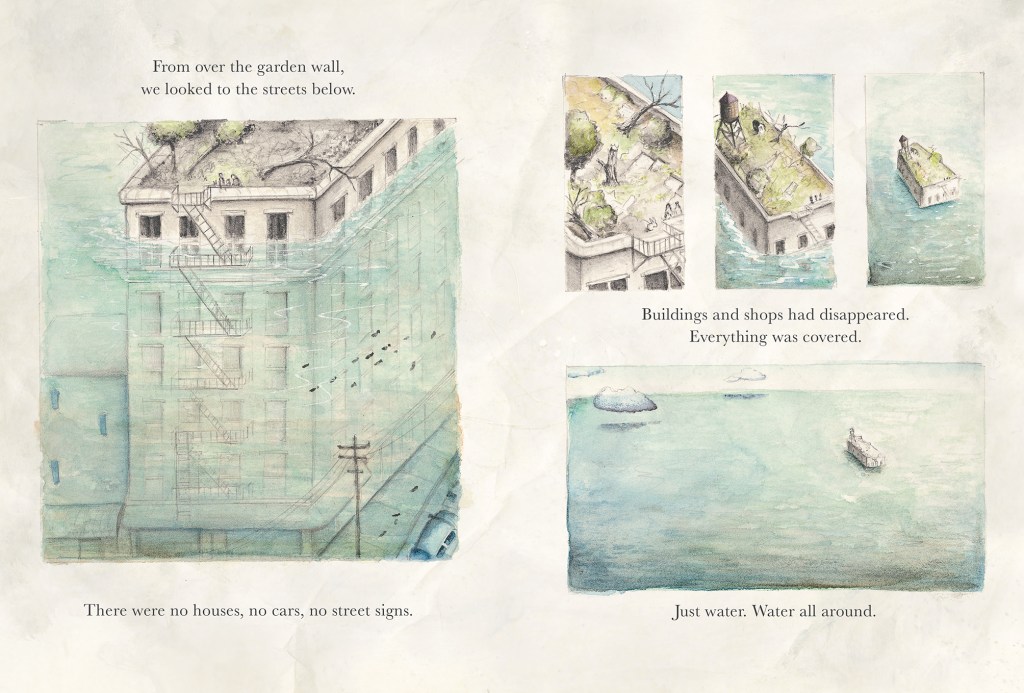
After I am happy with how the storyboard looks, I transfer each rough sketch onto a final piece of watercolour paper. Multiple layers of transparent sepia-toned washes are applied to give the illustration a base tint of light and dark. Additional mediums are used in order for me to capture a particular mood and tone of each scene. For instance, soluble graphite powder helps with muting down the scene, and giving it a dystopian feel. For dynamic scenes, I will add in a thick application of gouache and acrylic paints.  In contrast, luscious and lively scenes are injected with a dab of bright coloured pigments using a combination of watercolour, gouache and/ or ink. 

A double page spread: pages from inside Higher Ground by Tull Suwannakit.
From Higher Ground by Tull Suwannakit.

Although the time spent with my grandma was brief, her teachings left an everlasting imprint on me. I learned a thing or two from her about how to go about preserving fruits and vegetables, and how to take care of the garden. Growing up and living away from home at the young age of nine to attend boarding school, I learned early on valuable life lessons and skills from the wonderful people that I met along the way. I learned to cook for myself and others, I mastered a handful of essential skills and gained many words of wisdom, all of which manifested into the character of Grandma in Higher Ground

This has always been my debate right from the start – whether or not they should be given names. In the end, by not giving the characters names, I think it allows readers to be a part of the journey in a more immersive and  empathetic way. 

I was more of a visual oriented child, and expressed much of my feelings through pictures. So, when I first moved from Thailand to Singapore, there were huge cultural and language barriers. I found journaling, through simple writing to accompany my pictures, helped me understand and connect with myself and the world around me.  This practice continues to this day. 

I have just wrapped up an anthology of Australian Poems, which I did the illustrations for.  It is a collaboration with The National Library of Australia with Libby Hathorn and Jude Fell and will be out later in 2025.

Higher Ground is out now! Ask for it at your favourite bookshop or local library!


AWESOME EXTRAS

Download activities and Teachers’ Notes for Higher Ground

Visit Tull Suwannakit’s website for more about him and his books

The cover of Higher Ground, a children's hardback book.
Posted in authors, interviews

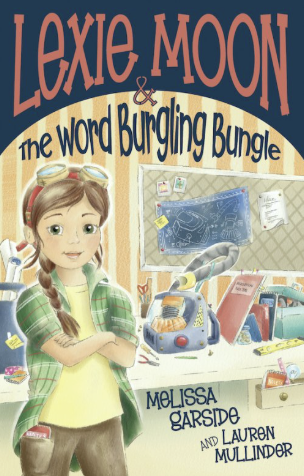
Melissa Garside on Lexie Moon and the Word Burgling Bungle

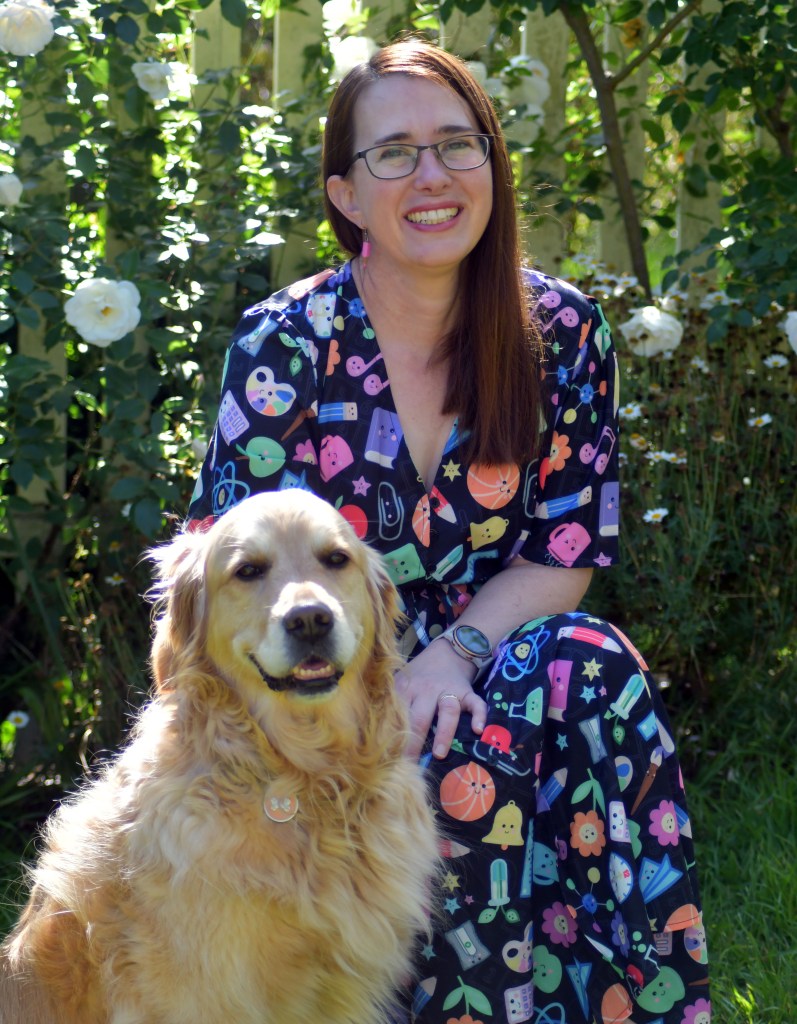
Melissa Garside lives south of Sydney with her family, their hilarious golden retriever and some entertaining free-ranging chooks. When she’s not writing or teaching, she enjoys getting her hands dirty in the garden, immersing herself in nature and using her family as guinea pigs for her recipe-free kitchen experiments. Today we’re chatting to Melissa about her debut junior fiction novel: Lexie Moon and the Word Burgling Bungle, illustrated by Lauren Mullinder.

The publisher provided Alphabet Soup with a reading copy of Lexie Moon and the Word Burgling Bungle.

From the publisher:


Lexie Moon is an enthusiastic inventor – did you try your hand at inventing gadgets when you were growing up?

I didn’t think of myself as an inventor as a child – although I did do a fair bit of inventing in the kitchen, coming up with many recipe-free, experimental dishes, and I’ve always played with different forms of design, including drawing fantastical house and garden plans. Dad was an electronics technician which meant that I was surrounded by a lot of gadgets, components and parts, and spent many hours in places like Sparky’s Electronics. Among my ‘toys’ were empty photographic film canisters and an egg-beater drill. I also used to imagine that the printed circuit boards Dad used were city streets and the various components were skyscrapers and vehicles.

I wanted Lexie Moon to be an inventor partly because I needed a way for the villain to steal people’s words, and also because I really love books that have things that are slightly outrageous or impossible. I think most of Lexie’s inventions are both!

Lexie is a courageous kid who isn’t afraid to race into danger. Are you like this yourself?

No way! I wish I was more like Lexie. To her, it’s more important to do the right thing than worry about being scared, and once she decides what she needs to do, almost nothing can stop her. I’d like to think that I would always do the brave thing, and there have been one or two occasions in which I’ve had to face a snake or spider, but to be honest I’m usually much more of the scream-if-I-see-a-mouse sort of person.

If Lexie’s Vocabuliser could help you pronounce a particular tricky word, which word would you choose?

Well, these days I teach English to migrants from around the world. I must say I probably find the Vietnamese pronunciation the trickiest of all, so I would quite like The Vocabuliser to help me say some tricky Vietnamese words. If we’re talking about English words, I would like some help with words I read in books but don’t know how to say properly. Words like isthmus (a narrow strip of land), interlocutor (someone you talk to) and sphygmomanometer (a blood pressure machine)! That last one really is a tongue-twister!

Lexie Moon and the Word Burgling Bungle has lots of twists as the reader hurtles through the story! Do you have a tip for young writers who would like to add some extra excitement to their storytelling?

The advice that I’ve been given is that to make your story extra exciting, you need to put your character in danger or put them in a very tricky situation. Once you’ve done that, you can make your story even more exciting, by making the danger even more dangerous or making the tricky situation even trickier.

I recommend thinking about the situation that your character is in and brainstorming all the different ways things can go wrong. Choose one or two things from that list and make them happen in your story. Then your character’s job is to find a way out of the tricky situation and get everything back to normal. That part of writing can be a lot of fun!

Can you tell us a bit about your next Work/s-in-Progress?   

I’m very excited to be able to tell you that the next book in the Lexie Moon series, Lexie Moon and the Space Day Disaster, is planned for publication in August this year! I really enjoyed writing it and I can’t wait to share it with everyone.

If all goes well, I have a few ideas for other Lexie Moon titles. I’m also currently working on a portal adventure story and have lots of ideas for other books.

Lexie Moon and the Word Burgling Bungle is out now! Ask for it at your favourite bookshop or local library.


Design your own gadget and try Melissa’s Lexie Moon wordsearch

Listen to Melissa read the first chapter of Lexie Moon and the Word Burgling Bungle on the Your Kids Next Read Podcast [it starts at 02:49 on the slider]

Visit Melissa Garside’s website to find out more about her and her books

Visit Lauren Mullinder’s website to find out more about her and her art and design work

The book cover of Lexie Moon and the Word Burgling Bungle by Melissa Garside and illustrated by Lauren Mullinder
Posted in authors, interviews

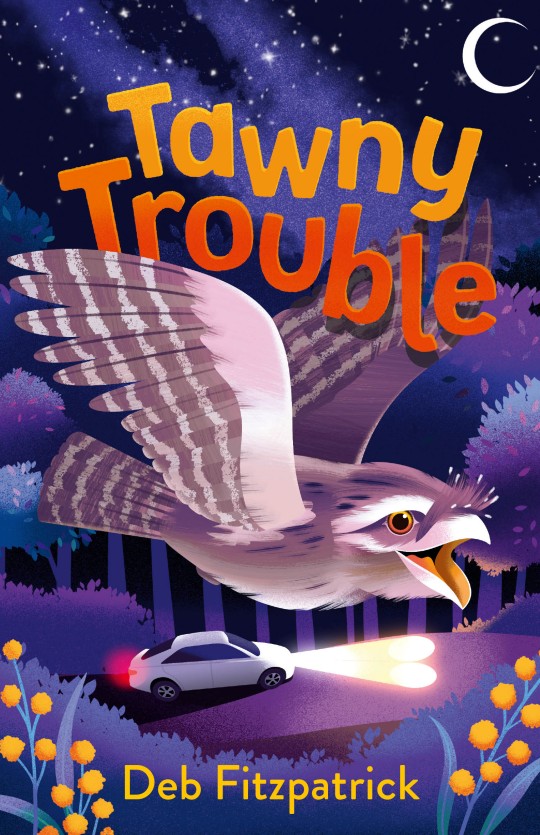
Deb Fitzpatrick on Tawny Trouble

Deb Fitzpatrick writes for adults, young adults and children. She loves using stories from real life in her novels and regularly teaches creative writing to people of all ages. Deb loves bushwalking with her family. When she can, she sneaks away to a shack in the karri forest of the south-west of Western Australia. Today we’re thrilled to be chatting to Deb about her latest book: Tawny Trouble

The publisher provided Alphabet Soup with a reading copy of Tawny Trouble.

From the publisher:


My family goes to the Nannup Music Festival every year and on the midnight drive home through the forest we always dodge Tawny Frogmouths, which feed on moths and insects attracted to the lights of cars. One year we came horribly close to hitting a tawny and it made me think: WHAT IF?? That question — what if? — is often the catalyst for my writing.

I can’t just share one wonderful Tawny Frogmouth fact! I beg your indulgence, Alphabet Soup readers!

The most important fact we need to know about Tawny Frogmouths is that while they are nocturnal and as such are often confused for owls, they’re not owls. They’re closer to the nightjar.

Tawny Frogmouth feathers are soft, allowing for stealthy, silent flight. And their mottled grey, brown and black colouring helps them mimic tree branches — this is why Tawny Frogmouths are often referred to as the ‘masters of camouflage’.

The spark of the idea is probably the easiest part for me, and the most exciting, and I think that’s true for a lot of writers. Reaching the end of a first draft is a huge relief, because for me the hardest part of writing any novel is getting through THE MIDDLE. Novel-writing is a sort of long-distance event; keeping positive, focused and confident in your abilities during that long middle phase can make or break the project. To maintain the sporting metaphor, that middle phase is about your creative stamina, your mental fitness, your willingness to go all the way. You really have to back yourself and your project, and it helps enormously to have the support of others during this time. I share my works-in-progress with another published children’s writer, and she sends me her work. We offer each other detailed editorial feedback including suggestions for improvement, observations on what’s working, and a solid dose of encouragement. I find this exchange really keeps me on track and lifts my motivation when I’m flagging.

I would suggest incorporating a topic you’re fascinated by and want to know more about (I love native animals, for example, and love to write about them). Do some research (I had to do quite a bit to write Tawny Trouble as I didn’t know a lot about these beautiful birds) and weave a few facts into the story here and there. Before you know it, you’re engaging your readers while completely immersing yourself in research and writing — and it works because it’s something you care about.

I’m currently writing a novel for middle readers set on Penguin Island off the WA coast. It’s about 11-year-old Mitch, who gets caught up in an environmental adventure with the island’s Little Penguin population. Little Penguins are the only penguins that are native to Australia, and they’re the smallest of the 18 species of penguin in the world. This book is for readers who love nature and adventure, and perfect for fans of Kelpie Chaos and Tawny Trouble!

Tawny Trouble is out now! Ask for it at your favourite bookshop or local library.


Read the first chapter of Tawny Trouble

Download Deb’s nature tracker printable

Download the Teachers’ Notes for Tawny Trouble

Visit Deb Fitzpatrick’s website for more about her and her books
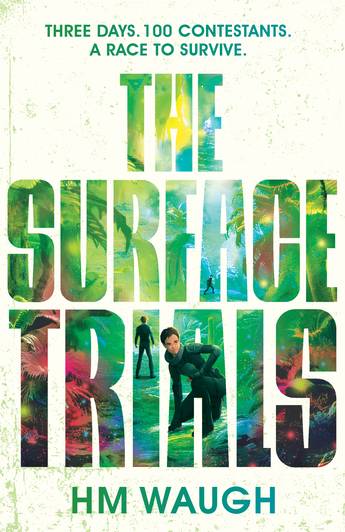
The cover of Tawny Trouble by Deb Fitzpatrick.
Posted in authors, interviews

Angie Cui on My Mum is a Bird

Angie Cui was born in Harbin, China and now lives in Melbourne with her husband and two children, whom she calls the ‘ABC Family’ – four people, three cultures – Australian, Bangladeshi and Chinese (her kids are Australian-born, and her husband is originally from Bangladesh). She loves the rich culture of her family’s languages and enjoys using them to tell stories. Today we’re chatting to Angie about her debut picture book: My Mum is a Bird, illustrated by Evie Barrow.

The publisher provided Alphabet Soup with a reading copy of My Mum is a Bird.

From the publisher:


When I first started writing this story about four years ago, I wasn’t sure where it would go. In my original draft, Mum was a phoenix in a human body, but feedback from editors and writing friends pointed out that it felt too mature and a little too scary for younger readers. I didn’t want to create something that was too serious, sad, or frightening, so I decided to use the bird as a metaphor. I wanted to show difference in a fun, fantastical way – something playful and positive. Birds seemed perfect for that. They’re loud, colourful, free-spirited, and a bit out of place in a human world. They also have wings and can fly, symbolising freedom and adventure. A bird mum could soar, sing, swoop, and flap – this energy felt right for the message I wanted to convey about embracing who you are, even when it makes you stand out.

A little behind-the-scenes story: I pitched the story idea at the Kidlit VIC Conference in 2022. After my publisher offered me a book deal, they asked if I had a preferred illustrator. Evie was my top choice! Surprisingly, my publisher had already reached out to her to check her availability. So, we ended up choosing Evie almost by coincidence!

In traditional publishing, authors and illustrators don’t typically work directly, which is quite common with picture books. I personally don’t like to give many illustration notes unless the publisher asks me if there’s anything I’d like included or changed. I certainly didn’t want to stifle Evie’s creativity, as I believed she would bring her own unique vision to the story. From the moment I saw her early sketches, I knew the book was in great hands. Her work brings so much warmth, humour, and gentle quirkiness to the pages – exactly the tone I had planned. She captured the heart of the story beautifully, balancing the child’s mix of awkwardness, love, and growing confidence, along with the bird mum’s joyfully unapologetic presence. Her illustrations do a lot of the storytelling, especially the emotional moments (my favourite).

In a way, I made the skeleton, and Evie gave it a soul. Together, we created a book!

Each story is different, so my process can vary, but I often start with a strange image or a question that makes me stop and think: “What if … ?” For My Mum is a Bird, the idea was inspired by a close friend’s experience – she’s always felt different from her family. This made me wonder: What if a child had a mum who was different from all the other mums?

From there, I write lots of drafts, exploring different structures, voices, and points of view. As I mentioned earlier, I wasn’t sure where the story would go initially, so I experimented with various versions until I found one that felt right. I didn’t want to write something too didactic, but rather a story that was easy to read and emotionally engaging.

Absolutely! Tip one: start small but stay curious. A picture book doesn’t need a complicated plot – it just needs an idea. Write down your thoughts, your emotions, and what’s important to you. You can even write about how you feel today, something you’ve experienced, or even just something or someone you noticed. As you get more comfortable with writing, let your imagination run wild!

Tip two: Patience is the key! Don’t worry if things seem messy or don’t make sense at first. Think of it as planting a small seed and nurturing it until it grows into something bigger over time.

Also, keep in mind, though, that writing picture books can be challenging. You’re basically trying to tell a complete story in 500 words and make it feel like a movie! The last draft I handed to my publisher was about 800 words, and I had to trim it down to 500. It might sound easy, but it was tough as a first-time author. However, during the editing process, I realised that a lot of the story could be conveyed through illustrations, and that’s the magic of picture books.

So, tip three – when you write a picture book, think about how the illustrator will bring your words to life. Picture books are a team effort, and the art plays just as big a role as the words.

I have two more picture books coming out this year and next. They cover completely different themes than My Mum is a Bird. I’m also working on other projects across different genres – one junior fiction book, one middle-grade novel, and two adult novels (I’m trying to keep myself busy! Haha).

My Mum is a Bird is out now! Ask for it at your favourite bookshop or local library.


Take a peek inside My Mum is a Bird

Download the Teachers’ Notes

Visit the author’s website for more about her and her books
Visit the illustrator’s website for more about her and her work

The cover of a children's picture book: My Mum is a Bird.

Posted in authors, interviews

Sandi Parsons on Salty

Sandi Parsons is an avid reader, writer and storyteller. She lives in Western Australia with some problem puppies and many teetering stacks of books. Today we’re chatting to Sandi about her latest book: Salty.

The publisher provided Alphabet Soup with a reading copy of Salty.

From the publisher:


I researched lots of words before I settled on a handful I wanted to include. As a dog lover, groke (the way a dog stares at you, hoping you will share your food) was always going to be in the story. With my starter words in hand, I started writing Salty. In my second draft, if I felt a chapter needed a “word” that wasn’t in my word stash, I’d hunt about to see if I could find a word that would fit. That’s how I found chork (the sound shoes make when they are wet). Occasionally, my hunt wouldn’t reveal a suitable word, but would give me different word to use somewhere else in Salty

Originally, my favourite word, scurryfunge, (to rush about tidying up on the moments before a guest arrives) didn’t find a place in Salty. When I did a structural edit, some interactions between Dara, Melody and Justine changed places, and scurryfunge slotted into place like it was always meant to go there. 

I’m also quite fond of snollygoster (a corrupt politician, or person who is in public service for their own benefit.) It’s a word that rolls off the tongue easily, but there wasn’t a logical place to include it.

The original idea for Salty was a question. Why would a criminal need to hide in a school? After brainstorming some scenarios, the most likely answer was that students could be ‘camouflage” for someone casing a museum. Teachers on excursion have an excuse to take more photos than they need. I included Ned Kelly, because I wanted the thief to steal something uniquely Australian. The death mask was something I could picture Dara getting enthusiastic about, while Josh would turn his nose up at it.

I experienced way more problems with my digestive system than I did with my lungs when I was Dara’s age. So, to some extent, Dara’s experiences do mirror mine. No one with CF ever wants to have someone waiting for them in the bathroom! I wanted to go to friends houses and play after school, but I had to go home to do my afternoon treatments. This meant I was excluded from some friendship groups. 

When I was six, my enzymes came in foil packets. They took ages to open, and there was no way to take them discreetly. Everyone would stare. I was ten when the foil packets were replaced with bottles. I would quickly pop them in my mouth hoping no one would notice (they always did). When I was older I turned it into a party trick. If you draw attention to something, you give it less importance. (Dara isn’t that confident yet!)

Everyone with CF has a story to tell about people staring when you cough. Some people have very loud looks! Others will make nasty comments.

I wanted to make it clear to the reader from the beginning that Ms Isoba was not what she seemed. (Just like Count Olaf in A Series of Unfortunate Events.) So, my focus was on making Ms Isoba seem like she had fooled everyone while the reader knew she was … probably … guilty. It was tricky!

Salty is out now! You can buy copies online or ask for it at your local library.


Visit Sandi Parsons at her website to find out more about her and her books.

The cover of a children's book: Salty by Sandi Parsons. The cover is predominantly yellow and features the title of the book as if it was a word on a chain (necklace) and underneath is the illustration of two children. A boy on the left holds a magnifying glass up to his eye, the girl on the right has clips in her blonde hair and she is holding up a dictionary. Just next to the children is a ned-kelly type helmet and what looks like scrabble tiles on a table that spell out Salty
Posted in authors, interviews

Dianne Wolfer on Soaring with the Sugarbird Lady

Dianne Wolfer is the award-winning author of 26 books, including the acclaimed ‘Light’ series, adapted for stage, street theatre, and choirs! She lives on the southwest coast with her husband, Pete, and dog, Harry. Today we’re thrilled to be talking to Dianne about her latest book, a biography of Robin Miller, Soaring with the Sugarbird Lady.

The publisher provided Alphabet Soup with a reading copy of Soaring with the Sugarbird Lady.

From the publisher:


Researching someone as respected and loved as Robin Miller was challenging and an honour. To begin with I reread Flying Nurse, written by Robin and published in 1971, as well as The Sugarbird Lady, published after Robin’s death, and based on her diaries. I watched online presentations, including talks by Patsy Millett, Robin’s sister, and read books written by family members (Patsy, her father Horrie Miller, and mother Mary Durack). Both the State Library of Western Australia and the National Library in Canberra hold boxes of Robin’s papers and memorabilia. Sifting through items that Robin treasured helped give me a stronger sense of who Robin was, and how best I could write her story. I loved holding things like the brooch from her air race across the United States! After researching widely, I came back to Robin’s books. That’s where I heard her voice. Quotes from Robin’s books and diaries became the bedrock of my early drafts. Over many story drafts and edits, the quotes were pared back until just a few remain.

It’s important to cross-reference and check all information. History is recorded by humans who can easily make mistakes and who write from their own perspective. I often asked myself, is this a trustworthy source?

Deciding what to leave out was the hardest part! My process is to overwrite then try to edit bravely, cutting out words and unnecessary scenes. So many amazing flights and adventures were left out while shaping the book, to keep the pace moving along. I hope readers will be inspired by Robin’s courage and determination, and that Soaring with the Sugarbird Lady will provide a taster to find out more about this amazing aviator. 

Readers might find it hard to believe that until the late 1960s, women who worked in the Australian public service had to give up their job when they married. My mother was one of them. Once the law changed, when I was seven, Mum returned to work. When I finished high school, four years after Robin’s death, it was still unusual for women to venture beyond teaching, nursing or office work. I was lucky that Mum encouraged my sister and I to embrace our adventurous spirits. She hid her worries when I travelled across south-east Asia alone and worked in a remote village in the Himalayas for a year. Over the years there have been improvements, but many industries are still challenging workplaces for women …

The start of 2025 has been busy, and wonderful. Three books are coming out with three different publishers: Soaring with the Sugarbird Lady (Fremantle Press), The Colt from Old Regret, illustrated by Erica Wagner (NLA Publishing), and Cattle Muster, illustrated by Frané Lessac (Walker Books). I’ve been working on each book for years and suddenly they’re all here!

I’m also excited to have just launched a newsletter. There’s a link to subscribe on my website. Two other exciting things that are happening: the regional tour of Theatre 180’s The Lighthouse Girl Saga, as well as the Chauvel Light Horse ride, where riders travel 750 km across regional Victoria/NSW to honour Sir Harry Chauvel. They’re presenting schools along the way with copies of The Last Light Horse, my book about the only horse to return from WWI.

Soaring with the Sugarbird Lady is out now! Look for it at your favourite bookshop or local library.


Read sample pages from the book!

Download a crossword activity inspired by the book

Download the Teachers’ Notes

Visit Dianne Wolfer’s website to find out more about her and her books

Posted in authors, interviews

Sandy Bigna on Little Bones

Sandy Bigna is a reader, a book reviewer and a writer. Today we’re excited to be chatting to her about her debut book – a verse novel called Little Bones.

The publisher provided Alphabet Soup with a reading copy of Little Bones.

From the publisher:


While I hadn’t started collecting bones myself before starting to write Little Bones, I’ve always had a fascination with them, and for people who do collect them. As bones are on the inside of us we don’t generally get to see them, which makes them seem mysterious and interesting. I remember once finding some tiny lizard bones in the driveway of the house where I grew up – and to me it was fascinating to have a glimpse of something that is usually hidden. I even took photos! It was this initial fascination that inspired the theme of bones and bone collecting. I needed to do some research to increase my knowledge about bones and skeletons – using both online sources and library books. I learnt many fun facts about bones. Did you know that birds sometimes eat animal bones to get calcium for making eggshells?

I’ve always loved reading verse novels. I love that they can tell a complete story, and convey such powerful emotions, in so few words. I love all the white space around the words, which helps you as the reader take a breather, and reflect on what is written – and on what is not written. I love the creative placement of words on the page and fun use of text font. I love reading verse novels so much that I always knew I wanted to try to write one of my own, and I’m so glad I did! It just felt like the right way to tell this story, and it was the most fun I’ve ever had writing a manuscript. I had the creative freedom to play with the joy of language.

Editing is such a valuable part of the journey to publication, and I enjoyed the editing process much more than I thought I would! The finished book changed quite a lot from the original draft that I submitted to the publisher. The first part of the story, and the ending, stayed mostly the same, but the middle part of the story received a much needed overhaul. The hardest part was cutting around 15,000 words from the manuscript! Thankfully my wonderful editor Felicity helped me with this part. We also decided to cut a couple of characters from the story (originally, there were going to be three animal skeleton characters, not just Bird). Once these characters were cut, we realised they were not essential to the plot. With each round of edits the plot was tightened, the magic elements made more consistent, the relationship between Bones and Bird strengthened, and the tension drawn out, to make a more satisfying conclusion. Each round of edits ultimately made the story so much stronger. 

The most important tip is to have fun and try new things! The best part about writing a verse novel is that you have the freedom to play with ideas and language and placement of words on the page. I would also suggest reading a lot – verse novels, as well as all types of fiction and non fiction, to generate ideas, and see how other authors have succeeded in your chosen genre. It’s not essential to read and write poetry to write a verse novel – but I found doing both quite helpful in inspiring me to experiment with free verse and lyrical language.  You might even want to try reading song lyrics and listening to music – as in many ways, writing a verse novel is a bit like writing a song! Verse novels often have the same rhythm and energy as music.

I’m excited about the next chapter of my writing journey. I have a two-book deal with UQP and would ideally like to continue to write for a middle grade audience, as this is where my passion lies, but I am always open to writing for different age groups or experimenting with other genres. I look forward to the next part of this writing journey and sharing more stories of hope, friendship and adventure with you all! 

Little Bones is out now! Look for it at your favourite bookshop or local library.


Read some sample pages from Little Bones

Watch Sandy Bigna introduce Little Bones to the world [YouTube]

Download the Teachers’ Notes

The cover of a book: Little Bones by Sandy Bigna
Posted in authors, illustrator, interviews

James Foley on Bigfoot vs Yeti

James Foley makes picture books, novels and graphic novels for kids. He creates with pen and ink, pencil, charcoal, and watercolour and also uses digital tools for his work. Today we’re excited to be chatting with James about his latest picture book: Bigfoot vs Yeti.

The publisher provided Alphabet Soup with a reading copy of Bigfoot vs Yeti.

From the publisher:


At first I tried real linocut, which is a printmaking technique you basically take a piece of lino (flat rubbery plastic) and you carve little bits out of it to make the picture. Then you add ink to it, and then you press it on paper. You’re basically making a giant stamp! But I quickly realised it would take a lot more time than I had, and I would need a lot of supplies (and practice) to do it properly. I also wouldn’t have the luxury of an undo key if things went wrong; I would just have to start a picture again. 

So rather than doing proper linocut, I used the same techniques digitally: I opened Procreate on my Ipad, downloaded some ‘linocut’ brushes that some much cleverer people had designed, and I created my images that way: digitally ‘carving’ out the images bit by bit. 

It was still a challenge, because linocut is the opposite way of thinking to normal drawing. If I want to draw a black line on white paper, then I just get a black pen and draw the line. But if I want to make a black line using linocut, then I need to start with black and add the white around the space where I want the black line to be. I’m carving out all the spaces around where I want the lines to go. It takes a bit of getting used to!

I didn’t set out to make a story about the ancient feud between Bigfoots and Yetis; that was a surprise! It all started with a character idea. Without giving away too much about the book, there’s a character at the very end that was the first thing I came up with. Then I worked backwards where would this character come from? And how could I make their backstory full of drama and conflict? That’s where the story came from. 

The rift wasn’t inspired by an actual place, but I found photos of forests and snowy mountains and lakes, sometimes all together particularly around the Pacific Northwest of North America. I’d love to visit in person one day. 

This picture book took a while to marinate just like Stellarphant did. Both stories are very important to me and I wanted them to be the best they could be. So I wrote many, many versions. Early versions of this didn’t work, so I left it for a long while, brainstormed lots of possibilities, and let the best ideas rise to the top. Then when it came to writing the story, I often read it aloud as I went. I always want to make sure that when the book is bought and taken home, that it’s going to be pleasing for the person who’s reading it as well as the child who’s listening. 

I’m working on four books this year a capybara sequel, a funny picture book about onomatopoeia, a junior fiction novel written by Nathan Luff, and [drum roll] a non-fiction follow-up to Stellarphant. I can’t wait to share these with everyone! The capybara sequel should be out later this year and the others will be 2026-ish. 

Also out this year are the colour editions of Dungzilla (April) and Chickensaurus (June). Exciting times!

Bigfoot vs Yeti is out now! Ask for it at your favourite bookshop or local library.


How James created the digital linocut for the illustrations [YouTube]

Spot a Bigfoot in the wild with James Foley [YouTube]

Take a sneak peek inside the book

Download the Teachers’ Notes for Bigfoot vs Yeti

The cover of a picture book: Bigfoot vs Yeti by James Foley
Posted in authors, interviews

Sally Murphy on The Riding Gallery

Sally Murphy is an author, poet, speaker and educator based in the South West of Western Australia. Sally has published more than 40 books, and we’re thrilled to be chatting to Sally about her verse novel: The Riding Gallery, illustrated by Martina Heiduczek.

From the publisher:


For my previous verse novels, they were always going to be in that form – that is, they came to me as stories in verse. This one was a little different. I stumbled across the piece of history (a merry go round tracing back to World War 1) and when I researched its origins and saw the story behind it, I thought it might make a historical picture book.  I wrote it that way, but feedback from publishers was that it didn’t work – there needed to be more story to really make clear why things happened around that merry-go-round. It took me a while, but I finally realised they were right – and that I needed characters other than Anton, the ride’s owner. That is when I realised multiple voices, in verse, would be the ideal format. Verse novels allow for those multiple viewpoints, and the depth of emotion a story like this one needed.

The story found me in Canberra one very cold July, when I was there for a month courtesy of the May Gibbs Children’s Literature Trust. I walked every day, and often walked past the merry-go-round that is located in the city centre. I got curious about that merry-go-round, read an interpretive sign, and had to know more. It was a hard story to piece together, but the more I learnt the more I knew it needed to be told.

The story takes place against the backdrop of World War 1, and I wanted to be sure to include some of the major war events, even though the story is set on the home front, in St Kilda.  Most of what people knew about the war was dependant on the reporting in the papers, so it seemed a good way to know what was reported was to look at the papers of the day. The poems that resulted are all found poems – that is, they each use only words from a single news report from 1915.

I have indeed ridden it – along with my publisher, Clare Hallifax. But I’m embarrassed to admit I don’t remember the name of the horse – I was pretty overwhelmed by actually riding on Anton’s ride.

A woman in a black and white coat stands holding a book in front of a merry-go-round
Sally Murphy at the riding gallery, Canberra.

I always have multiple projects on the go, at different stages of completion. I’ve recently sent the manuscript for a war-themed picture book to my publisher – I think that will be out in 2026. And I am  trying to edit another historical verse novel, set in WA in World War II. I’ve also got other projects waiting (im)patiently for me to get back to them.

The Riding Gallery is out now! Ask for it at your favourite bookshop or local library.


Read some sample pages in The Riding Gallery

Check out the names of the animals on the riding gallery at ‘Libraries ACT’.

See some photos of the riding gallery at the National Carousel Association website

Find out more about Sally Murphy and her books

The cover of a children's verse novel: The Riding Gallery
Posted in authors, interviews

Charlie Archbold on The Sugarcane Kids and the Empty Cage

Charlie Archbold has been a teacher in Australia, the UK, and Indonesia, which has given her a trove of experiences to infuse into her stories. Charlie’s books often explore themes of curiosity, community, and justice. Today we’re chatting to Charlie about the second book in her adventure series: The Sugarcane Kids and the Empty Cage.

The publisher provided Alphabet Soup with a reading copy of The Sugarcane Kids and the Empty Cage.

From the publisher:

Gloria the talkative eclectus parrot is missing from the animal sanctuary, and Anna the massive ‘not an anaconda’ Australian scrub python has vanished from her enclosure at the library. Have they escaped? Or were they stolen? Andy, Eli, Harvey and the twins, Bernie and Fletch, along with Eli’s trusty sausage dog Washington, have their eyes on a prime suspect. Can the Sugarcane Kids follow the clues to discover what is going on?


I always start with an idea of the feeling and themes I would like my readers to take away. I especially like to round off or echo the beginning and end so the story has a symmetry. How I get there though is a bit of a journey. I unravel the mystery with the characters. The balancing out of the story then becomes my focus in later drafts. It is really fun not knowing how a choice you make as a writer will affect the story. One thing leads to another and that is the best bit.

Queensland is a special place to me, especially the far north. I spent time working there when I was in my twenties and then twenty years later. It is always the place I choose to visit. It is a magical place. Full of ancient rainforest and turquoise sea. I also set my books there because it is a regional non-urban area. Many books are set in cities but I like to set my books in unusual places.

I have been lucky to see both a male and female in the wild. They are so gorgeous, cheeky and clever. I have also met some close up in wildlife parks. My aunt had a pet parrot for years called Bird. He really made an impression on me.

Start with a problem or situation that needs to be solved. I suggest dropping your characters straight into the problem. Decide how you want it to end. Is the mystery solved or left undone? I like my mysteries to be solved. If you are a plotting person you can then plot and write. If you are not a plotter, jump on in and see where the story leads you but be prepared to rewrite it.

I have a new Sugarcane Kids mystery coming out in 2025, which I am extremely excited about, The Sugarcane Kids and the Mystery at Angel Bay. This time the characters are heading out onto the Great Barrier Reef to find out what has happened to Jerry, a massive Queensland Groper fish.

The Sugarcane Kids and the Empty Cage is out now! Ask for it at your favourite bookshop or local library.


Read Chapter 1 (look for a ‘Preview this book’ link under the photo of the cover)

Download the Teachers’ Notes

Check out Charlie Archbold’s website for more about her and her books
The cover of The Sugarcane Kids and the Empty Cage