I love reading, but I never thought about curling up with an ebook. Then I got sick and ended up in hospital—all of a sudden I found myself curled up with an ebook (or seven!).
Sony recently offered to lend me a Sony Reader, Touch Edition (PRS-650) to review.
I haven’t tried any other e-readers yet, but here’s what I liked about this one:
The Sony Reader, Touch Edition I reviewed.
It wasn’t ‘backlit’—my eyes didn’t get tired like they do when I read on a computer screen. It was like reading the pages of a paper book.
It was quite thin, and was like holding a book.
It had a built-in dictionary, so I could check words I didn’t know. (Actually, it supposedly had TWELVE dictionaries, but I could only find one. Maybe it’s because I was in hospital … )
I had about 10 books with me on the e-reader, and I read 7 while I was in hospital. And it was a lot more convenient to have them on an e-reader than carry around 10 paper books.
I could bookmark a page by double tapping in the corner. The next time the e-reader was switched on, it went straight to that page.
I could adjust the font size (I liked the words to be bigger at night, when my eyes were more tired and the light in my room wasn’t very bright.)
There is a stylus that goes with it, and and I could make notes on the screen while reading.
I could listen to audiobooks as well as read ebooks. I didn’t actually test the audiobook part while I was in hospital though.
I could buy ebooks off some online bookstores (Sony purchased Tensy Farlow and the Home for Mislaid Children from Borders for me. I’ll post a review here soon.) I could also upload some ebooks for free—like Jane Austen’s books, now out of copyright. (When I’m not reading children’s books, I like to read Jane Austen.)
It would be handy to take on holidays, on the train or bus and WHEN YOU’RE IN HOSPITAL. It’s small enough and light enough to put in a bag or backpack.
Here’s what I didn’t like about this e-reader:
I couldn’t find the other 11 dictionaries and the one I had used American spelling. (But it’s possible the other 11 weren’t that hard to find and I just needed to try harder … other people who own this e-reader tell me they had no trouble finding 12 dictionaries!)
The dictionary didn’t have a definition for every word I tried out.
This e-reader is in black-and-white, so even if it includes a picture of the book cover, it’s not as cool as the cover on a real book. (I like looking at the covers of books I’m reading.)
I like the feel of paper pages. Swiping your finger to turn pages was fun, but it’s not the same as feeling real paper. (Maybe that’s an old-person thing!)
And e-readers in general: I read a lot of picture books but you couldn’t read a picture book on an e-reader like this because the screen is so small and it’s not in colour. (I haven’t tried an iPad yet, perhaps picture books work OK on one of those.) I was surprised to find that I really enjoyed reading ebooks after all and I will miss having an e-reader when this one goes back to Sony. ebooks would never replace all my paper books at home, but I can see myself using an e-reader when I go on holidays or take a bus or train. (Hopefully I won’t need to use one in hospital ever again … )
What about you? Have you tried an e-reader or do you think they’re a bad idea? Do you think they are just too expensive for kids? If you had one, do you think it would replace all the books and/or school books you own? (What would you do with all that bookshelf space?)
We’ve updated the ‘Activities’ page! (You can find it on the menu across the top of the blog, under the header picture). If you click on it, you will find a list of activities to go with the theme of each issue (starting from issue 7), and a music listening list—compiled by Danielle Joynt of Cantaris.
For each issue of the magazine (starting with issue 7), we will add activities and a themed listening list to this page. Enjoy!
ISSUE 9 – SUMMER 2010
ACTIVITIES
1. PLAY wetlands-themed games, like ‘Leap Frog’, or ‘Duck, Duck Goose’.
3. FIND OUT about frogs in your local area. Research to find out what you can do to protect them. Some frogs in Australia are under threat. To identify frogs (and their calls) visit the WA Museum website, or the Frogs Australia website.
4.ADOPT a local wetlands area—visit it regularly with family or friends to collect rubbish to keep it healthy.
5. MAKE FROGS-IN-A-POND!
You will need: 1 packet green jelly, 1 chocolate frog per person, 1 clear plastic cup per person.
What to do: make the jelly according to the directions on the packet. Put it in the fridge. When cooled, but not set, add a chocolate frog to each cup. Return to fridge until jelly is set. EAT! Yum.
If you’d like to make a feature pond for a party table, use two or more packets of green jelly and use a large clear glass bowl. Add some of the chocolate frogs to the cooled jelly (before it sets). ‘Float’ some nasturtium leaves (to be lily pads) on the top of the jelly once it has set. Sit the remaining chocolate frogs on the lily pads. Give everyone a spoon and eat!
MUSIC LISTENING LIST
Our listening list is compiled by Danielle Joynt, from Cantaris. Danielle has also included comments for some of these pieces. (Tip: Ask about CDs at your public library—libraries often have a good collection of CDs for loan if you prefer not to buy.)
1. PETER SCULTHORPE
Peter Sculthorpe is an Australian composer (1929 – ) whose music often evokes the sound and feeling of the Australian bush and outback. His works “Kakadu” “Mangrove” and “Earth Cry” reflect the vastness of the Australian landscape and the sounds of Australian wildlife. He often uses the Aboriginal chant—Djiilili—in his works. Djilili means “whistling duck on a billabong”.
The Russian composer and teacher Anatoly Liadov (1855-1914) arranged eight Russian folk songs for orchestra, including his famous wok “The Enchanted Lake” and “Last Night I Danced With A Mosquito”. Liadov was a wonderful but very strict music teacher, and taught theory to the young Prokofiev.
4. CAMILLE SAINT-SAENS-–CARNIVAL OF THE ANIMALS
Camillle Saint-Saëns (1835-1921) is the French composer of Carnival Of The Animals (1886).
Saint-Saëns wrote Carnival Of The Animals as a musical jest, and after the piece’s first private premiere, Saint-Saëns forbade it to be played in public—feeling it might damage his reputation as a serious composer.
He only allowed one movement—”Le cygne” (“The Swan”) to be published during his lifetime.
Carnival Of The Animals was only published as a whole after the composer’s death, and has since become one of the world’s most famous and best-loved pieces of music.
5. PYOTR ILYICH TCHAIKOVSKY—SWAN LAKE
The music for the ballet “Swan Lake”was composed over twelve months in 1875 and 1876 by the Russian composer Pyotr Ilyich Tchaikovsky (1840-1893). When the ballet premiered in St Petersburg in 1877 it was a dreadful failure, due to the very poor stage production. Most critics considered Tchaikovsky’s music far too complicated for ballet! The production was revised several times, and the musical score was revised after Tchaikovsky’s death by the Italian composer Riccardo Drigo. It is his revision of Tchaikovsky’s orignial score which is most often performed to the Swan Lake ballet today.
6. GEORGE FREDERIC HANDEL—WATER MUSIC
The “Water Music” is a collection of orchestral movements composed by George Frederic Handel. It premiered on the 17th July 1717 after King George 1 requested a concert on the River Thames. The piece was performed by fifty musicians on a barge near the Royal Barge from which the King listened with his close friends. King George I loved the music so much that he asked the exhausted musicians to play the whole work three times!
7. FRANZ SCHUBERT—TROUT QUINTET
“The Trout Quintet” is the name given to the Piano Quintet in A Major by Franz Schubert (1797-1828). The quintet was composed in 1819, when Schubert was 22 years old, but was not published until 1829, a year after he had died. The usual instrumentation of a piano quintet is for piano, two violins, viola and cello; however, Schubert wrote his Trout Quintet for piano, violin, viola, cello and double bass.
The Quintet is called “The Trout” because the fourth movement is a set of variations on Schubert’s earlier Lied (the German word for “song”) “Die Forelle”(“The Trout”).
8. HOW DOTH THE LITTLE CROCODILE
Several songs are based on the poem “How Doth The Little Crocodile” by Lewis Carroll, which appears in his book “Alice’s Adventures In Wonderland”
“The Little Crocodile” by Gary Buchland (1991) from Alice Songs
“The Little Crocodile” from “Five Lewis Carroll Poems” No 3 by John Woods Duke (1899 – 1984)
“How Doth The Little Crocodile” (1908) by Liza Lehmann (1862 – 1918)
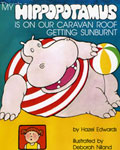
Issue 9 features a Q&A with Hazel Edwards, author of There’s a Hippopotamus on Our Roof Eating Cake, and Plato the Platypus Plumber (Part-time) and many more books! We could only include a selection of questions in the magazine, so here’s the full interview for you to enjoy.
Where do you live?
In my imagination. But also in the same house (in Blackburn, Victoria) where my cake-eating hippo still lives on the roof.
How old are you?
The age of the character I’m writing at the time.
(Hazel’s Tip: on the publisher’s page of a book there is a year the author was born, like 1945, and then a dash. If there’s nothing after the dash, they are still alive.)
I try to keep my photo up-to-date, my real face.
Hazel Edwards, 2010
What was the inspiration for There’s a Hippopotamus On Our Roof Eating Cake?
Our new roof leaked. My then 3-year-old son thought there was a hippo up there, when the workmen banged around trying to fix the leak.
Of your own books, which is your favourite?
The one I haven’t written yet.
Your favourite character?
Plato the Platypus Plumber, who has a toolkit that also fixes grumpy people. I love the way illustrator John Petropolous has drawn the toolkit, the water pipes and the Cassandra font he’s used (named after his daughter)
Where do you get your ideas?
I have an ideas notebook of things I see or hear, mixed with ‘What if?’ imagination. Other stories depend upon participant-observation, of going and doing something new, knowing you will write about it afterwards. So you pay special attention. Like in Antarctica. Or when I went down the waterways to find out about the platypus.
Why did you become an author?
Being an author is also an excuse for asking questions, and then it’s called research.
I like learning new things to write about, and new formats in which to write the stories.
I like (collaborating) working with other creators like co-authors, illustrators, film-makers and puppeteers. I learn new ways of thinking in pictures, movement or textures. Even with interpreters who change the words into another language. Plato is being translated into German. Many of my books are in Braille or Auslan signing for deaf kids, Some are becoming electronically available on Kindle, iPad and iPhone and that’s an exciting and quick way for stories to travel across cultures and countries.
My favourite is when a story is performed especially on stage. I’m loving the process of film-making with Pocket Bonfire.
When did you first appear in print?
A story in the newspaper’s kids’ section when I was about eight.
Are you working on a new project at the moment?
Pocket Bonfire Productions’ short film inspired by There’s a Hippo … is out. Working with these guys across three years has been fun as they read the book as children and remained fans taking it into film, their way of storytelling.
—
Hazel shares some of the best questions she’s been asked.
I was asked, “Does Plato the Platyplus Plumber talk to the cake-eating hippo?’ Previously I hadn’t thought about my fantasy character from one picture book talking to one of my others.
Do your characters ever talk to each other?
In my head. Maybe all my characters from different stories could meet? … Imagine a party or a TV panel with the clumsy Bumble from The Flight of the Bumblebee, the grumpy male bellydancing pig from Duckstar, my Gang-O orienteering sleuths … and other characters I haven’t written about yet who are waiting in my imagination.
A challenge
A librarian set students a challenge—Make up your own story based only on ALL Hazel’s book titles. Try it. They were allowed to add ‘and’ or ‘but’ joining words. Some fun stories appeared.
Does Hippo cook?
No, but recently we did a Channel 31 ‘Kids in the Kitchen’ program. Two 10 year olds made ‘hippo footprints’ (pancakes) and ‘ muddy platypus bubbles’ while I read the books Plato the Platypus Plumber and Hooray There’s a Hippo on Our Roof Having a birthday Party’. We also made ‘ant bread.’
Do your children help with stories?
My children are adults now but I co-wrote, ex-blog Cycling Solo; Ireland to Istanbul with my son Trevelyan. He did all the cycling. Now 11-year-old Truman helps me with story ideas.
How long does it take to write a book?
There’s thinking time and writing time. And re-writing time. I do about ten drafts. A picture book takes an illustrator at least a year to draw, sometimes longer.
Any advice to aspiring illustrators?
I write an art brief, which is like a letter to the artist. For Plato, I asked for a plumber’s tool kit with a mobile phone that a platypus could wear underwater.
Any advice if doing a project on an author?
1. Read at least three of the author’s books
2. Google the author’s website.
What is the kind of answer the Hippo gives to fan’s questions?
Jenna asked, “How old are you Hippo?”
Hippo said: As the cake-eating, rooftop hippo, I am celebrating the 30th anniversary of being found on the roof. But I am ageless.
Maybe I am your age?
I am as old as you imagine me.
Love from
Hippo (via Hazel who does the typing. My feet are a bit big for the keyboard.)
—
Visit Hazel Edwards’s website for more about her books and book trailers, notes, reviews and publisher links. You’ll also find a link to Pocket Bonfire Production, film makers of the Hippo.
Q&A with Hazel Edwards, author of There’s a Hippopotamus on Our Roof Eating Cake (and many more books!)
Australian Wetlands at Perth Zoo
Stories, poems and book recommendations
Kids’ writing (your own stories, poems and book reviews!)
Crossword
The Book Chook’s writing tips for kids
Summer 2010 writing competition
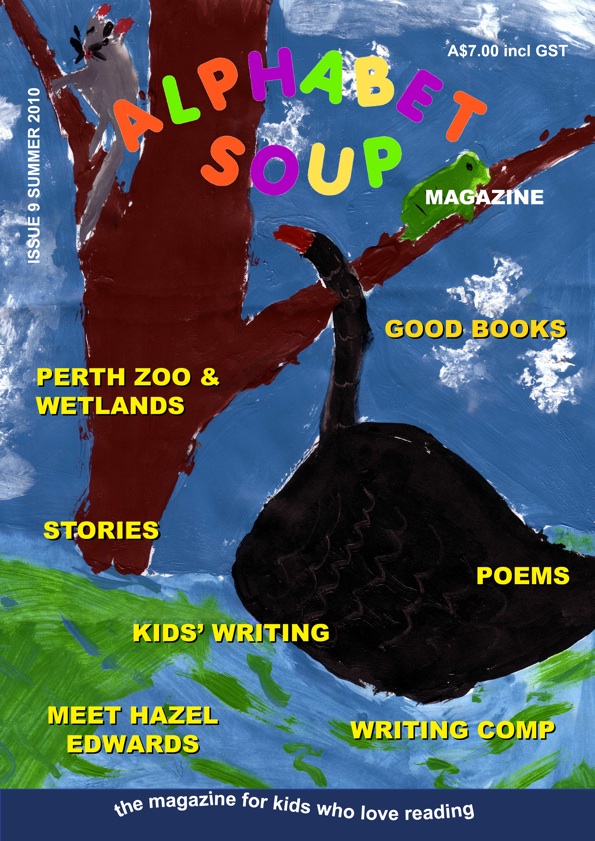
Oh! And don’t forget to admire the cover. The artwork is by Angel Hatton, the winner of our design-a-cover competition.
—
SUBSCRIBE NOW FOR CHRISTMAS and we’ll post your order on 20 December 2010 with a postcard attached notifying the recipient that it is a gift subscription from you.
Subscribe onlineand write ‘Christmas gift’ in the ‘message to sender’ field or
Download an order form and send it in with your cheque or money order (and note on the form that it is a Christmas gift).
A 1-year subscription is only $29.80 (including p&h)
Riley and the Curious Koala is the third in the Riley series of picture books. Riley’s first adventure began in Beijing with Riley and the Sleeping Dragon, continued on to Hong Kong with Riley and the Dancing Lion, and his latest adventure brings him to Sydney Australia.
To celebrate the launch of Riley and the Curious Koala, author Tania McCartney has set off on a blog tour. You can check out the other stops on her tour if you scroll to the bottom of this post. She’s here today to talk about how to come up with good ideas for writing stories.
Over to you, Tania!
—
Before you start reading this article, you need to do something—and don’t skip ahead and cheat or it won’t work! Write these words down a page: setting, character, object, situation. Now, next to each word, write a two-digit number between 11 and 99. Go on, do it now. It should look something like this:
Place 17
Character 87
Object 56
Situation 44
Put it somewhere safe. Done it? Good. Okay—now let the article begin …
One of the questions I receive most when reading to school kids is this:
Where do you get your ideas from?
This is such an interesting question! Least of all because it’s such a hard one to answer. Everyone gets their story writing ideas in different ways—and many authors will tell you it’s from the everyday happenings in their life—boring but true. From opening a yoghurt pot to tripping on a rug … these are the things that inspire an active imagination. And yes, they’re also the things that inspire me.
Imagine, if you will, opening that yoghurt pot and finding something other than creamy white yoghurt inside. Perhaps it’s a pot full of centipedes. Or a tiny white rabbit. Or a strange green slime that pours out pink smoke. What kind of story could unfold from such an opening?
And what of the rug trip? Perhaps it’s an old Persian rug, tightly woven with mystical patterns. Perhaps I trip and I fall, only I don’t hit the floor, I keep going, right through the carpet into another world …
These everyday occurrences can really spill over with story ideas if you just open yourself to the possibility … and think outside the square.
But you know what—sometimes it’s hard to think outside the square when you’re young and life experience hasn’t twisted your brain into a mangled wreck of crazy thinking. There’s also those Parent and Teacher expectations—the pressure of coming up with something marvellously creative.
So I’ve come up with a little exercise that will help you create a fantastically imaginative story that will ooze out of you like taffy.
We all know the basic storyline structure—yes? Basically, there’s a beginning, middle and end. Got it? Great.
Then there’s the details. First of all—the settingor the place. Where is your story going to take place? Then we have to think about characters. Who is involved? Who are the main players? Next is a situation. What is actually going to happen in this story? It helps if we add an object that becomes the focus, along with the characters, in making a story come to life.
The other thing we need to consider is conflict. Conflict means making something troublesome or difficult for our characters. Changing things around, making them do something or work towards something. One of the easiest ways to do this—as with my Riley travelogue books—is to make them search for something.
Characters often search for something in books, even if it’s not an actual object. It’s a common recurring theme.
When a character searches for something, you can put in as many cool plot twists and problems as you like. Plot twists, problems, drama, conflict—that’s what makes a story interesting—and makes people want to read your story. Nothing worse than writing a story no one wants to read.
So—here’s a challenge for you. I want you to write a story—an adventure story where someone is searching for something. And here is how you’re going to do it.
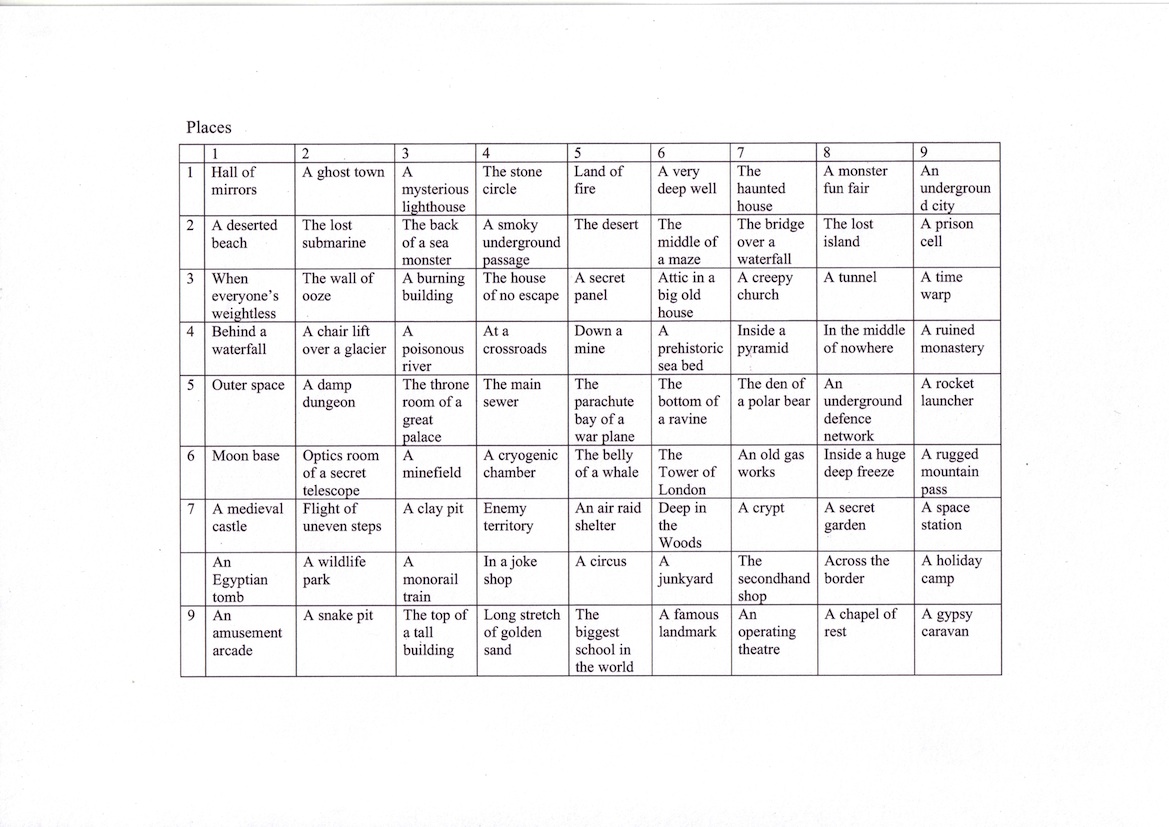
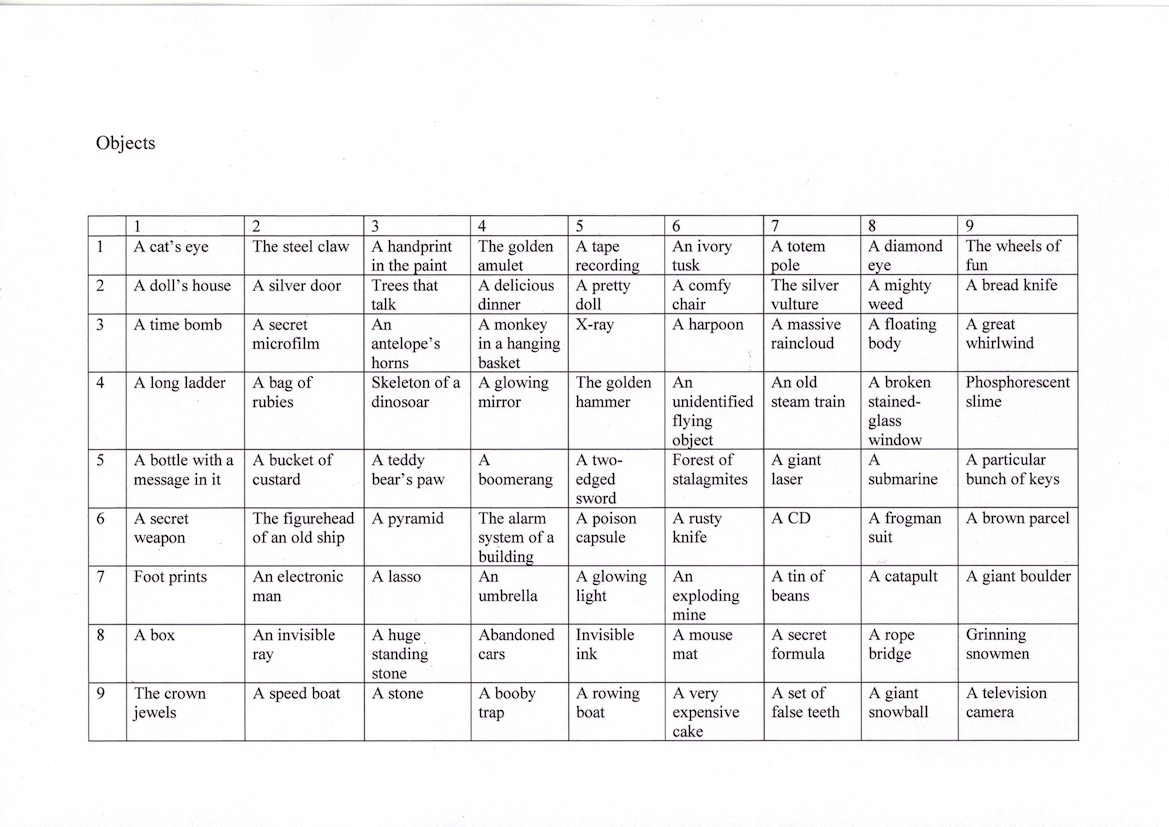
Grab the page with words and numbers you wrote at the beginning of this article and find your numbers on the following grids—reading first down the side of the grid then across the top. For example, for my number choices (above), I will write a story with the following components:
Place 17 – haunted house
Character 87 – a tribe of eskimos
Object 56 – a forest of stalagmites
Situation 44 – having plastic surgery
Place Chart: Double click on the image to zoomCharacter Chart: Double click the image to zoomObjects Chart: Double click the image to zoomSituations Chart: Double click the image to zoom
Once you have written down your four basic elements, you now need to construct a short story using these references. So, for me, I need to write about a tribe of Eskimos hunting for a forest of stalagmites in a haunted house. And plastic surgery will need to be someway involved in order for me to find those stalagmites.
Hmmm. Maybe I should leave this particular story up to you …
You have just 20 minutes to write your story. Make it fast and off-the-cuff so you don’t think about it too much. Then, if you want to—why not email it to Soup Blog (or to me for Kids Book Review!) to be published online, so we can revel in your cleverness. You can also ask your teacher to run this challenge in your classroom.
You might surprise yourself how creative you can be when writing this story. Remember to throw in conflict along the way and to resolve the story at the end … will your character(s) find what they are searching for?
I, for one, would love to see what you come up with. Use this story writing grid often to challenge that wonderful imagination you have hiding inside your head. And do let me know when your first book is published, will you not?
Tania McCartney is an author, editor, publisher, blogger, book reviewer and mango devourer who loves writing, celebrating and supporting children’s literature—and literacy. She is the author of the Riley series of travelogue picture books, as well as several published and self-published books. Tania is also an experienced magazine writer and editor, is the founder of Kids Book Review and is a Senior Editor at Australian Women Online. She lives in Canberra with a husband, two kids and a mountain of books.
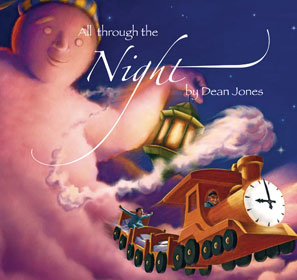
If you dream of being an illustrator when you grow up, here’s your chance to meet a real, live illustrator—Dean Jones, author-illustrator of All Through the Night.
Dean Jones will be signing books after an illustration demo.
In Western Australia, children who live in the City of Nedlands, or attend a school within the City of Nedlands can enter the I Imagine 2030 art competition. Children are asked to imagine how their community will look in 2030 and create a picture to enter the competition.
There is a first prize of $100 in two age categories, plus other prizes.
Entries close 4pm, Friday 19 November. For more information, email Tarn Reynolds at the City of Nedlands or phone (08) 9273 3579.
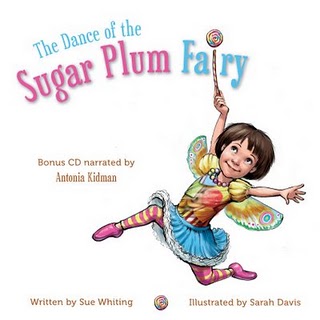
It’s a fairy tale book with a CD, about two adults that work as candy makers, their names were Marcus and Mary.
The King comes and tastes the lollies, he loves them so much he says he’ll take fifty jars.
Marcus was worried how they would make them in time and a fairy overheard.
But will the fairy come to save the day?
I liked the book because I liked the happy ending and the colourful pictures.
[If you’d like to take a peek at a few pages of Dance of the Sugar Plum Fairy, then visit the illustrator’s website. *CD includes the music of Dance of the Sugar Plum Fairy, from The Nutcracker Ballet by Tchaikovsky. ]
—
Olivia is a member of our Undercover Readers Club, a book reviewers’ club for kids. (The book was provided by the publisher, New Frontier Publishing.) If you or your class would like to join the club, you can download an information pack (PDF) from the magazine’s website. Membership is free!









 alphabetsoup.net.au