Some of you probably remember me posting before about when I was growing up and listening to my dad’s terrible jokes and bad puns. I recently read a new picture book by Katrina Germein—and she could have been talking about MY DAD! So I invited Katrina to visit our blog today to talk about My Dad Thinks He’s Funny (illustrated by Tom Jellett). Here’s a taste:
Katrina Germein is celebrating her new book My Dad Thinks He's Funny.
My dad doesn’t like babysitting.
He says no one should sit on babies.
My dad doesn’t eat seafood.
He says there’s something fishy about it.
My dad doesn’t lie in bed.
He says you should always tell the truth.
My dad thinks he’s funny.
Congratulations on your new book, Katrina! When you were growing up, did your dad make all the jokes in My Dad Thinks He’s Funny?
A peek inside the book!
I’m lucky because I grew up with two dads, my father and my step father. My dad likes to tell long stories and my step dad likes to recite silly poems. Mainly, the jokes in My Dad Thinks He’s Funny came from lots of other people.
Once I had the idea for the book I started listening out for jokes and every time I heard one I would write it down. My father-in-law probably contributed the most but there are also jokes from my sister-in-law, my brother and my husband. I was looking for the kind of jokes that make us roll our eyes and also make us laugh.
Once I had a collection of ‘dadisms’ I decided to write the book from the point of view of a child. I wanted to create a story that was warm and humorous, rather than just a collection of jokes.
What does your family think about you using their best jokes in your book?
I think my father-in-law is quite proud to see some of his best material in print! He jokes that I should share the royalties from the book with him.
Now you have your own kids—do they hear these jokes from their dad (or your dad or stepdad)?
Yes! Unfortunately it runs in the family and my husband tells jokes just like his dad.
What’s your favourite joke from the book?
My favourite page is the one where the little boy asks, “Dad, do you know what?” and Dad answers, “I don’t know What, but I know his brother.” That makes me laugh every time. It’s one of the hardest jokes for very small kids to understand but children who are seven or over really like it.
What is the best way to deal with a ‘dad joke’? (Do you roll your eyes?)
Usually I just laugh. I actually think they’re funny!
Katrina Germein is the author of many children’s books, including My Dad Thinks He’s Funny, Little Dog and Big Rain Coming.
You can find out more about Katrina Germein and her books by visiting her website, her blog, Twitter, and her Facebook page.
1. VISIT the Arts Alive site! You can look at virtual instruments and click to hear a short sample of what each instrument in an orchestra sounds like.
2.MAKE your own musical instruments. There are some ideas on page 14 of the spring issue but we’re sure you can come up with some of your own. (Raid your craft box, or even the saucepans drawer!)
3. HOW MANY WAYS can you make music with your body? (Have you ever made a popping sound with your finger in your mouth? Try stomping your feet on the floor, clicking your fingers, or slapping your hands on your legs.) Chant and clap rhymes like ‘Miss Mary Mack’.
4.SING A ROUND with a friend. Do you remember Three Blind Mice? Start singing, and when you start singing ‘See How they Run’, that’s when your friend starts at the beginning of the song. If you haven’t tried it before it can be hard not to sing your friend’s part! (If you have a third friend, they can start singing or chanting from the beginning when you start the part that goes ‘They all run after the farmer’s wife”.)
Try chanting it instead of singing. It can get very noisy!
5. HAVE A RHYME-OFF. Find a friend (or find a whole bunch of friends and separate into two teams). The aim of the game is to see who remembers the most Nursery Rhymes. The first team begins by singing or chanting one verse of a Nursery Rhyme. When they finish, the second team has five counts to start singing or chanting another Nursery Rhyme. And when they finish, the first team has five counts to come up with another Nursery Rhyme. And so on. The winner is the team who sang or chanted the last nursery rhyme.
Appoint someone to be the umpire to make sure no-one repeats a Nursery Rhyme or goes beyond the 5 counts, to say whether they’ll accept a particular song as a Nursery Rhyme or not, and to decide how many people on a team have to know the rhyme for it to ‘count’.
OR divide the grown-ups into groups at the next family gathering and YOU be the umpire! (Grown-ups know heaps of Nursery Rhymes, they just need their memories jogged a little!)
MUSIC LISTENING LIST
Our listening list is compiled by Danielle Joynt, from Cantaris. Danielle has also included comments for some of these pieces. (Tip: Ask about CDs at your public library – libraries often have a good collection of CDs for loan if you prefer not to buy.)
1. VIOLA.
There are many, many beautiful pieces written for the viola – with and without orchestra. Here are just a selection –
(i) Sinfonia Concertanate (1779) by Mozart. This was one of the first pieces to treat violas and violins as equal partners. Before this, Bach, Handel and Vivaldi had given the viola important passages in several of their fugues and concertos. (ii) Potpourri. Johann Hummel – a virtuoso pianist and pupil of Mozart – wrote “Potpourri” for Viola and Orchestra and the shortened version – “Fantasy” is a staple of viola repertoire. It contains many quotes from the operas of Mozart and Rossini.
(iii) “Harold In Italy” by Berlioz, is a four-part work with extensive viola solo throughout. Berlioz composed “Harold In Italy” at the suggestion of Paganini. Paganini had acquired a superb Stradivarius viola, but lamented to Berlioz that there was no music good enough for him to play on it. He asked Berlioz to compose a solo piece for viola, adding the Berlioz was the only one he could trust.
When Berlioz showed Paganini the Allegro movement – which had lots of rests for viola – Paganini took offence, telling Berlioz it would not do, as he expected to be playing continuously. The two then parted ways. When Paganini heard it – years after it was written – he loved it!
William Primrose (see below) made the first recording of this work in 1946.
(In 2009, the composer/accordionist William Schimmel wrote the piece ” Harold is alive and doing (seemingly) OK somewhere in Lisbon” for chamber orchestra and solo accordion, instead of viola)
(iv) William Primrose, Lionel Tertis and Paul Hindemith were viola virtuosos in the twentieth century. Hindemith wrote concertos for the Viola, as well as pieces for Viola and Piano and solo Viola works.
(v) Ralph Vaughn- Williams composed the Suite for Viola and Orchestra in 1934 for Lionel Tertis. The suite is a beautiful set of dances.
(vi) William Walton wrote his Viola Concerto in 1929, for the Viola virtuoso Lionel Tertis. Tertis originally shunned the work, with Paul Hindemith premiering the work that same year, with Walton conducting.
Lionel Tertis later took up the work himself . Yehudi Menuhin and Nigel Kennedy have also recorded the concerto on viola, although they are better known as violinists.
(vii) In January, 1945, William Primrose commissioned a viola concerto from Bela Bartok. Already gravely ill with leukemia, Bartok began the work and, by September, had completed the viola part and sketches for the orchestra. He died later hat month, however, and the concerto was completed by his pupil Tibor Serly. Bartok’s son Peter revised the concerto in the 1990s. There are four versions – all completed by different composers – in existence – and all hotly discussed and disputed!
2. ROUNDS OR CHANTS
Sumer is Icumen In is the oldest surviving round in English. (See an image of the manuscript here.) Here’s the Hilliard Ensemble performing it:
The first published rounds in English were by Thomas Ravenscroft in 1609. Including –
Three Blinde Mice,
Three Blinde Mice,
Dame lulian,
Dame lulian,
The Miller and his merry olde Wife,
shee scrapte her tripe licke thou the knife.
(What do you think that song is about? The words use old fashioned spelling but can you recognise the song?)
Popular rounds you might know include – Row, Row, Row Your Boat
London’s Burning
Frère Jacques
Chant is the rhythmic speaking or singing of words or sounds.
Chant is found all over the world African, Native American and Australian Aboriginal culture, Gregorian chant, Vedic chant, Jewish chant, Buddhist chant, Roman Catholic, Lutheran, Eastern Orthodox and Anglican chant.
Rounds were also mentioned in Shakespeare’s plays!
3. BAGPIPES!
Well-known Bagpipe pieces include “Scotland The Brave” and “Amazing Grace”, although there are thousands of traditional bagpipe pieces (and many different types of traditional bagpipes) from all over the world. Listen to The Pipes and Drums of the Chicago Police Department perform Amazing Grace:
In modern culture, they can be heard on many pieces, including “Mull Of Kintyre” by Paul McCartney and “Orkney Wedding. With Sunrise” by Peter Maxwell Davies.
4.MUSIC INSPIRED BY THE PIED PIPER
In 1803, Johann Wolfgang von Goethe wrote a poem based on the story of the Pied Piper that was later set to music by Hugo Wolf.
“Der Rattenfänger von Hamelin” is an opera in five acts by Viktor Nessler to a German libretto by Friedrich Hofmann.
John Corigiliano composed “The Pied Piper Fantasy” (1982), a concerto for flute and orchestra, first performed by the flautist James Galway.
Dr John Long is a palaeontologist and a writer of fiction and nonfiction for children, including The Big Picture Book of Human Civilisation. We interviewed Dr Long about writing nonfiction, and you can read some of his answers in the spring 2010 issue of Alphabet Soup magazine. We couldn’t fit all of his answers in the magazine—so we thought we’d post the whole interview here. Read on!
Why did you become a writer?
I have always enjoyed writing since my school days. I used to write essays for the school magazine about dinosaurs and other prehistoric animals and later in high school I contributed poems to the school magazine. I think enjoying reading is the first step towards thinking about writing. I read lots of books and enjoy trying my hand at writing for different levels of factual information, from straight nonfiction information books to occasional works of fiction where I can really indulge in using my imagination. (I’ve actually published 3 children’s novels.)
What do you love best about being a writer?
Using my imagination and trying to think of new ways to present information that is engaging and inspiring to my readers. I also love that moment when your new book comes out and you get to hold it in your hand.
Where do you live?
Currently I’m living in Santa Monica, a beach-side town within Los Angeles in the USA. It’s a great place with plenty of open space, where mountains meet the Pacific Ocean. It’s a groovy neighbourhood to be part of.
Do you have any pets?
Yes a white fluffy cat called Molly. We saved her from the RSPCA cat haven and have recently flown her over from Australia to be with us in the USA. I reckon she must be the first member of her family to travel overseas! She loves watching squirrels and hummingbirds from our balcony.
You’ve written fiction and nonfiction books for children. What’s different about writing a nonfiction book?
Writing nonfiction means you have to be accurate with your facts and figures, so there’s a lot of research work goes into making sure everything is correct. This often involves me ringing up professional friends who have specialist knowledge in some fields, or checking library references.
Was it easy to get your first book published?
It took quite a bit of work. I had an idea to write a book about Australian dinosaurs back in 1989 and wrote a sample section and did the drawings myself then sent it off to a number of publishers. After a few months I received an letter from a publisher saying they liked the idea and wanted to offer me a contract. That book, Dinosaurs of Australia, was published in 1991 and has been reprinted 2 times since (1993, 1998).
Are there any downsides to being a writer?
Yes, sometimes you commit to writing a book and as the deadline draws closer to deliver the final manuscript, you realise you have a lot more work to do, so you end up writing at nights and working all weekends to meet those deadlines. Also once the writing is done and you have your book in press with a publisher, you then have a lot of subsequent work checking proofs and organizing illustrations, and permissions for using artwork, which can also take up lots of time when you least expected it.
What was your favourite book as a child?
I loved The Hobbit by Tolkien and also The Lord of the Rings but I only worked my way through the latter in my teenage years.
How do you do your research for a book?
As a scientist (paleontologist) by trade I am already accomplished in doing research work. I know that I can search databases for primary information from scientific and history journals, search museums collections for suitable objects to illustrate my writing, and can even ring up other experts in the field to get information or arrange to have my writing checked for accuracy.
When you write a book like The Big Picture Book of Human Civilisation, do you have to find your own photographs and images for the book?
As I have travelled the world extensively I sometimes draw upon my own images for some of my books, but most are sourced from photo libraries or as images form museums that the publisher can buy for use in a book. I use many of my own photos in both The Big Picture Book and The Big Picture Book of Environments but none of my own shots were used in TheBig Picture Book of Human Civilisation.
What do you like to do when you are not writing?
I love reading, exploring new places and bushwalking in wilderness environments.
Of your own books, which is your favourite?
Probably the book I am most proud of is The Big Picture Book, as I’ve received a lot of great feedback about it from both children and teachers in Australian schools when I give talks.
Would you like to have lived in another point in history?
No, I’m very happy living with our present levels of medical science and advanced technology right now, thank you very much.
Are you working on a book at the moment? Can you tell us something about it?
Yes I’m nearly always working on a new book at any time. I want to explain in very simple language for children How Do We Know Stuff?
How do you know when you read something in the paper, or on the internet or see it on TV that it is likely to be true or an approximation of the truth? So much information in the media is simply not accurate, and I want to provide kids with a bit of a roadmap to be able to decide for themselves how to determine the accuracy of information they find.
Do you have any advice for young writers (and in particular young writers of nonfiction)?
Yes, make sure you first know how to find reliable (i.e. accurate) information and then think about how you want to get it across to the reader in ways that haven’t been done before. Writing is much like speaking, if you can communicate vocally well you can generally write well. The trick is how you present your information to make it exciting and engaging, and this is where time is needed for thinking. Practise writing at any chance you get, the more you write, the better you become.
Next week is Book Week in Australia and today the winners of the CBCA Book of the Year were announced. Visit the Children’s Book Council of Australia website to see the winners and honour books for 2010. I’ll be posting about this again over the weekend.
In the meantime … how many of the winners have you read?
Have you ever thought it’s too hard to be a writer when you are still growing up? Keep writing, and don’t give up! We’re thrilled to have teenager, Laura Dudgeon, visiting us today. Her first book, Lilli and Her Shadow was published earlier this year. Laura Dudgeon was born in Darwin in 1993 and is descended from the Beniol Bardi people from north of Broome.
Before we begin, here’s a bit about the book.
Lilli and Her Shadow is a first chapter book about a girl whose family is moving to the city from the bush. Lilli is not looking forward to it and knows she’ll miss everything about the bush, including her cousins and especially her nan. But when she gets to the city, she discovers Nan has sent her something to help her settle in to her new place. A secret Shadow …
Lilli and Her Shadow is part of the Waarda series, a new Indigenous children’s series published by Fremantle Press. (Waarda is Nyungar for talking and sharing stories and information).
Lilli and Her Shadow was co-written with your aunt, Pat Dudgeon. How did you come to write the book?
I have been writing short stories ever since I was 8, so when Aunty Pat got this opportunity she asked me if I would like to be a co-author with her.
Is the character, Lilli, like you?
Yes she is. Lilly’s experiences and emotions where based on my own when I moved from Darwin to the big city of Perth when I was 8.
What do you love best about being a writer?
I love how I have no limits to the creation of a story. I have always had a wild imagination and putting it on paper and sharing it with others brings me great joy.
Is there any ‘downside’ to being a writer?
When you do something you love and get paid for it there really isn’t a downside.
When do you find time to write?
On the weekends and after school if I don’t have much homework.
What was your favourite book when you were younger?
Where’s Wally? I was interested in the adventures and trying to find Wally.
What sort of books do you like to read now?
Adventure books, scary books and books that I can relate to and give you something to think about.
Do you have any pets?
Yes, a miniature Fox Terrier crossed with a Jack Russell, named ‘Monty’.
Where did you get the idea for Lilli and Her Shadow?
It was based on my own experience when I moved with my family from Darwin to Perth, the feelings I had to deal with leaving family especially my nana and the difficulty changing schools and making new friends.
What do you like to do when you are not writing?
Just being a normal teenage girl, shopping and hanging out with friends.
Do you prefer to write on paper, or on a computer?
A bit of both, but mainly computer because I can’t lose it.
Lilli and Her Shadow is a chapter book for early readers. How important do you think it is for children to have access to books with Indigenous characters in them?
I think that it is very important. Children growing up from all nationalities need to feel they are important enough to be written about. Through inclusion we are all important and this is a step forward to get rid of issues such as racism.
What is positive and what is challenging about co-writing a book?
Co-writing allows you to grow your ideas through brain storming and building of the creativity of each other. I think at the end of the manuscript you have a greater story.
Are you working on another book?
I have been co writing with my Aunty Pat another book about a young girl’s secret struggle which is expected to be released later this year. Besides this I am always writing short stories especially when I am in a creative mood to challenge my imagination and when I have an important topic to talk about. One day I hope to be able to use these materials in other stories.
Do you have any advice for young writers?
Keep a diary, this is where you can write down everyday events that affect you emotionally. At this real time you can feel and express on paper with greater accuracy and therefore relate to real events and real readers about an issue or something that you feel passionate about. Later on you can use this material in your stories.
Also have a book that you write down brilliant ideas as soon as they come into your head as they can be quickly lost, then you can also use this book to stimulate your creativity when writing.
Thank-you for giving me the opportunity to share my story and give other kids ideas for writing.
Thanks for answering our questions. We loved having you here!
Lilli and Her Shadow, by Pat Dudgeon and Laura Dudgeon, ill. by Tracey Gibbs and Sally Morgan, published by Fremantle Press.
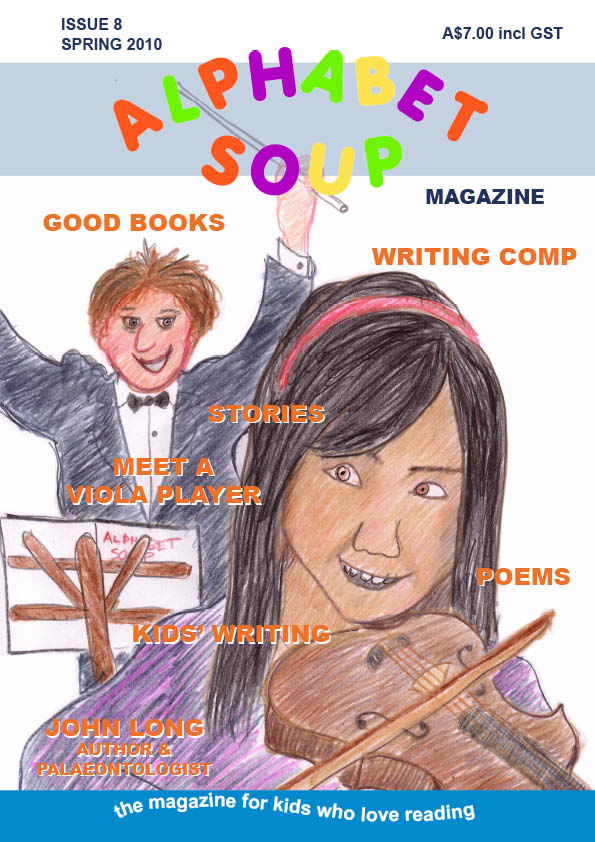
Issue 8 of Alphabet Soup magazine will be out in a few weeks, and it has us humming a happy tune. It will be heading off to the printer very soon—here’s a taste of what you’ll find inside.
Q&A with John Long, author and palaeontologist
a round chant in four parts you can try with your friends
Stories, poems and book recommendations
crossword
kids’ writing and artwork (stories, poems, book reviews and artwork)
The Book Chook’s latest writing tips (How to write funny stories)
Do you subscribe to Alphabet Soup? The winner of our issue 8 subscriber draw will receive a $200 book pack from Fremantle Press. If you’d like to subscribe, you can subscribe online (and order single copies of the magazine) via our website. 🙂
Today we welcome Aleesah Darlison to talk about her books, and what being a writer is like!
Aleesah Darlison
What do you like most about being a writer?
Sharing my stories with other people. Creating characters and scenes and settings, becoming lost in other worlds and playing make believe just to see where it can take me. And I just adore working with illustrators, having them bring my story to life in a way I never could because I can only draw stick figures.
Are there any downsides to being a writer?
Having to do everything on your own, like marketing your book, organising events and managing your money. As a writer, you’re basically running a business so you have to wear lots of different hats. It isn’t easy switching from one thing to another and it’s hard to find the time to do everything. Luckily, I don’t need much sleep and I’m super efficient!
What brought you to write your first book?
I’ve been writing since I was a teenager and I wrote lots of books (that were never published) as an adult. I would work during the day and write at night. When I decided to make writing a proper career four years ago, I chose to write for children because I had two of my own. They gave me lots of ideas for stories and I also used memories and experiences from my own childhood to write other stories.
Was it easy to get your first book published?
The first novel for children that I wrote, Rodeo Brumby, was about a brumby horse named Racer, who is captured and sold into the rodeo. I really, really loved writing that story and I still believe in it with all of my heart, but it hasn’t been taken up by a publisher yet. Maybe one day.
Puggle's Problem by Aleesah Darlison
Since then, I have had other books accepted for publication, though. The first one to come out is Puggle’s Problem, which is a picture book. I had to do lots of drafts of the story before it was ready to be sent off to publishers. After several years and several rejections, Wombat Books, said they wanted to publish it. More redrafting followed before the book was finally ready to be printed. So, I would have to say it isn’t easy getting any book published, but it’s certainly worth all the hard work.
Of your own books, which is your favourite?
I love them all! Each one is different and special in its own right. I believe in each character and story and theme or issue that I’m writing about. Every book has a story behind it and takes a long time to make just right. Puggle’s Problem is special to me because it’s about a gorgeous puggle, a baby echidna, and it’s my first ever picture book. My series for girls aged 9+, Totally Twins, which will be out in September, is special because it’s funny and quirky. It’s illustrated, too (by Serena Geddes), so it has a little added bonus for readers. Totally Twins is about identical twins, Persephone and Portia Pinchgut. I always wanted to have an identical twin when I was a kid, so writing Totally Twins was a way for me to live out a childhood fantasy – finally!
Are you working on a book/project at the moment?
I’m working on a few new projects, including a humorous picture book about an accidentally adventurous spider named Iggy.
Did you have a favourite children’s book when you were growing up?
I read loads of books when I was a kid. I actually used to get in trouble for reading so much! My favourite books were from the Narnia series by C.S. Lewis, like The Lion, The Witch and The Wardrobe. Even now I’m older I read loads of kids’ books. One of my favourite authors is Victor Kelleher and one of my favourite picture book illustrators/authors is Bruce Whatley.
Do you have any advice for young writers?
Read a lot. Write a lot. Don’t be afraid to share your work with other people – how they react to your stories will teach you how to write better stories. Ask your parents to take you to see as many authors and illustrators as you can so you can learn what it’s like to be one.








 alphabetsoup.net.au
