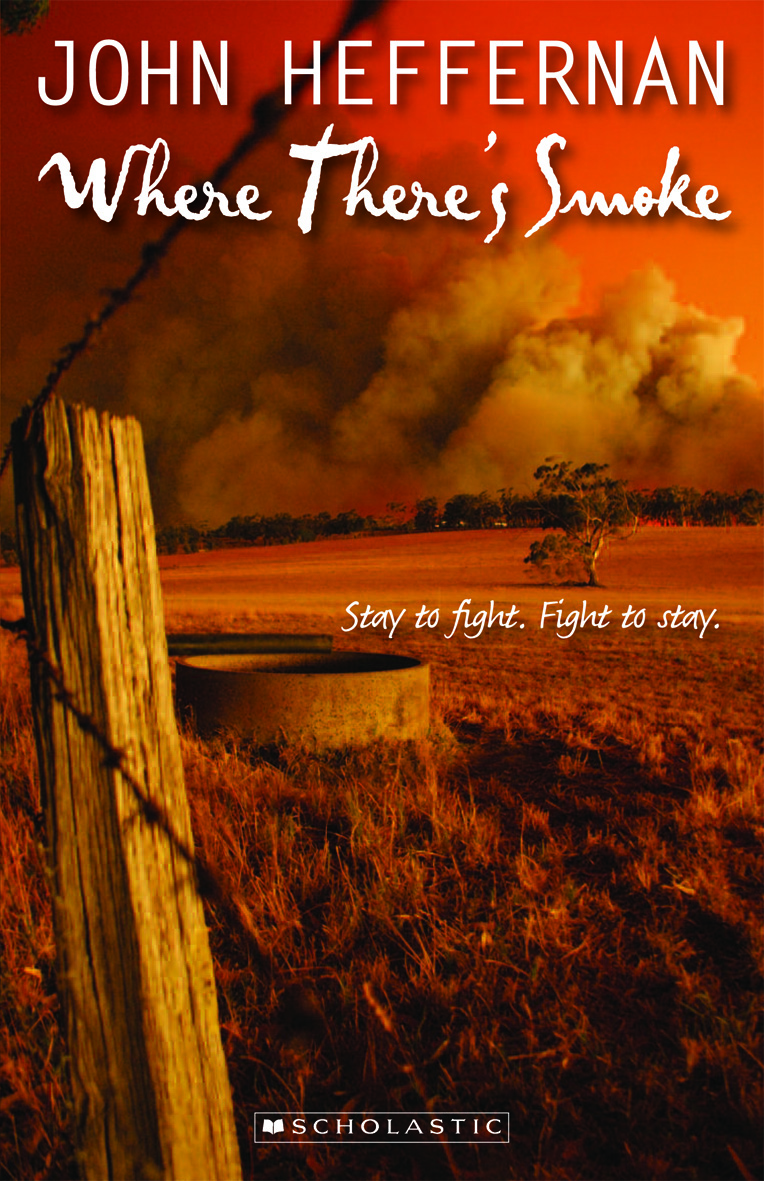
Where There’s Smoke, by John Heffernan, ISBN 9781862918665, Omibus Books.
Reviewed by Alexandra, age 10, Beaconsfield Primary School.*
For the last few weeks, our class has been reading Where There’s Smoke, by John Heffernan. All or most of the class really enjoyed it.
Where There’s Smoke is about a boy called Luke and his mum, Nina. They had been running away from Luke’s dad until a friend of Nina’s (Tiny Cob) told them about Edenville, the place that becomes their new, safe home. In Edenville Luke makes friends with Sarah and develops a very close friendship with Tiny Cob. But when a bushfire comes, how can Luke help the town of Edenville? The place that he now calls his home.
This book was a great book that I really enjoyed. I think it made me understand things like: The house is the place that people live in, the home is the people that live in it. Where There’s Smoke also is an adventurous story as well as the type of book that helps you learn things.
All together I think that Where There’s Smoke is a wonderful book for all ages, out of ten I would rate it nine and my standard is very high. I would like to read another one of John Heffernan’s books one day.
–
*Beaconsfield Primary School is a member of our Undercover Readers Club. A review copy of Where There’s Smoke was provided by the publisher.
For each issue of the magazine (starting with issue 7), we will add activities and a themed listening list to this page. Enjoy!
ISSUE 12—SPRING 2011
ACTIVITIES
for Issue 12—SAIL AWAY!
1. MAKE a pirate’s treasure map. Hide something in your garden (or in your house if it’s raining). Then on a large piece of paper, draw a map so someone else can find the treasure. Use footsteps and arrows to show the way to go. Include some landmarks (like the tree with the tyre swing, or the kitchen table). Mark the hiding place with a red X. Give the map to a fellow pirate—can they find the treasure using your map? (Tip: make your pirate map look old and authentic by using a damp tea-bag to stamp all over it. When it is dry, roll up your map and tie it with a piece of string. Arrr!)
2.PLAY Ship to Shore (sometimes called Captain’s Coming!). One person becomes the captain and shouts out commands to the group—like ‘Ship!’ (everyone must run to the side of the room designated as the ship), ‘Shore!’ (run the other way), ‘Captain’s Coming’ (stand still and salute), ‘Shark!’ (lie on stomach and swish tail). Anyone who fails to follow a command correctly is ‘out.’ For a list of commands (and some more detailed instructions) visit the myplaygroundgames blog.
3. MAKE an origami boat: Using paper-folding techniques, make some paper boats to sail. Here are some instructions.
4. EXPERIMENT—float or sink?: Grab a variety of objects from around your house or garden (check with a parent that it’s OK) e.g. a feather, an apple, a pumpkin, a plate, a paperclip, a coin. Try to predict which objects will float and which will sink. Were you right?
—
MUSIC LISTENING LIST
Our listening list is compiled by Danielle Joynt, from Cantaris. Danielle has also included comments for some of these pieces. (Tip: Ask about CDs at your public library—libraries often have a good collection of CDs for loan if you prefer not to buy.)
1. SEA PICTURES
1. Sea Pictures is a song cycle by the English composer Sir Edward Elgar, consisting of five songs written by various poets.
The songs and poets are—
A. Sea Slumber Song by Roden Noel
B. In Haven (Capri) by Caroline Alice Edgar (the composer’s wife)
C. Sabbath Morning At Sea by Elizabeth Barrett Browning
D. Where Corals Lie by Richard Garrett
E. The Swimmer by Adam Lindsay Gordon
Adam Lindsay Gordon, although born in the Azores and educated in England, lived most of his life in Australia. His collection—Bush Ballads and Galloping Rhymes—is regarded as one of the most important pieces of Australian literature.
Sea Pictures was composed in 1899 and premiered the same year with the famous contralto Dame Clara Butt singing, dressed as a mermaid! Two weeks later Dame Clara performed the cycle for Queen Victoria at Balmoral.
2. DRUNKEN SAILOR (WHAT SHALL WE DO WITH THE DRUNKEN SAILOR?)
The music for Drunken Sailor was taken from a traditional Irish dance and march tune Oró Sé do Bheatha ‘Bhaile (“Oró, you are welcome home”).
First appearing in print as a sea shanty (shipboard working song) in 1824, the song was widely sung when hand-over-hand hauling on ships. It was also known as “Early In The Morning”.
The Australian composer Percy Grainger used the song and lyrics in his work Scotch Strathspey And Reel.
The main theme from the first movement of Piano Concerto No. 2 in F Major by Shostakovich mimics Drunken Sailor.
The melody of Drunken Sailor is often used in SpongeBob Squarepants!
3. LA MER
La Mer (The Sea) by the French composer Claude Debussy is a shimmering musical sketch inspired by the sea. Debussy’s use of instruments to create soundscapes and moods was groundbreaking for the time.
Movement 1 “From dawn to noon on the sea” is an instrumental mixture of floating colours. The music seems to wander around, never settling in to any form. The composer Erik Satie joked that he liked the part at 11.15am!
Movement 2 “Play of the waves” is much livelier, with orchestral swells imitating the waves.
Movement 3 “Dialogue of the wind and the sea” is very dramatic, illustrating the clashing forces of the wind and the ocean.
Although La Mer was not initially well-received when it premiered in France in 1905— due to lack of rehearsal—it soon became a great favourite of audiences at subsequent performances.
One American critic wasn’t so impressed however; he thought a better title would have been “Mal de Mer” which means seasick!
4. CALM SEA / PROSPEROUS VOYAGE
Calm Sea and Prosperous Voyage is the name given to two much-loved pieces of music—a 1815 cantata by Beethoven and an 1828 concert overture by Mendelssohn—both set to poems by the German writer Goethe. Beethoven’s piece is dedicated to Goethe.
The poems are not synonymous; however, in the days before steam, a totally calm sea was cause for alarm—it is only when the wind rises that the ship can continue its voyage.
The first half of Beethoven’s cantata depicts a ship becalmed, the second half, its success in resuming its voyage.
Mendelssohn’s overture (inspired by Beethoven’s work—and in the same key, D Major) finishes with a fanfare of trumpets, suggesting the ship’s safe arrival at its final destination.
Arrr! International Talk Like a Pirate Day be on 19 September—and that be today! So be practising yer best pirate-speak and don’t be swabbing any decks, me hearties!
Here be a pirate book for ye to enjoy.
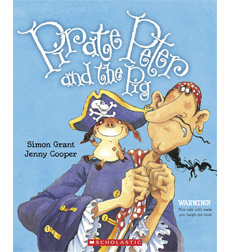
Pirate Peter and the Pig by Simon Grant, ill. Jenny Cooper, Scholastic NZ, ISBN 9781869439408
A review copy of this book was sent to us by the publisher.
Peter is a pirate who goes into a pet shop to buy a parrot. The pet shop owner doesn’t have any parrots—she offers him a pig instead. Peter is not sure a pirate should be walking about with a pig on his shoulder. And then the pet shop owner suggests Peter would look more like a pirate with an eye patch. She doesn’t have an eye patch, but she suggests he try something else from her shop …
This is a very funny picture book. The story gets sillier and sillier and poor Pirate Peter can’t escape from the enthusiastic and helpful pet shop owner.The illustrations show Peter getting more and more frustrated. But the pig is really enjoying himself!
—
Happy International Talk Like a Pirate Day! (Do you have any favourite pirate-y books?)
Lorraine Marwood is celebrating her new book of poetry, Note on the Door, with a poetry competition. You can win a copy of the book (there are prizes for kids AND grown-ups, so make sure you tell your Mum and Dad, too!)
Today (7 September) is Indigenous Literacy Day. We will be donating 10% of all subscription orders received today to the Indigenous Literacy Foundation. If you’ve been thinking of subscribing, today is the day to do it!
A 1-year subscription (including postage to an Australian address) costs $29.80 and a 2-year subscription is $50. Check out our website for postage to addresses outside Australia.
Today we welcome Tania McCartney to Soup Blog! Tania will share with us how she goes about writing a story. (This post is part of a Blog Tour to celebrate the launch of her newest book—Riley and the Grumpy Wombat: A Journey Around Melbourne.)
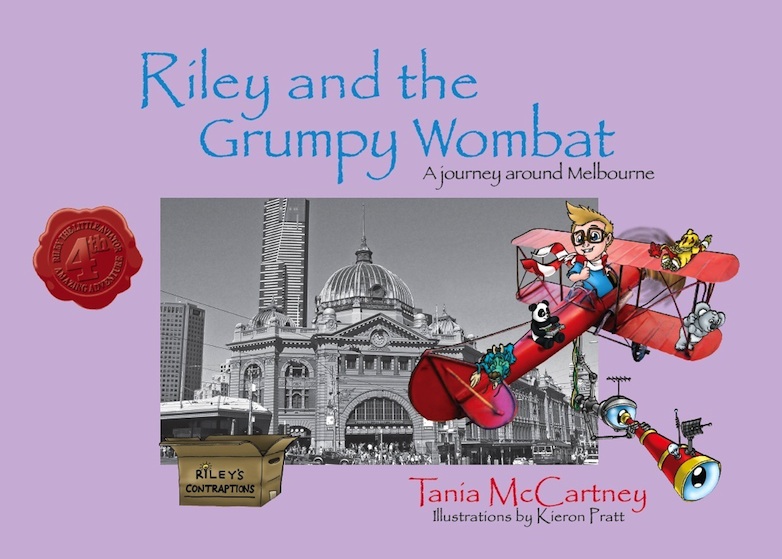
Riley and the Grumpy Wombat: A Journey around Melbourne by Tania McCartney, ill. Kieron Pratt. Ford Street Publishing, ISBN 9781921665486
Before we hear from Tania, here’s a bit about the book:
Riley has discovered a wombat in his nanny’s garden. But why is this furry creature so grumpy? Join Riley and his friends from books one, two and three, as they zoom around the stunning sights of Melbourne in search of a wombat that simply needs a place to call home.
Riley and the Grumpy Wombat has black and white photos along with illustrations, and takes the characters on a fun adventure around Melbourne, Victoria.
And now, over to Tania McCartney!
Tania McCartney, with characters from her books
It seems the writing processes of authors are as varied as there are books … and perhaps this is why it’s so fascinating to learn how authors go about penning their work. I’ve been writing since my teens, yet each style of book I write goes through an almost entirely different process—and this process has actually changed over the years as I’ve found better ways of working.
I remember writing my first adult novels in my late teens and early twenties—the process I used then was … well, there wasn’t really a process. It was just ramblings. There was no plot structure, no character development, no deliberately-placed threads that were then woven delicately through the text, no no. It was just open slather. I wrote from the heart, I wrote with passion—I just wrote.
That was some of the easiest writing I’ve ever done. I sent one of these novels—Breathing Under Water—in for The Australian/Vogel Award (this was around 20 years ago) and although it wasn’t shortlisted, the publisher liked it enough to send it to an outside reader. After a few months, I received the outsider’s critique, which basically said there was ‘obvious talent’ but did the publisher really want to spend time working with me to hone a messy storyline. The publisher didn’t.
I was so crushed, I didn’t submit anything to a publisher again for close to ten years. But it wasn’t only because I was crushed—it was because I had no idea how to hone and structure my work.
Since that time I had plenty of ideas but was simply too confounded about the process. I thought about reworking Breathing Under Water, and I played with it occasionally, but nothing eventuated. Then, in 2007, I began work on a fresh idea for a young adult novel that struck me so quickly, it poured with ferocity from my fingertips.
The plot of this new book—let’s call it The One—required a lot of research, intense character placement and development, and a mass of location and time links. I needed to plan.
So what I did was set up a spread sheet listing the characters, their location, their specific roles and their connection to each other. I also kept detailed notes on the information required to tie characters and events together, and placed ‘markers’ through the manuscript to indicate where extra pieces needed to be written.
I needed these markers because I found I was writing parts of the book that weren’t necessarily in chronological order. It didn’t help that the book also skips through time, so I had to be very careful about where I placed which occurrence.
Taking the time to chart what I was writing kept me on track. At first I was worried a spread sheet would endanger the freedom of the storyline. I worried it would become too formulaic—too predictable. But the opposite happened. Extraordinary coincidences began to occur with characters and events and the research I conducted. It was extraordinary.
Life circumstances forced a four-year break from The One, and I have only just looked at the manuscript again this past month or two. Without my notes and spread sheets, I would have been lost, so I’m thankful I learned how to structure my own writing process.
When it came to writing my Riley the Little Aviator picture books, things went a little differently. I’m a really visual person, so all four books (as well as number five, being written now) were actually done after I had chosen a series of photographs to dot throughout the storyline.
I would place these photos directly onto Adobe Illustrator book pages and begin to write the text around the photos, chopping and changing it as the story went along. For all four books, I had absolutely NO idea of the endings. I knew roughly where the story was going and I had faith that the ending would unfold, magically. And indeed—each time, it did.
For Riley and the Curious Koala, this writing style was particularly strong. As Kieron illustrated each page, I was spurred on to the next, and would often make changes to the text to reflect Kieron’s (often hilarious) interpretation. The storyline for Curious Koala wasn’t finished until around three weeks before printing. This was a wonderful process—collaboration between author and illustrator. I loved it.
For Grumpy Wombat, I had to get the text in shape well beforehand because Paul Collins from Ford Street needed to approve it for publication. The final version, however, was still played around with right up to the last minute, even as pages were being laid out by the graphic designer.
On the back cover of Riley and the Grumpy Wombat
I absolutely loved having such freedom and scope to perfect the text so close to printing.
For my non-fiction books, my process is more methodical. For my history book for the National Library (Australian Story: An Illustrated Timeline, out 2012), I did a stack of historical research. I kept a Word document and a spread sheet that covered the text, images, references, links and notes. When it came to actually finalising the text, I placed it onto landscape book pages, just like I did with my Riley books, so I could ascertain how much text would be needed and in which timeslots I would need to write more. This helped me with image selection, too. It helped me keep focus.
For my lifestyle book—Handmade Living—I kept computer and hard copy versions of the work so I could write, layout and edit with greater ease. This helped me cut down the editing process considerably.
Some authors may work their way through books from front cover to back cover, but I find that, no matter the genre, I tend to jump around and write what works at the time. If I’m struggling in one area, I leave it and move onto a part I feel compelled to write in. Whilst I do believe in ‘pushing through’ writer’s block (it works for me), I also believe that if a section of any work is sticking, you may need to work on another section for a while. Sometimes we just need a few hours or even a week to let a certain part of any book simmer. Then things will flow again.
The writing process is certainly a unique one and—like anything—the more you practise, the easier it becomes.
So long as I have good coffee, silence, a nearby plant or flowers, and lots of sunshine streaming into the room, my writing processes are always joyful.
—
Thanks for visiting and talking to us about the writing process, Tania!
If you want to follow the Riley and the Grumpy Wombat Blog Tour, here’s where to go:
Be sure to stop by here tomorrow, we’ll have Tania McCartney visiting. She’ll be talking to us about writing as part of a blog tour celebrating the launch of Riley and the Grumpy Wombat. See you tomorrow!
Alphabet Soup will be turning THREE in October. Hip hip hooray! So, we’ve decided to have a three-themed writing competition for our spring issue.
————
WIN A $20 BOOK VOUCHER (& see your story here on the blog)
Entries close 21 October 2011
Write your own tale about The Three Little______ (choose your own characters). Your story should be no longer than 450 words and shorter is fine.
Include a competition entry form. This may be printed from the website (see competition rules), photocopied, or contact us to have one emailed or posted to you.
Don’t forget our Design-a-cover competition closes on 16 September 2011. The winning entry will be used for the cover of our summer issue. Check out our designing tips here.

 For the last few weeks, our class has been reading Where There’s Smoke, by John Heffernan. All or most of the class really enjoyed it.






 alphabetsoup.net.au