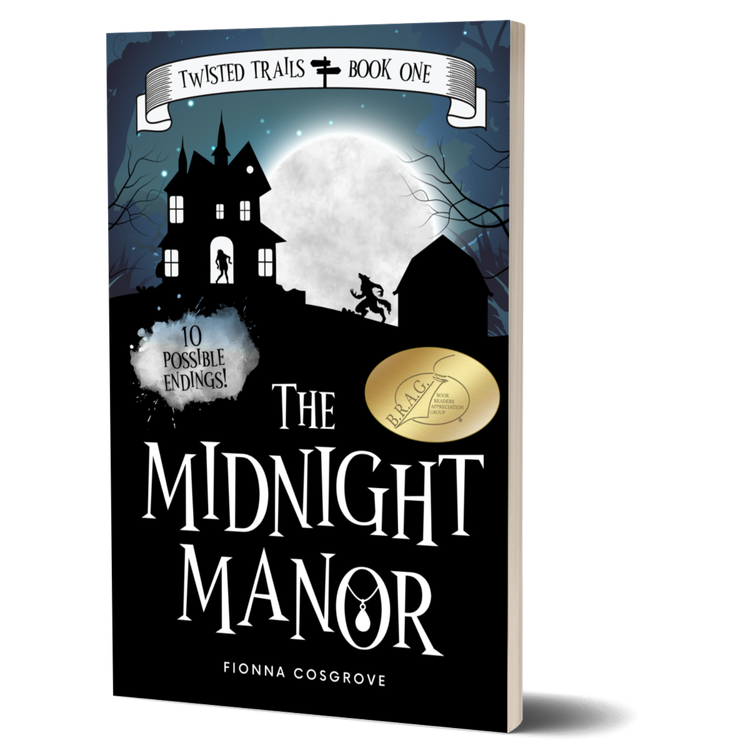
The Midnight Manor by Fionna Cosgrove, Lightning Source Inc., ISBN 9780645723304
Ayaan received a review copy of this book.
The Midnight Manor is the first book in the twisted trails series and was published in 2023. It was written in a ‘choose your own adventure’ style, sharing the story of the Manor and the Game.
But this is not like other stories of the same genre. Cosgrove has written the scenes out in impeccable detail and interesting side comments. Can you escape the manor before you are trapped for all eternity? Or will the mist take you all?
You must weave your way through the manor facing wolves, zombies and a creepy old innkeeper. And if you don’t like the way your story turned out, you can always go back to the start and have a do-over.
I would rate this book 5 out of 5 as its description makes me feel as if I am really in the manor. You should definitely read this book.
Indigo in the Storm by Kate Gordon, Yellow Brick Books, ISBN 9780645218039
Bella received a review copy of this book.
Indigo in the Storm is a wonderful book from the award winning Kate Gordon. Kate Gordon has won many awards for this series. One of her unbelievable, award-winning books is Indigo In The Storm and I can see why. This is a book you can’t stop reading because of how interesting, surprising, and hysterical it is.
Indigo In The Storm is an unpredictable book about a sad girl, called Indigo, struggling to find her happiness once her mum had left her. Not much happens until an annoying boy, Liam, comes along. My favourite part about the book is when Indigo and Liam are having fun together, drawing things and writing quotes.
A funny part about Indigo In The Storm is when Indigo doesn’t like what her only/not really friends are doing so the unpredictable happens …
The saddest thing about this book is when her Mum is a bad influence and they become very close together and then her mum leaves! This made me think of how it would make me feel if that happened to me, I would be very sad and angry.
I like this book because when I was getting a bit bored early in the book, I read on and I’m glad I did because yet again the unpredictable brought it back to a 4 star rating in my opinion.
Overall, I liked this book because of the use of creativity within the story and I love the story because I find sad books the most interesting, but most of the time, the story has a happy ending! 4/5 stars.
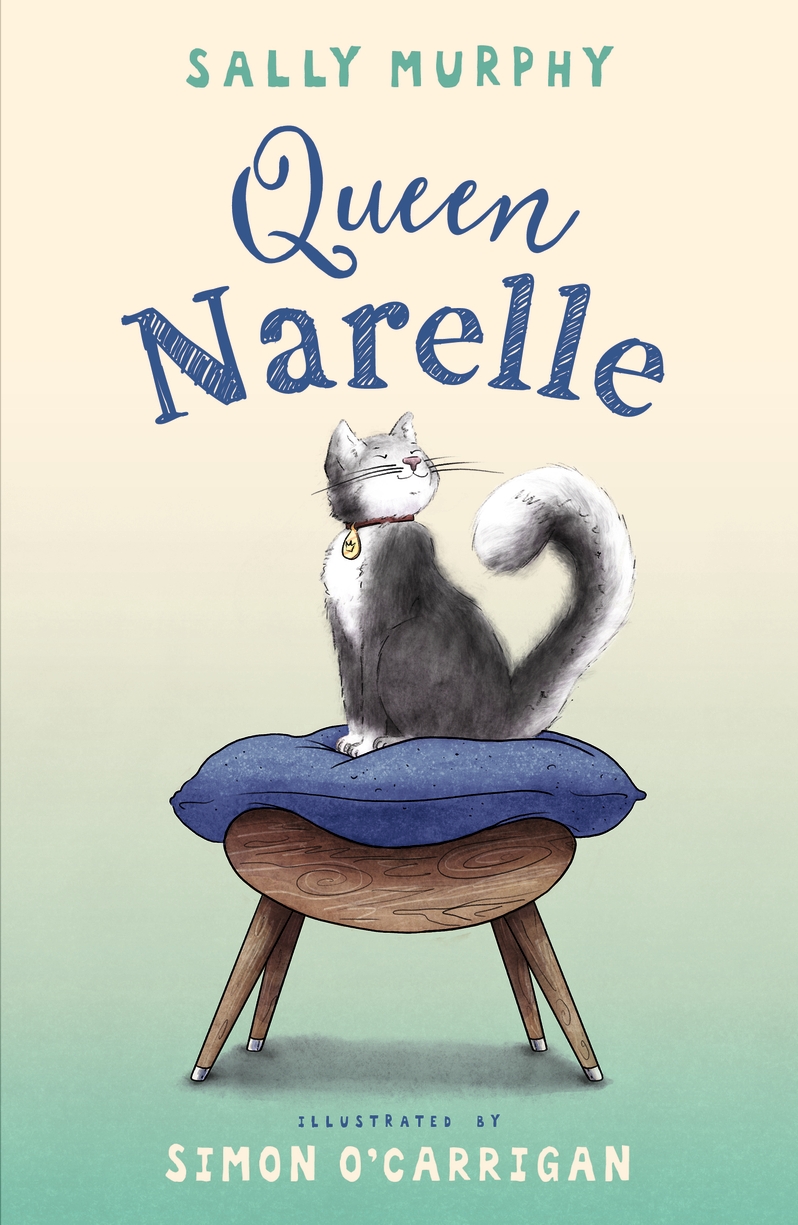
Queen Narelle by Sally Murphy, illustrated by Simon O’Carrigan, Walker Books Australia, ISBN 9781760655334
Aashi received a review copy of this book.
Meet the Queen, her name is Narelle. Her subjects shall bow to her, whenever they greet her. She’s the keeper of the kingdom, ruler of the domain, and, most importantly, Maddie’s best friend.
Narelle is a cat and is the queen of her household. The household includes Narelle (The Queen of the household), Will (The Noisy Person of the household), Mum (The Court Counsellor of the household), Dad (a respected subject) and Maddie (Narelle’s princess and best friend).
Narelle is wise and caring. She loves all her subjects and makes sure they are happy. However, when Maddie’s friends, Nicole and Samira, become bullies because of a silly fight, Narelle is Maddie’s only friend. Nicole and Samira were writing mean and nasty notes in class about Maddie. When a subject is sad it is Narelle’s job to make them happy, but, in this case, Narelle is not sure what to do. Poor Maddie!
I rate this book 5 out of 5. Sally Murphy once again wrote a fabulous book. The book was detailed covering different opinions and perspectives. I recommend the book for 7 to 9-year-olds, they will truly love it. I loved it because it had a beautiful ending. It also showed that love is very important and that someone will always love you no matter what happens.
Once again, I enjoyed reading this book and I hope you will read it too.
Ashleigh Barton lives in Sydney, Australia. As well as writing the Solomon Macaroni novels, Ashleigh is the author of several picture books. Today we’re pleased to have Ashleigh visiting Alphabet Soup to talk about the second book in the Solomon Macaroni series: Solomon Macaroni and the Vampire Vacation, illustrated by Sarah Davis.
The publisher provided Alphabet Soup with a reading copy of this book.
The world’s friendliest vegetarian vampire and his six mischievous cousins are going to Paris with Uncle Dracula. They can’t wait for the fine food, fabulous fashion and fang-dangled art. But Uncle Dracula is not himself. When the kids see the Mona Lisa, they get an idea to cheer him up … and it’s their naughtiest one yet.
Uncle Dracula takes Solomon and all the cousins on a holiday to Paris. If you were heading off to Paris yourself, what would you be most looking forward to?
I’m like Elvis – I would definitely be most looking forward to the food! The other thing I’d most be looking forward to is seeing the Bouquinistes of Paris (the booksellers of Paris), which are green wooden boxes along the Seine that hold hundreds of thousands of books, including second-hand and antique books. These open-air bookstores have been there for more than 500 years. I’d originally included a scene revolving around the Bouquinistes in Solomon Macaroni and the Vampire Vacation but it got edited out for pacing reasons. If I ever go to Paris again, I can’t wait to see these – I bet there would be so many amazing treasures to discover.
The Catacombs played a big part in this story and I haven’t seen them in person either, so I’d have to add that to my list too, along with a lot of other things I discovered in my research.
Have you seen the Mona Lisa at the Louvre?
I have seen the Mona Lisa at the Louvre but it was a very long time ago! I was lucky enough to go to the Louvre when I was nine years old. It was quite incredible knowing how long ago the painting was made and how revered it is. When I was researching for the book, I watched a lot of videos and read a lot of accounts to see how other people felt when seeing the Mona Lisa in person and one thing I read a lot was how surprised people were by the size. It’s actually fairly small (which made it much easier for our characters to steal!).
Unfortunately I didn’t make it back inside the Louvre when I visited Paris again many years later, but I will have to add it to my wish list above!
The cousins are big fans of ice-cream … which ice-cream flavours would be in your own multi-flavoured ice-cream tower?
If someone gave me a multi-flavoured ice cream tower I would have to try one of everything. When else would you get the chance to try every flavour in the shop and have no regrets about choosing the wrong one?
This book involves a careful plan being carried out with precise timing. Are you a plotter or a pantser when it comes to writing about planning a heist?
I think I’m a mix of both! I’m pretty terrible at admin generally and for me plotting feels a lot like admin. I also find that one idea leads to another, so things take unexpected turns for me along the way when I’m writing. But I do try to have some kind of plan in place, whether that’s a point A and point B with nothing planned to get from one to the other, or something more detailed. When I plotted this particular heist, I knew exactly what was going to happen once they pulled it off but I didn’t plan every step or the things that went wrong along the way until well into writing it.
Can you tell us a bit about what you’re working on next?
I’m not sure what will be happening next with Solomon, but in the meantime, I have two picture books and a brand-new series coming out next year. I’m not sure I can say too much about this new series yet, but it’s completely different to Solomon Macaroni and for a slightly younger audience. It is contemporary fiction with a bit of a non-fiction twist and another amazing illustrator on board!
Solomon Macaroni and the Vampire Vacation is out now! Ask for it at your favourite bookshop or local library.
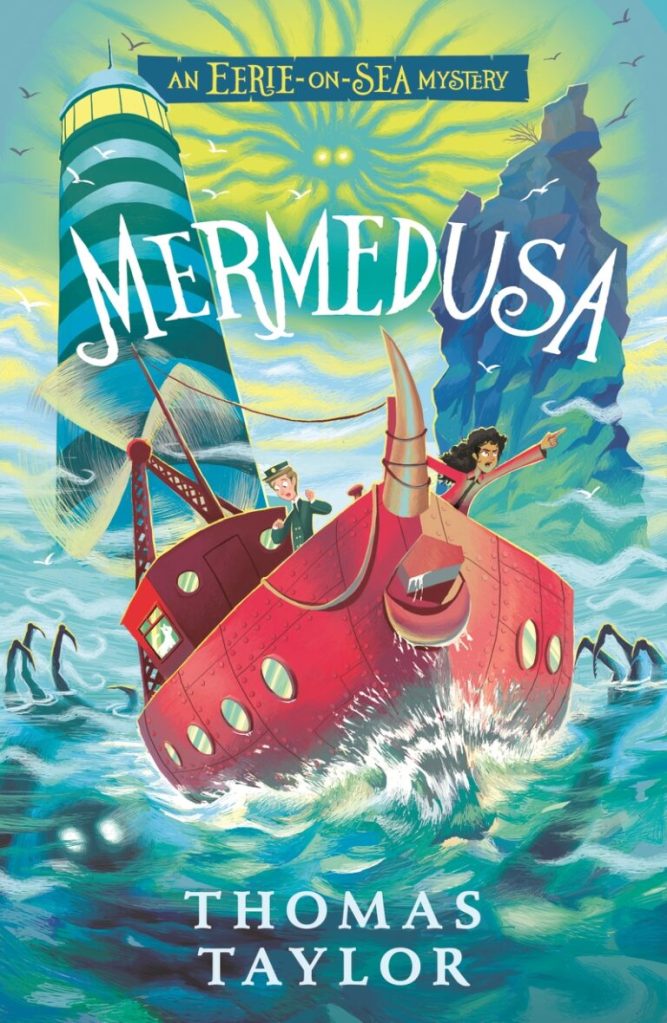
Mermedusa by Thomas Taylor, Walker Books Australia, ISBN 9781529502138
Rory received a review copy of this book.
Prepare for a wild, mysterious and funny adventure in Mermedusa, the final book in the Eerie-on-Sea book series. Join Herbie and Violet as ghostly things begin happening in the seaside town of Eerie-on-Sea. First podcasters coming to investigate the creepy myths of the town and next giant sea-monsters from the deep depths of the ocean trooping through the town!
When an eerie, hypnotic hum begins to resonate around the town and when Sebastian Eels – the friends’ worst enemy – starts driving his boat out into the stormy ocean at midwinter time, the most dangerous time of the year, Herbie and Violet instantly know something is up.
Suddenly everything starts coming into place: could the deepest secret of Eerie-on-Sea be close to getting revealed?
I rate this book a 10/10! It’s just so good with descriptive language, cliff-hangers, mysteries and more. There’s literally nothing bad about it! I think this book would be great for 9-year-olds and above. I read this book all night long and I know that you will too!
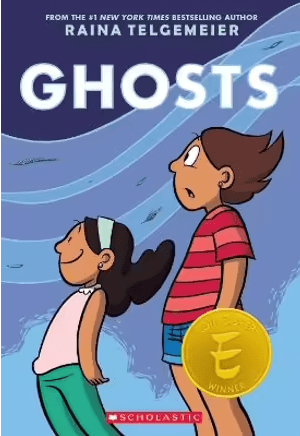
Ghosts by Raina Telgemeier, Scholastic Inc, ISBN 9780545540629
Aashi reviewed her own copy of this book.
Ghosts is a graphic novel written and illustrated by an outstanding author Raina Telgemeier. The main character is Catrina who doesn’t want to move to the coast of Northern California. They move because of Catrina’s little sister, Maya, who has Cystic Fibrosis. Cystic Fibrosis is a breathing and digestion condition, so they move to Bahia de la Luna which is on the coast of Northern California for cleaner air.
When Catrina and her family get to Bahia de la Luna they move into a little green house. Wild Maya wants to go on the ghost tour run by their next-door neighbour, Carlos. Catrina can’t say no. Will this end well … ?
I rate this book four out of five stars for it uses more perspectives of what other people think besides Catrina, though overall the book was great. It would make a spectacular read for ages 8–11.
Ghosts was a fabulous book, so in 2017 it won an Eisner Award for Best Publication for Kids (ages 9–12), and the Dwayne McDuffie Award for Kids’ Comics.
The Third Form at St Clare’s by Enid Blyton, Hachette Children’s Books, ISBN 9781444930030
Aashi reviewed her own copy of this book.
School days at St. Clare’s are never dull for Patricia and Isabel O’Sullivan.
When the mistresses announce that the third form shall be running their production, trouble starts. However, that’s only the beginning of their problems! Will the show still go on? But despite all the chaos pranks are still being pulled on poor Mam’zelle, the French mistress.
I adored The Third Form at St. Clare’s, a fantastic book. The book is full of surprises, mischief, jokes, and mysteries. I rate it a five out of five.
However, I wasn’t the only person who thought so. Here are some quotes from other readers …
'A great story with some new characters along the way.'
by Felicity

'A great book. Never bores you.'
by Phoenix

'I loved this series, it's one of my childhood favourites.'
by Bhavya
I enjoyed this great book and it made for a spectacular read. I hope you read it too and like it.
Chenée Marrapodi is an author and journalist who has danced ballet and jazz her whole life, loving the stories that can be created through movement. Today we’re pleased to be talking to Chenée about her debut novel One Wrong Turn.
The publisher provided Alphabet Soup with a review copy of One Wrong Turn.
From the publisher:
Amelia is a ballerina on the rise — she’s talented, dedicated and set to star in the lead role of the annual production. But when Valentina arrives from Italy and joins the ballet academy, the competition gets fierce. Can Amelia outshine Valentina and keep her place in the spotlight?
At your book launch, you mentioned going to ballet classes in Australia and in Italy. Do you have a memorable ballet performance you were in when you were young?
My first ballet performance was definitely a standout. I was a sheep and two farmers had to shear our wool on stage!
It’s funny to look back at now, but at the time I was so disappointed because in the previous year’s concert the girls got to be fairies.
What is your all-time favourite ballet production? ( … Would it be Cinderella?)
Cinderella is definitely one of my favourite ballet productions, which is one of the reasons it features in One Wrong Turn. There’s something special about seeing a familiar story brought to life on stage. I find it easier to get lost in the beauty of the dance because I already know the narrative so well.
I particularly love WA Ballet’s production of Cinderella, which is described by Amelia in my novel. Amelia talks about getting to ride on Cinderella’s coach as a young child, which is something that kids actually get to do in WA Ballet’s performance. It’s really special to watch!
In particular, I love watching the Step Sisters. They are hilarious and always steal the show. I once saw one of the sisters do tap dancing on her toes in pointe shoes. I still don’t know how she managed to do it!
Did you need to do any research while you were writing One Wrong Turn? Or did your experiences growing up cover everything you needed to get your story down?
Most of the story was inspired by my own experiences in dance classes. Some of Miss Lily’s funny corrections were things I’d heard my own teachers say over the years. Given I was never training for a career in ballet, I did chat to a couple of professional dancers to make sure the amount of training my characters were doing was realistic.
Valentina’s Italian family and traditions were also inspired by my own experiences. I’m Italo-Australian and grew up with big family meals and traditions like sauce and sausage making days. Valentina’s house is actually based on my Nonna’s and features some of the quirky pictures that used to hang on her walls.
I also lived in Italy for a while and danced at a small school while I was over there. Like Valentina, I couldn’t translate my teacher’s corrections while I was dancing. I found it too hard to remember choreography, listen to music and translate corrections in a foreign language at the same time. It took my teacher a whole year to figure out my secret!
Despite being fluent in Italian, I got one of my good friends in Italy to double check the Italian phrases in the novel. I don’t speak the language as much as I used to and I’m a little bit rusty. The last thing I wanted was an error forever printed in my book!
What’s the worst writing tip you’ve ever been given?
“Edit the story as you go.”
It might work for some people, but it doesn’t work for me. If I edit as I go, I get too fixated on trying to make every sentence perfect. It makes the whole task feel too overwhelming and I never make it to the end. Instead, I find it better to write a messy and fast first draft. I don’t reread my work until I make it all the way to the end of the story. It’s much easier to edit a messy page than a blank one.
Can you tell us a little about what you’re working on next?
I’m really excited to be working on a sequel to One Wrong Turn. It’s great fun being back at the ballet academy. You can expect the same characters, with a couple of new additions. There’ll also be lots of dancing (including a different style), fun, friendship, a tiny bit of romance and some very big challenges for everyone to overcome.
One Wrong Turn is out now! Ask for it at your favourite local bookshop or local library.
One Wrong Turn by Chenée Marrapodi, Fremantle Press, ISBN 9781760992439
Hannah received a review copy of this title.
Amelia wants to get the lead role in a ballet concert but there’s a new girl (Valentina) who’s really good, so it will be harder for Amelia to get the lead role. Valentina’s family doesn’t really understand ballet and when rehearsals start it might be a problem for the show if Valentina has to stop ballet.
The book had a few Italian words. I thought it was cool because in Valentina’s family they were talking to each other in Italian. Sometimes when Valentina was talking to her family the book didn’t tell us what they were saying. But if Valentina used Italian words when she was speaking with her friends, she would give the words in English as well. So if I kept reading it told me what she said.
I liked the book because, even though it was a long book with small writing, the more I read the easier the book got. I still really liked it because I really like dancing and I wanted to get to the showcase at the end! I don’t do ballet but I do hip hop and jazz. Kids who like ballet, or any kind of dancing, will enjoy this book and see how hard it is to do ballet well.
Carina promised her Dad that they would find a Moon Tree together. Sadly Carina’s Dad passes away before they get to do so, so Carina is more determined than ever to find it herself.
After moving to the Otaway Ranges, Carina believes that there is a Moon Tree in a nearby forest. Carina has a strange and mystical encounter with a black cockatoo in the forest who she thinks may be magical. Will the magic lead Carina to find a Moon Tree?
I rate this book 7/10 because I really enjoy stories about nature, love and the power of family connection. It’s suitable for ages 9+.







 alphabetsoup.net.au