Posted in authors, Pass the Book Baton

Pass the Book Baton: Sue Whiting

PASS THE BOOK BATON
Sue WhitingEarlier this year Alphabet Soup started a series called Pass the Book Baton. Every week we featured a book creator who answered one question before throwing a new question to the next Friday visitor. (It was kind of like a book relay in slow motion.) Our book creators took a break for the school holidays but we are pleased to announce … Pass the Book Baton is BACK!

You might remember that we left Kelly Canby with the book baton in March. (She’ll be feeling quite tired by now.) Today she finally passes the baton to Sue Whiting.

Sue Whiting lives and works in a coastal village south of Sydney. She is an editor and an author and writes books for a range of ages, from picture books through to books for young adults. Her latest book is Platypus, illustrated by Mark Jackson.

Here are just some of Sue Whiting’s books:

Back in March, Kelly Canby asked:
When you’re in the planning stage of a new book, do you prefer to work in a quiet space where it’s just you and your thoughts or do you head out to cafes and parks where you’re surrounded by outside sources of inspiration — people/colour/activity — to help develop your ideas?

Sue Whiting answers:
Thanks for this great question, Kelly.
 .
The planning stages of a new book fill me with great excitement. There are just so many possibilities! In fact, anything is possible. And I love that.
 .
I usually think about a new book idea for many, many months, letting it simmer away, slowly developing like a good stock. During this time, I might also do some research,  collect other ideas, try to make connections and get to know potential characters. And I do a lot of walking. Alone. Letting my characters chat away in my head while I eavesdrop on them! Then I hit the drawing board.
 .
Literally.
 .
I am lucky enough to have a drawing board that belonged to my son when he was studying engineering. When he flew the coup and left it behind, I quickly claimed it. It is my favourite place. I peg on large sheets of paper, grab a pencil and let all those bubbling thoughts spill out onto the paper. It’s the ultimate brainstorm. I ask myself questions and write numerous answers. I challenge myself to think outside the square, to think of unlikely scenarios and elements. Eventually, after many days of scribbling and scribbling, I start to circle the ideas that have the most appeal and seek out further connections. Gradually, elements of plot and story, character and setting start to emerge, and that’s when I begin wrestling the best ideas into some sort of order and to work out what it is that this story is actually about.
 .
All of this is done in my writing studio, in absolute silence. I need to be totally alone with my thoughts in order to release them and see where they take me. Sometimes, good ideas are very shy and need quite a bit of coaxing to emerge and even background music can be enough to make them hide away!
 .
Once I am about halfway through my first draft and have a clear idea of where I am heading, I can write just about anywhere — on the train, in a
café, on the sofa with the TV blaring!
 .
That all sounds quite nutty! But what can I say? You have to be a little nuts to be a writer, don’t you?
 .
 .

And now Sue Whiting passes the baton to the next Friday visitor — Gabriel Evans. Gabriel is an Australian illustrator of more than 20 books. 

Sue asks:
“I have had the privilege of working with Gabriel (as an editor) and have been a big fan of his work for a number of years. It has been great to watch his career develop, going from strength to strength. So my question is: What would you do differently in terms of the development of your career as an illustrator if you had your time over again?”
..
Check in every Friday for questions and answers from children’s authors and illustrators.
 .
See you next week!

Save

Save

Save

Posted in Book reviews by kids, Book reviews by Matilda

Book review: Magic Fish Dreaming

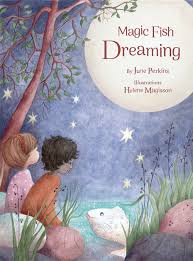
Magic Fish Dreaming (book cover)REVIEWED BY MATILDA, 11, WA

Magic Fish Dreaming by June Perkins,
ill. Helene Magisson, Gumbootspearlz Press, ISBN 9780980731187

Matilda received a review copy of this book from the publisher.

This book has poems mostly based around nature and families in the environment in Queensland. My favourite poem in the collection is called ‘Rain song,’ about the rain moving across the land and affecting banana towns, cassowaries, and fields of sugar cane. I liked the sense of movement.

The illustrations are floaty and dreamy (not bright and shabam!) and they suit the style of the poems. I really like the illustration for the poem ‘Tawny’ — you can almost feel the fluffiness of the bird.

The book is divided into two sections — ‘Hunting for Giggle Poems’, and ‘Magic Fish Dreaming’. I didn’t think that the poems’ themes in each of these sections really matched their section titles and so I thought it would have been more effective just to have the poems all in together, without dividing the book into sections.

This is a poetry book with a really Australian feel to it. I would recommend these poems to children ages 7 to 10.


Matilda is one of our regular book reviewers. You can read all of Matilda’s reviews here. If YOU would like to send us a book review, check out our submission guidelines. Happy reading!


Posted in poetry

Young writers in action: Oh the things you can do!

Jump image by Pexels.com


Oh the things you can do!
by Siddh, 7, QLD

Oh the things you can do,
You can skip, you can dive,
You can spy, you can fly,
You can jump, you can pump,
You can hike, you can strike,
So everybody has a special thing to do.
And that is the poem of the things you can do.
.

Siddh has had poetry published with us before. His first poem published at Alphabet Soup was called All about people. If YOU would like to send us a story, drawing, poem, or book review, check out our submission guidelines. Happy writing!

 

Posted in poetry

Young writers in action: Anger

ANGER

by Kaia, 10, California, USA

Anger; the smell of smoke
Of flames, of still burning embers flickering in ashes
Of a fire, grasping for air out of the windows
A fire, taking everything down with it
A crackling log fire, slowly changing, forming into a destructive weapon
Anger smells burnt.
Burnt anything.


This is Kaia’s first poem published with Alphabet Soup. If YOU would like to send us a story, drawing, poem, or book review, check out our submission guidelines. Happy writing!

Posted in info

TOP READS: April 2017

Welcome to Term 2 — we hope you had a wonderful break and you read lots of books! If you’ve read your way through your bedside pile and you’re desperate for something new to read … you’ve come to the right place. On the last day of every month our Top Reads team members* recommend books they’ve recently read and loved. Look for these books at your library, bookstore, or best friend’s bookshelf!

You’ll find a recommended list from our Top Reads Team on the last day of every month (February to November). If you missed last month’s, don’t forget to check out the March Top Reads.

*All our Top Readers are kids aged 13 and under. No grownups allowed!

Save

Save

Posted in info

TOP READS: March 2017

It’s the last day of the month, which means it’s time for book recommendations from our Top Reads team. We are pleased to welcome Stacey to the team.

Meet our 2017 team — read about them (including Stacey!) in an earlier post.

Here are their fabulous book selections for your school holiday reading pile:

You’ll find a recommended list from our Top Reads Team on the last day of every month (February to November). If you missed last month’s, don’t forget to check out the February Top Reads.

*All our Top Readers are kids aged 13 and under. No grownups allowed!

Save

Posted in info

Young writers in action: Nina Sinclair’s letter

NINA SINCLAIR’S LETTER
by Kate, 9, The Glennie School, QLD


To My Dear Family and Friends,

My name is Nina and I am in Australia, which I came to with the First Fleet by surprise. I hope that you can keep this letter for many years to come.

For the first 15 years of my life, it was very peaceful with my younger sister, Ava, who was 6 and my younger brother, Dillan, who was 2, as well as my mother, Queenie, and my father, Duncan. We had just the right amount of money to keep us going, but when I went out in the streets to buy bread while mother warmed the dripping from the roast, I encountered countless numbers of people sleeping on the streets and sometimes, a poor person stealing an apple from the grocer’s cart. The crime rates were high then, so there were police everywhere. You didn’t have to wait for long before dirt-stained white horses with the police on their backs came galloping after them and throwing them in Newgate Prison. I always was thankful that I wasn’t one of them!!!

Then, when I turned 16 on the 2nd of January, guards marched up to our small, wooden house door and delivered a letter. Dillan answered the door and when he saw the guards staring at him, he fell over backward onto the floor. Ava pushed past him and the guard gave her the letter. The guard said his thanks and shut the door behind him. She gave it immediately to father and he carefully opened it and took it out. This is what it said:

Dear Duncan Sinclair,

You have been appointed as Captain of the ship Alexander on the First Fleet to the Great South Land, which departs on the thirteenth day of May in the year 1787.

This expedition will be led by Admiral Arthur Phillip, who will be Governor of the Great South Land. There will be eleven ships and seven hundred and seventy-eight convicts.

I hope that you will be there.

Yours,
Jeffery Amherst
Governor of England

We were very surprised at this letter (Dillan almost fell over again, but I caught him) and it also meant that we would never see him again. All of our family was so very sad and spent a lot of time with our father before he left. The 13th of May 1787 came so quickly, I don’t think I could even blink before it came!!!

When the day came, father said goodbye to us all and asked me to come to see him off. All of us cried as he went out the door and I stepped out with him in my blouse (and my handkerchief as well) as we walked out together.

Then, we lined up for a headcount, and surprisingly I went on the ship as well!
Before I knew it, I was going on the First Fleet to Australia!!!

It was very smelly and hurt my nose to go under into the cabins that the convicts were living in. The convicts were fighting all the time, (which was really quite horrid!)

Up on the deck, though, where the seamen, marines and I were, was fantastic with the air smelled of the salty ocean and father was captain, driving the ship.
I had a small go once, and it was fabulous!!
We stopped at Rio de Janeiro to fulfill supplies. I tried this fruit called ‘watermelon’ and the definition of it was a sweet-tasting, big, heavy, red, black seeded fruit. I was overjoyed as the juice trickled down my chin, and I giggled as I spat the pips into the blue sea. The black seeds looked like boats as they floated away and then sank down for these fearsome-looking animals with claws to eat.

The eleven ships sailed for another few months with the seamen, marines, 778 convicts, father and me until we got to this island in the French Polynesia called Tahiti. The convicts were so happy when we stopped again, but we didn’t stay for long, and Tahiti wasn’t nearly as good as Rio de Janiero, in my opinion.

One of the convicts was very bad: 12 year old Noah. He fought with their night guard and so, got put in the coalhole for three days. He came back a little more respectful of others, which was good. Serves him right to be punished, I think!!!

The next few months until we got to Australia were rather dull, because nothing much happened. I really was looking forward to landing in Australia, but I did miss mother, Ava and Dillan.

When the Alexander was near Australia, rumours went around that there were big rats in Australia with HUGE tails and that they could knock you over! Even though I didn’t think this was true, someone told the convicts and I don’t think they liked it!!!!

When we arrived in Australia, I was so excited that I practically jumped out of the ship. After that, I had to help round the convicts up to the factory to do their work. They had to work for seven years to gain their freedom, and then they could make their own homes and get their own servants like they had once been. However, since I was definitely NOT a convict, I was given some land straight away and so I hired some convicts to make a house.

Four years passed very quickly. I was having a great time in Australia because there were no crowded streets and there was no crime at all.

When I was 20, I married a man called Luke and we both lived a happy life together in our little house with chickens pecking around in our garden.

So, dear friends and relatives, I hope that you can come to Australia soon.

Yours Sincerely,
Nina Sinclair


This is Kate’s first piece published with Alphabet Soup. If YOU would like to send us a story, drawing, poem, or book review, check out our submission guidelines. Happy writing!

Posted in info

Young writers in action: Diary entry

Historical Narrative: Diary Entry
By Amy, 9, The Glennie School, QLD

Dear Diary,

I used to hear the drunk people sing this song in England many, many, years ago: “We’re bound for Botany Bay.” I never knew what “Botany Bay” was, but now I certainly do. My childhood has been tough in many ways but I always sing that song.

On the 10th of May, 1787, my family was in need of food, and I was only 7 years old. So I crept out onto the dirty, polluted and unhygienic streets of London. I saw the butcher selling some cooked sausages. He was calling out: “Come and get your cooked sausages!” It made me so hungry that I came and snatched six sausages right before his eyes. I sprinted and sprinted and sprinted, but I was running so fast that I didn’t notice a big pebble right in front of me. I was caught right on the spot.

They threw me into Newgate Prison for three days. On the second day I was told I would be sentenced to transportation. I was also told that the fleet would be leaving tomorrow. I felt very apprehensive and panicky.

In chains early in the morning on the 13 May 1787, in iron, cold chains around my neck, ankles, and feet, I was loaded onto the convict ship Lady Penrhyn. There were around 101 women.

The life on the ship for the first week was very challenging until I met some friends, Rebecca, Isabella, Rose, Ambrose , Elizabeth, Sarah and Phebe. We played games and sang together. Then, a few weeks into the trip, people started getting illnesses such as scurvy. All of my friends and I were lucky and escaped from the diseases.

After a period of around one month, we arrived at Rio de Janeiro on the 6 August 1787,  to select supplies. This was my first time tasting a hairy, yellow fruit and a big, round, juicy red fruit, another juicy green and orange fruit as well.

After being there till 4 September 1787, we set sail again. The seas were very bumpy and nearly everyone got seasick and the sea and under the deck smelled disgusting. The hospital was full of people with other diseases as well. Luckily, again all my friends and I escaped with minor health issues.

Then our next stop, was The Cape of Good Hope in South Africa.

We finally arrived at the Cape Of Good Hope on October the 14th to get more supplies, get the ship serviced and buy some animals to start the new colony.

We left The Cape of Good Hope on the 12 November 1787, and all of my friends and I were healthy.

We finally spotted Van Diemen’s Land on the January 3, 1788. We were so excited.

About three weeks later, we anchored the ship at Botany Bay. We had our stupid chains on again. We were assigned jobs. Like making roads and looking after the animals. All my friends and I were lucky that we were all assigned the same jobs; making roads.

We had to work 6am to 6pm every single day for seven years. Once I turned 18, and all my friends turned 17, we all were pardoned. I married a man named Thomas who was a farmer. I worked making cream, butter and milk, and sold it to the villagers.

I hope someone will read my diary  in the future.

~ Blanche


This is Amy’s first piece published with Alphabet Soup. If YOU would like to send us a story, drawing, poem, or book review, check out our submission guideline

Posted in info

Young writers in action: A normal girl

A NORMAL GIRL
by Azuki, 9, NSW

Girl looking out window. Photo from pexels.comI got out of bed and I stared out the window, longing for a friend. Girls and boys were playing outside happily. It was 1902 in France. See, my sister had tuberculosis when I was four. Two years later she is forgotten. The memory of her is tossed away like an old newspaper.
Well, at least I remember her fondly. Camille, with her soft blond hair, bright blue eyes and dainty little dimples. Maman said she was belle.

“Il est temps pour petit-déjeuner!” Maman yelled.
“J’arrive!” I called back. Breakfast was ready. I could smell just-baked croissant. Okay. So I’ll tell you more about it later.

I haven’t been outside so I don’t have any friends. I haven’t met anyone except Maman, Camille and my imaginary friend Carlos. After Camille died, I got lonely. Carlos was my only hope.

Carlos was a jolly soul. But one day, we had a fight.
“C’est vrai, les licornes sont reélles (It’s true, unicorns are real)!” I told him.

“Non, non,” Carlos argued. ”C’est une idée stupide (That’s a stupid idea)!” That made me angry. Furious. My fingernails dug in to my palms because of my tight fists. No one messes with my unicorn theory. That’s when it all started.

The next crisp morning, I heard Maman’s horses clopping down Marseille, which meant she was going to work. Maman banned me from going outside because of “dangers.” Because I was an obedient little girl, I did what I was told. But that day was the day. I was going to go outside. No more Carlos! Well, at least that’s what I thought. He might follow me.

I went down to the bottom floor and the door was locked from the inside. Then I thought of an idea. I was on the bottom floor. Right? There are always windows in a house. I could climb outside the window! After putting aside some provisions, a picture of Maman and food in a bag, I set off.

It was a rough journey. People stared at me like I was a strangely dressed tourist. I walked and walked for ages until I reached a grassy field.

“C’est beau,” I sighed as I gazed at its beauty. Dandelions, roses and violets, purple and blue! It was amazing. That’s when I heard the explosion.

Suddenly the sky was filled with planes and I was choking on dust and ash. I didn’t understand what was happening. I was only five. All I remember was that I ran. I ran until I found a gathering of people. They were all speaking French. I was so excited to think that I could find Maman. I got out the picture of her and started asking people if they had seen her.

“Avez-vous vue cette personne?” I asked whoever would lend an ear. But all the feedback I got were shaking heads and shrugging shoulders.

Would I ever see Maman again? I ran to a corner and started crying. Then, I heard a familiar voice, “Anne, tu me manques tellement. Oú êtes-vous ma petite douse?” That was the distinctive sound of Maman’s voice! She was asking where I was!

“Maman?” I whispered, my voice hoarse from dehydration.
“Ma fille! Allez, nous devons trouver un abri! Je connais un ami (My daughter! We have to find shelter! I know a friend),” she cried. We ran through the warzone, barely missing bombs flying down from all the warplanes.

Finally, we found our destination. There was a pretty woman standing at the door, followed by two children. The woman was named Mila, Maman’s friend, a boy named Liam and a girl called Lola. They had a small house but I was excited that I could possibly live a normal life again.

The next day I went to school and I met nice people. I played with Lola and Juliet, a girl from our neighbourhood. A few weeks later, Maman came up to me and said that our home was safe from war now and we had to go home.

I got out of bed and stared out the window. I wasn’t longing for a friend. For once, I was one of those boys and girls playing happily. I was a normal girl.


This is Azuki’s first story published with Alphabet Soup. If YOU would like to send us a story, drawing, poem, or book review, check out our submission guidelines. Happy writing!

Save

Save

Save

Posted in authors, illustrator, Pass the Book Baton

Pass the book baton: Kelly Canby

PASS THE BOOK BATON

It’s Friday! And that means it’s time for Pass the Book Baton. Every week Alphabet Soup features a book creator who will answer one question before throwing a new question to the next Friday visitor. (It’s kind of like a book relay in slow motion.)

Kelly Canby

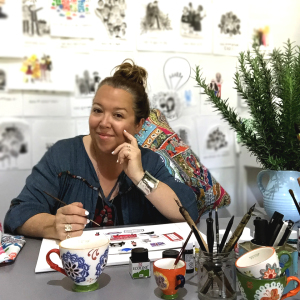
Today the book baton is passed to Kelly Canby. Kelly is an internationally published illustrator and author of picture books, early reader books, chapter books, and colouring books. She lives in Western Australia — you can see her above, busy drawing and painting.

You might recognise some of these books:

Last week Lorraine Marwood asked:
Hello Kelly, I see you do illustrations for a range of children’s genres, as well as colouring books!  Can you tell us a bit about your illustrative journey and what you’d passionately love to draw in the future?

Kelly Canby answers:
Thanks for the question, Lorraine! My illustrative journey begins many years ago at university. I studied design at Curtin where I majored in Illustration and minored in Graphic Design and Advertising. When I graduated I freelanced for while as an illustrator for advertising agencies and eventually landed a full time graphic design job with the design studio of my dreams. From there I moved between working in design studios and advertising agencies until I became senior designer at a very wonderful, very creative and fun (really fun) design studio.

Then I needed to do something completely different so I bought a florist. And I made flower arrangements.

And once that was out of my system, I started to think about design and illustration again. Also, around this time, I was buying a lot of picture books for my son and I fell completely in love with them knew that’s what I had to do. I had to make children’s books for the rest of my life! So I hopped online and discovered SCBWI (Society of Children’s Book Writers & Illustrators), I made myself a portfolio of work, got an agent and began. That was about 4 and half years ago and since then I have illustrated around 14 books, written and illustrated one picture book, with another picture book that I’ve written in the works with Fremantle Press as I type, and I’m having so much fun doing it all.

As for what I’d passionately love to draw in the future … Well, on the very top of my wish list for a long time was to illustrate a middle grade novel with lots and lots of detailed, full page, black and white drawings, which I happen to be doing right now with Allen & Unwin so I am one very happy illustrator, indeed!

Visit Kelly Canby’s website to find out more about her and her books: kellycanby.com


PlatypusAnd now Kelly Canby passes the baton to the next visitor — Sue Whiting.

Sue writes picture books, chapter books and novels for teens.

Kelly asks:
Hi Sue, my question for you is, when you’re in the planning stage of a new book, do you prefer to work in a quiet space where it’s just you and your thoughts or do you head out to cafes and parks where you’re surrounded by outside sources of inspiration – people/colour/activity – to help develop your ideas?
..
Pass the book baton is taking a break for the school holidays. The series will resume at the end of April.
 ..
See you then!
Save

Save

Save

Save

Save

Save