The publisher provided a review copy of this book.
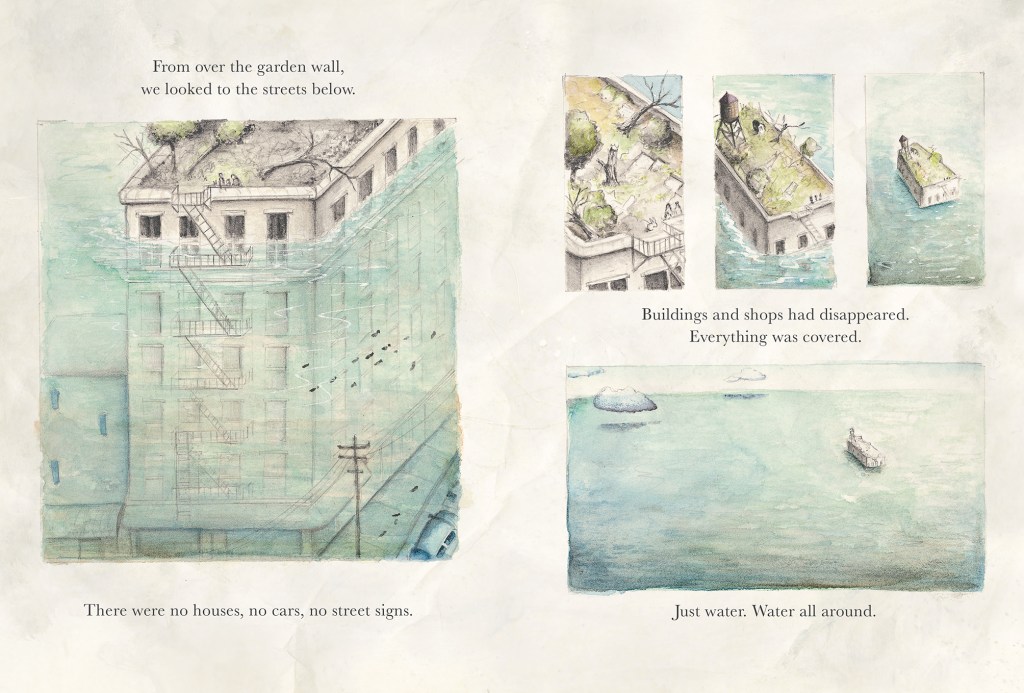
Higher Ground is a picture book about a grandma, brother, sister and one rabbit who get stranded on a really tall apartment building in the rooftop garden, because of a huge flood and lots of rain. There’s nowhere to go unless they take a boat. The water is filled to the brim.
Their grandmother teaches them ways to survive with a scarce amount of food. She taught them how to tie knots and how to eat every part of a fish. She teaches them all of the knowledge she has so they can pass it on in the future.
My favourite page is where the illustrations show how they have all grown up over time. You can even see at this point, in their faces, that they have lost hope.
They end up never giving up and have enough hope that something great will happen. The moral of this book is to never give up and keep on pursuing what you believe in.
My favourite thing about this book is that there is always a cliffhanger to keep it interesting.
The book itself feels really high quality with an embossed cover and thick pages of illustrations.
I really enjoyed this book and people that like big cliffhangers and that are into adventure books and like learning new things would enjoy this book too.
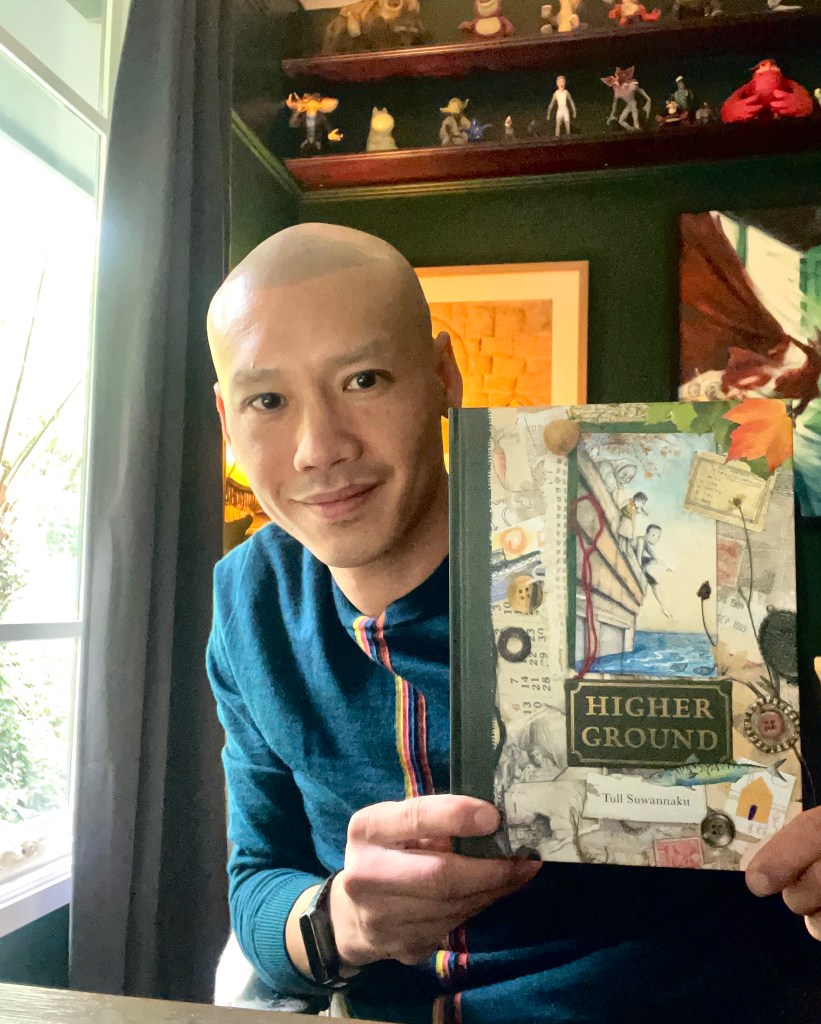
Tull Suwannakit is an award-winning illustrator and author with a background in animation and fine art. When Tull is not writing and illustrating, he runs art classes and workshops for children and adults at his art school in Melbourne. Today we’re excited to hear from Tull about his latest book: Higher Ground.
The publisher provided Alphabet Soup with a reading copy of Higher Ground.
From the publisher:
After a great flood, a grandmother, her two grandchildren and their pet rabbit must learn to survive living on their rooftop garden, relying on scarce resources and limited space. Days turn into weeks, and weeks into months, but through life lessons and words of wisdom, hope emerges.
Higher Ground is illustrated with watercolour, graphite powder, gouache and acrylic paints. Can you tell us a bit about your approach to illustrating the book?
After I am happy with how the storyboard looks, I transfer each rough sketch onto a final piece of watercolour paper. Multiple layers of transparent sepia-toned washes are applied to give the illustration a base tint of light and dark. Additional mediums are used in order for me to capture a particular mood and tone of each scene. For instance, soluble graphite powder helps with muting down the scene, and giving it a dystopian feel. For dynamic scenes, I will add in a thick application of gouache and acrylic paints. In contrast, luscious and lively scenes are injected with a dab of bright coloured pigments using a combination of watercolour, gouache and/ or ink.
From Higher Ground by Tull Suwannakit.
Higher Ground is a dystopian tale, with a small family – Grandma and her two grandchildren – isolated following a natural disaster. Thanks to Grandma’s wise, calm guidance, the characters maintain hope and a focus on doing what they can do to survive and thrive in this new challenging environment. The book in our hands becomes a sort of stand-in for Grandma when we come to the end of the story – we can hold onto her instructions for survival skills, food preserving and preparation, and seasonal information. Is the Grandma character based on someone in your life – did you have someone who hands on life skills, family recipes and other knowledge?
Although the time spent with my grandma was brief, her teachings left an everlasting imprint on me. I learned a thing or two from her about how to go about preserving fruits and vegetables, and how to take care of the garden. Growing up and living away from home at the young age of nine to attend boarding school, I learned early on valuable life lessons and skills from the wonderful people that I met along the way. I learned to cook for myself and others, I mastered a handful of essential skills and gained many words of wisdom, all of which manifested into the character of Grandma in Higher Ground.
The main characters aren’t named. Was there a reason you decided not to share their names with readers?
This has always been my debate right from the start – whether or not they should be given names. In the end, by not giving the characters names, I think it allows readers to be a part of the journey in a more immersive and empathetic way.
The younger sister sketches and take notes about their everyday activities. Were you also a diary or journal-keeper when you were growing up?
I was more of a visual oriented child, and expressed much of my feelings through pictures. So, when I first moved from Thailand to Singapore, there were huge cultural and language barriers. I found journaling, through simple writing to accompany my pictures, helped me understand and connect with myself and the world around me. This practice continues to this day.
Can you tell us a bit about what’s next for you?
I have just wrapped up an anthology of Australian Poems, which I did the illustrations for. It is a collaboration with The National Library of Australia with Libby Hathorn and Jude Fell and will be out later in 2025.
Higher Ground is out now! Ask for it at your favourite bookshop or local library!

 alphabetsoup.net.au