
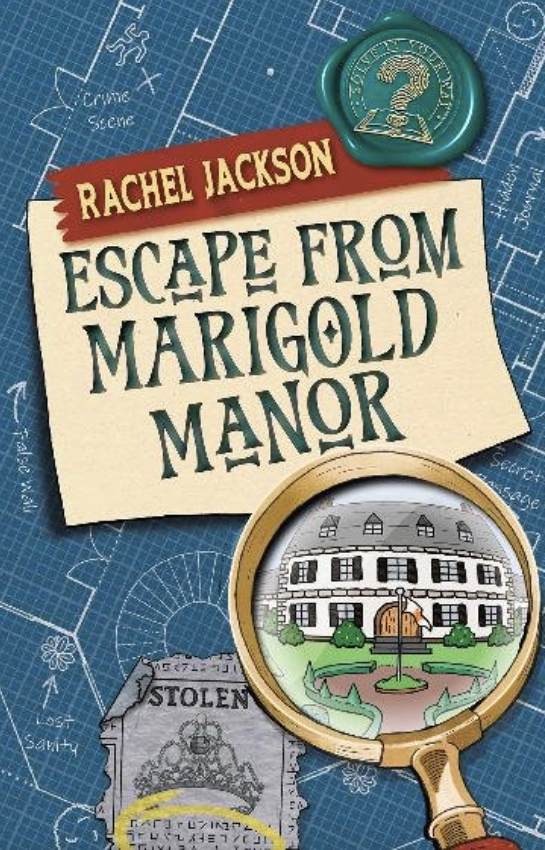

Rachel Jackson draws on her extensive experience as an intelligence specialist to create twisty branching plotlines. She’s also a sucker for good puzzles and bad jokes – subject matter that she shares generously with her readers in the Solve It Your Way series published by Riveted Press. Today we’re chatting to Rachel about her latest book in the series: Escape from Marigold Manor.
The publisher provided a review copy of Escape From Marigold Manor.
From the publisher:
You are the greatest detective in the land and you’re facing your biggest mystery yet. It turns out there is more than one way to leave Marigold Manor … You’ll find thirty-two unique endings in Escape from Marigold Manor. Each mystery requires you to complete a series of interviews and brainteasers in order to identify the culprit. The challenges include puzzles that you must crack in order to unlock safes, read secret messages and locate hidden clues. The casefiles at the back of the book will help you keep track of which cases you’ve sold, and which cases still await you in the mansion. Can you solve them all?
Escape from Marigold Manor has 32 mysteries in one book, with the reader’s choices affecting the path each mystery takes. As the writer, is it tricky to keep track of all those story paths?
I always joke that my brain is all over the place, and the Solve It Your Way books are just a reflection of my brain! Truth is, when I’m writing an interactive fiction like this, I use a spreadsheet to create a visual chart of the book’s structure. If you’ve ever done mind-mapping – with the ideas in little bubbles and lines branching out from there to more idea bubbles – it’s a lot like that.
The tricky part can be finding the right puzzle for a specific part of the story. This is particularly true in the case of Escape from Marigold Manor – where there are puzzles inside of puzzles as you navigate crime scenes and suspects.
When you read interactive stories like these, are you the kind of reader who picks a path and forges on – or do you keep a finger bookmarking the various pathways so you can try a different path if you don’t like the outcome of your first choice?
Oh, finger bookmarking – definitely! And I would run out of fingers. In fact, this is the exact reason that Escape from Marigold Manor has a checklist at the back with page numbers so you can reinsert yourself into the story at key junctions, without having to start all over again. Now, fingers are free for tearing out hair, biting fingernails or otherwise immersing yourself in the dastardly world of Marigold Manor.
In real life you have experience solving mysteries, and in Escape from Marigold Manor, the reader is the detective. When there’s a mystery to be solved, what makes a great detective?
Firstly, kindness. Because the whole point of trying to solve the mystery is that you want to help someone – the victim, their family, the community and even the offender.
Once you’re knee deep in clues and suspects you need to have enough attention to detail to gather all the information surrounding the mystery, but then you need to be able to decide which information is actually useful. If you find yourself faced with a mystery (say, your pencil is gone), start by asking small questions that you can answer (such as – when did you see it last? Two days ago, on your bookshelf!). This will lead you to bigger questions that you can’t answer – yet! (Who had access to my bookshelf in the last two days?). That knowledge gap is where you need to focus your investigation. You might want to interview suspects (your little brother?) to identify motive (he was looking for a pencil last week!) and opportunity (but he was camping with Dad the whole time, so he couldn’t have taken the pencil). Keep asking questions and chasing up new leads. Even the ones that don’t seem important at first (mum did the shopping yesterday), might turn out to be the key to solving the mystery! (Mum borrowed your pencil to write the shopping list.)
Do you have a tip for young writers who want to write a mystery story of their own?
Do it! Honestly, it’s so much fun. The key to a good mystery, in my opinion, is that more than one character should have good reason to have committed the crime. So, make your characters really interesting, with shades of good and bad. That way, whoever your villain turns out to be, it will make sense to the reader!
Can you tell us a bit about what you’re working on next?
The most wonderful thing about the Solve It Your Way Series is that I get to build these puzzle-filled interactive storylines in a brand new setting each time. First was a swashbuckling pirate adventure in Escape from Cuttlefish Cove, then came the detective who-dunnit in Escape from Marigold Manor. Up next – dragons! Oodles of dragons for the reader to collect and interact with. Sleep with one eye open – Escape from Firestone Fortress is coming!
Escape from Marigold Manor is out now! Ask for it at your favourite bookshop or local library.
 alphabetsoup.net.au