Posted in authors, interviews

Sandy Bigna on Little Bones

Sandy Bigna is a reader, a book reviewer and a writer. Today we’re excited to be chatting to her about her debut book – a verse novel called Little Bones.

The publisher provided Alphabet Soup with a reading copy of Little Bones.

From the publisher:


While I hadn’t started collecting bones myself before starting to write Little Bones, I’ve always had a fascination with them, and for people who do collect them. As bones are on the inside of us we don’t generally get to see them, which makes them seem mysterious and interesting. I remember once finding some tiny lizard bones in the driveway of the house where I grew up – and to me it was fascinating to have a glimpse of something that is usually hidden. I even took photos! It was this initial fascination that inspired the theme of bones and bone collecting. I needed to do some research to increase my knowledge about bones and skeletons – using both online sources and library books. I learnt many fun facts about bones. Did you know that birds sometimes eat animal bones to get calcium for making eggshells?

I’ve always loved reading verse novels. I love that they can tell a complete story, and convey such powerful emotions, in so few words. I love all the white space around the words, which helps you as the reader take a breather, and reflect on what is written – and on what is not written. I love the creative placement of words on the page and fun use of text font. I love reading verse novels so much that I always knew I wanted to try to write one of my own, and I’m so glad I did! It just felt like the right way to tell this story, and it was the most fun I’ve ever had writing a manuscript. I had the creative freedom to play with the joy of language.

Editing is such a valuable part of the journey to publication, and I enjoyed the editing process much more than I thought I would! The finished book changed quite a lot from the original draft that I submitted to the publisher. The first part of the story, and the ending, stayed mostly the same, but the middle part of the story received a much needed overhaul. The hardest part was cutting around 15,000 words from the manuscript! Thankfully my wonderful editor Felicity helped me with this part. We also decided to cut a couple of characters from the story (originally, there were going to be three animal skeleton characters, not just Bird). Once these characters were cut, we realised they were not essential to the plot. With each round of edits the plot was tightened, the magic elements made more consistent, the relationship between Bones and Bird strengthened, and the tension drawn out, to make a more satisfying conclusion. Each round of edits ultimately made the story so much stronger. 

The most important tip is to have fun and try new things! The best part about writing a verse novel is that you have the freedom to play with ideas and language and placement of words on the page. I would also suggest reading a lot – verse novels, as well as all types of fiction and non fiction, to generate ideas, and see how other authors have succeeded in your chosen genre. It’s not essential to read and write poetry to write a verse novel – but I found doing both quite helpful in inspiring me to experiment with free verse and lyrical language.  You might even want to try reading song lyrics and listening to music – as in many ways, writing a verse novel is a bit like writing a song! Verse novels often have the same rhythm and energy as music.

I’m excited about the next chapter of my writing journey. I have a two-book deal with UQP and would ideally like to continue to write for a middle grade audience, as this is where my passion lies, but I am always open to writing for different age groups or experimenting with other genres. I look forward to the next part of this writing journey and sharing more stories of hope, friendship and adventure with you all! 

Little Bones is out now! Look for it at your favourite bookshop or local library.


Read some sample pages from Little Bones

Watch Sandy Bigna introduce Little Bones to the world [YouTube]

Download the Teachers’ Notes

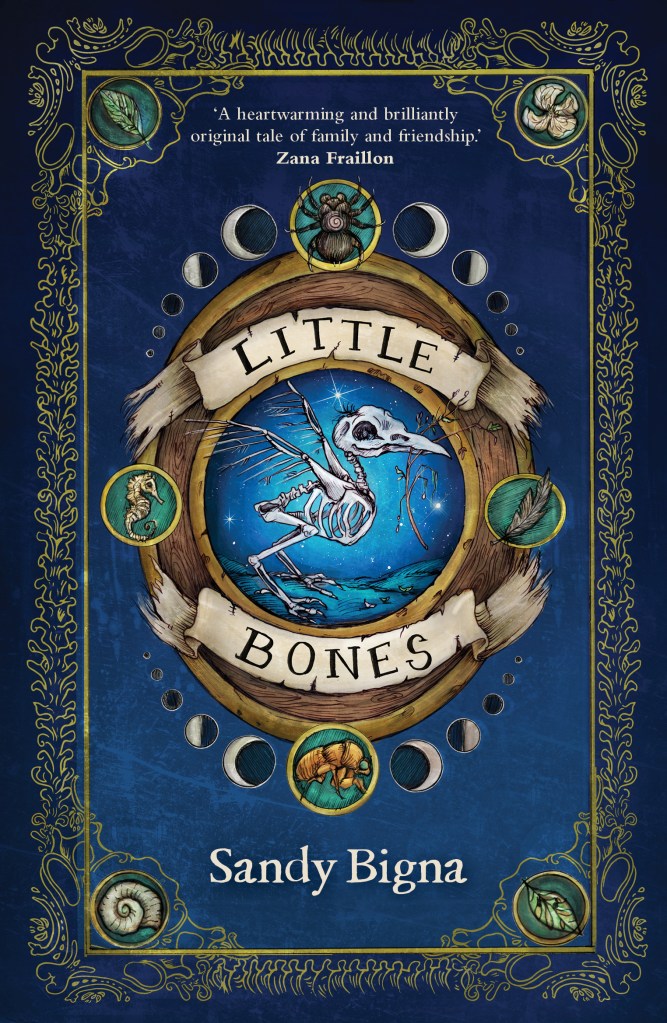
The cover of a book: Little Bones by Sandy Bigna
Posted in authors, interviews

Wendy Orr on Honey and the Valley of Horses

Wendy Orr is an award-winning author with 40 books for children, teenagers and adults Her books have been published in 29 languages and her Nim’s Island books were made into movies. We’re thrilled to be talking to Wendy about her latest book – Honey and the Valley of Horses.

From the publisher:

When Honey was four and her brother Rumi was a tiny baby, her family loaded up their converted ice-cream-van-camper and drove away from all they knew, as an illness swept the sad wide world. High in the mountains, they crossed a bridge to follow a mysterious herd of enchanted horses into a sheltered valley. The bridge and the track disappeared behind them – and now they are trapped in paradise.


He’s a combination of our family’s first horse, Biddy, who was an American quarter horse with a touch of Thoroughbred, and my father in law’s palomino Australian stock horse, Pancho. Biddy was over 12 when we got her; I was ten, my sister eight and my brother three, and she behaved differently with each of us, deciding just how much she had to look after us. So she was always completely trustworthy with my little brother, but once I’d learned to ride she’d test me quite a bit – and when we did a paper route for a while, she got bored with doing the same ride every day and started throwing me every time! Pancho was probably the best trained horse I’ve ever ridden, an absolute delight to ride though a very spirited stallion. He had a fantastically smooth gallop, which was as wonderful to watch as to ride, and when he was galloping loose in his paddock, loved to race towards something and stop dead or spin around just before he hit it.  And there’s a bit of my own horse Tala, who I got when I was fourteen. She was an enormous mostly Standardbred, who was quite neurotic and very flighty, but always tuned in to my moods and would be very affectionate and gentle if I was upset.

Absolutely. Although we live in a rural area, we were classified as metropolitan Melbourne for the purpose of lockdowns, so it was very strict and long. My son and his wife and toddlers lived with us for the first year, but when they moved out they were more than 5 km away so for long periods we weren’t able to see them, or my daughter and her toddlers, who were on the other side of Melbourne. My parents and siblings were in Canada, and with the borders closed for so long I was very aware that I might never see my parents again – which in fact happened, as my dad became ill and died during 2021. So the isolation, the sense of not being able to see people we loved, and also the general fear and anxiety during this time were a crucial part of forming this book. The good thing is that it meant it was all the more important to create a fun and adventurous paradise for the family to escape to. It was certainly very important to me to escape to it while I was writing! And I hope that the reader will enjoy that escape too. We all need special places in our lives and our minds.

She loved it! At first she was worried that no one would know what an editor does, so I hope I explained that during the book. But she loved escaping to the valley too, which made life easier for me.

I have several things which range from already in a first draft, to an idea I’m quite excited about but don’t know very much about yet. All I can say right now is that I love thinking about how many thousands of people we’re all descended from. Each one of them had their own story – which is quite mindblowing when you think about it!

If you’re going to use a touch of magic, you need to have clues that something strange could happen, right from the start. It doesn’t need to be much: in Honey and the Valley of Horses I start with the sentence, ‘In the mountains there was a valley, and in the valley were the horses.’

The rhythm of that sentence suggests that this is a story-telling type of story, not a realistic ‘kids going to school’ type of story. Even saying, ‘the horses’ suggests something different than if I’d said, ‘There was a valley in the mountains, and lots of horses lived there.’ Those could be any horses, but saying ‘the horses’ suggests there’s something special.

Making up a world that has a bit of magic means that you can do anything you like – but it doesn’t mean that there are no rules. You need to work out what the rules are for your magic. In this book, the horses certainly have some kind of mysterious magic, and are stronger and faster than other horses – but they are still horses. For example, they can’t talk or fly. You could write it so they do talk or fly, but you would need to show that from the start, or if you didn’t want them to do it until the end, you could have a detail early in the story so that it made sense if they flew when they absolutely needed to. For example there might be a certain grass that people said would make horses fly if they ate it, or there might be old stories about a horse that flew, and people have noticed that this horse looks just like her ancestor, with the white snip above the left fetlock… Just some little hints.

Everything that isn’t magic has to make sense. Unless it’s part of the magic, water can’t run uphill, the sun rises in the east, people and animals need food, water and sleep…

Any touches of fantasy need to be significant for the story.  They need to show the reader something important about a character, whether good or bad; or about the place; or they need to move the plot along. If you have a scene you really want to write –  a purple sun that shines at night; birds standing still while dogs sing, whatever your imagination has built for you – you can use it as long as you work out why it belongs in the story. Working out the reason might take your story in a different direction, but that’s okay too.

If you roll all these tips into one, it would be, ‘Your story has to make sense right through. If magic is going to help resolve the problems, it needs to be hinted at from the beginning. And it should always be your character who actually solves the problem, whether it’s by being brave enough to dare to use a power, or by passing a test that makes a power appears, or by harnessing a power to do the right thing.  But definitely try to avoid having a realistic character in a difficult but realistic situation, when suddenly at the end of the story, Abracadabra! everything is magically solved.

Also, don’t forget that good stories usually have many drafts. If you really liked that Abracadabra! scene you can keep it. You just need to go back and weave in some hints earlier in the story.

 But don’t forget the most important writing tip of all, no matter what genre: Have fun, play with your story, and see what happens!

Honey and the Valley of Horses is out now! Ask for it at your favourite bookshop or local library.


Image shows the cover of a children's novel: Honey and the Valley of Horses by Wendy Orr. The cover illustrations shows a valley with an ice-cream van parked under a large tree, a family of four in the shade of the tree and three horses galloping by.

Watch Wendy Orr talking about the book [YouTube]

Are you in Melbourne? You can meet the author and hear her talking about Honey and the Valley of Horses! 2pm, Saturday, 26 August 2023 at Readings Kids in Carlton. Tickets are free but bookings are essential.

Download the Teachers’ Notes at the publisher’s website.

Visit Wendy Orr’s website for more about her and her books.

Posted in authors, interviews

Paula Hayes on The Vexatious Haunting of Lily Griffin

Paula Hayes is an Australian writer of magical realism for young people. This means she is good at making strange stuff up and setting it in real life. Her first novel, Lily in the Mirror, was a CBCA Notable Book in 2017. Then Lily in the Mirror grew and grew and turned into an omnibus, illustrated by Katy Jiang – a trilogy of Lily books! Today we chat to Paula about the omnibus, The Vexatious Haunting of Lily Griffin, launched in July 2022.

From the publisher:

When Lily Griffin finds a girl trapped inside a magic mirror, she uncovers a long-forgotten family secret and sets in motion a remarkable chain of events. Lily is a singular character, hilariously funny, sweetly poignant and deeply daggy. Plagued by social doubts and her own pecularities, she is the perfect person to investigate the many secrets of her grandfather’s house and, along the way, mend some family relationships, discover enduring friendships and learn to play netball.


Lily in the Mirror started out as one book on its own and now you’ve added two more books about Lily – bound up in one omnibus! Was there anything you found different about writing books two and three, compared to writing book one?

The wonderful thing about writing a series is that the characters are created in book one and then they are fleshed out able to grow and develop over the course of the two books. This makes writing the books easier because you know exactly how your character will react and what situations will show them off to their best advantage. For example, Linden, Lily’s older brother (AKA PigBoy) is quite a flat character, he is a trope of a nasty big brother but during the course of book two and three he is fleshed out, he develops, and changes and we come to understand his point of view much more.

Have you ever been in a haunted house yourself?

I haven’t been in a haunted house for reals, but in my imagination, I have! I have the sort of imagination that can turn noises into ghosts. My toys used to come alive in my bedroom at night as I sweated under the sheets. Again – imagination … or was it?

We follow Lily’s story as she writes updates in her journal. Did you keep a journal or diary when you were growing up?

During my late primary school days and early high school days I kept a journal every night. I had a great English teacher who encouraged me to write anything and everything, especially feelings. I found writing a way to clear my head and clarify my emotions. I would tie the note book up with a shoelace with complicated knots for safe keeping. At the end of high school, I had about seven big books and I threw them in the bin. I had processed all the events and big feelings and released it. I’m sure if Lily stopped at the first journal, her relationship with her brother would not be properly represented. It’s just a moment in time.

How did you go about researching information about the various time periods that pop up in the omnibus?

As well as being a word nerd, I am a history freak. I studied it at uni. My grandmother’s house was a time capsule for the 1910s to the 1990s and so I was lucky enough to see a lot of the things that are contained in the Rosy Room and the Little House. I love to read history books, biographies and collect old books. But when I want to know a specific fact, I google and go down a slippery rabbit hole where I get immersed in the past and I love it.

Do you have a tip for young writers who’d like to try writing a series or trilogy?

My advice to young writers is just to pick up the pen or your laptop and write. Write anything, you can cull and edit later. As for a series, you might like to map out how your plot is going develop over the course of three books unless you’re like me, I’m a pantser (I develop my story as I go … by the seat of my pants).  Once you know your characters well, they will start talking to you and you will know where to take them and how they will react. Writing a series gives you the freedom to explore themes and characters properly and that is an amazing feeling. Hopefully it’s amazing for your readers too!

The Vexatious Haunting of Lily Griffin is out now! Ask for it at your favourite bookshop or local library.


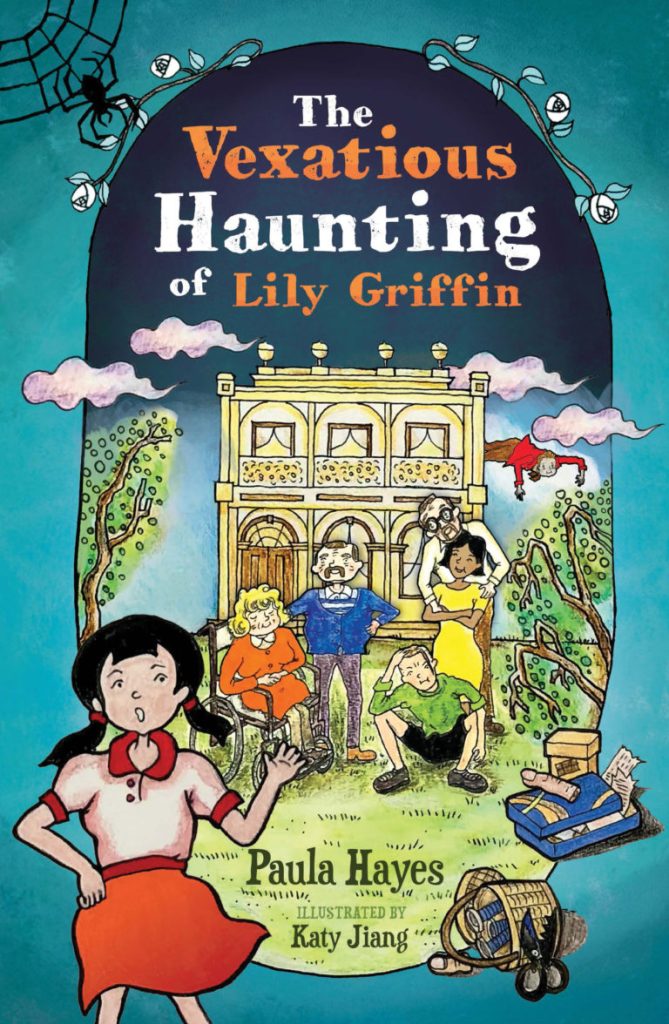
Image shows the cover of a children's novel: The Vexatious Haunting of Lily Griffin by Paula Hayes and Katy Jiang. The cover shows Lily standing at the bottom left of the cover. Lily is a young girl with dark hair in pigtails, wearing a white blouse with red collar and an orange skirt. Behind her are an old woman in an orange dress sitting in a wheelchair, a man with a moustache wearing a blue cardigan and brown trousers, a woman wearing a yellow dress being hugged from behind by a man in a white shirt. At the woman's feet sits a teenage boy in a green shirt resting his forehead on his hand. Above them all floats a teenage poltergeist in a red shirt and brown pants. At the top left of the cover is a spider in a web.

AWESOME EXTRAS:

Read an excerpt from the book on the publisher’s website

Download the teaching notes

Visit Paula’s website for more about her and her books