Penny Draws a Class Trip by Sara Shepard, Text Publishing, ISBN 9781922790712
REVIEWED BY AASHI, 10, VIC
The publisher provided a review copy of this book.
Sara Shepard has written a great story about Penny Lowry, a girl who loves drawing and writing. Penny is 11 years old and in 5th Grade. She was delighted to find out that her class is going to meet and work with a best-selling author, Billy J Plumberry.
Penny is thrilled that she will be spending the weekend in the big city. Penny is also nervous about the different things in the city like falling pianos or aggressive pigeons.
The thing that worries Penny most is being Violet’s buddy. This means she will have to spend the whole trip with Violet. Violet Vance is her ex-best friend.
The story is very funny and heartwarming. I loved how Sara wrote the story through Penny’s eyes and how the doodles connect with the words.
I would recommend this book for 7–12-year-olds. I think this would also be a good class novel. I hope you read the book.
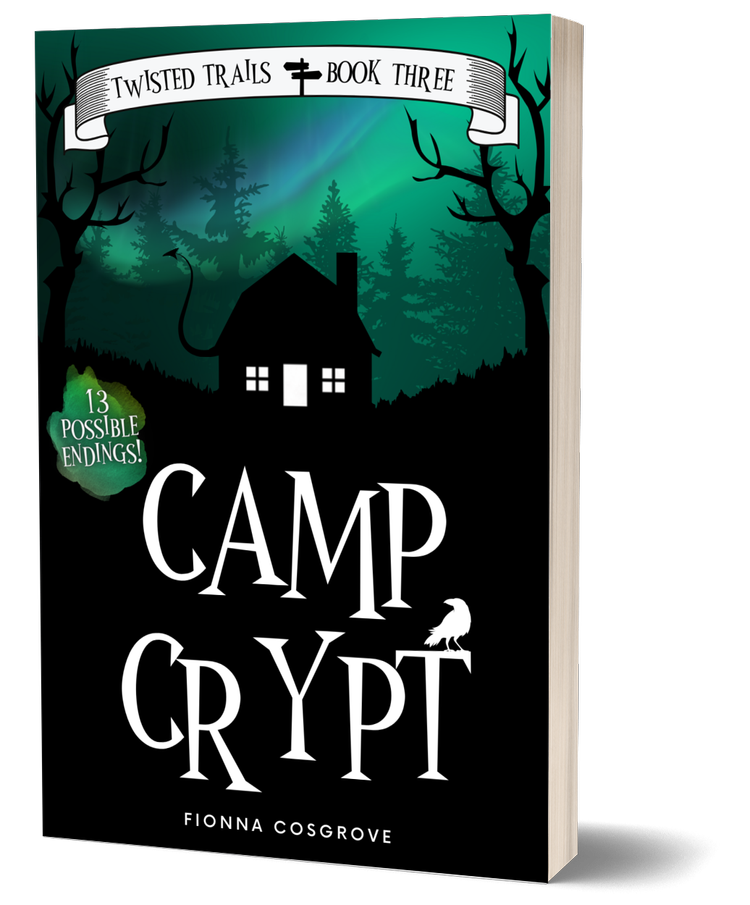
Twisted Trails: Camp Crypt by Fionna Cosgrove, published by Fionna Cosgrove, ISBN 9780645723342
REVIEWED BY AASHI, 10, VIC
Aashi received a review copy of this title.
You pull off a prank, only meant to teach a boy a lesson, when the boy almost dies. The next thing you know, you are on a bus to a camp for youths who have committed crimes. You have no idea why your parents sent you to this camp, but you know you were not supposed to break someone’s neck.
At this camp, you notice some weird things, like why does the bus driver have horns or the camp director shimmer and glow? You have many ways to escape, others where you die.
Camp Crypt has twelve possible endings. I kept on trying to find a possible ending where everyone lives happily ever after. Whether you read very little or a lot you will still find satisfaction. The book keeps you on your seat and is a thriller.
I would rate the book 5 out of 5 because I thought it was great whether you made it out alive or not. It was a fun book and I would recommend 9-12-year-olds to read it. Fionna Cosgrove has once again created such a wonderful book about wishes and pranks, vampires and criminals, and most importantly friendship and loyalty.
Sally Murphy is an author, poet, speaker and educator based in the South West of Western Australia. Sally has published more than 40 books, and we’re thrilled to be chatting to Sally about her verse novel: The Riding Gallery, illustrated by Martina Heiduczek.
From the publisher:
In Melbourne’s St Kilda, as World War 1 begins, Anton (a German immigrant) fulfils his dream of creating the most beautiful steam-driven “riding gallery” – a merry-go-round – in the world. Evelyn, who has just moved to the city, befriends a local boy, but the war, and anti-German sentiment, soon takes its toll on the children, Anton, their families, and the riding gallery itself.
This is your sixth verse novel, and you also write prose novels. When you sat down to write this story, how did you come to choose to write it as a verse novel?
For my previous verse novels, they were always going to be in that form – that is, they came to me as stories in verse. This one was a little different. I stumbled across the piece of history (a merry go round tracing back to World War 1) and when I researched its origins and saw the story behind it, I thought it might make a historical picture book. I wrote it that way, but feedback from publishers was that it didn’t work – there needed to be more story to really make clear why things happened around that merry-go-round. It took me a while, but I finally realised they were right – and that I needed characters other than Anton, the ride’s owner. That is when I realised multiple voices, in verse, would be the ideal format. Verse novels allow for those multiple viewpoints, and the depth of emotion a story like this one needed.
The Riding Gallery is historical fiction. How did the story find you?
The story found me in Canberra one very cold July, when I was there for a month courtesy of the May Gibbs Children’s Literature Trust. I walked every day, and often walked past the merry-go-round that is located in the city centre. I got curious about that merry-go-round, read an interpretive sign, and had to know more. It was a hard story to piece together, but the more I learnt the more I knew it needed to be told.
Could you tell us a bit about the newspaper poems included in book?
The story takes place against the backdrop of World War 1, and I wanted to be sure to include some of the major war events, even though the story is set on the home front, in St Kilda. Most of what people knew about the war was dependant on the reporting in the papers, so it seemed a good way to know what was reported was to look at the papers of the day. The poems that resulted are all found poems – that is, they each use only words from a single news report from 1915.
Have you been able to ride on the merry-go-round (the riding gallery) from the book yourself?
I have indeed ridden it – along with my publisher, Clare Hallifax. But I’m embarrassed to admit I don’t remember the name of the horse – I was pretty overwhelmed by actually riding on Anton’s ride.
Sally Murphy at the riding gallery, Canberra.
Can you tell us a bit about what you’re working on next?
I always have multiple projects on the go, at different stages of completion. I’ve recently sent the manuscript for a war-themed picture book to my publisher – I think that will be out in 2026. And I am trying to edit another historical verse novel, set in WA in World War II. I’ve also got other projects waiting (im)patiently for me to get back to them.
The Riding Gallery is out now! Ask for it at your favourite bookshop or local library.
I am Rebel by Ross Montgomery, Walker Books, ISBN 9781529502909
Rebekah’sreview of this book was longlisted in the 2024 Young Reviewers’ Competition.
This heartachingly tender quest novel is an adventure from the very first page.
In Ross Montgomery’s I Am Rebel, readers are whisked away into a world where bravery and imagination collide. Set against the backdrop of a dystopian, war-torn world, this middle-grade novel introduces us to a canine protagonist, Rebel, who embodies the true essence of loyalty. As I journeyed through its pages, I found myself captivated by Rebel’s courageous spirit and the profound themes woven into Montgomery’s narrative tapestry. I Am Rebel not only entertains but also challenges young readers to experience the world in a refreshingly new way.
Rebel is a good dog, and he loves his simple, perfect life on the farm with his owner, Tom — until one day, the war comes too close …
Now Tom is determined to join the rebellion to defeat the king’s men. But Rebel knows war is dangerous, and he will stop at nothing to save the human he loves, meeting unexpected friends along the way.
The main characters of this story include Rebel, Tom, and the animals Rebel befriends on his journey to find Tom: – Rebel’s role in this story is key; the book is told from his perspective and his role is just to be the true embodiment of doggedness. He stops at nothing to find Tom or help his friends, and he is caring, kind and courageous. At one point, he says:
I’m Tom’s dog, and he’s my boy. And if he’s stepped right inside the jaws of death, then I’m going to follow him into them and bring him back out.
– Tom is a determined 12-year-old, and he lies that he is 16 so that he can join the rebellion. Tom’s role in this story is to be Rebel’s goal to reach.
– Rebel’s animal friends provide him with shelter and help him navigate his way to the High Castle, where Tom is.
The themes in I am Rebel are meaningful and deep, especially in the dystopian world that Rebel must navigate through.
Themes of friendship, love and loyalty are explored in this book. Rebel’s hunt for Tom is the central message of this story, and it displays all of these.
The author, Ross Montgomery, has woven these themes in such a way that they are rooted in every nook and cranny that they can be.
Montgomery uses much description, and as I delved deeply into this book, it was as if I could feel pain, or heat, or rushing water. The emotive language is heartwarming, and the tension keeps you on the edge of your seat. There are parts where you bury your face in the pages and say: “No! It can’t end there!” Montgomery has used these elements in a perfectly balanced way.
Some other feedback from other readers:
“I Am Rebel both broke my heart and made it sing. This book is as close to perfect as it’s possible to get.” Natasha Farrant.
“A beautiful, heartfelt adventure.” Sophie Anderson.
Overall, this book is a classic; with strong themes, description, and the occasional dash of humour, it’s a treasure of writing.
Rebekah’sreview was longlisted in the Primary category of Alphabet Soup’s 2024 Young Reviewers’ Competition. The competition is now closed, but we publish book reviews by young writers all year round. To send us YOUR book review, read our submission guidelines. Happy reading!
REVIEWED BY CLASS 4K AT GREAT SOUTHERN GRAMMAR, WA
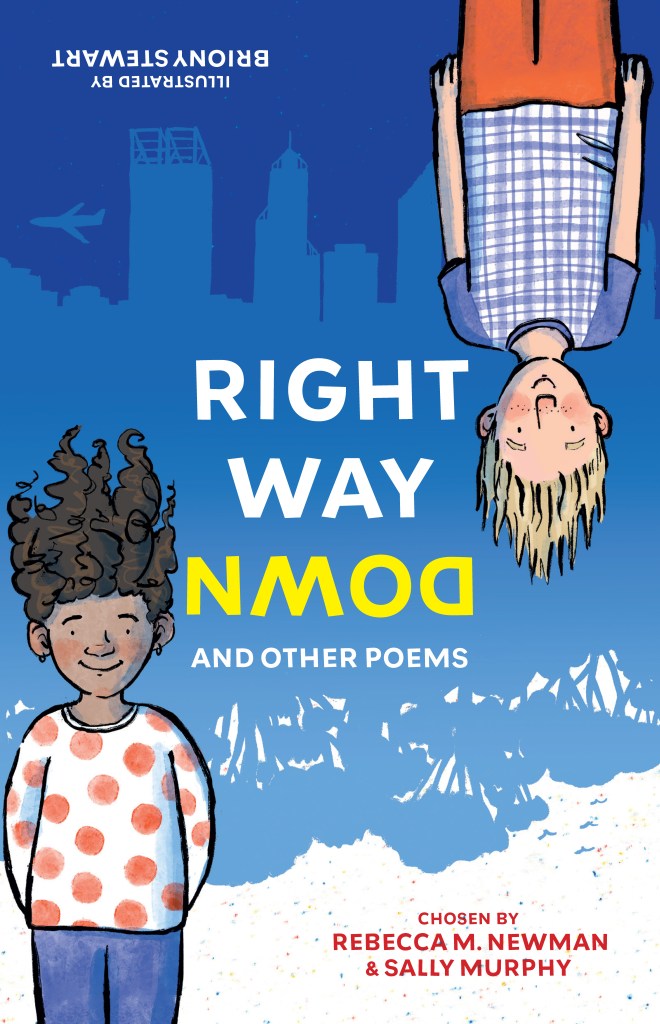
Right Way Down and Other Poems, edited by Rebecca M. Newman & Sally Murphy, illustrated by Briony Stewart, Fremantle Press, ISBN 9781760993429
Alphabet Soup is a co-publisher of this book andprovided a review copy.
Right Way Down and Other Poems is a great book filled with fun and awesome poems. Each poem tells a little story that makes you think. Some even make you laugh out loud.
The poems voted as our favourites were:
‘How to be a Dragon Egg’ by Rebecca Newman – This poem made you feel that you were the dragon in that egg.
‘Right Way Down‘ by Sally Murphy – The front cover is such a good design and we had fun reading this poem upside down.
‘Rain!‘ – When we read this poem in class, it was raining, and the poem put words to what we were hearing.
Why It’s Great: The poems are easy to read and have a nice rhythm, so they sound good when you read them out loud and even to yourself. The words are simple but create vivid pictures in your mind.
Pictures: The book has lots of black and white drawings that don’t overshadow the poem and still lets you create your own pictures when reading the poem.
Overall:Right Way Down and Other Poems is a fantastic book for kids and adults. It’s great reading for those spare couple of minutes you find in your day. If you love great poems, you’ll really love this book!
This is the first ever book review from Class 4K at Great Southern Grammar. If YOU would like to send us a book review, check out our submission guidelines. Happy reading!
Home of the Brave by Katherine Applegate, St Martin’s Press, ISBN 9780312535636
Skye reviewed her own copy of this book.
Home of the Brave by Katherine Applegate is a heartfelt story about finding a true home away from home. An 11-year-old refugee named Kek migrates from Africa to America to live with his only living family members, his aunt and cousin. As curious as he is, English is not his native tongue and he finds that life in America happens to be a great deal different.
What makes this book so special is the poetry of the language and the way Kek observes the world in this new environment. One of my favourite quotes is the first line of the book: ‘When the flying boat returns to earth at last, I open my eyes and gaze out the round window. What is all the white? I whisper. Where is all the world?’ This was the moment I realized Kek had never been on an airplane before. He says ‘flying boat’ to describe an airplane, using the only English words he knows.
Adventuring through this new world, Kek meets friends who bring him strength, including a girl in foster care who might actually understand what he’s been through. Kek in return brings his own meaning of life to America. He finds a weary old cow in need of love; the owner does not have the money to give the cow the life it deserves. In Kek’s culture cows are the meaning of life, also known as ‘God with a wet nose.’ Kek knows there is beauty in this cow and makes it his mission to love the cow like his native people would have treated them.
This book makes you feel happy and teaches the life lesson of being grateful. Kek’s innocent mistakes continue to make me smile. The story symbolises hearts being mended not only for Kek but also the people around him. My rating would definitely be a 10 out of 10.
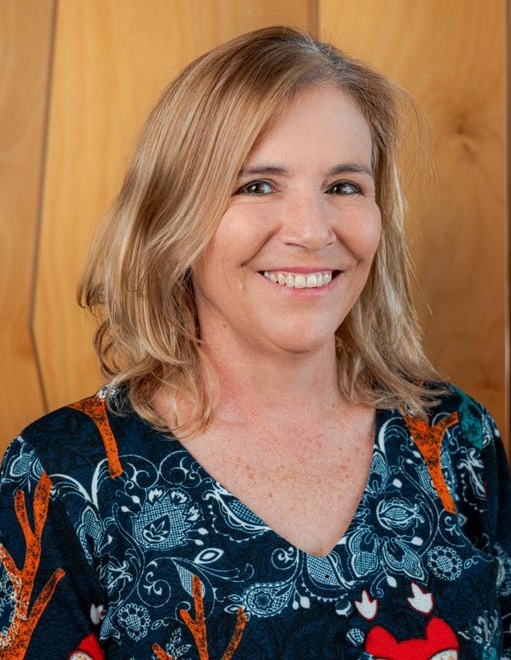
Fionna Cosgrove is a Western Australian writer with a taste for the wonderfully macabre. Her writing has been published in The School Magazine and anthologies, and she’s also the author of the Twisted Trails series for young readers. Today we’re chatting to Fionna about how she writes her Twisted Tales!
About the Twisted Trails series:
Will you end up a zombie’s breakfast? Or maybe coming face to face with a kelp-haired sea witch is more your style? Whatever your taste, you’ll find it in this wild and spooky interactive series … How will your story end? Well, that’s entirely up to you.
What brought you to write The Midnight Manor (Book 1 of your series)?
It actually came about while I was waiting to hear back from publishers about another manuscript. I had sent out one manuscript and was wondering what to write next. It was around October, and I thought why not quickly write a book for my niece and nephew for Christmas? So I started writing The Midnight Manor. It was only meant to be a short choose-your-path book, aimed at kids 6–8. With that in mind, the word count was quite low, so I wrote the book within a few weeks. It was once I went back and started fleshing it out that the book kept expanding, and expanding and expanding, and I realised pretty quickly I had a middle grade book in my hands … and not just one, but a whole series. Once I had written the draft I figured if I’m going to get it printed for my niece and nephew, why not self publish it and put it out into the world? So with shaking hands, I started the process!
The idea for a series developed pretty easily after that. Why not write more if the first one was so much fun? Plus, there are MANY more creepy settings I’d love to explore!
How do you go about plotting a choose-your-path style book when there are so many different storylines/endings to keep track of?
I found this tricky. I initially just started writing and at any point that felt like a decision needed to be made, I made a fork and went on my merry way. It was only after a few forks and a few dead ends and plot holes, that I realised I needed to be a bit more organised. I pulled out a giant piece of paper and started drawing a big old story map. I start with one box at the top then drew two lines out of that for each decision with more and more boxes and lines indicating the paths. It sounds a bit complicated but it’s actually pretty easy. I’ve even made some free printouts you can download from my website that talk you through it.
One thing that can get confusing is time lines. Trying to remember where all your characters would be if different choices were made or not made can get a little confusing, but plotting it out helps! As far as the endings, I like to have a good mix of ‘reasonably happy’ endings and ‘not so happy at all’ endings, with one or two ‘absolutely perfect’ endings. I also try and figure out the ‘absolutely perfect’ endings first so that I have a bit of direction while I’m writing, otherwise I have a tendency to get myself a little lost …
You also write the regular kind of novels that only have one ending! Does one type of book take longer to write than the other?
The choose-your-path books are actually much quicker to write for me. They are full of crazy twists and turns and wild characters, but I don’t spend too much time on backstories or character growth. It’s fast-paced action with a lot of humour thrown in. And horror … a lot of horror.
I have a book coming out in October called Sadie and The Secret of The Swamp which has just one story line! I know, crazy. And that took me over a year and a half to write and edit. In comparison, The Midnight Manor only took three months from first draft to sending it off to my editor.
Do you have a tip for kids who’d like to try writing their own choose-your-path book?
Choose a great setting! With an interactive book you get dumped right into the action straight away so there’s less time for a detailed backstory. I find the best way to add some intrigue is to have a brilliant setting that acts as its own character. A spooky mansion that appears out of the mist at midnight … or a submerged grotto filled with bioluminescent coral in a deserted town, or my latest one – a creepy summer camp set in the middle of the forest.
And use a story map to keep track of your paths!
I’d also like to say plot everything out to save you running into plot holes and dead ends everywhere, but sometimes I think the most fun part of writing is discovering the story as you go. So just have fun. The first draft is meant to be messy and weird. The second draft is for making sense of it!
What’s next for Fionna Cosgrove?
I have two books coming out this year! I have book 3 of my Twisted Trails series: Camp Crypt. This is my creepiest one yet, with even my 45-year-old sister telling me she had to sleep with the lights on after reading it. (Spoiler, she’s not a fan of clowns). And I have another spooky mystery – Sadie and The Secret of the Swamp – coming out at the end of October. Other than that, I’ve booked in a few author talks across the year, so that should keep me and my nerves busy for a while. And in general, I just want to keep writing and live a creative life, however that looks at any particular moment.
Ask for the Twisted Trails series at your favourite bookshop or library, or order online.
Allison Tait (A.L. Tait) is the internationally published bestselling author of adventure series The Mapmaker Chronicles, the Ateban Cipher novels, and the Maven & Reeve Mysteries. Today we’re chatting to A.L. Tait about her latest novel The First Summer of Callie McGee, a cosy mystery novel.
From the publisher:
It’s the last summer before Callie starts high school and she’s been dragged along to yet another ‘family friends’ holiday. Determined to change her nerdy reputation, Callie sets out to make waves but nothing is quite as she expects. Her usual ally, Sasha, has outgrown Callie; her nemesis, Mitch, has brought his cousin Owen along; and the boring south coast town of Sawyer’s Point has been rocked by a series of burglaries. Callie, Owen and Mitch decide to investigate the robberies, bringing them face to face with a local gang … and a possible ghost. But then Sasha goes missing …
You’ve published multiple fantasy novels, what was different about writing contemporary realism?
When you’re writing a story set in a fantasy world, you have to work incredibly hard to bring that world to life on the page with every tiny detail. You’re thinking about everything from what people wear and what they eat to how they buy things at the shops and how they travel from A to B – and then you have to make sure the reader understands all of that without resorting to long descriptive passages (boring!).
In a contemporary world, your reader knows what a car is and what a double-storey brick house looks like, so that side of things is easier – but it’s still essential to build a world for the reader to immerse themselves in.
The biggest challenge for me in the switch was the ‘real’ factor. In a fantasy novel, my characters can drink ale and fling themselves into rivers and readers know it’s not real, without having to be told not to try it themselves. In a contemporary novel, I felt like I had to take a lot more care about my character’s action. When Callie throws herself into a rip to rescue her younger friend Cody, for instance, I’ve already made it clear that she’s a strong swimmer and she’s been a Nipper, so she knows what to do.
When your series The Mapmaker Chronicles began you talked about sketching a map of the books’ world. While you were writing The First Summer of Callie McGee, did you draw a map of Sawyer’s Point?
Sawyer’s Point is based on a real seaside village called Gerroa, about 20 minutes’ drive from my house. I’ve spent a lot of time there over the years (in a friend’s holiday house!) so I could see in my mind exactly where Callie and her friends were at any time. Having said that, I did move things around a bit – Sawyer’s Point has a surf club, but Gerroa does not.
Is Callie’s trying on of a new name based on your own childhood experiences – did you ever try out different nicknames for yourself when you were growing up?
I’ve always found names fascinating – what they say about us, how they fit us and, maybe, how we grow to fit them. And nicknames are even more interesting, because having one implies you have that easy sort of relationship with someone else. I didn’t try to change my name as a child (though I know people who did), and my nickname has always been Al.
Do you have a tip for kids who’d like to write a story based on a real place/setting?
Write what you know, but make it new. Choose a place that you know really well and then change one thing. That one thing might be bringing a new person (character) into that place (one of the best ways to describe a place is to show it through a new person’s eyes – even if it’s your class at school). It might be adding a mysterious statue that’s been there forever and then, one day, has vanished – or perhaps it’s never been there before and then, one day, appears out of nowhere. It might be putting a trapdoor in the floor that leads to a secret tunnel.
Can you tell us a bit about what you’re working on next?
I’m excited to be working on a new contemporary middle-grade novel, which will hopefully be out next year! It’s got all the things I love – a character with heart, adventure, and mystery. Watch this space!
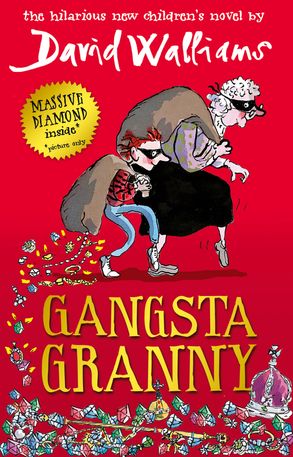
Gangsta Granny by David Walliams, HarperCollins, ISBN 9780007371440
Aashi reviewed her own copy of this book.
Ben’s granny is your typical granny. She knits, loves Murray Mints, has fake teeth, loves Scrabble, has white hair, and is obsessed with cabbage. Ben reckons she’s the most boring person in the whole, wide world. Ben goes to Granny’s every Friday after school while his parents go and watch Strictly Stars Dancing live. Ben’s parents love ballroom dancing and say they discovered their love of ballroom dancing too late, so they got boring jobs at a nail salon and a security guard at a shopping mall. They want Ben to be a professional ballroom dancer, but Ben has other interests like becoming a plumber.
When Ben goes to Granny’s one day, he goes to get a chocolate biscuit but finds something thrilling instead. He is mind-blown by this discovery and is determined to find out more about this mystery. Ben is on the case!
This fabulous tale by David Walliams is a stupendous book and I rate it 5 out of 5. Walliams has made a thrilling tale that has so many twists and turns. It kept me on the edge of my seat! It’s a great book and I recommend it for 6–9-year-olds, it will surely be loved by them. Once again it was a stupendous book, and you should surely read it. I hope you read Gangsta Granny as your next novel.
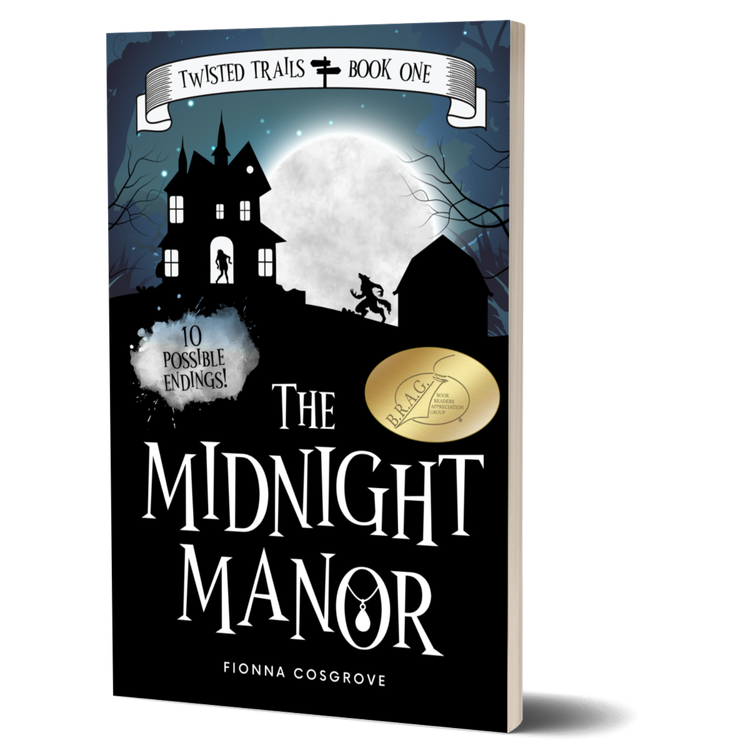
The Midnight Manor by Fionna Cosgrove, Lightning Source Inc., ISBN 9780645723304
Ayaan received a review copy of this book.
The Midnight Manor is the first book in the twisted trails series and was published in 2023. It was written in a ‘choose your own adventure’ style, sharing the story of the Manor and the Game.
But this is not like other stories of the same genre. Cosgrove has written the scenes out in impeccable detail and interesting side comments. Can you escape the manor before you are trapped for all eternity? Or will the mist take you all?
You must weave your way through the manor facing wolves, zombies and a creepy old innkeeper. And if you don’t like the way your story turned out, you can always go back to the start and have a do-over.
I would rate this book 5 out of 5 as its description makes me feel as if I am really in the manor. You should definitely read this book.