Spooky Sleuth & Solve:Decode mind-twisting mysteries inspired by classic creepy characters by Victor Escandell (an adaptation of mysteries by Ana Gallo), Chronicle Books, ISBN 9781797205908
REVIEWED BY ARJAN, 11, NSW
Arjan reviewed his own copy of this book.
This is a nice adaption of spooky stories for kids to read and added twist of detective work. I liked its goofy and hideous drawings.
I learned that you need to fully read and absorb the information given to be able to solve the mystery. The book helps with building comprehension skills. When I read the first story, I didn’t get the answer but by the third story I had improved my thinking and observation skills. It was fun solving the questions and decrypting the answers.
I recommend this book for kids to read for Halloween, and it gives ideas for Halloween costumes. It’s a fun book that has twists on classic scary stories. When I first started reading the book, I found it was quite creepy and dark, but the more I read, the stories became funny and interesting. My personal favourite story was ‘The Loch Ness Monster’ because you had to read the text thoroughly to get the answer.
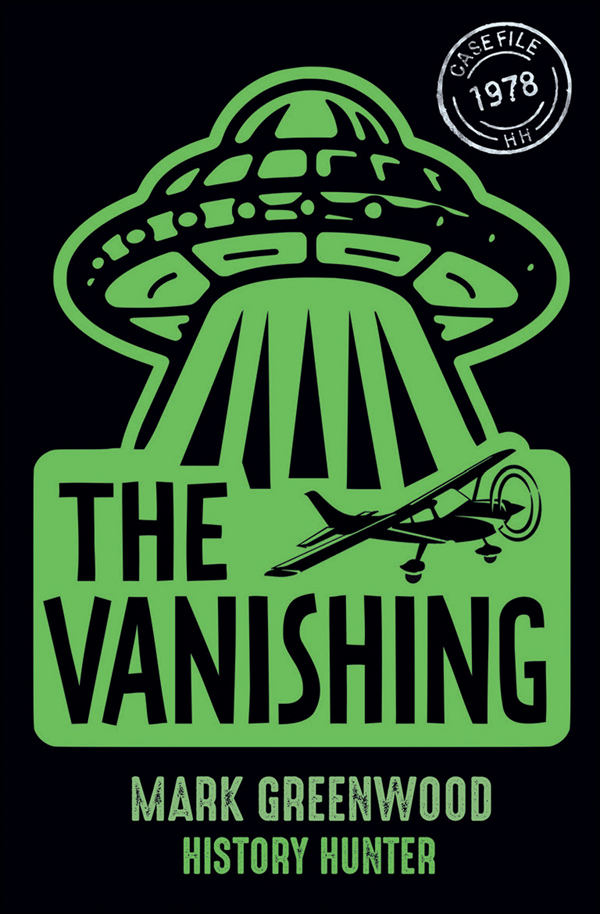
The Vanishing by Mark Greenwood, Fremantle Press, ISBN 9781760993962
REVIEWED BY MARLEY, 9, PALMYRA PRIMARY SCHOOL, WA
The publisher provided a review copy of this book.
The Vanishing is a non fiction mystery book about Frederick Valentich going missing in his aircraft. He was a very kind person and his life was going very well for him and he was persistent and dedicated to becoming a pilot. One evening Frederick was meant to fly over Bass Strait but he and his plane vanished after he said he saw a UFO. He described it over the radio in his eerie last transmission as being ‘not an aircraft’.
People have lots of different theories about him going missing. One of them is being abducted by aliens, but his partner, Rhonda, says that he told her he would never board a UFO without her. Another theory is that he crashed into the water, but none of his aircraft pieces were found. There was also a photographer who took a picture that night of the sunset, where Frederick was flying, and it looks like a UFO hovering over his aircraft.
I really enjoyed this book as there was so much information and investigation, and the story itself was really interesting. The cover is also really inviting – if I had seen this cover at the library I would have chosen it. This is the first investigative book I have read and it was a great experience getting to learn about the case and that it actually happened.
I think this book should be for nine or ten years and up because some of the words are really big and hard to read. I think anyone interested in mysteries and cold cases and the paranormal would enjoy this book very much.
Charlie Archbold has been a teacher in Australia, the UK, and Indonesia, which has given her a trove of experiences to infuse into her stories. Charlie’s books often explore themes of curiosity, community, and justice. Today we’re chatting to Charlie about the second book in her adventure series: The Sugarcane Kids and the Empty Cage.
The publisher provided Alphabet Soup with a reading copy of The Sugarcane Kids and the Empty Cage.
From the publisher:
Gloria the talkative eclectus parrot is missing from the animal sanctuary, and Anna the massive ‘not an anaconda’ Australian scrub python has vanished from her enclosure at the library. Have they escaped? Or were they stolen? Andy, Eli, Harvey and the twins, Bernie and Fletch, along with Eli’s trusty sausage dog Washington, have their eyes on a prime suspect. Can the Sugarcane Kids follow the clues to discover what is going on?
The Sugarcane Kids are good at solving mysteries. When you’re starting a new mystery book, do you work out the whole plot (including the end/solving the mystery) before you begin the first draft? Or do you prefer not to plan – and to solve the mystery alongside your characters instead?
I always start with an idea of the feeling and themes I would like my readers to take away. I especially like to round off or echo the beginning and end so the story has a symmetry. How I get there though is a bit of a journey. I unravel the mystery with the characters. The balancing out of the story then becomes my focus in later drafts. It is really fun not knowing how a choice you make as a writer will affect the story. One thing leads to another and that is the best bit.
Your series is set in Queensland – is there a particular reason you’ve chosen Queensland?
Queensland is a special place to me, especially the far north. I spent time working there when I was in my twenties and then twenty years later. It is always the place I choose to visit. It is a magical place. Full of ancient rainforest and turquoise sea. I also set my books there because it is a regional non-urban area. Many books are set in cities but I like to set my books in unusual places.
At the centre of this mystery is Gloria the eclectus parrot. Have you seen an eclectus parrot in the wild?
I have been lucky to see both a male and female in the wild. They are so gorgeous, cheeky and clever. I have also met some close up in wildlife parks. My aunt had a pet parrot for years called Bird. He really made an impression on me.
Do you have a tip for young writers who want to try writing a mystery story?
Start with a problem or situation that needs to be solved. I suggest dropping your characters straight into the problem. Decide how you want it to end. Is the mystery solved or left undone? I like my mysteries to be solved. If you are a plotting person you can then plot and write. If you are not a plotter, jump on in and see where the story leads you but be prepared to rewrite it.
Can you tell us a bit about your next writing project?
I have a new Sugarcane Kids mystery coming out in 2025, which I am extremely excited about, The Sugarcane Kids and the Mystery at Angel Bay. This time the characters are heading out onto the Great Barrier Reef to find out what has happened to Jerry, a massive Queensland Groper fish.
The Sugarcane Kids and the Empty Cage is out now! Ask for it at your favourite bookshop or local library.
AWESOME EXTRAS
Read Chapter 1 (look for a ‘Preview this book’ link under the photo of the cover)
Ash Harrier has a great fondness for puzzles, scientific facts, birds and the smell of dried tea. Today we are thrilled to chat to her about her latest novel – The Deadly Daylight, the first book in the Alice England Mysteries series.
From the publisher:
Twelve-year-old Alice England is curious, truthful and smart, but when you work in your father’s funeral home and you get messages from the dead, it can be difficult to make friends. When she comes across the peculiar case of George Devenish, who was allergic to sunlight, Alice is convinced there’s more to his death than meets the eye. With the help of George’s niece, ‘Violet the Vampire’, who shares her uncle’s allergy, and a boy named Cal, who has secrets of his own, Alice begins to investigate. It seems the truth of George’s death may never see the light of day – unless Alice and her companions can put the clues together and solve a mystery much bigger than anybody expected.
12-year-old Alice in The Deadly Daylight works in her father’s funeral home. Were you already familiar with a funeral home setting before writing the book or did you need to do some research before you began?
I didn’t grow up in a funeral home and I have never worked in one, so I had to do a lot of research to understand the kind of things Alice and her dad do each day. I started by reading articles about how funerals are planned and how bodies are prepared for funerals. I have also read documents and guidelines from the funeral industry, watched videos on Youtube and documentaries, and listened to podcasts. Some of the information is quite confronting – if you’re squeamish, you might want to avoid doing this sort of research for yourself. But I found it fascinating and enlightening.
The two main things I have discovered about the preparation of bodies for funerals are firstly that it’s highly scientific and secondly that it’s very important to funeral workers to be respectful of the dead. Because Alice England is an ongoing series, I generally have to refresh my memory or hunt for new information about death, bodies and funerals as I write each book.
Are you good at solving mysteries in everyday life too? (Do you channel your inner-Alice when unusual things happen or items go missing?)
Now you mention it, I am a bit of an amateur sleuth! Like Alice, I’m extremely curious. I love looking into old, unsolved mysteries and trying to imagine what was likely to have happened. I also love trying to solve mysteries in movies I’m watching or books I’m reading, and I am absolutely obsessed with supernatural or paranormal mysteries. I take a highly skeptical approach and believe that, generally speaking, many “paranormal” mysteries can be explained as a hoax or something natural, but I’m intrigued and delighted when I come across things that can’t be explained. In my everyday life, I am the renowned “finder” of lost things at home, and if I suspect there is a little animal or bird rustling around in a shrub, I’ll always pause to try to find out what it is.
What’s different about writing the first book in a series compared to writing a standalone title?
I think the main difference is that you need to know where the stories are going – you need a bit of a roadmap for the whole series, rather than just the one book. Although each book has its own mystery, there also needs to be one big overarching journey that the characters are going on. I think it would be a bit dull if there wasn’t a special, powerful story running through the entire series. Alice has some things to discover about herself and her past, and that thread runs through the whole series.
Do you have a tip for kids who’d like to try writing a mystery novel?
My biggest tip is not to take shortcuts when solving the mystery. You need to know “whodunnit” right from the start of writing the story. Otherwise, you will find yourself struggling to solve it at the end. That’s when it can be tempting to solve your mystery by having a great big coincidence happen – or even a confession. In real life, people would try to cover their tracks if they’d committed a crime. They would not, for example, leave a diary describing their burglary or murder for the sleuth to find! If you decide early on who committed the crime, then you can be looking for opportunities to drop in clues as you go, as well as working out how they have gotten away with it so far, and how you’re going to catch them.
Can you tell us a bit about what you’re working on next?
Alice Book 2 is called The Eerie Excavation and it will be out next January. If you like archaeology, eerie histories or old witchcraft superstitions, then you’ll like it:
It’s summer break in Damocles Cove and Alice, Violet and Cal are off to Archaeology Camp. Alice’s enthusiasm carries them away to the mysterious Malkin Tower on the edge of the spooky Pendle Woods. The work is hard and the findings are scanty, until the day a fellow camper turns up something shocking, and Alice is plunged into a puzzle from the past. Do curses really exist? Is a monstrous beast haunting Pendle Woods? And who is creeping around the tower after midnight? When camp ends and everyone is sent home without answers, Alice will need her logic, her unusual gift, and the support of her friends to reveal the secrets of Pendle Woods – and bring an end to a fatal family feud that’s gone on for far too long.
The Deadly Daylight is out now! Ask for it at your favourite bookshop or local library.
It’s Friday! And that means it’s time for Pass the Book Baton. Every week Alphabet Soup features a book creator who will answer one question before throwing a new question to the next Friday visitor. (It’s kind of like a book relay in slow motion.)
Today the book baton is passed to Jen Banyard!
Jen Banyard lives in Western Australia and writes fun adventure stories, including the Riddle Gully series. Her books have been serialised in the West Australian newspaper.
You could say there are three main reasons I write. One is that when I write I feel I’m having the kind of experience I’m giving my characters. If I’m writing a sad part, I feel sad, a scary part, scared, or a funny part, happy. So when I sit down to write I’m giving myself lots of feelings and ‘experiences’ I wouldn’t otherwise be having that day.
Also, when you write stories you start looking more closely at the things going on around you—I mean really looking. Otherwise your stories miss the little details that bring them alive. Have you ever seen one of those nature films where everything is magnified and slowed down? Well, that’s what writing is like—it turns you into a giant magnifying glass and everything you see is more vivid and significant. (When I’m mid-sentence, though, a bird could poop on my head and I wouldn’t notice!)
Lastly, there’s the big buzz you get from creating something, be it building a raft or baking muffins. You’re in control of the story and you get to say how it turns out. You have all these parts—an idea, some images in your head—and gradually you file them down and shuffle and shape them into something people want to read. It’s awesome!
Read more about Jen Banyard and her books at her website: www.jenbanyard.com
And now Jen passes the book baton to our last Friday visitor — Leila Rudge. Leila Rudge is a writer and illustrator. Her books feature artwork in pencil, paint and collage.
Jen asks:
In your books you’ve painted ducks, bears, pigeons, dogs and skunks. If you could take all the best bits from the animal characters you’ve created, what would your animal look like?
(While you’re waiting for Leila’s interview you can catch up on all the interviews in the Pass the Book Baton series so far!)



 And now Jen passes the book baton to our last Friday visitor — Leila Rudge. Leila Rudge is a writer and illustrator. Her books feature artwork in pencil, paint and collage.
 alphabetsoup.net.au