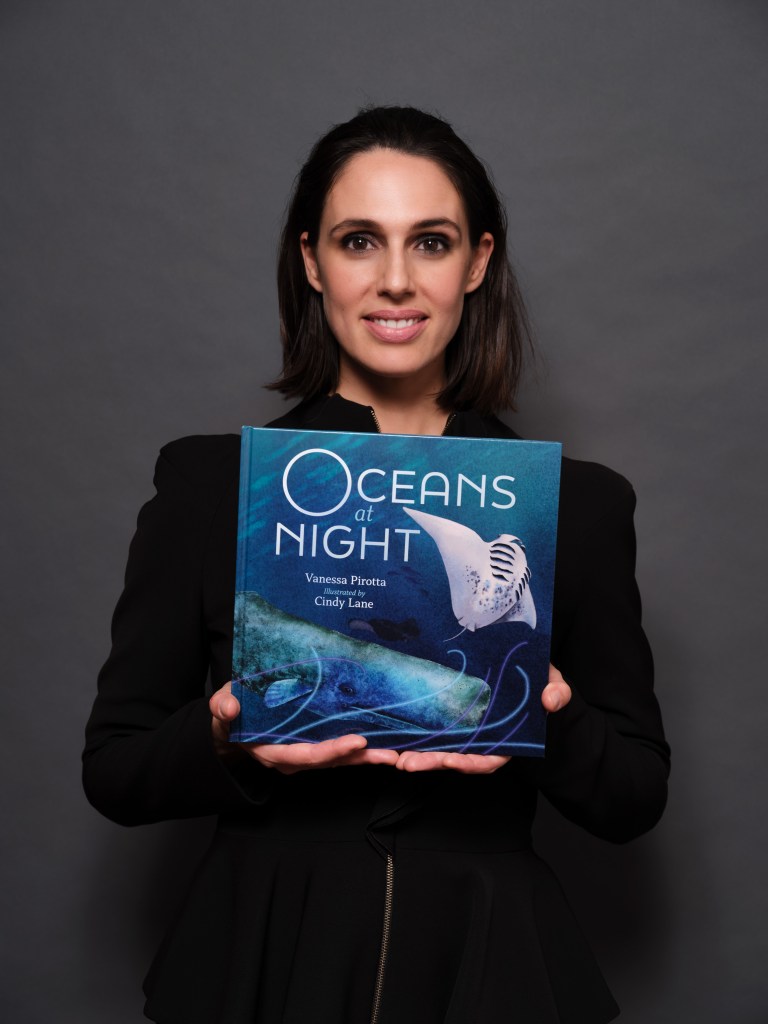
Dr Vanessa Pirotta is a wildlife scientist, science communicator and author.
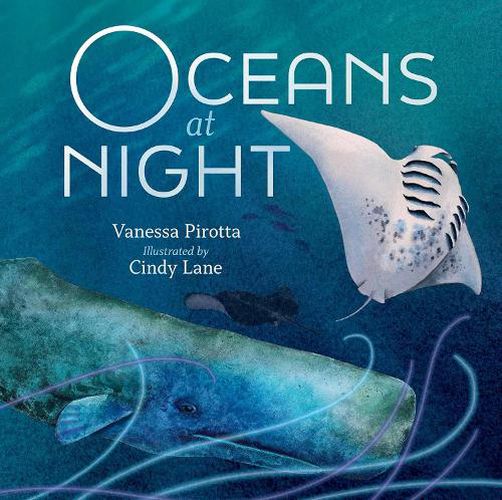
Vanessa’s research is extensive, she has even used drones to collect whale snot, and computer algorithms and AI for the detection of illegal wildlife trafficking! Vanessa is the author of three books, with more on the way. Today we’re excited to be talking to her about her latest children’s book: Oceans at Night, illustrated by Cindy Lane.
The publisher provided Alphabet Soup with a reading copy of Oceans at Night.
From the publisher:
As night-time nears, a world of creatures comes alive in our oceans. Settle in and explore the wonderful world under the waves, and see what animals do from sunset to sunrise. From penguins to sharks, giant squid and plankton, discover the fascinating after-dark lives of ocean creatures. Oceans at Night showcases the beauty and wonder of life below the sea, so dive deep and discover what happens while you sleep!
What dangers does a marine biologist face while conducting research?
Working with animals, like whales, can be dangerous because they are so big! We also have to make sure that we don’t touch anything that could be harmful as many sea creatures can bite and sting. When we conduct science, we always make sure that the animals are safe and so are humans. This means lots of planning and asking questions before we even go into the sea. Thankfully, we can use new technologies like drones to gather scientific information from whales without having to be close to them or needing to touch them.
Do you have a favourite sea creature from those included in Oceans at Night?
Yes! I LOVE sunfish. These are the biggest bony fish in the sea! They look like aliens and flap their flips on the top and bottom of their big bodies. We sometimes see them off Sydney, Australia. I also swam with them in the Galapagos islands. I wanted to make sure this book showed some of the incredible creatures I love and have seen. I have yet to see cuvier’s beaked whales or dumbo octopus. Perhaps I can go on a quest to meet the creatures of Oceans At Night one day.
Some of the sea creatures in the book live in very deep ocean. How do you study these creatures – can you get down there yourself somehow?
That’s true! The dumbo octopus and angler fish are a great example of this. I think I would need to go down very deep in a submarine. Or, perhaps we could send a remotely operated underwater vehicle to try and spot one. Getting to the ocean depths is dangerous and expensive so I am not sure if I will ever get to see these creatures. Perhaps through ongoing scientific research, we might get to see one of these creatures in the near future.
What do wish more people knew about our oceans?
How important it is for all of us. Many of us might not know that the ocean is so important for our everyday lives here on land. The ocean helps provide the air we breathe, and regulates our climate. Whales, for example, are very important for eating in one area and pooing in another – moving nutrients (good things for our ocean) around. Whales are kind of like a cow on land, they eat and then their poo helps the grass grow.
Can you tell us a bit about what you’re working on next?
I LOVE writing books and I’ve been thinking about something very special for a long time now. I love being able to educate and explore different worlds inside and out of the school classroom. Watch this space.
Oceans at Night is out now! Ask for it at your favourite bookshop or local library.
AWESOME EXTRAS:
Download the Teachers’ Notes for Oceans at Night [scroll down to the For Teachers tab]
Visit the author’s website for more about her and her books
 REVIEWED BY REUBEN, 7, WA
 alphabetsoup.net.au