Today (7 September) is Indigenous Literacy Day. We will be donating 10% of all subscription orders received today to the Indigenous Literacy Foundation. If you’ve been thinking of subscribing, today is the day to do it!
A 1-year subscription (including postage to an Australian address) costs $29.80 and a 2-year subscription is $50. Check out our website for postage to addresses outside Australia.
Today we welcome Tania McCartney to Soup Blog! Tania will share with us how she goes about writing a story. (This post is part of a Blog Tour to celebrate the launch of her newest book—Riley and the Grumpy Wombat: A Journey Around Melbourne.)
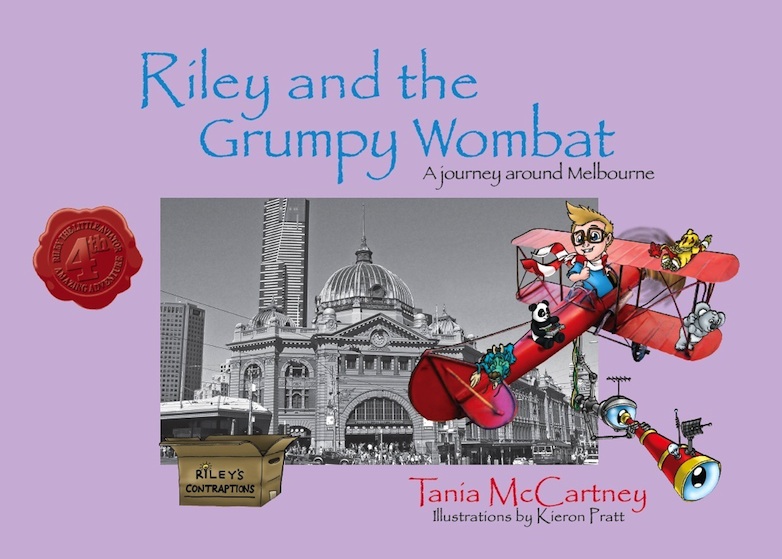
Riley and the Grumpy Wombat: A Journey around Melbourne by Tania McCartney, ill. Kieron Pratt. Ford Street Publishing, ISBN 9781921665486
Before we hear from Tania, here’s a bit about the book:
Riley has discovered a wombat in his nanny’s garden. But why is this furry creature so grumpy? Join Riley and his friends from books one, two and three, as they zoom around the stunning sights of Melbourne in search of a wombat that simply needs a place to call home.
Riley and the Grumpy Wombat has black and white photos along with illustrations, and takes the characters on a fun adventure around Melbourne, Victoria.
And now, over to Tania McCartney!
Tania McCartney, with characters from her books
It seems the writing processes of authors are as varied as there are books … and perhaps this is why it’s so fascinating to learn how authors go about penning their work. I’ve been writing since my teens, yet each style of book I write goes through an almost entirely different process—and this process has actually changed over the years as I’ve found better ways of working.
I remember writing my first adult novels in my late teens and early twenties—the process I used then was … well, there wasn’t really a process. It was just ramblings. There was no plot structure, no character development, no deliberately-placed threads that were then woven delicately through the text, no no. It was just open slather. I wrote from the heart, I wrote with passion—I just wrote.
That was some of the easiest writing I’ve ever done. I sent one of these novels—Breathing Under Water—in for The Australian/Vogel Award (this was around 20 years ago) and although it wasn’t shortlisted, the publisher liked it enough to send it to an outside reader. After a few months, I received the outsider’s critique, which basically said there was ‘obvious talent’ but did the publisher really want to spend time working with me to hone a messy storyline. The publisher didn’t.
I was so crushed, I didn’t submit anything to a publisher again for close to ten years. But it wasn’t only because I was crushed—it was because I had no idea how to hone and structure my work.
Since that time I had plenty of ideas but was simply too confounded about the process. I thought about reworking Breathing Under Water, and I played with it occasionally, but nothing eventuated. Then, in 2007, I began work on a fresh idea for a young adult novel that struck me so quickly, it poured with ferocity from my fingertips.
The plot of this new book—let’s call it The One—required a lot of research, intense character placement and development, and a mass of location and time links. I needed to plan.
So what I did was set up a spread sheet listing the characters, their location, their specific roles and their connection to each other. I also kept detailed notes on the information required to tie characters and events together, and placed ‘markers’ through the manuscript to indicate where extra pieces needed to be written.
I needed these markers because I found I was writing parts of the book that weren’t necessarily in chronological order. It didn’t help that the book also skips through time, so I had to be very careful about where I placed which occurrence.
Taking the time to chart what I was writing kept me on track. At first I was worried a spread sheet would endanger the freedom of the storyline. I worried it would become too formulaic—too predictable. But the opposite happened. Extraordinary coincidences began to occur with characters and events and the research I conducted. It was extraordinary.
Life circumstances forced a four-year break from The One, and I have only just looked at the manuscript again this past month or two. Without my notes and spread sheets, I would have been lost, so I’m thankful I learned how to structure my own writing process.
When it came to writing my Riley the Little Aviator picture books, things went a little differently. I’m a really visual person, so all four books (as well as number five, being written now) were actually done after I had chosen a series of photographs to dot throughout the storyline.
I would place these photos directly onto Adobe Illustrator book pages and begin to write the text around the photos, chopping and changing it as the story went along. For all four books, I had absolutely NO idea of the endings. I knew roughly where the story was going and I had faith that the ending would unfold, magically. And indeed—each time, it did.
For Riley and the Curious Koala, this writing style was particularly strong. As Kieron illustrated each page, I was spurred on to the next, and would often make changes to the text to reflect Kieron’s (often hilarious) interpretation. The storyline for Curious Koala wasn’t finished until around three weeks before printing. This was a wonderful process—collaboration between author and illustrator. I loved it.
For Grumpy Wombat, I had to get the text in shape well beforehand because Paul Collins from Ford Street needed to approve it for publication. The final version, however, was still played around with right up to the last minute, even as pages were being laid out by the graphic designer.
On the back cover of Riley and the Grumpy Wombat
I absolutely loved having such freedom and scope to perfect the text so close to printing.
For my non-fiction books, my process is more methodical. For my history book for the National Library (Australian Story: An Illustrated Timeline, out 2012), I did a stack of historical research. I kept a Word document and a spread sheet that covered the text, images, references, links and notes. When it came to actually finalising the text, I placed it onto landscape book pages, just like I did with my Riley books, so I could ascertain how much text would be needed and in which timeslots I would need to write more. This helped me with image selection, too. It helped me keep focus.
For my lifestyle book—Handmade Living—I kept computer and hard copy versions of the work so I could write, layout and edit with greater ease. This helped me cut down the editing process considerably.
Some authors may work their way through books from front cover to back cover, but I find that, no matter the genre, I tend to jump around and write what works at the time. If I’m struggling in one area, I leave it and move onto a part I feel compelled to write in. Whilst I do believe in ‘pushing through’ writer’s block (it works for me), I also believe that if a section of any work is sticking, you may need to work on another section for a while. Sometimes we just need a few hours or even a week to let a certain part of any book simmer. Then things will flow again.
The writing process is certainly a unique one and—like anything—the more you practise, the easier it becomes.
So long as I have good coffee, silence, a nearby plant or flowers, and lots of sunshine streaming into the room, my writing processes are always joyful.
—
Thanks for visiting and talking to us about the writing process, Tania!
If you want to follow the Riley and the Grumpy Wombat Blog Tour, here’s where to go:
Be sure to stop by here tomorrow, we’ll have Tania McCartney visiting. She’ll be talking to us about writing as part of a blog tour celebrating the launch of Riley and the Grumpy Wombat. See you tomorrow!
Alphabet Soup will be turning THREE in October. Hip hip hooray! So, we’ve decided to have a three-themed writing competition for our spring issue.
————
WIN A $20 BOOK VOUCHER (& see your story here on the blog)
Entries close 21 October 2011
Write your own tale about The Three Little______ (choose your own characters). Your story should be no longer than 450 words and shorter is fine.
Include a competition entry form. This may be printed from the website (see competition rules), photocopied, or contact us to have one emailed or posted to you.
Don’t forget our Design-a-cover competition closes on 16 September 2011. The winning entry will be used for the cover of our summer issue. Check out our designing tips here.
In every issue of Alphabet Soup magazine we interview an author or illustrator. The trouble is, we can only fit some of their answers in the magazine. So we print the full interviews on the blog—we wouldn’t want you to miss out!
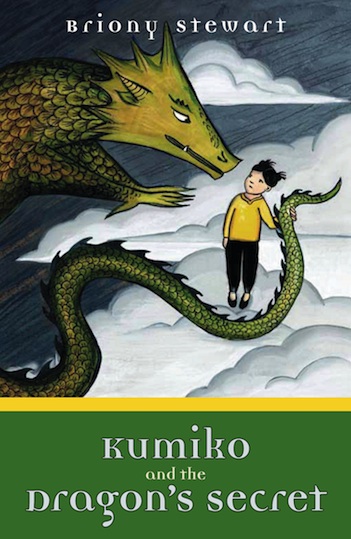
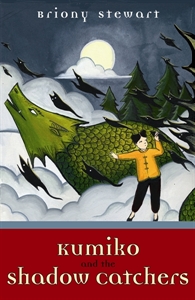
In issue 12 we talked to Briony Stewart, author & illustrator of Kumiko and the Dragon, Kumiko and the Dragon’s Secret, and Kumiko and the Shadow Catchers.
What do you love about being a writer-illustrator?
I’ve always enjoyed being “away with the fairies,” (as my mum used to call it,) I love daydreaming! Imagining things, solving problems and inventing are some of my favourite things to do. When the things I dream up make other people happy, make them laugh or have a good think, then it makes me happy too.
Was it easy to get your first book published?
Hmm … a tricky question … Can I say yes and no?
Yes, because I was lucky enough to have a book editor ask to publish my first book before I had even started to try to find someone to publish it! That doesn’t happen very often—even J.K Rowling was rejected a few times to start out with …
But I’ll also say no, because the truth is, even though I ended up in the right place at the right time, I had done a ton of work to get there in the first place. I studied fine art and writing at university, and I wrote and drew every day from the age of fifteen because I decided I wanted to publish a book one day.
I used to say I got lucky, but then someone said “you make your own luck,” and I think that’s kind of true too.
What do you like to do when you are not writing or illustrating?
I love movies, especially but perhaps not surprisingly, kids movies, sci-fi and adventure films. I also like making things—anything. Right now I am trying to make a hexagrammic antiprism lampshade out of cardboard for the kitchen. I also like long chats over a cup of tea, cycling (lazy cycling that involves scenery, short distances, and ice cream), pottering about in my kitchen cooking with music turned up loud enough to sing along to, or sitting on the back steps patting my rabbit Winston, whilst quietly observing the garden.
What made you become a writer-illustrator?
These three things:
1. Other people’s books and stories. I wanted to live in their worlds forever, so I started extending and exploring their stories in my head. For instance, I would take myself on walks through Misselthwaite Manor as though I was Mary from The Secret Garden. Soon I started coming up with my own stories and worlds too.
2. When I was 15 I started catching the train to school. It took half an hour and it was boring, so I started writing journals (and dreaming) to pass the time.
3. My English teacher started reading my journals, then the English department, then my friends. I liked having readers to write for. My teacher told me I should publish a book, which was great because I secretly wanted to anyway. Having people who believed in me helped me decide to do it.
Where do you get your ideas?
Mostly I come up with ideas from things I see or hear or feel in everyday life. Sometimes they morph with some of the daydreams that have been floating around my head for a while, and mutate into a story. I have always been inspired by old stories, myths and folktales too, I’m not sure why. Anything that sounds mysterious and possibly real gets me pretty excited.
Do you have any advice for young writers and artists?
Keep practising, and trying new things all the time. Art and writing is something that for the most part, you have to teach yourself because unlike a lot of other subjects it’s individual. Collect authors and artists that you really like, and study the things you like most about their work. Keep making your own stuff and stick at it. If it really means a lot to you, there’s no way you won’t get really good at it.
Are you working on a book at the moment?
Well, I have just finished my last Kumiko and the Dragon book, and have just begun a new novel for teenagers. It’s about growing up, and graffiti. There’s another novel I am working on too, its for upper primary school students and it is to do with time travel. I think it’s going to be awesome … so awesome that I can’t say any more!
Are there any writers/illustrators who influence your writing/artwork?
Shaun Tan showed me that illustration and art are the same thing, and I admire that. I love fine art illustrators, like CM Barker, Mucha, Searl, Rackham and Dulac. I like the animated work of Miyazaki and the written work of Tim Winton and poet Robert Frost. But songs and scientific drawings—even beautiful packaging—influence me! I find something to love in the work of most authors and illustrators.
When you were working on the Kumiko books, which came first—the artwork or the story text?
Kumiko definitely started out as a story that I wrote down, but for me images and writing are closely linked. I see the events of a story vividly as I write—almost like watching a movie. I would have loved to have painted all the scenes from Kumiko and the Dragon but the story was too long to be a picture book. Because I knew there would only be 20 black and white pictures, I actually turned many of the images into description instead! So the story is more vivid because I absorbed a lot of what would have made great pictures into the writing. Also, as I am writing I often draw the scenes and characters as references while I’m writing. So the text and art in this book really grew together at the same time, though the text was completed before the final illustrations were done.
What materials do you prefer to use in your artwork?
I am more of a drawer, so pen and pencil are my main tools. But I like using gouache and watercolour paints too, and have started using them more.
Does the story influence your choice of materials?
Of course! Kumiko and the Dragon had to be black and white, but I chose the style and materials because they reminded me a bit of traditional Japanese wood block prints, and Manga, which are both inherently Japanese. But I would equally use soft, watercolour washes for a gentle story, or bright bold, gouache for an action packed adventure!
Do you mostly write in a paper journal, or on a computer?
Time wise I mostly work on the computer, but paper journals are special. I like making covers for new journals, and collecting them. They remind me that I am working towards a book, not a blog or email. They also keep better records of all my more random thoughts (from the doodles in the margins to the shopping list in the top corner). I use my journal for all the real creative work, and only use the computer to pull all the little pieces together, to begin the long process of editing.
—
For more information about Briony and her books, check out her website.
Here is the winning Under 7s story from our winter 2011 writing competition. You were asked to imagine waking up one morning to find you had grown wings—and to write a poem about it.
A reminder: always check the rules of the competition. If you don’t stick to the rules, we have to disqualify your entry and that makes us sad!
Under 7s winner: A Flack (WA)
WINGS
I woke up
One morning
And I had
Grown wings
I didn’t know
There were such things
Whizzing around
I flew high in the air
Then I found myself
Back in my chair
Then I was
Back in my bed.
Here is the winning Under 9s story from our winter 2011 writing competition. You were asked to imagine waking up one morning to find you had grown wings—and to write a poem about it.
A reminder: always check the rules of the competition. If you don’t stick to the rules, we have to disqualify your entry and that makes us sad!
Under 9s winner: M Watervoort (WA)
SURPRISE
The sun slapped my face
It gave me a fright.
Morning was here
Gone was the night.
I looked in the mirror
I turned my back
And what I saw
Gave me an attack!
Wings! Wings!
All on my back.
Six pairs of them.
What a six pack!
Here is the winning Under 12s story from our winter 2011 writing competition. You were asked to imagine waking up one morning to find you had grown wings—and to write a poem about it.
A reminder: always check the rules of the competition. If you don’t stick to the rules, we have to disqualify your entry and that makes us sad!
Under 12s winner: S Morgan (WA)
A STRANGE FEELING
It’s another Monday morning,
I feel like sleeping in.
I tossed and turned all night long,
Like I was being poked in the back with a pin.
My mother’s voice came down the hall,
Yelling ‘STUART GET DOWN HERE!’
I felt that I was too big for my clothes,
Like I was growing too fast, how queer.
I found two holes in my pyjamas,
Where my shoulder blades would cling.
I hover just above the ground,
Oh God—do I have wings????
The Children’s Book Council of Australia’s Book of the Year awards for 2011 have been announced! You can see the list of winning children’s books over at the CBCA website. (Note: some books are for older readers and young adults.)





 alphabetsoup.net.au