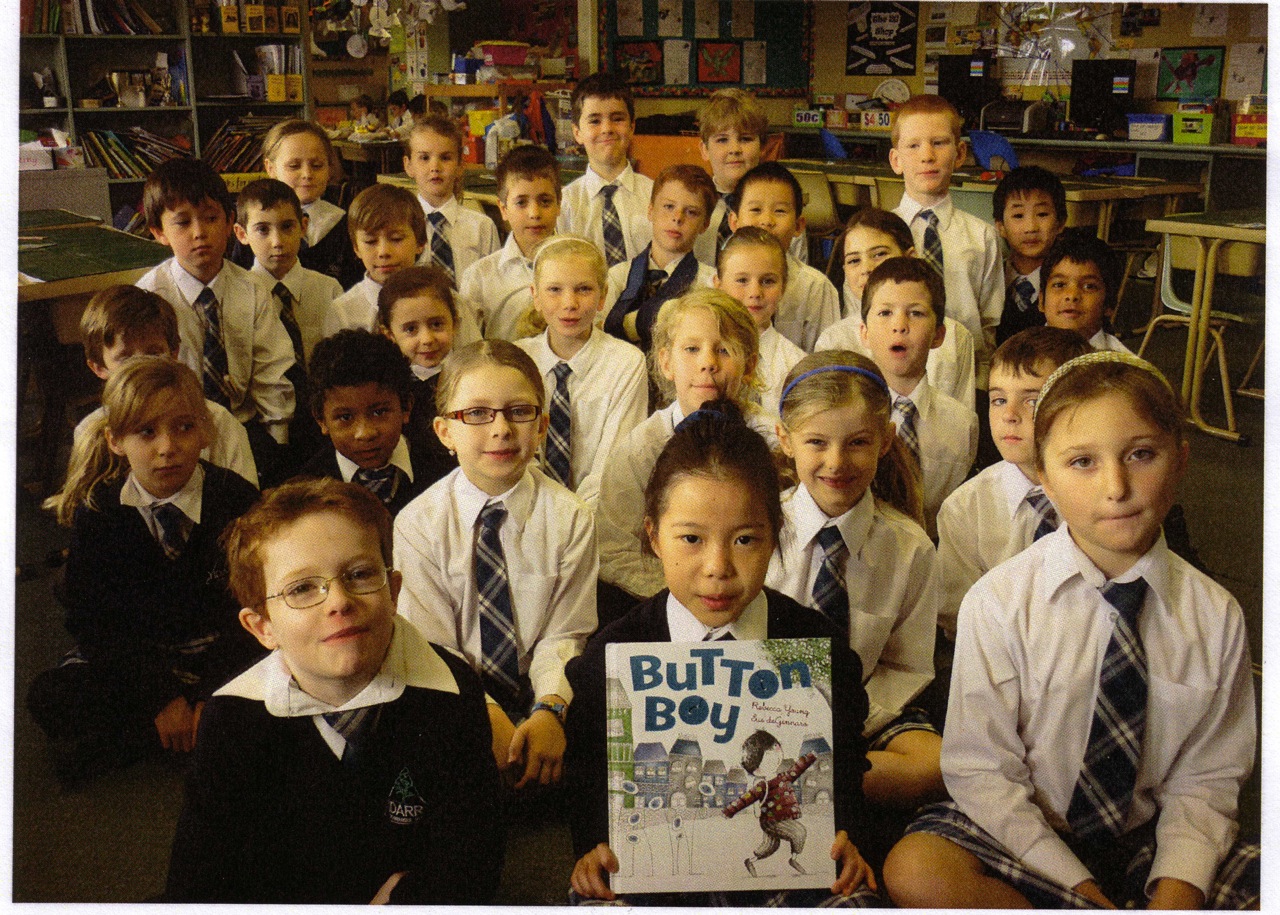
The book Button Boy was written and illustrated by Rebecca Young and Sue deGennaro. Button Boy is a fabulous book because it is about being helpful.
Button Boy is about a little boy called Banjo who loves to collect buttons. His grandma sews the buttons onto his jumper. Every day when he’s on his way to school he finds someone who has a missing button and he gives them one. Finally, he has only one button left. Banjo is a kind and giving boy.
We like the book because the pictures are very funny. The best thing about Button Boy is that the main character is a kind little boy. People who like collecting things would like this book. It would be good for boys or girls aged 5 to 8.
You should go and get this book now! It is great.
–
* Year 2 at Yidarra Catholic Primary School is a member of our Undercover Readers Club. A review copy of Button Boy was provided by the publisher.
In every issue of Alphabet Soup magazine we interview an author or illustrator. The trouble is, we can only fit some of their answers in the magazine. So we print the full interviews on the blog—we wouldn’t want you to miss out!
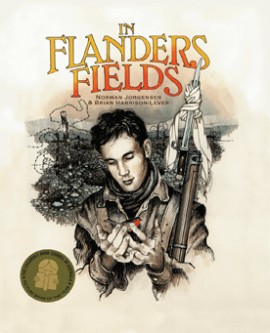
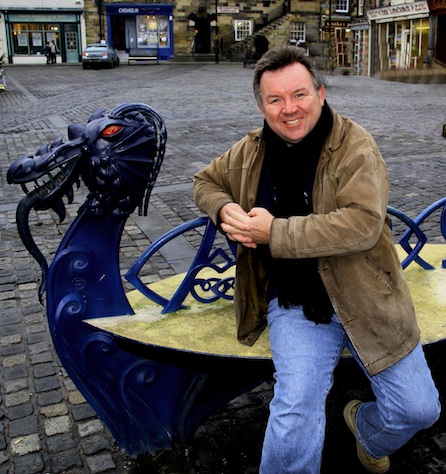
In issue 13 we talked to Norman Jorgensen, author of many books includingThe Last Viking, and In Flanders Fields.
Where do you live?
I live just out of Perth city in an old Federation house built in 1906. It is a bit too cosy; in fact, it is far too small for all the books I have collected over the years. If I buy any more books my wife and I will have to go and live out in the garden shed along with the rakes, spades, half empty paint cans and redback spiders.
What do you love about being a writer?
I love the way stories develop from just the flimsiest shred of a single thought or sentence into full-blown worlds full of exotic places and interesting out-of-control people.
I also love the ego stroking that comes with the job. People seem to think writers are special, especially children’s book creators, and treat us accordingly. I know for a fact, however, that most kids’ book writers are just adults with arrested development issues, and have never really grown up properly. That is certainly true in my case.
A real bonus being a writer is that I get to travel to all sorts of great places for literature festivals and writers’ talks, and get to meet kids who like reading.
What was your favourite book as a child?
There was a load. One I remember and was very keen on was as series by Anthony Buckeridge, called Jennings and Darbyshire, about boys in an English boarding school that was an awful lot like Hogwarts. Unlike Hogwarts, though, Linbury Court Preparatory School was a ripping and topping place with midnight feasts, easily fooled school masters, japes and pranks, and, fortunately, or perhaps unfortunately, no wizards. The books were also a great deal funnier than Harry and Co. They kept me in stitches of laughter for days at a time and I loved them.
My other great favourite was Biggles by Captain WE Johns, a series of nearly a hundred books about an ace World War I fighter pilot who never seems to get any older and also flies planes in WWII and into the jet age, and has hair-raising adventures together with his chums, Ginger, Smyth and Algy. They are probably horribly dated by now, but at the time they sure kept me wide awake at night.
Was it easy to get your first book published?
My first book came out years ago. It was a graphic novel illustrated by Allan Langoulant and was called Ashe of the Outback. At the timeI had no real idea of what I was doing and used to flood Allan with hundreds of ideas, often on coasters or scraps of paper. He was very patient with me and managed to pull them into a sequence that made sense and that he could illustrate. Luckily for me, he was such a clever artist and well-known that that a publisher soon contracted it.
My fourth book In Flanders Fields proved to be a much harder task. A picture book about the war in the trenches for small children? Are you joking? A number of publishers couldn’t see past the idea that picture books don’t always have to be about talking rabbits or cute teddy bears, or for little kids, and instantly rejected it. Luckily, the crew at Fremantle Press weren’t so traditionally bound.
Like all writers I read a great deal. I like comedies and funny writers, historical novels, spy thrillers and well constructed sentences but, above all, I like a good story that drags you along with it.
I also love travelling, especially with my gee-wiz top-of-the-range camera and taking photographs, especially to Europe. I love the old castles, cathedrals, villages, country pubs, museums, battle grounds and all the stuff that makes history so exciting.
Watching old movies give me a thrill, especially black and white dramas, westerns and silent comedians like Charlie Chaplin and Laurel and Hardy (go and look them up on You Tube. They are hilarious, even 80 years later. )
I like woodworking and have made several pieces of furniture using old recycled Jarrah. I love the smell of wood shavings and the sense of achievement when you do something as well as you can.
What made you become a writer?
Truthfully? I saw an old film when I about fifteen called Beloved Infidel, starring Gregory Peck, about the famous writer F Scott Fitzgerald. He was a romantic, tortured writer and as a teenager I could see myself being just like that. These days I’m not particularly tortured and, sadly, neither do I look like Gregory Peck or F Scott Fitzgerald.
Where do you get your ideas/inspiration?
Here you go, from the horse’s mouth, as they say:
Ashe of the Outback was inspired by Biggles (and The Jolly Postman).
In Flanders Fields isfrom a scene is a movie called All Quiet on the Western Front.
The Call of the Osprey came from all the times I spent with my grandfather in his marvellous old workshop in Northam.
A Fine Mess isfrom a poster I have on my office wall of old comedy duo Laurel and Hardy, and also the adventures my brothers and I had growing up in Kalamunda.
Another Fine Mess 002 has James Bond stamped all over it.
Jack’s Island is a collection of stories about my father’s life growing up on Rottnest Island during the 1940s.
The Last Viking I wrotebecause of my Danish name, and the thought that perhaps one day I should do a Viking story to honour the ancestors. You never know if they are watching. If they are, I hope they like it. It has only just been released.
Do you have any advice for young writers?
Yes, ignore all advice!!!Except, practice writing a lot. Just like violin or netball training, the more practice you put in the better you get at it. Oh, and always carry a notebook with you to jot down ideas when they occur. They are such fleeting things and are easily forgotten.
Also don’t take rejection too personally. Pick yourself up, dust yourself off, and start all over again.
Are you working on a book at the moment? Can you tell us anything about it?
Hmmmm … There are three on the go.
The Goldminer’s Son is a picture book, based on a true Western Australia story, about a miner trapped underground, his son’s steadfast belief he’ll be saved, and the heroic efforts to rescue his dad from a flooded pit.
Brave Art is about a girl who doesn’t fit in at a school, at home or with her friends. All she wants to do, with a single-minded passion, is paint pictures like the Great Masters and become a famous artist herself. Luckily, it has a happy ending as she does achieve her ambition.
Sons of the Desert is, hopefully, an authentic and action-packed, rip-roaring, page-tuning, old-fashioned adventure with horses, villains, stagecoach robberies, explosions and enough realism for you taste the dust and feel the heat as the battles rage.
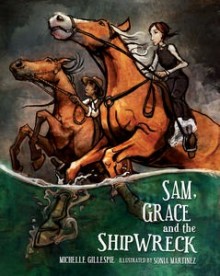
Sam, Grace and the Shipwreck by Michelle Gillespie and illustrated Sonia Martinez. Published by Fremantle Press, ISBN 9781921696008.
(A review copy of this book was sent to us by the publisher.)
A ship—the Georgette—runs aground in Calgardup Bay WA in December 1876. This is the true story of a shipwreck and the daring rescue of the survivors by stockman Sam Isaacs and sixteen-year-old Grace Bussell, both on horseback.
This picture book tells an exciting story and it’s great to read aloud. Here are the opening words:
There is something about this morning—a quiet in the hills, a shiver in the air—something that prickles the nose of the stockman’s horse.
The illustrations show the drama as it unfolds and have the feel of long-ago adventure—with sepia coloured backgrounds framing lots of the artwork. We also love books with interesting endpapers, and the endpapers in this book are paintings showing scenes before and after the events in the story.
At the end of the book you’ll find a summary of the events of that day and a brief biography of the author and illustrator (apparently the illustrator drew lots of horses when she was growing up, and it came in handy for illustrating this story!).
Sam, Grace and the Shipwreck has adventure, bravery, history … and horses. You’ll love it!
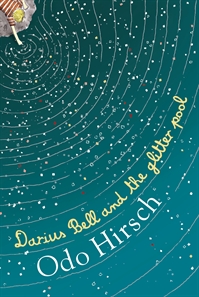
Darius Bell and the Glitter Pool, by Odo Hirsch, ISBN 9781741757163, Allen & Unwin.
Reviewed by Year 5 students at Duncraig Primary School.*
Darius is worried. Time is running out. Will he and his family ever decide upon this generation’s Bell Gift from the family to the town so they can retain the family house and name? When he and his friends find a mysterious glittering pool in the grounds of the house they wonder if it might provide an answer.
This imaginative book will appeal to some tween readers but does not work as a read aloud book as the detail slows the plot. Quirky, well-developed characters carry the story. Our class thinks it would help retain interest if the author moved between locations and plot lines more frequently. We enjoyed the unexpected plot turns and the overall quest structure.
This acclaimed author has written the much-loved Hazel Green series and others such as Amelia Dee and the Peacock Lamp.
—
*Duncraig Primary School is a member of our Undercover Readers Club. A review copy of Darius Bell and the Glitter Pool was provided by the publisher.
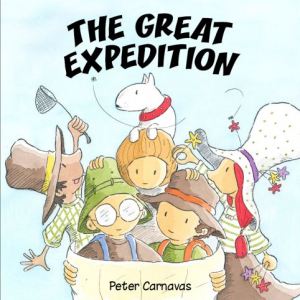
This story is loosely based on the expedition of explorers Burke and Wills. In The Great Expedition, the exploring party is assembled—with a leader, a navigator, a botanist, a biologist and an animal handler (to keep the dog under control). The group of young explorers needs to get a parcel safely to its destination. They set off in high spirits but soon run into all sorts of trouble … and then disaster strikes.
Although they are exhausted by their journey, obviously this adventure is not as arduous as the one Burke and Wills faced (plus, this journey has a happy ending!). This is a great picture book for kids learning about explorers—learning what happens on an expedition, and the roles of the people involved. At the end of the book there is a little about Burke and Wills, too.
Younger kids will enjoy the story as it is, older kids will appreciate the humour behind the kids’ expedition mirroring a real one. And everyone will love the quirky illustrations (look out for the dog in the endpapers!).
A fun adventure, and a springboard for learning about the great explorers of history.
For each issue of the magazine (starting with issue 7), we will add activities and a themed listening list to this page. Enjoy!
ISSUE 12—SPRING 2011
ACTIVITIES
for Issue 12—SAIL AWAY!
1. MAKE a pirate’s treasure map. Hide something in your garden (or in your house if it’s raining). Then on a large piece of paper, draw a map so someone else can find the treasure. Use footsteps and arrows to show the way to go. Include some landmarks (like the tree with the tyre swing, or the kitchen table). Mark the hiding place with a red X. Give the map to a fellow pirate—can they find the treasure using your map? (Tip: make your pirate map look old and authentic by using a damp tea-bag to stamp all over it. When it is dry, roll up your map and tie it with a piece of string. Arrr!)
2.PLAY Ship to Shore (sometimes called Captain’s Coming!). One person becomes the captain and shouts out commands to the group—like ‘Ship!’ (everyone must run to the side of the room designated as the ship), ‘Shore!’ (run the other way), ‘Captain’s Coming’ (stand still and salute), ‘Shark!’ (lie on stomach and swish tail). Anyone who fails to follow a command correctly is ‘out.’ For a list of commands (and some more detailed instructions) visit the myplaygroundgames blog.
3. MAKE an origami boat: Using paper-folding techniques, make some paper boats to sail. Here are some instructions.
4. EXPERIMENT—float or sink?: Grab a variety of objects from around your house or garden (check with a parent that it’s OK) e.g. a feather, an apple, a pumpkin, a plate, a paperclip, a coin. Try to predict which objects will float and which will sink. Were you right?
—
MUSIC LISTENING LIST
Our listening list is compiled by Danielle Joynt, from Cantaris. Danielle has also included comments for some of these pieces. (Tip: Ask about CDs at your public library—libraries often have a good collection of CDs for loan if you prefer not to buy.)
1. SEA PICTURES
1. Sea Pictures is a song cycle by the English composer Sir Edward Elgar, consisting of five songs written by various poets.
The songs and poets are—
A. Sea Slumber Song by Roden Noel
B. In Haven (Capri) by Caroline Alice Edgar (the composer’s wife)
C. Sabbath Morning At Sea by Elizabeth Barrett Browning
D. Where Corals Lie by Richard Garrett
E. The Swimmer by Adam Lindsay Gordon
Adam Lindsay Gordon, although born in the Azores and educated in England, lived most of his life in Australia. His collection—Bush Ballads and Galloping Rhymes—is regarded as one of the most important pieces of Australian literature.
Sea Pictures was composed in 1899 and premiered the same year with the famous contralto Dame Clara Butt singing, dressed as a mermaid! Two weeks later Dame Clara performed the cycle for Queen Victoria at Balmoral.
2. DRUNKEN SAILOR (WHAT SHALL WE DO WITH THE DRUNKEN SAILOR?)
The music for Drunken Sailor was taken from a traditional Irish dance and march tune Oró Sé do Bheatha ‘Bhaile (“Oró, you are welcome home”).
First appearing in print as a sea shanty (shipboard working song) in 1824, the song was widely sung when hand-over-hand hauling on ships. It was also known as “Early In The Morning”.
The Australian composer Percy Grainger used the song and lyrics in his work Scotch Strathspey And Reel.
The main theme from the first movement of Piano Concerto No. 2 in F Major by Shostakovich mimics Drunken Sailor.
The melody of Drunken Sailor is often used in SpongeBob Squarepants!
3. LA MER
La Mer (The Sea) by the French composer Claude Debussy is a shimmering musical sketch inspired by the sea. Debussy’s use of instruments to create soundscapes and moods was groundbreaking for the time.
Movement 1 “From dawn to noon on the sea” is an instrumental mixture of floating colours. The music seems to wander around, never settling in to any form. The composer Erik Satie joked that he liked the part at 11.15am!
Movement 2 “Play of the waves” is much livelier, with orchestral swells imitating the waves.
Movement 3 “Dialogue of the wind and the sea” is very dramatic, illustrating the clashing forces of the wind and the ocean.
Although La Mer was not initially well-received when it premiered in France in 1905— due to lack of rehearsal—it soon became a great favourite of audiences at subsequent performances.
One American critic wasn’t so impressed however; he thought a better title would have been “Mal de Mer” which means seasick!
4. CALM SEA / PROSPEROUS VOYAGE
Calm Sea and Prosperous Voyage is the name given to two much-loved pieces of music—a 1815 cantata by Beethoven and an 1828 concert overture by Mendelssohn—both set to poems by the German writer Goethe. Beethoven’s piece is dedicated to Goethe.
The poems are not synonymous; however, in the days before steam, a totally calm sea was cause for alarm—it is only when the wind rises that the ship can continue its voyage.
The first half of Beethoven’s cantata depicts a ship becalmed, the second half, its success in resuming its voyage.
Mendelssohn’s overture (inspired by Beethoven’s work—and in the same key, D Major) finishes with a fanfare of trumpets, suggesting the ship’s safe arrival at its final destination.
Here’s a competition open to NSW students aged 12 and under. Write a story called ‘STUCK AT HOME IN MY PJs’.
Prizes include having your story published on the Asthma Foundation NSW website, a signed book by Libby Gleeson, and being invited to read your story at a morning tea where you will meet Libby Gleeson and also hear her read from one of her books. (There are also prizes for school groups.)
1. MAKE paper butterflies. Use a square of colourful paper or cut up some junk mail. Make concertina folds—fold the top edge of the paper down towards yourself in a thin rectangle. (Don’t fold the paper in half, that fold is too big!). Flip the paper over so that the folded side is now face down on the table and at the bottom of the page. Fold the bottom of the page up, so that the previous fold lines up with it. Flip the paper over again so the folded pieces are now face down on the table and at the top of the paper. Fold the paper from the top again and continue folding and flipping until the whole page has been folded like a concertina. Then pinch the rectangle at the centre and twist a pipecleaner (chenille stick) around it to hold it tight. The two ends of the pipecleaner will be the antennae. Fan out the wings a little. And make twenty more! (Perhaps you could attach them all to a coathanger to make a mobile.)
2.FOLD painted butterfly pictures. On a blank piece of paper, dab some blobs of paint around the middle section of the paper. Fold the paper in half (with the paint on the inside) and gently press it flat so the paint inside squishes about a bit. Open the paper and inspect your butterfly painting! (Great for cards or use as wrapping paper or stick on the fridge!)
3. PAPER AEROPLANE RACES: Grab some friends and check out a paper-aeroplane website to learn how to fold your favourite paper aeroplanes and then have a competition to see whose design is fastest or flies furthest or looks the coolest. (Record your predictions about which one you think will fly furthest, and write down the distances each plane flies. Then you might even convince your parents or your teacher that paper aeroplane flying is educational!)
4. GET BAKING!: Make some butterfly cupcakes. Try this recipe for cakes with wings, or this recipe using marshmallows and sour worms might be more your style. If butterflies aren’t your thing, can you think of a way to adapt these recipes to turn them into bat cakes or owl cakes?
5. READ some wing-themed books! For upper primary kids, we like Cicada Summer by Kate Constable, Storm Boy by Colin Thiele, for lower to middle primary kids, try The Magic Finger by Roald Dahl, or Duck for a Day by Meg McKinlay and if you love picture books you could try The Truth About Penguins by Meg McKinlay & ill. Mark Jackson, The Story of Ping by Majorie Flack ill. Kurt Weise or the nonfiction picture book Australian Owls, Frogmouths and Nightjars by Jill Morris & Lynne Tracey. Or read ‘The Six Swans’ folktale in the current issue of Alphabet Soup (or the poems also in the current issue!). Can you think of any others?
–
MUSIC LISTENING LIST
Our listening list is compiled by Danielle Joynt, from Cantaris. Danielle has also included comments for some of these pieces. (Tip: Ask about CDs at your public library—libraries often have a good collection of CDs for loan if you prefer not to buy.)
1. FLIGHT OF THE BUMBLEBEE
“Flight Of The Bumblebee” is a piece written by the Russian composer Nikolai Rimsky-Korsakov for his opera “The Tale Of Tsar Sultan”, composed in 1899-1900.
The piece is played at the end of Act Three, where the magic Swan-Bird changes the Tsar’s son into an insect so that he can fly away to visit his father (who does not know he is alive).
In 2010, the violinist Oliver Lewis broke the record for the fastest performance of “Flight Of The Bumblebee” – playing it in 1 minute and 3.356 seconds.
2. THE BUTTERFLY LOVERS VIOLIN CONCERTO
“The Butterfly Lovers” is a violin concerto co-written by Shanghai Conservatory of Music students Gang Chen and Zhanhao He in 1958.
It premiered to great acclaim in 1959, but was then declared decadent five years later during the Cultural Revolution – and both composers were imprisoned. Their “crime” was attempting to fuse Western instrumentation and tonalities with traditional Chinese melodies.
3. SWAN LAKE
The music for the ballet “Swan Lake” was written by Pyotr Ilyich Tchaikovsky. The story is thought to be based on “The Stolen Veil” by the German author Johann Karl August Musäus and the Russian folktale “The White Duck” .
The premiere performance in 1877 was not a huge success.
The Russian ballerina Anna Sobeshchanskaya – for whom the role of Odette was originally intended – was removed from the performance, when a government official in Moscow complained about her, stating that she had accepted several pieces of expensive jewellery from him, and then married a fellow dancer – selling the jewellery for cash.
The dancers, decor and orchestra were all unanimously crtiicised, and Tchaikovsky’s music was considered too complicated for a ballet. His music was decried by critics as too noisy!
After Tchaikovsky’s death in 1893, the Italian composer Riccardo Drigo was granted permission by Tchaikovsky’s brother Modest to revise the music for the ballet’s revival.
It is Drigo’s revision of Tchaikovsky’s score of Swan Lake that is the most often performed and recognised today.
4. THE THREE RAVENS
A traditional English folk song printed in the song book “Melismata”, compiled and published by the English composer Thomas Ravenscroft in 1611. It is also known as “Twa Corbies” (“Two Ravens” or “Two Crows”) and most often sung to the Breton melody – “An Alarc’h” (“The Swan”).
The American scholar Francis James Child (appointed Harvard’s first ever Professor of English in 1876) included these versions in his monumental five volume collection of English and Scottish ballads – The Child Ballads – released between 1892 and 1898.
5. THE SWAN
“Le cygne” or “The Swan” is the thirteenth movement of “The Carnival Of The Animals” by Camille Saint-Saëns.
The famous piece features a solo cello.
This is the only movement from “The Carnival Of The Animals” that Saint-Saëns would allow to be played in public during his lifetime, as he thought the other movements were all too frivolous and would damage his reputation as a serious composer.
The Last Viking by Norman Jorgensen and illustrated James Foley. Published by Fremantle Press, ISBN 971921888106.
(A review copy of this book was sent to us by the publisher.)
– Josh’s pop is always talking about ‘exciting stuff like Vikings, and Spitfires and Redcoats, though not usually when Nan’s around.’ Josh is staying with Nan and Pop for the holidays and that’s when he decides to become a Viking, and change his name to Knut. Although he’s not very brave, when trouble arrives, Josh summons up some Viking courage and discovers just how brave he really is.
If you don’t know anything about Vikings yet, you’ll know heaps about them by the time you finish The Last Viking. The illustrations are fun and cartoon-like and if you’re a super sleuth, you’ll notice that on some of the pages there are messages written in code—rune carvings. At the back of the book (on the endpapers) you’ll find the key to crack the code.
Keep an eye out for the ravens in the book, too. In Norse mythology they are Odin’s messengers, and in The Last Viking, they keep the Viking gods updated on Josh/Knut’s progress.
The Last Viking is an exciting adventure about courage, imagination and dealing with bullies.
 at Yidarra Catholic Primary School is a member of our Undercover Readers Club. A review copy of Button Boy was provided by the publisher.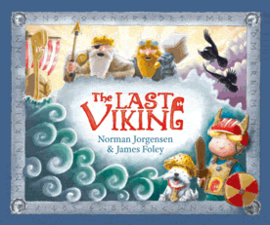

 alphabetsoup.net.au