Posted in Book reviews by Rebecca, teachers' resources

Book review: Press Here by Hervé Tullet

Reviewed by Rebecca Newman, Editor
"Press Here (cover)"
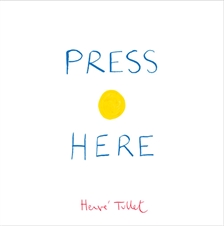
Press Here by Hervé Tullet

With thick, shiny white pages and brightly coloured spots, this is a fun picture book. It has instructions on each page and you’re asked to press or tap on the dots. It’s a book, so you KNOW pressing or tapping is not going to do anything … and yet … you can’t help pressing and blowing and tapping and shaking that book and doing whatever else you are asked to do to make the dots move and change.

I read it with a 5 year old and a 7 year old and they can’t get enough of it.

As well as being fun to read (and press), it helps with understanding some Maths ideas, too. It’s fun to test out some predictions: “If you tip the book this way, what do you think will happen to the dots?” Tipping the book to the left will make all the dots slide to that side of the book (well, they don’t REALLY, but it looks like they do!) and tipping it to the right will make them all slide the other way. And with all the dots lined up, you have to stop for a bit of counting every now and then (you just can’t help yourself).

This book trailer shows you how it works.

Press Here by Hervé Tullet, Allen & Unwin, ISBN 9781742375281
A review copy of this book was sent to us from the publisher.
Posted in info, teachers' resources

Send us your writing & artwork!

In every issue of Alphabet Soup, we include 6 pages of kids’ work—your stories, poems, letters-to-the-Editor, book reviews and artwork. Issue 11 is coming up. We still have a few spaces left for a poem or a story (or two) and some artwork.

If you’d like to see your work published, read our submission guidelines and send us something! (If it doesn’t arrive in time for issue 11, we can include it in a later issue. So if you can’t send something until next week, don’t panic.)

Remember, you don’t have to subscribe to the magazine to send us your work or to enter our writing competitions.

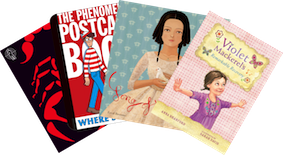
"Walker Books 2011 titles"

For those of you who DO subscribe, subscribers are automatically entered in a Subscribers’ Draw every issue. The winner of the issue 11 Subscribers’ Draw will receive a $200 book pack from Walker Books Australia. (See some of their books above. Books in the winner’s pack might differ though.)

Now I’m going to sit by our post office box to wait for your writing and artwork. (Give that postman something to do and send me some mail!)

Rebecca Newman, Editor

Posted in Book reviews by Rebecca, teachers' resources

Book review: Song of the Dove

Song of the Dove by Errol Broome, illustrated by Sonia Kretschmar

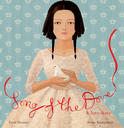
"Song of the Dove (cover)"This picture book for older children might remind you of Romeo and Juliet. This is the story of the rise to fame of Italian composer, Vincenzo Bellini.

Bellini falls in love with Maddalena Fumaroli, one of his singing students, but Maddalena’s parents refuse to allow her to marry a poor musician. Bellini and Maddalena agree that if Bellini writes ten great operas, her parents will see what a great musician he is and allow them to marry.

After writing his second opera, Bellini leaves for Naples and continues to write operas. His fame spreads and Maddalena’s parents do realise they have made a mistake. But is it too late for a happy ending?

The illustrations by Sonia Kretschmar are detailed and show how hard it is for Bellini and Maddalena to wait for so long. Through the artwork we also learn a little about the 19th century world—the art, music and fashion of the time. And we see how powerless you were if you were a young woman living then. Maddalena tells Bellini that doves live in pairs for life, and doves in the illustrations and endpapers reflect the couple’s story.

Song of the Dove includes a brief biography of Bellini, and a list of his ten operas.

Song of the Dove, by Errol Broome, ill. Sonia Kretschmar, Walker Books Australia, ISBN 9781921529245.
A review copy of Song of the Dove was sent to us by the publisher.
Posted in competitions, teachers' resources

Kids’ writing comps 2011

A good way to hone your writing skills is to enter a writing competition. You won’t always win, of course, but it’s a good way to get motivated, get ideas and get writing!

"Boy writing © Greg Mitchell"

Keep an eye on the closing dates, and remember to read the guidelines. Judges hate it when they read a fabulous story or poem and they can’t award it a prize because it was longer than the word limit, or didn’t stick to a rule listed on the entry form.

Here are some upcoming competitions for kids.

Australia-wide:

Alphabet Soup‘s autumn 2011 short-story comp (Closes 29 April. Entries postmarked 29 April accepted)

Dorothy Mackellar Poetry Awards (Closes 30 June 2011)

Sally Odgers Aussie Schools Writing Contest (Closes 30 June 2011)

WA:

The Tim Winton Award for Young Writers (Closes 22 May 2011)

Make Your Own Story Book Competition (Closes 3 June 2011)

Randolph Stow Young Writers Awards 2011 (Only open to Geraldton area. Closes 8 July)

Write a Book In a Day (Teams must complete the challenge by 31 August 2011)

SA:

SA English Teachers Association—The Young Writers Award 2011 (Closes 31 May 2011)

Do you know of any other writing competitions for kids?

Posted in poetry, teachers' resources

Poem in Your Pocket Day 2011

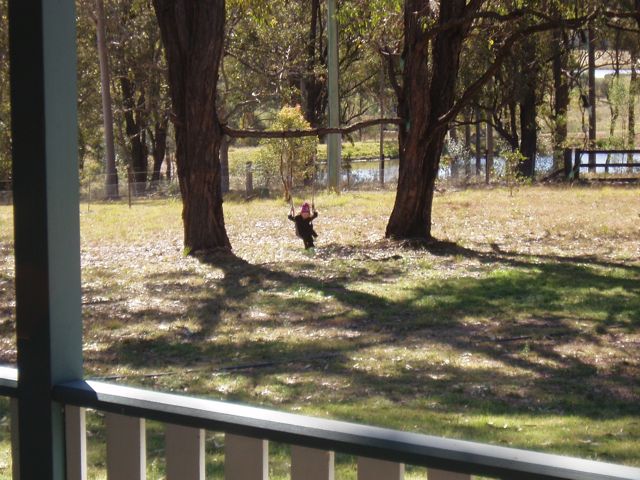
"Child on swing © Rebecca Newman 2009"Today is Poem in Your Pocket Day!

I love pockets, and the bits and pieces carried around in them (except tissues, after the washing machine—I don’t love those). Carrying a poem around in your pocket is fun. You can read it to yourself if you need cheering up. You can read it to someone else if they need cheering up. You can give it to someone—as a Poem in Your Pocket Day present. And you can even use it for inspiration to write your own poem.

The first poem I ever remember learning (if you don’t count nursery rhymes) was The Swing by Robert Louis Stevenson. My mum used to recite it whenever we went to the park and we begged her to push us on the swings.

The first poem I remember learning at school was Forgiven by AA Milne. And that’s the poem I have in my pocket today.

Forgiven
by AA Milne

I found a little beetle; so that Beetle was his name,
And I called him Alexander and he answered just the same.
I put him in a match-box, and I kept him all the day …
And Nanny let my beetle out—
Yes, Nanny let my beetle out—
She went and let my beetle out—
And Beetle ran away.

She said she didn’t mean it, and I never said she did,
She said she wanted matches and she just took off the lid,
She said that she was sorry, but it’s difficult to catch
An excited sort of beetle you’ve mistaken for a match.

She said that she was sorry, and I really mustn’t mind,
As there’s lots and lots of beetles which she’s certain we could find,
If we looked about the garden for the holes where beetles hid—
And we’d get another match-box and write BEETLE on the lid.

We went to all the places which a beetle might be near,
And we made the sort of noises which a beetle likes to hear,
And I saw a kind of something, and I gave a sort of shout:
“A beetle-house and Alexander Beetle coming out!”

It was Alexander Beetle I’m as certain as can be,
And he had a sort of look as if he thought it must be Me,
And he had a sort of look as if he thought he ought to say:
“I’m very very sorry that I tried to run away.”

And Nanny’s very sorry too for you-know-what-she-did,
And she’s writing ALEXANDER very blackly on the lid,
So Nan and Me are friends, because it’s difficult to catch
An excited Alexander you’ve mistaken for a match.

Do you know a poem you’d like to put in your pocket? If you had a poem in your pocket, would you keep it a secret? Or would you read it to someone?

~ Rebecca (Editor, Alphabet Soup)

Posted in teachers' resources

Need some writing tips?

Sometimes writers need inspiration. Are you having trouble coming up with ideas for your next story?

"Miss Llewellyn-Jones Goes to Town"Yesterday I found the writing tips page on Elaine Forrestal’s website. It has a section dedicated to writing tips—like how to get ideas, finding the right voice for your characters, and using metaphors and similes. (And some other tips too!)

Elaine Forrestal is the author of many books and her latest is the picture book Miss Llewellyn-Jones Goes to Town (illustrated by Moira Court).

Posted in authors, teachers' resources

Susan Stephenson, bullying and MONSTER MADDIE

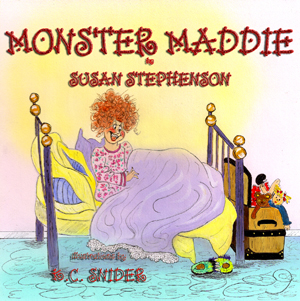
18 March is the National Day of Action Against Bullying and Violence. Today we are talking to author, Susan Stephenson (aka The Book Chook), about her picture book, Monster Maddie."Monster Maddie cover"
A bit about the book:

On Maddie’s first day at a new school, nobody notices her, even though she hangs around the edges of the other kids’ games and hopes to join in. On the second day, she becomes Monster Maddie, with ‘fangs and claws and wild, wild hair … “I’ll show them!” she said’. Of course her mean and hurtful behaviour doesn’t win her any friends and she realises nobody is going to invite her to play. She stomps away in tears—then, with the help of a curious kitten,she  finally comes up with a better way to join in on the playground.

What sparked the idea for you to write Monster Maddie?

As a school teacher, I saw lots of kids like Maddie. They didn’t understand how to make friends, and acted out. They did mean hurtful things in a desperate effort to be noticed and they certainly didn’t realise their behaviour was driving other kids further away. Sometimes those kids grow up to be bullies; sometimes they’re lucky—they realise what’s happening, and make an effort to be friendly. I wanted to write a book for those kids.

When I was at University, studying German, we read a book called Metamorphosis by a writer called Kafka. In the beginning of that story, the main character wakes up as a giant bug. I guess the idea of Maddie actually looking monsterish came from the profound effect that book had on me. I’ve also written a short story where a guy wakes up as a rooster. So far, I have only woken up as a human, but that doesn’t stop me checking the mirror each morning!

Did you ever feel like Maddie when you were growing up?

I certainly felt awkward in new situations, but I don’t remember putting ooze in people’s shoes and dirt in their shirts! I was lucky in that when I switched schools I had lots of my friends with me. Being a new kid is difficult. Often it seems that people are ignoring you, when they just need you to find a way to include them in a game.

How long did it take to write Monster Maddie?

Months and months. The hardest part for me is always the rewriting of a book. I get feedback on it from my writing friends, think about it, put it away for a while and make changes to it when I can see it with fresh eyes.

You say you have to rewrite after you write the story down. Is Monster Maddie very different from the first version you wrote?

It was always a story about a little girl who got mad when the kids at her new school wouldn’t notice her, and turned into a monster.  I think what changed was that it got fine-tuned. I deleted unnecessary words, made the structure of the story stronger, and worked hard to make sure the story sounded good to read aloud.

Have you met Monster Maddie‘s illustrator?

No, K.C.Snider lives in the USA and I live in Australia. But I talked to her via email.

Are you working on a new project at the moment?

At the moment, I’m working on two novels and a picture book. The picture book is about some sheep who want very much to go to the farmer’s wedding, only they aren’t invited. They try hard to get in, and end up succeeding in a most surprising way.

Monster Maddie includes 7 pages of activities, including a script for Monster Maddie to be performed. Do you think picture books make good theatre?

I think picture books are wonderful! They are perfect for kids to use to create their own reader’s theatre around, or just to act out the story for family and friends. I have a  series of four articles at The Book Chook blog where I talk you through the process of using Reader’s Theatre.

You can find out more about Susan Stephenson and her books on her website. The Book Chook has writing tips for kids in every issue of Alphabet Soup magazine. You can find more about literacy for parents and teachers on The Book Chook’s blog).
Posted in Book reviews by Rebecca, teachers' resources

Book review: Monster Maddie

Monster Maddie, by Susan Stephenson. Illustrated by KC Snider. (Guardian Angel Publishing, Inc.)

"Monster Maddie cover"

This picture book’s main character—Maddie—hates feeling invisible and ignored on her first day of school. After that terrible first day she decides she’ll make the other kids notice her. And she becomes MONSTER MADDIE, with ‘fangs and claws and wild, wild hair.’ Her mean tricks and bullying behaviour don’t win her any new friends, of course. Even she knows she’s become a monster and she doesn’t like it.

Sometimes it’s hard to know how to make new friends (especially if you’re a bit shy). Monster Maddie shows the approach that some kids might take when they feel lonely and frustrated about joining in.  And Maddie is mean. ‘She put ants in their pants, dirt in their shirts, and ooze in their shoes.

When you’re reading the book, you can tell that she’s not going be asked to join in when she’s so mean. I’ve seen kids behaving like Maddie on the playground—back when I was growing up, but also when I’ve been around playgrounds as an adult. Luckily, by the end of the book Maddie comes up with a way to approach the other kids and join in with them. But it’s not much fun for the other kids OR for Maddie until she does!

This picture book includes 7 pages of activities, including a script of Monster Maddie as a play. This is a great idea for a book about bullying—sometimes acting out a story can help you to see things from a character’s point of view. The activities also include ideas for writing, thinking and creating. There are also some questions to get you thinking about bullying behaviour and what you might do if you feel like Maddie (or if you are one of the other kids in the story).

Susan Stephenson writes The Book Chook’s column (with writing tips for kids) in every issue of Alphabet Soup magazine.

Reviewed by Rebecca Newman