My aunt Daisy owns a cafe. The cafe’s name is Cove Daisy. My mum and I always order something there when we have time. Could be a blueberry muffin. Maybe some macarons! Carrot cake, chocolate fudge, choc chip cookies, or an American twist, whoopie pies! Whatever we order, it is always delicious, and that’s why I love Cove Daisy.
There’s a huge sign at the front of the cafe. It’s written in a beautiful font, and has a black outline. The words have a beach background, which I think is so cool. Inside there are cushions on the floor, and low tables with self-decorated menus placed on them. Of course, Cove Daisy is not a normal cafe. It is more like a fancy bakery.
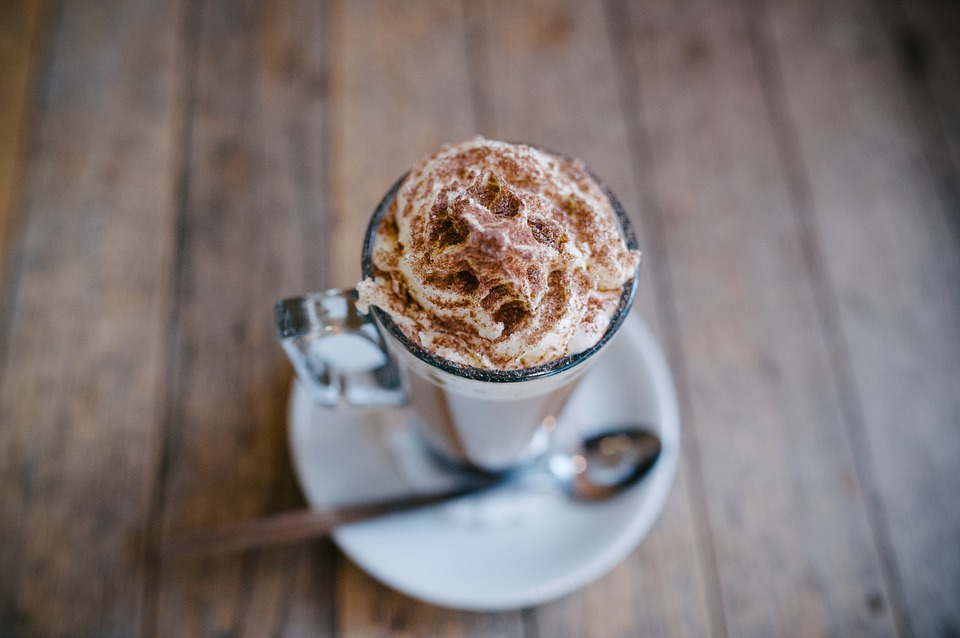
Every time you walk in, there is a faint smell of vanilla extract. It is always cozy and warm, which makes you super happy when you’re eating. But Cove Daisy doesn’t just sell delicious treats. It sells hot chocolate, and coffee. I don’t really get the point of coffee, and why adults like it so much, but I love the smell.
There’s two points in the day when you walk in and it’s packed. It’s before and after school, of course! I’m not the only kid who loves the treats at Cove Daisy. My friends – Charlotte and Nova – and I always head there before school for a quick pit-stop and after school if we’re hungry (which we always are!). Nova loves the energy balls, which have dates, coconut, and tiny bits of white chocolate. Our mums make Charlotte and I eat them, but we don’t like energy balls! We’d much rather have a cookie or a macaron.
I love Cove Daisy because there are so many yummy desserts there, and they’re healthy as well (at least, that’s what I say)! I hope Aunt Daisy finds more treats to make next time I’m there!
REVIEWED BY STEPHANIE, 11, WA (IONA PRESENTATION COLLEGE)
Girl of the Southern Sea by Michelle Kadarusman, UQP, ISBN 9780702262937
The publisher provided a review copy of this book.
When Nia’s life is turned upside down, can she still find the strength to keep going and persevere? I love how Nia is faced with so many difficult challenges throughout the book and how she gets through them all.
Her mother died giving birth to her younger brother, Rudi, her Bakap (dad) is always getting drunk and her best friend is making her keep a bad secret. Yet, Nina still has time to work the fritters cart, to help pay the rent, and look after her brother, Rudi. I think Nia is the strongest character from any book I have ever read, she is smart, helps others and is very devoted to her family.
If I had to rate this book I would give it 100 out of 10, that is how good it is. I loved learning some Indonesian words, I feel that it was a great touch to put Indonesian words in a book based in Indonesia. Overall, this is one of the best books I have ever read. I hope I can be as strong as Nia when life faces me with challenges.
Stephanie is a member of Iona Presentation College’s student reviewers’ team. This is her first review for Alphabet Soup. To send us YOUR story, poem, artwork or book review, check out our submission guidelines. Happy reading!
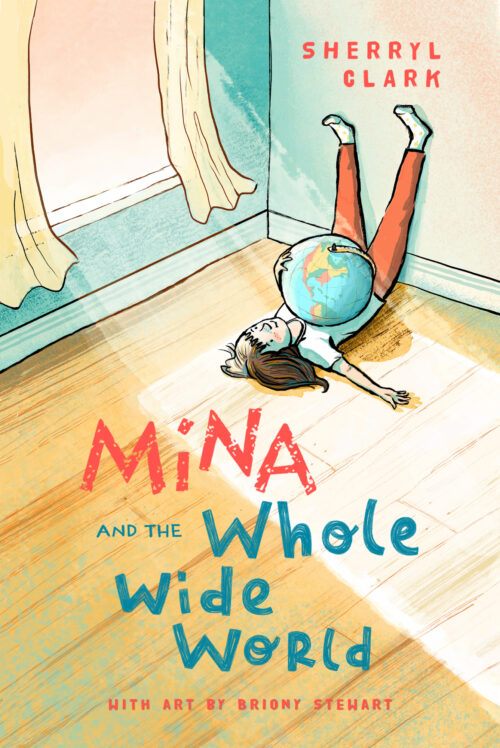
Sherryl Clark is an award-winning writer, editor and writing teacher. Sherryl has been writing poems and stories for children for over twenty years. We’re pleased to be chatting to her today about her latest verse novel – Mina and the Whole Wide World, illustrated by Briony Stewart.
From the publisher:
A powerful story about a young girl, Mina, and how she copes when her family take in a refugee boy and give away what was meant to be her first very-own bedroom.
What brought you to write Mina and the Whole Wide World?
I have been thinking about it for several years. I wanted to write something about refugees and also about what kids learn from their parents, and about how hearing someone’s story can change us and change how we perceive the world. But I was very conscious of appropriating stories – that stopped me in my tracks and the book just stalled after about five poems. Finally I went on a writing residency to Finland, and I realised one day that it was Mina’s story, and I could tell it from her point of view. Then the book just burst out – I wrote it in about five sittings of two to three hours at a time.
You write for a variety of ages and the style across your writings and books is also varied. Canyou tell us about how you approached the writing? Did you set out to write it as a verse novel?
Yes, it was always going to be a verse novel. I think simple poems with lots of imagery and ideas allow the reader into the spaces and gaps, and they can then imagine and feel the story for themselves. Not all stories work in verse (and not all verse works). I’ve actually tried to write a fantasy novel in poems and I just got bogged down by the world-building and the plot details! On the other hand, Motormouth started as a prose novel and was really flat and stuck until I turned it into a verse novel.
How long did it take you to write the book from the first germ of the idea, to the final draft?
I think I wrote the first five poems about four years ago. They just sat in my notebook and I couldn’t keep going. I didn’t know how to tell the story. When I got to Finland, the silence in my writing room and the fact I was there to write and do nothing else seemed to allow my brain to expand and “see” better. It’s hard to explain. I went there to write a crime novel! And I did, but Mina and the Whole Wide World kept pushing in and the poems just kept coming. As soon as I had Mina’s voice, I started writing madly. So it was finished in less than three weeks (and the original five poems were back in Australia so I had to start from the beginning). I did another draft when I came home but it was mostly refining and changing a few things.
Do you have a tip for young writers who would like to try writing a verse novel of their own?
Think imagery and story, and put them together if you can. Having a clear story idea or a plot is really helpful. It acts like a beacon to keep you on track. I’d also think a lot about voice – who is telling the story? Who do you imagine is speaking through the poems? And keep the poems tight – don’t over-explain. It’s a balancing act!
Could you tell us a bit about your next project?
I’m writing another adult crime novel at the moment. I was a bit stuck because I had to do some important research about private investigators to help me sort out some plot problems. I finally found someone I could interview so now I have to do some rewriting before I can work on the rest of it. Sometimes it’s like that. You stop because you know something is missing or wrong, and you have to go away and solve it before you can keep writing.
Mina and the Whole Wide World is out now! Ask for it at your favourite book store or local library.
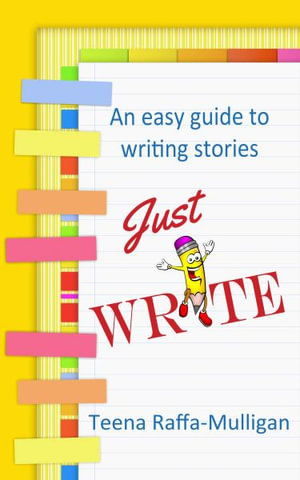
Teena Raffa-Mulligan writes poetry, short stories, picture books and novels. She has also worked as a journalist and editor. Today we’re pleased to welcome her to Alphabet Soup to chat about about her latest book, Just Write – an easy guide to writing stories.
From the publisher:
Just Write can help to kick-start the process for kids who are stuck at the start. Find out how to come up with ideas, create interesting characters, paint word pictures and more in this easy-to-follow guide full of activities and helpful examples.
How did you come to write Just Write?
I never had any trouble writing stories when I was a kid. My pen flew over the page and I could barely keep up with the ideas spilling out of my imagination. I had a head full of stories and would even run home from the park to write them down. When my children were in primary school, I became a parent helper in the classroom and realised there were lots of kids who struggled with story writing.
Around the same time, my first picture book was published and I did some school visits. The idea of putting together a book for children about writing took shape as I had more books released and continued to share my love of stories in talks and workshops. The first version, which was called What Comes Next? Story Writing Made Easy for Children, was accepted for publication but that never happened so the manuscript stayed in my filing cabinet for years.
Last year I had extra time at home because of the COVID lockdowns and restrictions but I didn’t feel like writing anything new. I did need a project to work on so I decided to take another look at some of my unpublished manuscripts. You Can Be a Writer came out in January and is a picture book for early primary children that is based on a talk I give in schools. Just Write is the next level up, so it’s for mid to upper primary age.
I hope the books will encourage children to see story writing as a fun activity. There’s a blank page waiting for our imagination to take us on an exciting adventure and we don’t know where it will lead until we start out.
What’s the WORST writing advice you’ve ever been given?
Be disciplined, write for set hours every day, work on one story from start to finish, and stick to one genre so readers know what to expect.
This may be excellent advice for another writer – I’ve learned it isn’t a fit for me, so I don’t have a set routine. I’m always working on a range of different stories and I don’t work from start to finish. A lot of the time my stories come together like jigsaw puzzles.
You write poetry, picture books, children’s novels, novels for teens and novels for adults. Which do you find easiest to write?
Anything short that I can write quickly and move on to the next bright, shiny new idea! It takes a lot of focus to write a novel and I am easily distracted so sometimes it will be months between writing one chapter and the next. I used to get really cranky with myself for not being more disciplined and concentrating on one story at a time. I’ve now realised this stop and start approach to novels works really well for me because when I return to the story after a break it will head in unexpected directions.
You love reading as well as writing! Can you recommend a book you’ve enjoyed recently?
Maddie in the Middle by Julia Lawrinson kept me so engrossed in the story I read it in two sittings. I had to stop for lunch! It is all about friendship and breaking the rules and Julia captures Maddie’s voice brilliantly. Another story I loved recently was Catch a Falling Star by Meg McKinlay, set in 1979 when the world was waiting for pieces of Skylab to fall back to Earth. Meg is one of my favourite authors and everything she writes is exceptional, from the language she uses to her vividly drawn characters and understanding of human nature.
Can you tell us a bit about your next writing project?
I’m working on a novel about a kid who finds a mysterious object at the local quarry the night after his next-door neighbour claims to have been chased by a flying saucer. That night Callum notices his toes have turned red and as the days pass the bright stain creeps steadily up his body. He can’t let Mum know or she won’t let him go to his first ever school camp. Lara from up the street has a secret too, and when the aliens turn up in search of the missing bits of their spaceship, the two kids have to decide what to do. It’s the sort of story I like writing because I let my imagination run free and until I write each scene, I don’t know what’s going to happen next.
Just Write is out now! Ask for it at your favourite book store or local library.
Fish Kid and the Turtle Torpedo by Kylie Howarth, Walker Books Australia, ISBN 9781760652548
Elizabeth received a review copy of this book.
‘Go, Hermie! go’ I whispered.
‘No, mine is going to win,’ said my best friend Emely.
This is Fish Kid and the Turtle Torpedo and it is about Bodhi and Emely. They are on a vacation in the Maldives and they find a turtle that is sick because it can’t swim underwater or dive.
Bodhi (Fish Kid) cannot carry Emely and the turtle back to their island to show Bodhi’s dad who could help. So Bodhi just takes the turtle and leaves Emely behind at the beach island.
Is the turtle going to survive? Will Emely get home?
I love this book! That is why I give this book 10/10! I love when they help the turtle. I like that the author introduced real animals in Fish Kid Fact pages such as the spinner dolphins and black tip reef sharks.
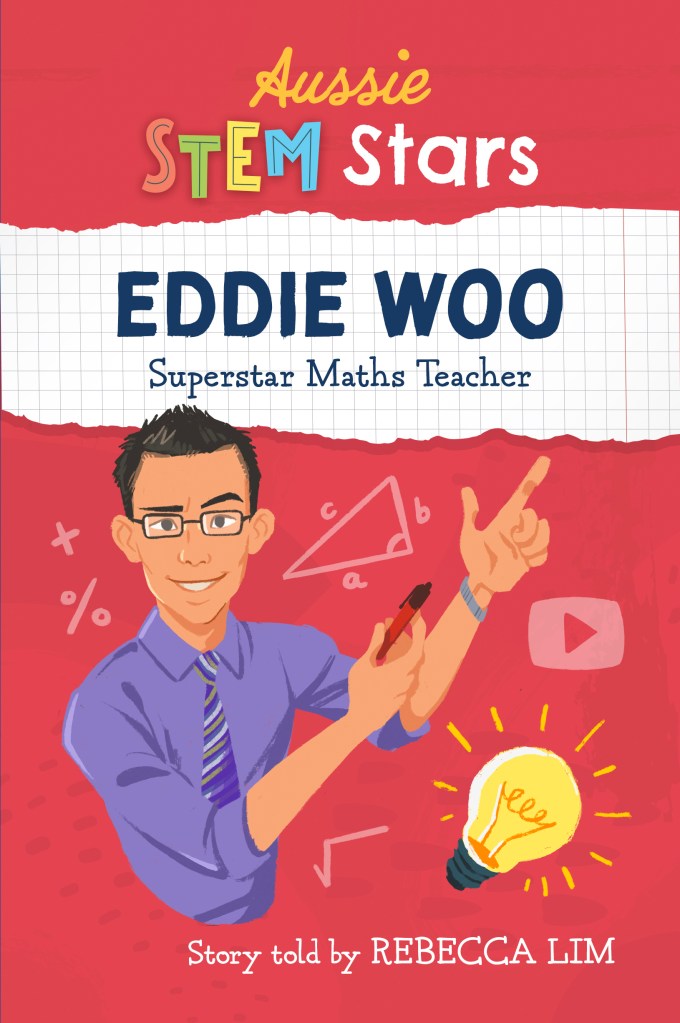
Eddie Woo, the award winning mathematics teacher, has an intriguing past with lots of surprises.
But was he always a superstar mathematician when he was young?
‘Catch you later,’ one of the boys hissed over his shoulder at where Eddie lay face down on the ground.
‘Drop you later, you mean!’ another one hooted over Eddie’s head.
Eddie Woo was one of the few Asian kids in his primary school. He was bullied for his short stature. Being known for studying didn’t help either. He had a lot of allergies and eczema which caused him to itch, only to be seen as a distraction in class by his teachers, who sent him to the principal’s office. He felt like no-one cared about him and he was neglected at school. He knew he was left out and overlooked, especially by his teachers. However, he always got high marks in English and History.
What happened to Eddie that changed him from a victim of bullying to becoming a superstar mathematics teacher? Find out in Rebecca Lim’s captivating biography of Eddie Woo’s life.
This is one of the most engaging biographies I’ve read because it is filled with surprises. Eddie shows his achievements and also his times of trouble. Throughout the book, you learn about Eddie’s emotions, feelings, thoughts and faith in God. Not only that, Eddie shows a few mathematical diagrams in the back of his book that emphasises how mathematics is everywhere in nature.
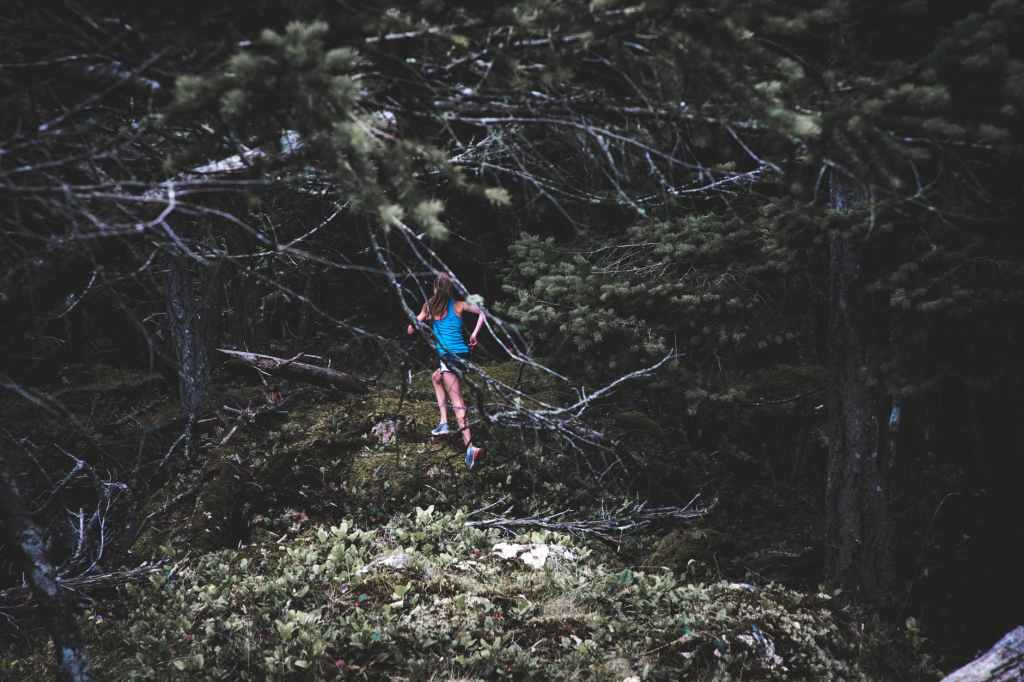
The air horn blared, breaking the silence. We all ran off, leaving behind a cloud of dust. In, out, in, out, my breathing went. A steady beat of determination in my breath ran through me all the way down to my feet, pushing me on. We entered the woods, a place of peace but not now. Now, it was a place of competition where we knew if we stopped we would never make it to the finish line. Jumping through the branches and sliding down the rocks, I felt the forest in my blood. I was impossible to stop, weaving in and out of different paths, following the red flags standing out in the green and brown. It went by in a flash, quicker than I imagined, and suddenly I was climbing my last hill. Completing my last descent. It was going to happen. Half a track to go and I was there.
Footsteps thudding. People cheering. I ignore it all and focus on the sound of my breathing. My heart leaps inside my chest. The final stretch, my running over in one step. Exhausted, I wasn’t sure if it was even possible to cross the finish line. My coach, Mandy, had decided to pursue the race along with me, and we crossed the finish line victorious.
“Go, Analia!”
My family cheered me on as I swept past them, completing the cross country 5K I had worked so hard to complete. Smiling in the sunlight I glance around feeling the support of all the other runners who had finished before me. I couldn’t wait for my next 5K!
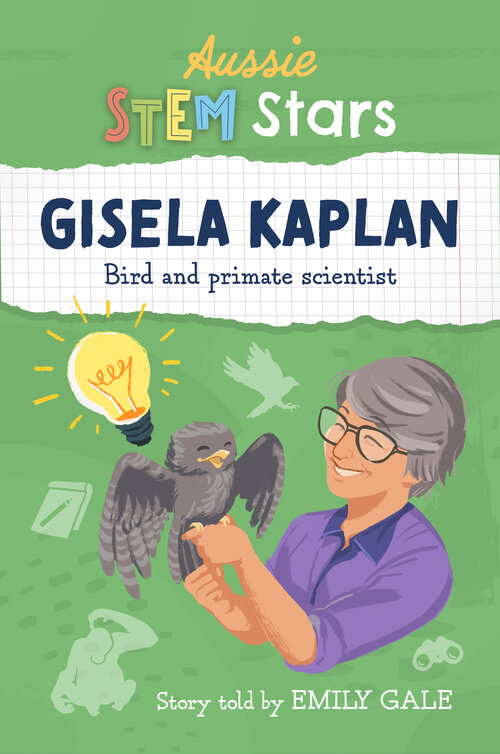
How did Gisela Kaplan, a young German survivor of WWII become a world-leading expert in the behaviour of animals?
This book is a biography of Gisela Kaplan written by Emily Gale. Gisela Kaplan had a hard life in Germany after the Second World War. Then after she immigrated to Australia, the book shows how other people helped her along in her career as she played a role in primate and bird science. In addition, there are notes to help explain words you don’t understand.
When she arrives in Australia what jobs could she take? How did she learn a second language, and how does she support her daughter? Read Aussie STEM Stars Gisela Kaplan to find out more and all the answers to these questions!
I like this book and for me, it is five-star rated because it shows an emotional story of immigration. It also shows how much practice has to go into work till you can fulfil your dream, as you can see how she consistently worked away from home, in the work field.
This book would be for ages ten and up to read by themselves although most children from the age of six to ten can read with someone to help the children understand. Go grab a copy of this amazing book either online or hard copy.
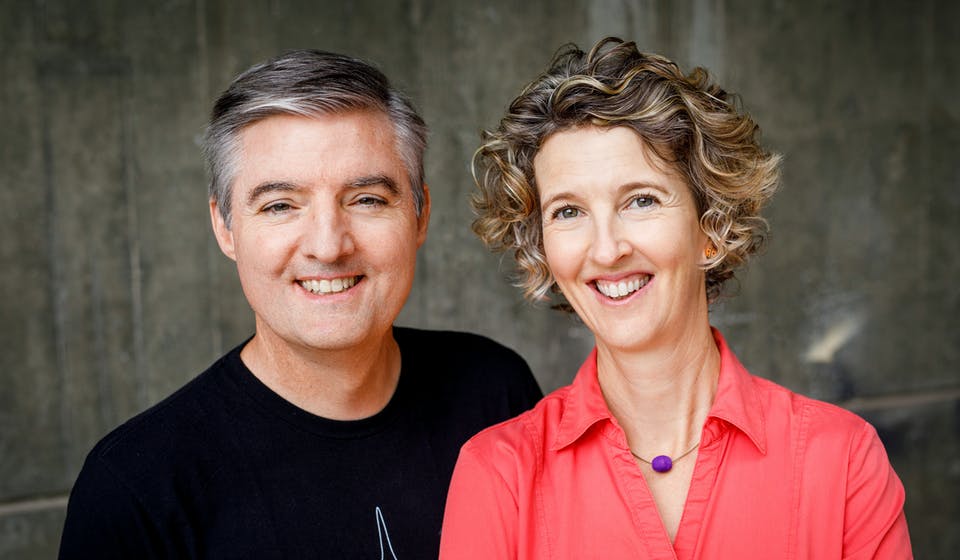
Science fiction and fantasy author Denis Knight is a computer programmer who grew up geeking out about the works of J.R.R. Tolkien, Terry Pratchett and Douglas Adams. He has also worked as a technical writer, a delivery boy, a tutor, and, for one glorious summer, a tour guide on Rottnest Island.
Cristy Burne has worked as a science communicator for nearly 20 years across Australia, Japan, Switzerland, the UK, US, South Africa and beyond. She has performed in a science circus, worked as a garbage analyst, and was a reporter at CERN when they turned on the Large Hadron Collider. Her books include To The Lighthouse, Off The Track, Beneath the Trees, and a non-fiction book, Zeroes and Ones. In 2020, she told the story of the inventor of spray-on skin in Aussie STEM Stars: Fiona Wood.
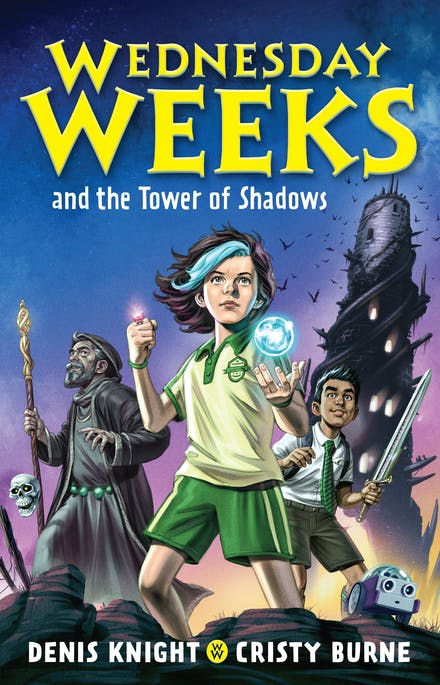
Denis and Cristy decided to collaborate on a book and the result is a hilarious new series featuring the adventures of a girl named Wednesday Weeks. Today Alphabet Soup is super excited to have Denis and Cristy visiting to tell us about co-writing Book 1 in their series – Wednesday Weeks and the Tower of Shadows.
From the publisher:
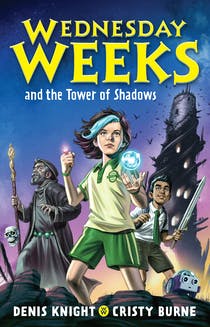
Wednesday Weeks never wanted to be a sorcerer’s apprentice. She’d rather study science than magic. But when her cloak-wearing, staff-wielding grandpa is captured by a power-hungry goblin king, Wednesday must find a way to embrace her magical heritage and rescue him from the dreaded Tower of Shadows.
One book, two authors. What was it like trying to write a book using two brains?
DENIS: Writing a book with two brains! I love that. It’s actually a great way to describe it. Although sometimes it feels like we only have half a brain between us. Ouch! Cristy just kicked me under the table.
CRISTY: Only because you kicked me first! It was actually really exciting, writing with Denis, because I could never predict what he would write, and I was always literally laughing out loud to discover what Wednesday and Alfie had been up to while I was away.
DENIS: Right. It was a lot of fun. But it was challenging, too – in a good way. When you’re working on your own, you can let yourself get away with stuff. But when you’re writing with a partner, you can’t do that any more. You have to level up.
How did you come up with/agree on the name for your main character?
CRISTY: Denis came up with the concept of Wednesday Weeks, a reluctant sorcerer’s apprentice, and in that very first chapter, he invented many of our favourite characters and names: Wednesday Weeks, Alfie, Mrs Glock … and of course, Abraham Mordecai Weeks (otherwise known as Grandpa).
DENIS: That’s true. Although, Wednesday’s character started out as something quite different from where she ended up. Cristy doesn’t know this, but my first idea was for a space bounty hunter named Serenity Weeks.
CRISTY: A what? Pardon?
DENIS: Then she was going to be a paranormal investigator named Wednesday Weeks. Wednesday’s character and voice started to develop when I wrote some short scenes where she and Alfie were searching for Bigfoot and the Loch Ness monster. Then the reluctant sorcerer’s apprentice idea popped into my head, and that was kind of the final piece of the puzzle.
CRISTY: More like the first piece of the puzzle. From there, we started writing. At first, it was literally a game. Denis wrote Chapter 1, and after reading this chapter, I wrote Chapter 2, and then Denis wrote Chapter 3. And we just trusted the story to evolve.
DENIS: I think the lesson here is to give yourself the time and space to play with an idea and see what develops. Also, that space bounty hunters are awesome. What do you think of the name Serenity Jones?
CRISTY: …
CRISTY: …
CRISTY: … I hope you’re not asking me?
How did you know/agree when Book 1 was finished and ready to submit?
DENIS: We wrote our first super-quick, super-short draft of Book 1 in early 2018.
CRISTY: That first draft was only around 25,000 words long, but it was enough for us to get to know Wednesday and her world, and to know we wanted to write more.
DENIS: We had the first ten pages critiqued by a publisher in June 2018, and she gave us some really good feedback.
CRISTY: Over the next year, we both worked on other projects, but we kept coming back to Wednesday.
DENIS: We rewrote the opening chapters based on the publisher’s feedback, and we fleshed out the middle section, adding in the Sword of Reckoning and the laundry kraken. In June 2019 we had the opening chapters critiqued again by a different publisher, and she loved it. So that’s when we knew it was ready to submit.
CRISTY: Later, as we worked with Hachette to progress the manuscript through the various editing stages, we had three different editors all offering their advice, and there were thousands of new notes on each fresh edit that we completed. Getting the story just right was a whole lot of work!
Do you have any ‘Must Do’ or ‘Must Not Do’ tips for young writers who might like to collaborate on a story?
CRISTY: Respect for the other author’s creative brain is really important. A big part of the game we play as we write each Wednesday Weeks book is to take up the reins from where the other author has left off, and to then drive the adventure where we think it needs to go.
DENIS: Be open to your partner’s ideas, and have fun.
CRISTY: Another Hot Tip is to trust. As you write, remember that you teamed up with this other creator for a reason, and although smooshing two brains into one story can be difficult, the results will be worth it.
DENIS: Also, don’t expect it to be brilliant right away. It won’t be! But if you keep working on it, you’ll get there.
Can you tell us a bit about what you’re writing next?
CRISTY: We’ve just finished putting the finishing touches on Book 2 of the Wednesday Weeks series.
DENIS: It’s called Wednesday Weeks and the Crown of Destiny and it’s out in September 2021.
CRISTY: We love it because it has all our favourite characters, plus more page-time for Adaline, our punk faery-friend from the laundry.
DENIS: There’s also some advanced magic for Wednesday to tackle, a hippo-bugamus, a giant pinball machine of death, a visit to outer space and, of course, some snarky Bruce-jokes.
CRISTY: And don’t forget a whole lot of dirty-rotten evil-doing from Gorgomoth.
DENIS: Right. Oh, and also, Grandpa gets turned into a frog for a while.
Wednesday Weeks and the Tower of Shadows is out now! Ask for it at your favourite bookshop or local library.






 alphabetsoup.net.au