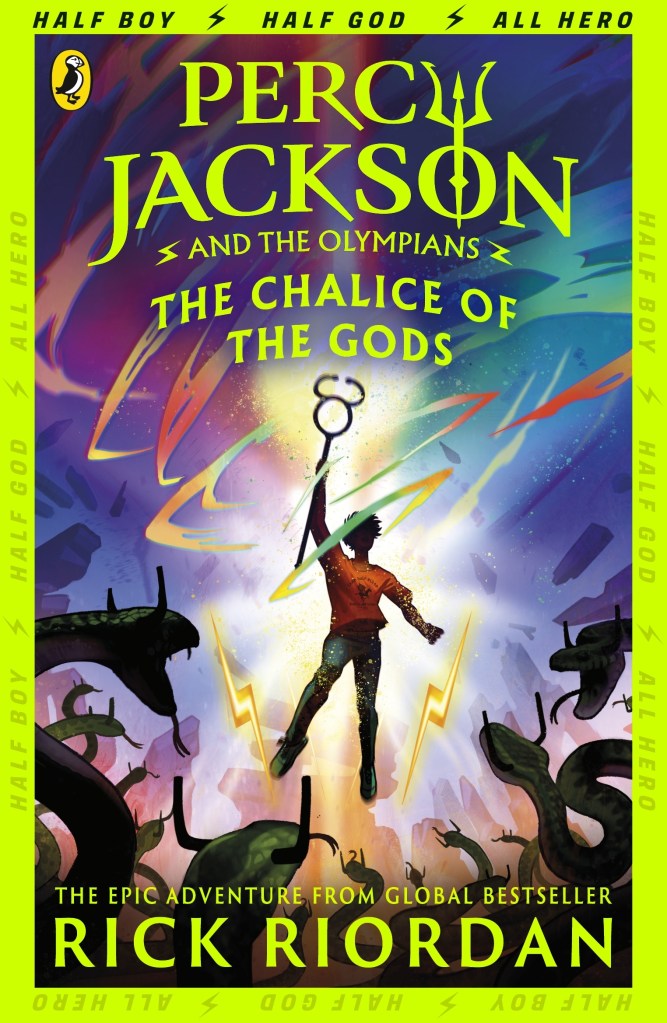
Percy Jackson and the Olympians: The Chalice of the Gods by Rick Riordan, Penguin UK, ISBN 9780241647523
REVIEWED BY MILAN, 10, NSW
Milan reviewed his own copy of this title.
Percy Jackson and the Olympians: The Chalice of the Gods is an adventure novel written by Rick Riordan. This story follows the Heroes of Olympus series and is a sequel to the other Percy Jackson books. This novel starts with Percy, Annabeth and Grover who are the protagonists. Being demigods, they complete quests and missions that gods have sent them. One peculiar day, the Greek god Ganymede shows up and makes a demand that they return his special chalice. This cup turns out to be the Chalice of the Gods, which holds great power and one sip can transform any mortal into an immortal god. And so, Percy and his demigod companions embark on this dangerous quest, nervously questioning various Greek gods. Some of these gods include Hebe, the goddess of youth and Iris, goddess of the rainbow. When asking for information from Iris, however, she demands a favour in return.
In this book I especially enjoyed the humour Rick Riordan used from Percy’s perspective during some of the serious scenes. I felt that it made the story engaging and a real page-turner. I also enjoyed the combat battles that the trio fought in. Riordan described the scenes so vividly that I could picture the story clearly.
The names of the chapters bothered me because they gave away what was about to happen. I think that Riordan could have improved on this by naming the chapters more vaguely. The surprise element of books is much more enjoyable and I would have preferred to find out through a more natural progression.
Overall I thoroughly enjoyed this book and would rate it 4/5 stars. I look forward to reading the rest of the Percy Jackson series. I would recommend this novel to children aged 10–12 years and to those who enjoy action-packed and mythical adventures.
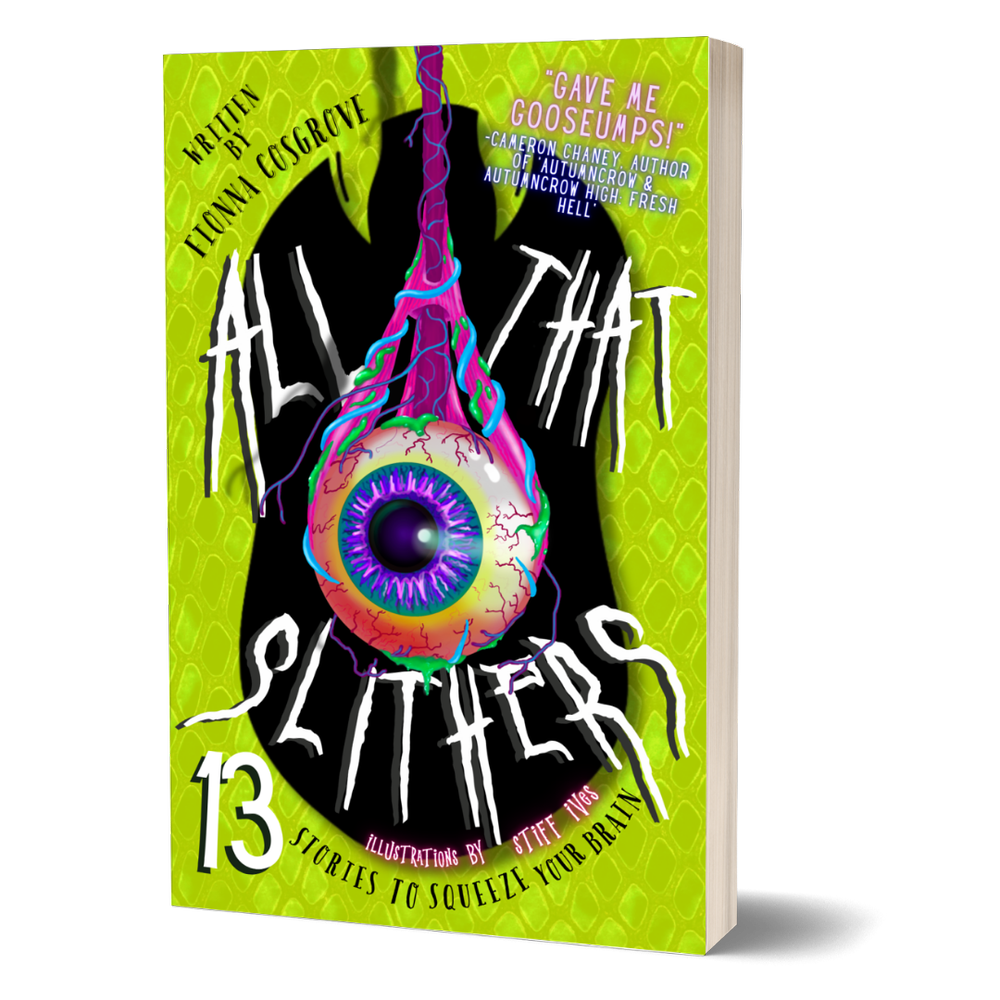
Fionna Cosgrove is a Western Australian writer with a taste for the wonderfully macabre. Her writing has been published in The School Magazine and anthologies, and she’s also the author of the Twisted Trails series for young readers and Sadie and the Secret of the Swamp. Today we’re chatting to Fionna about her latest book, a short story collection for older readers of horror stories: All That Slithers, with illustrations by Stiff Ives.
Fionna provided Alphabet Soup with a reading copy of this book.
From the publisher:
All That Slithers is a collection of unsettling and creepy short stories; a kaleidoscope of quiet dread, ghastly ghouls, and neon-tinted terror! In this hauntingly playful collection, monsters lurk in the most wholesome of places, systems hum with quiet resistance, and the safest routines conceal the strangest truths. Each story is calibrated for curious minds: creepy enough to raise goosebumps, curious enough to feel cosy. Suitable for humans (and others) 10 and beyond!
Of all the book genres out there, why do you choose to write horror stories? Did you also read horror when you were growing up?
I don’t necessarily think we choose what we write. I think we naturally gravitate towards certain things, and I think my brain, and by association, the rest of me, has always been interested in the paranormal, the bizarre and the unexplained. I grew up, thanks to my Dad, loving shows like Are You Afraid of the Dark? and the TheTwilight Zone, Unsolved Mysteries and Fact or Fiction. All of these shows had the best twists. They would lure you in thinking you knew where the story was going, only to throw a complete left hand turn right at the end and have you gobsmacked at the big reveal. I think I love that side of horror the most; the weird side. The side that kind of begs you to believe there’s more in this world than you can see, and nudges your flight response just enough to be fun, but not enough to traumatise. There’s also nothing quite like that feeling when you’re right on the edge of your seat, perhaps only surpassed by that feeling when you finish a story and have to take a moment to comprehend what you just read.
Growing up, Goosebumps [the series] was just released and it went bananas! It was on every kid’s table at school and everyone was talking about the latest release, but … I never really read them. They still hold a super nostalgic place in my heart, and I have since read many, and adore them, but my sister was five years older and was already reading Stephen King and Christopher Pike – the heavy hitters of horror in the 90s. As a result of always wanting to impress her, I skipped Goosebumps and went straight to her Point Horror and Christopher Pike books (avoided her King books though, thank goodness). And even back then, with all of those horror books, the ones that resonated for me were always the paranormal ones. I never really loved the stalker books or mystery killers, what I loved were the cosmic travellers, or the ghosts, or the possessed perfumes … nothing much has changed. So, yes, I did read horror as a kid, but even then I had a specific flavour that I liked, and that’s still my favourite to this day.
Have you ever written a story that got too scary/gory and had to tone it down? Have you ever scared yourself while writing a horror story?
Yes. To both. In my collection of short stories, All That Slithers, there’s a story called ‘Irene’s Eye-Scream Parlour’ and originally the final scene was really gory. There was mention of juicy optical nerves, intestines, splintered bones as toothpicks and several other references to body parts. In some ways I wish I had kept more of it in, as I think sometimes I underestimate what kids can handle (and what they enjoy), but when writing kids stories, I prefer to stay on the side of caution and figure I’d pushed that story far enough without needing the extra gore. Still, if anyone wants a copy of the original … just sing out! haha
And yes to scaring myself. I wrote another story in All That Slithers called ‘Sundowner’ at night on my bed. My favourite place to write is on my bed at night with the window open next to me so I can have moonlight filtering in. It’s quite a serene environment – unless you’re writing about haunted ships and ghostly sailors. I creeped myself out so much during that story I had to shut the laptop and continue writing during daylight the next day. I think because that story was inspired by Batavia, a real life shipwreck off the coast of WA, it hit harder, and I felt like I could actually be invoking something real from my words. Whereas usually, when I’m making stories up from my head, I figure I am somehow more in control … whether that’s true or not, I have no idea.
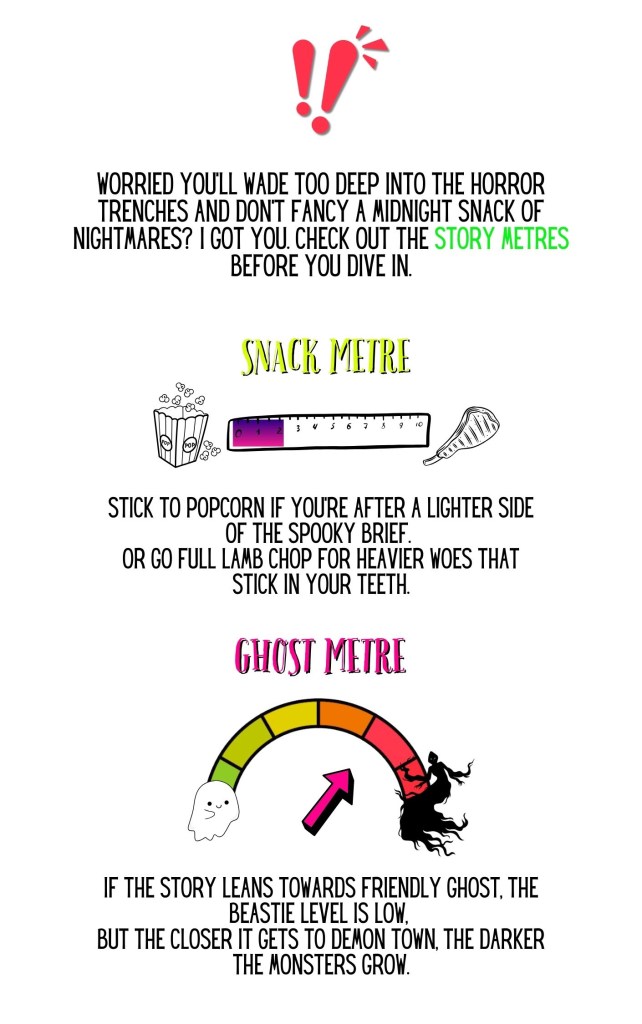
Each of the stories in your book (13 stories, plus a bonus 14th) feature two metres at the start to rate its horror level. How do you decide the rating of each story? Do you have test/sacrificial kid-readers?
I have several sacrificial kids 😈 and adults haha. I sent my stories to a handful of adults that write for kids, and also to several friends that have kids. It’s funny though, because everyone’s reactions to these stories are so different. I have a friend who’s daughter reads all of my stories, and she is never scared by anything. If anything, she gets bored unless there’s a significant amount of gory body parts. While on the flip side, there are some adults – like my Dad – who disliked any of the stories that edged too far into the horror world. In the end, I took on board everyone’s feedback, but then had to really follow my gut. I tended to rate the more light hearted stories higher on the snack scale, and the ones that tackled more serious concepts, closer to the meaty side. And then with the ghost metre, I rated the stories that veered more towards entertaining and funny closer to the ghost, and ones that moved into darker territory and featured darker, perhaps scarier entities, closer to the demon side. But reading is so subjective, what one person finds scary, the next may laugh at. So in the end, it really is just my best guess.
Fionna’s metres (scales) to gauge the scariness & monster presence in her stories.
Do you come up with your twist in the tale before you start writing, or during the writing process? What makes a good twist?
For the most part, it’s the endings that come first, and then, as a lover of the twist, I have to figure out how to lead the reader astray at the beginning, so the twist really lands. The fun part for me is figuring out how the story begins, and what I can weave into the scenes so that the twist lands in a way that makes the whole story suddenly shift. For example, with the bonus story, ‘Hush’, I knew the overall concept of what I wanted to write, but I wasn’t sure how to write it in a way that would really surprise the reader. That story for me, was the darkest, and aimed to have the biggest twist – whether I landed it or not is up to the reader!
I think a good twist makes the reader want to go back and read the story again. It’s one they never see coming that makes them want to look for the breadcrumbs, to analyse their own mind, and wonder why they thought the story was going somewhere else to begin with? A good twist reframes the entire story. And on an audible level, a twist that makes you gasp is always a winner! One of my favourite twists ever was in the story ‘Neato Burrito’ by Josh Allen in his book Out to Get You: 13 Tales of Weirdness and Woe. Besides being the most awesome name for a short story ever, I never saw the twist coming, and when it landed I was equal parts horrified and massively entertained.
Can you tell us a bit about what you’re working on next?
Currently I’m working on short stories for the Micro Terrors podcast, which is a kids horror podcast for ages 8 and up that I am a secondary writer on. It’s based in the US and the stories are a mixture of bizarre, funny, unsettling and creepy. It’s one of the most fun projects I’ve ever worked on. As well as those, I’m writing several novellas for my Twisted Trails Series, hoping to package them up into a Seasonal Screams Omnibus ready for a Halloween launch – each novella will take place during a festive season. I’ve just finished drafting Love Letters which is the Valentine’s novella, and aim to have either two or three more completed by Halloween – with one obviously taking place on Halloween.
In addition, I’ve been looking at starting a cosy fantasy snail mail club (but make it strange, obviously!). The world is called The Land of Grim (working title) – think trolls that harvest magical flowers, mermaids that prefer to swim in swamps, goblins that are grumpy government workers, and sirens that have taken over the open ocean as pirates. I’m currently in the process of commissioning art, writing up stories, and just generally over thinking the whole thing. ETA on that project is ‘who knows’.
Hover Car Racer by Matthew Reilly, Pan MacMillan Australia, ISBN 9781743283707
REVIEWED BY MILAN, 10, NSW
Milan reviewed his own copy of this title.
Hover Car Racer is a science fiction novel written by Matthew Reilly. This book is about two brothers who dream of becoming the world’s best hover car team. A hover car is a futuristic vehicle that is similar to a regular car but flies above ground and can reach a potential speed of 770 km/h. The story is set in the future where the two main characters are in a National Championship in Sydney and follows their journey as they compete around the world.
At the beginning, brothers Jason and the Bug are chosen to attend the International Race School after showcasing their skills. As the year progresses, the team is paired up with Sally McDuff, their new Mech Chief. Together they train and gradually improve in their pit stops, speed and accuracy.
I really enjoyed the journey Matthew Reilly described. It seemed very realistic because Jason had to face his fears and not everything went right for him. I have never read a science fiction book before this one and it was eye opening the way he described the futuristic scene.
I think Matthew Reilly could improve the description of Ravi Gupta and his motivations behind becoming a gambler. Although I disliked this character, I would have appreciated understanding him better.
I would rate this book 4/5 stars because it was exciting, fun and engaging. The racing scenes made it an absolute page turner. I would highly recommend this book to readers keen for adventure and those who love science fiction books.
The Light in Everything by Katya Balen, illustrated by Sydney Smith, Bloomsbury Publishing (AUS), ISBN 9781526622983
REVIEWED BY MILAN, 10, NSW.
Milan reviewed his own copy of this title.
The Light In Everything is a very intriguing fictional novel written by Katya Balen. The story is set in a seaside cottage. Here we meet Zofia and her dad, Marek, as well as Tom and his mum, Fiona. Each chapter switches perspectives between Zofia and Tom. Their personalities are the polar opposite of each other. Tom is a shy, timid boy who has trouble trusting others due to a traumatic experience with his father. Zofia, on the other hand, is an energetic, confident girl who has a close relationship with her dad and finds it difficult to share his attention. As the story progresses, Marek and Fiona fall in love and the families move in together which poses many challenges. The four of them quickly discover their differences and this causes tension in their relationships. Later, Fiona and Marek have a baby who is born with complications which forces Tom and Zofia to spend more time together.
Overall this was a very engaging book and I thoroughly enjoyed it. I really liked the description of the pain Zofia and Tom were going through. The language she used made me feel as if I was really there and experiencing their emotions. One of the quotes I really liked was “The sea is bright today. Far out towards the inky horizon are little licks of white foam that mirror the lazy clouds above them.” This quote shows us how powerful Katya Balen’s descriptions are and it made me imagine how the characters might feel.
One thing I didn’t like was how ruthless Fiona’s last husband was and how brutal he was towards Tom. The quote “I tell her that Dad used to hurt us and now he’s in prison but I’m still afraid” shows the impact Tom’s dad made on him. This made me empathise with Tom but I also found it difficult to read because it made me feel fearful. I thought that the end was quite predictable and I usually prefer a twist at the end of a book.
I would rate this book 4/5 stars and highly recommend it to readers who enjoy a heartfelt story about relationships and family.
This is Milan’s first book review for Alphabet Soup. To send us YOUR book review, read our submission guidelines. Happy reading!
The Wonder Brothers by Frank Cottrell-Boyce, illustrated by Steven Lenton, Pan Macmillan UK, ISBN 9781529048315
REVIEWED BY SCARLETT, 10, QLD
Scarlett reviewed her own copy of this book.
The Wonder Brothers is a book about three kids named Brodie, Nathan and Middy and Brodie’s unusual rabbit, Queenie, who decide to go to see the famous magician called Perplexion at his last show.
They climbed on a truck because they thought they were going to meet Perplexion at the airport on his way to Las Vegas for his final show. They end up stuck in Las Vegas, find out something mysterious about Perplexion and then have to find their way back to Blackpool.
I like this book because it is about kids, travelling, magic and it is very funny. I like the bit where they arrive in Las Vegas and don’t know where they are. They think they are in Paris and then they think they’re in Egypt because they see an Eiffel Tower and some pyramids. That is one of the funniest parts of the book.
I recommend this book for 8-15 year olds, I think they would really like it. I rate this book 9 out of 10. I didn’t rate it 10 out of 10 because I wish there more great books in the series so I can read more about the Wonder Brothers.
This is Scarlett’s first book review for Alphabet Soup. To send us YOUR book review, read our submission guidelines. Happy reading!
Wonder by RJ Palacio, Random House UK, ISBN 9780552565974
REVIEWED BY EMILY, 10, New York, USA
Emily reviewed her own copy of this title.
Wonder by RJ Palacio is an incredible book. It is about the main character, Auggie Pullmen and the challenges he has to face at a real school because of a facial disorder that he was born with. This is a book of mixed emotions – some of his feelings were happy, sad, mad and embarrassed.
Auggie had many struggles at school and with his friends because he was different. One example of when Auggie felt embarrassed is when Auggie trusted Jack with secrets of his surgeries, but Jack let him down by making fun of him with other kids behind his back. Even though this made him feel sad he didn’t forget about his other friendships. Another friend, Summer, made Auggie feel stronger about himself. Summer was always there for him and she didn’t care what other kids thought about his face. And Summer was very kind to Auggie. The way Jack treated Auggie made me feel unhappy and sad because you should always treat others the way you want to be treated. But Jack was unkind and didn’t care about how Auggie felt.
The life lesson of this book is to be brave and to not care what other people think of you. And to try and overcome those challenges in life even if it’s hard.
This is Emily’s first book review for Alphabet Soup. To send us YOUR book review, read our submission guidelines. Happy reading!
D-Day Dog by Tom Palmer, illustrations by Clohosy Cole, HarperCollins, ISBN 9781781128688
REVIEWED BY Arjan, 11, NSW
Arjan reviewed his own copy of this title.
D-Day Dog is a book that teaches kids about the D-Day landings on 6th June 1944. Eleven-year-old Jack has an admiration for war heroes, particularly men on D-Day. But his beliefs are questioned when his dad is called up for active service in Afghanistan. Out of the blue, Jack’s class is taken on an excursion to Normandy. There he learns the true story about D-Day and how one paratrooper took his dog with him at the airborne landings. Sadly neither of them survived.
I loved the shared dialogue between the different characters as well as the descriptions of the characters and the places. I liked the dream sequence, it showed Jack’s emotional turmoil.
The book teaches kids that war is not a good thing and empathises with different characters and their common traits.
This is Arjan’s first book review for Alphabet Soup. To send us YOUR book review, read our submission guidelines. Happy reading!
Escape From Marigold Manor by Rachel Jackson, Riveted Press, ISBN 9781763526068
REVIEWED BY ELLA, 9, WA
The publisher provided a review copy of this title.
Escape from Marigold Manor is a detective book with lots of cases, which the reader sometimes has to help solve.
This is not the kind of book I would usually read, but I enjoyed the surprising endings and interesting challenges. I did find some of the challenges a little bit tricky!
I would recommend this book to anyone who likes mysteries and puzzles, and choose-your-own-adventure books!
Teams of kids on an alien planet competing to get into Starquest Academy, three clues and only three days to find their way to the finish line. Today we’re chatting with HM Waugh about her latest book: The Surface Trials. HM Waugh is a children’s author, educator and environmental scientist with a long-term love of wild places and outdoor adventures. She has handled dragons for a job, and dreams of one day blasting into space. Her books mix humour, danger and friendship with a dash of science and imagination.
From the publisher:
An epic page-turner full of twists you won’t see coming, set on an alien planet where, under the watch of a galaxy-wide TV audience, Ammy Antares and her fellow competitors must complete a challenging quest to gain entry into an elite interplanetary academy. Welcome to the Surface Trials.
In your novel, squads are groups of children competing and the groupings are assigned. If you were in The Surface Trials, what talent/knowledge/skills wouldyou bring to your squad?
I love the idea of a squad, because when I’m in an escape room there’s no way I’m getting out without other people’s ideas and points of view.
I think I’d offer my squad some halfway decent analysis of clues to try and break codes – I love pulling things apart searching for hints and patterns … Sometimes I’m even successful! I have a vast array of potentially unhelpful facts about science, gardening, and my favourite fantasy and sci-fi books. I can read maps and building plans like a pro, thanks to an early love of architecture and an ongoing commitment to epic fantasy novels. And I think I’d be pretty good at navigation and survival. I ought to be, since I teach that stuff as part of my job. Plus, every time I’ve become lost in the wilderness, I’ve made it out again!
I am also very good at eating chocolate …
The squads face some pretty hairy scenarios. How do you go about writing a scary scene for your characters? How do you let go of those ideas at night so you can sleep?
Hairy, huh? I think I know exactly what scene you’re referencing there! Scary scenes are so much fun to write! They’re important for making a story exciting, and they give my characters a chance to work out how awesome they are – which is kind of the purpose of a story, I think. For me, making words on a page capture a reader is the result of lots of little things added together.
First, I need scary subject matter. I like to get inspired by freaky science, weird facts, mind-blowing history and mouldering industrial ruins. I make sure the stakes are high – failure has to mean something bad, so the reader is on the edge of their seat. To have this work, I need to connect the reader to the characters before I launch into a big scary scene. I want the reader to see the characters as real people, people they care about. People they don’t want eaten alive by a newly-hatched alien.
Next I need rising tension – that ever-increasing sense of impending doom. This is what keeps a reader hooked to the page. I keep raising the tension throughout my books, but every big scene is a tension peak. Increasing tension in a scary scene is about shorter, sharper sentences. It’s about concentrating on what the characters would be noticing in that moment – they’re not going to be giving a monologue on the colour of the sunset if they’re being chased by a ravenous monster. They’ll be more concerned about where their friends are, where they can hide, and how hot the monster’s breath is on the backs of their legs. I also often add in little elements of humour, right smack bang in the middle of the scariness. Honestly, I don’t want my readers terrified! Plus, that dash of a laugh makes the rest of the scene seem even scarier.
Finally, to make it feel real I inject real emotions. I may not have been in any of the exact situations I put my characters in, but I think of the times I’ve been terrified and I try to write those emotions onto the page.
How do I sleep at night afterwards? Blissfully. Once a scene is written down, my mind knows it doesn’t have to keep thinking about it. It’s time to start dreaming about what my characters might face next! But if I’m partway through writing a scary scene? Yeah, that can sometimes mean a bit of a sleepless night, but that also gives me lots of great ideas about what could happen when I continue writing the next day.
The storytelling offers multiple points of view in this book; we hear from several of the squad members. Why did you decide to tell the story this way, rather than choosing to tell the story through the eyes of one character only?
Choosing points of view (POVs) is always difficult. Two of my main characters, Deneb and Ammy, are both drafted into the same squad but they’re very different people. So I felt we needed to hear from both of them. For instance, how Ammy sees herself is not always how others perceive her, and I wanted some of that vulnerability and self-doubt to show. Deneb’s POV provides this.
And, of course, I have a disguised character. Nobody in the Surface Trials knows which contestant is actually Rian Amalthea, the uber-famous and mega-rich heir to two massive space Dynasties. He could literally be anyone. I didn’t even know at first! Having Rian’s POV deepens that mystery. Where is he? Which squad is he in? Who could he be?
Do you have a tip for young writers who would like to write their own page-turner?
First off, rising tension is your friend. It works (like I’ve talked about already) with scary scenes. It also works across an entire story. Rising tension keeps the reader hooked. So … keep ratcheting it up. The stakes need to keep getting higher, the mystery more mysterious, the dangers more dangerous. But beware! Too much continuously rising tension weirdly means it stops being tense. The reader gets used to it, and it loses its impact. To avoid this, I drop the tension slightly after each peak scene so the reader can sigh in relief, before I crank it back up and they realise things are actually worse than ever! <evil laughter>
Secondly, experiment with ending your chapters on mini-cliffhangers. I like to picture all the kids out there (my own included) who have been told they can read to the end of the chapter and then it’s lights out. My aim is to have them still reading many chapters later because they just have to know what happens next. I hope they’re so deep in the book they don’t even realise they’ve read past the chapter end. If this is you, feel free to tell your responsible adult that it’s not your fault, the author (me!) did it on purpose 😊.
Can you tell us a bit about what you’re working on next?
I have three things I’m working on at the moment, and I’m in love with each of them for very different reasons. None are contracted to be published. Yet!
The Surface Trials is out now! Ask for it at your favourite bookshop or local library.
Little Bones by Sandy Bigna, illustrations by Tamlyn Teow, UQP, ISBN 9780702268878
REVIEWED BY MARLEY, 9, WA
The publisher provided a review copy of this book.
Little Bones is about a girl called Bones and she loves collecting animal bones for her collection. She doesn’t have many friends at school and people think she’s a freak. She ends up finding a little skeleton of a bird at the wetlands, she brings it back to her house and wishes the bird would come alive again. And guess what? He came alive.
The book is very different to other books I’ve read. It’s way more heart-warming and has different formatting. And I love the front cover.
I liked how there was always a cliff hanger and you could never stop reading the book without finding out what happened next.
My favourite character was Tenny, because Tenny is really sweet and kind. They are the perfect match for Bones as they are kind of Bones’ happy shadow. I liked the inclusion of diverse characters.
I liked the setting because it has very big home cosy vibes and it makes it feel more realistic.
I found the story very interesting because there aren’t many stories about people dying in kids books, but i think more should because you can’t just hide away what’s sensitive from kids. I didn’t find myself being sad, but intrigued to see how Bones would overcome her own sadness and regret.
I think people that are not super sensitive would enjoy this book. Its a mix between fantasy and adventure and about overcoming your fears. Also people that don’t feel like they belong might be intrigued to find out what’s in this book.