Maddy McAllister: Shipwreck Detective (Aussie STEM stars series), story told by Deb Fitzpatrick, Wild Dingo Press, ISBN 9781925893823
Elizabeth received a review copy of this book.
Six-year-old Maddy McAllister, a shipwreck detective, started her adventure in Wangi Falls – her favourite place to cool down. But then her parents took an unexpected turn. Maddy and her sister Ally changed schools and moved to Pine Creek for their father’s job. It was 225 kilometres from Darwin where they used to live. Then she moved closer to her grandparents because her father found a different job in Perth, which meant Maddy and Ally, could spend more time with their grandparents. Maddy’s grandad was always by her side ever since they moved to Perth, every step of the way, encouraging her every day. He told her stories all the time when they went on fishing trips which her grandad called “on the high seas”.
One day, her grandad told her a story about a shipwreck which made her curious. A few days later, she heard on the radio that there was going to be a lecture about a different shipwreck discovery. Little did she know that this lecture would change her life.
My favourite person in this book was Maddy’s grandad because he was encouraging and supportive of Maddy in every way he could. I can relate to this book because Maddy faced what I faced when I was six years old, which was to leave close friends and transfer to a new school and new town.
This book is by Deb Fitzpatrick who also wrote Ajay Rane that I have written a review for as well. I think that this book Maddy McAllister is interesting and inspiring.
I recommend this book for age seven plus and rate this book 10 out of 10.
Maddy McAllister: Shipwreck Detective is out now! Ask for it at your favourite bookshop or local library, or order it online.
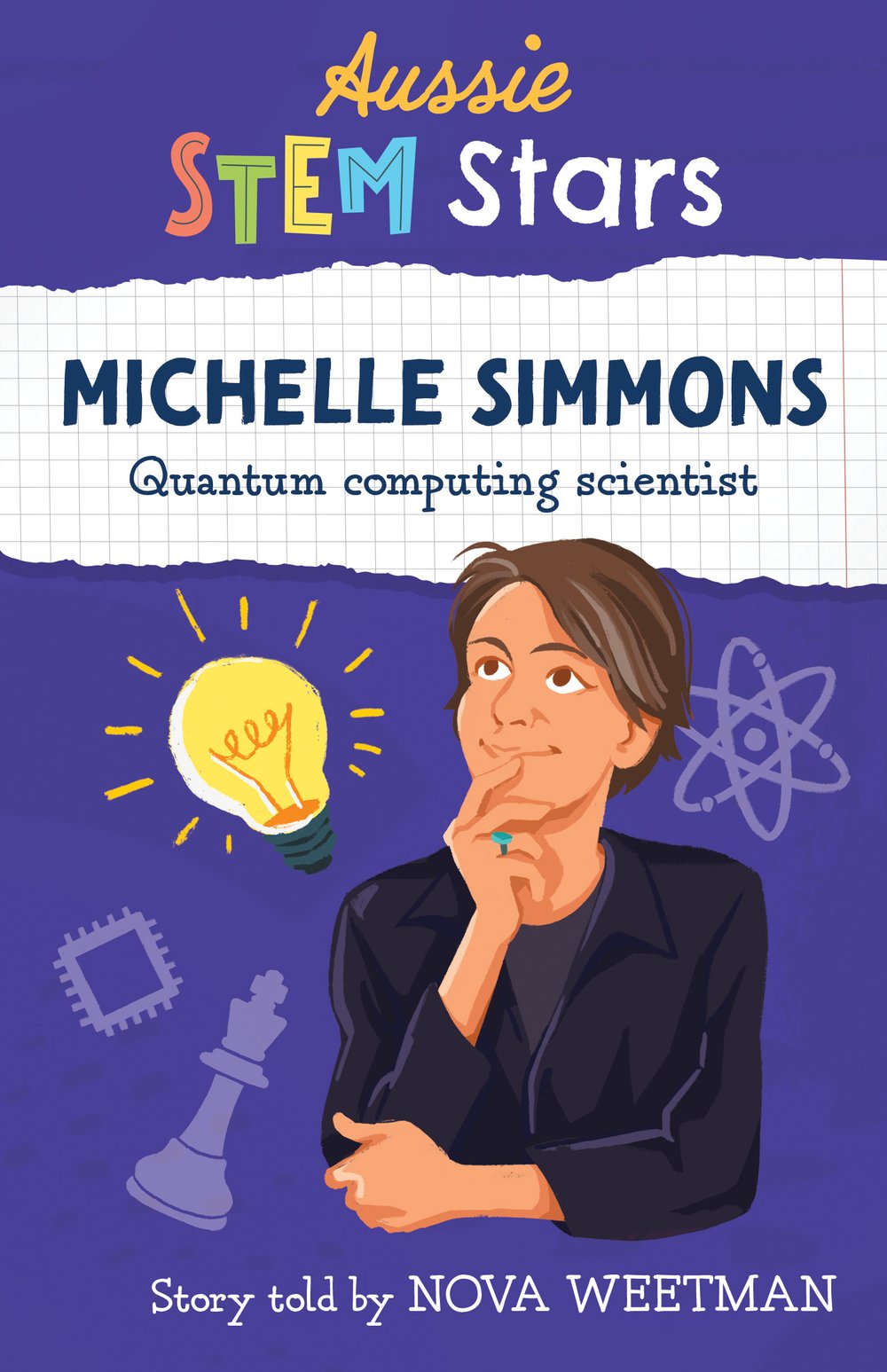
Michelle Simmons: Quantum computing scientist, told by Nova Weetman, Wild Dingo Press, ISBN 9781925893496
Gabrielle received a review copy of this book.
Michelle Simmons: Quantum Computing Scientist is penned by Nova Weetman, recording the life of the Australian of the Year for 2019. It unfolds the remarkable journey of a young girl who develops into the unconquerable English chess champion and discovers her passion for quantum computing, eventually leading to a groundbreaking achievement—the construction of the first silicon based quantum computer. Alongside her triumphs, the narrative delves into the challenges faced by her brother, Gary, who struggles with Behçet’s syndrome, a rare and deadly blood disease.
When Michelle developed the idea of using silicon to manufacture millions of micro transistors to the atomic level, skeptics among the English scientific community dismissed it. Despite the prevailing belief that increasing the production of silicon wouldn’t yield significant benefits, Michelle found support for her vision in Australia. A multi-million-dollar project was started, demanding years of careful planning to ensure each component met the stringent standards, given that even the slightest imperfection could lead to failure. Ultimately, the first silicon quantum computer emerged—a machine capable of completing calculations in hours that would take a computer years.
I would rate this book 4.5 out of 5 for its touching narrative and the valuable moral lesson it imparts—that with dedication and persistence, the seemingly impossible can be achieved.
I recommend this book for readers aged 10 and above, especially those with an interest in robotics and science.
Skye Blackburn-Lang: Eating bugs for the planet by Dianne Wolfer, Wild Dingo Press, ISBN 9781925893694
The publisher provided a review copy of this book.
Have you ever eaten a bug cookie? Well, Skye Blackburn-Lang has.
As the oldest child, Skye was curious about animals that when she was younger she even tried to eat a snail! She lived in Port Macquarie and Sydney where she took home insects to investigate and observe. Skye went to a museum on insects where she found jars of insects and spiders stacked to the ceiling. That’s when she knew that she wanted to be an entomologist. She was so interested in insects and spiders that she had a pet tarantula called Fluffy and she even kept its exoskeleton mounted in a frame!
This book is interesting because it is about Skye’s childhood and how she mixes food science and bugs to make sustainable food. Unlike the other books in this series this book is colourful, has photographs of insects and spiders and has two insect recipes at the end. I thought it was lovely.
I rate this book 10/10. I recommend this for children above 7 years old and those who like bugs.
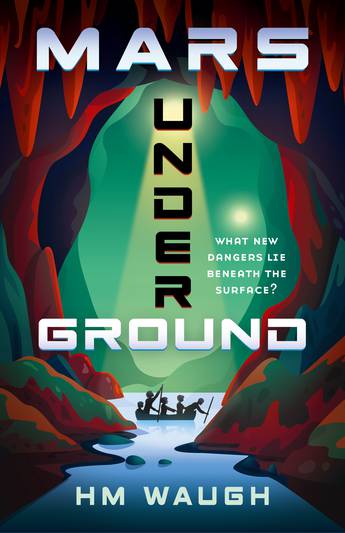
HM Waugh is the author of books for children and young adults. She’s also an environmental scientist and an educator with a love of wild places and high mountains. This has led to icy feet and sunburnt cheeks in magical countries like New Zealand, Nepal, Bolivia and Switzerland! Her latest book is book 2 of a duology: Mars Underground, the page-turning sequel to Mars Awakens.
From the publisher:
Dee, Holt and Chayse set out to cross the planet via a network of subterranean tunnels. Can they reach it without encountering the Others – the sinister biocloud they’ve been running from? And if they make it, can they convince the Newtonians to work with Davinci – those they’ve been trained to hate?
Did you set out to write these books as a duology or did the idea for a second book come after you’d finished writing Mars Awakens?
I am not what you’d call an awesome planner – I start a project by thinking up a character or two, and the details of their world, and I have a basic idea of what the plot might be, but I work the rest out as I write. If you’ve heard of plotters (who plot everything out before) and pantsers (who plan nothing and write ‘by the seat of their pants’), I’m a hybrid of the two, a plantser. So I was happily plantsing along, still writing Mars Awakens, when one day it hit me: there needed to be two books to finish this properly. So the duology was born.
This is your first published series. How did you find writing a sequel as compared to writing Book 1?
Completely different! In some ways it was easier, and in other ways: much harder!
The easier bits were things like the characters and the world – they were already there in my head, fully formed. I knew the main characters like they were my mates. I knew what they’d say, how they’d act. Sometimes, when I’m starting on a new idea, I might get a big way through a first draft and have to rewrite it because the characters finally come alive for me (this happened about 20,000 words into the first draft of Mars Awakens!). But I didn’t have that sort of issue with Mars Underground. Also, all the nitty gritty work of world building had already been done (thanks, Past Me!) so I just got to have super fun expanding it to places I hadn’t been yet. That was all awesome.
Some things were definitely harder, though. I felt this expectation that I’d never really felt before. There were all these readers who had connected with Dee and Holt’s story and were keen to see how it ended. Aaah! I didn’t want to let them down! Plus, I had a deadline! For all my other books I’d already written a full manuscript before signing a contract. But suddenly I had to write an entire sequel by a certain date? Double aaah!
I actually wrote 50,000 words of the sequel before Mars Awakens had been released, but when I picked it up again months later I knew it wasn’t right. And I’m not saying that like, ‘This isn’t quite right, I need to work on it a lot.’ I mean I archived the whole thing. Gone. Fresh document page. Start again from scratch. I re-read Mars Awakens to remind myself of the voice, and then launched into writing an entirely new sequel. And that became Mars Underground. I loved the draft so much, but I was still terrified there would be something missing. So I did multiple happy dances when my publisher came back with several big thumbs up! Yay!
Mars Underground involves your characters travelling via tunnels and caves on Mars, were their adventures inspired by caving adventures of your own?
I love pulling inspiration from real life, so their adventures were like a mix of my own, and the sort of caving and rafting adventures I’d love to have!
I remember going caving on a school holiday camp when I was in my early teens, shuffling on my stomach, so tight to the ground, to get to this special crystal cave. My helmet kept getting jammed, the ceiling was so low. And the crystals were protected behind this mouldering underground gate, so rusty the key could barely work. It was amazing! But once we’d crawled back out, we realised our camp leaders had already decided to leave. Without us. Everyone had climbed up and out, we could see them up by the pinprick of daylight that was the entrance, about to lock the main gates! I’m sure they would’ve realised we were missing before starting the bus, but what an adrenaline hit to be almost left behind in that deep wintry place, our torches running low!
Another experience I drew on was rafting what they call the God River, in Peru. Once we’d got onto the river, the gorge walls rose so high the only way out was through days of rafting. Changed your mind about going? Too bad! It was tough and it was amazing and I loved it! We got to one huge rapid, and the guide told me a girl had been lost there the previous year. I was like, ‘Did they find her again?’ and he looked at me and said, ‘Lost, like dead.’ That definitely made me realise exactly what I’d signed up to do.
So I tried to inject some of that danger and beauty and excitement into my characters’ adventures.
You ran a writing competition for young writers in 2022 and the winner had a character named after them in Mars Underground (Alice!). Did you already have a character ready and waiting to be named, or did you write the character into the plot while you were finishing writing the novel?
I had a few characters I knew I could change the names for, but I waited to see who’d won and what they’d written before I chose which character I’d use. And during editing I changed that character around to be even more awesome!
Can you tell us a bit about what you’re working on next?
As I write this, it’s halfway through July which means I’m deep in writing a project during Camp NaNoWriMo. I love writing with NaNoWriMo (the National Novel Writing Month) because it really gets me into the flow of my writing. Plus, I LOVE a good graph, and NaNo track my progress and give me badges and pep talks too! Normally I’d try to write 50,000 words in the month, but this month I’m aiming for 30,000 because I was on holiday for the first week.
Anyway, I’m loving this project so much. Dangerous new planet. Kids in a competition. Everyone watching their every move. A new friendship based on deception. And then something goes really wrong (of course!) and everything comes to the surface. How are they going to get out of this? It’s so. Much. Fun!
Mars Underground is out now! Ask for it at your favourite bookshop or local library.
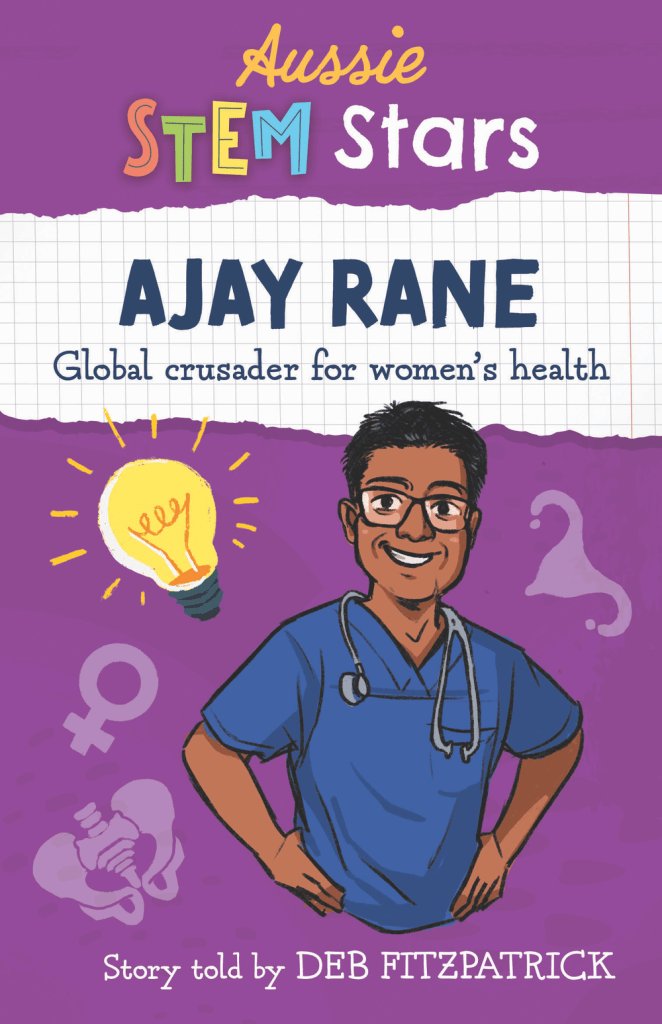
Ajay Rane: Global crusader for women’s health by Deb Fitzpatrick, Wild Dingo Press, ISBN 9781925893595
The publisher provided a review copy of this book.
‘Who is Ajay Rane and why should Australians know him?’ I hear you ask curiously. He is Dr Rane and he is an advocate for women’s health. He saves women’s lives by helping women who suffer from fistula after giving birth.
It all started with Ajay’s paternal grandmother. She told Murli, Ajay’s father, to remember the work he learnt at school. Murli tried his hardest and eventually became a doctor. Then he started a hospital in his home town. This is when Ajay comes into the story. Ajay followed his dad’s footsteps and became a doctor.
One of Ajay’s patients made me cry. She was a nurse until she had a baby and she could not go to work because she had fistula after giving birth. Then her husband kicked her out of the family. What will happen to her now?
I love this extraordinary book because it takes us back to Ajay’s ancestry. I have learnt so much about Ajay Rane and his family, like when Ajay was younger he celebrated the Diwali Festival with his family. Another section that was funny was when Ajay’s brother went to the toilet in his grandmother’s place in India only to find a pig in the toilet pit.
Julia Lawrinson has written more than a dozen books for children and teenagers, many of them award-winning. She grew up in the outer suburbs of Perth, Western Australia, not long after the first moon landing. She loves dogs, oceans, and sunsets, and still likes to gaze at the night sky, just in case. Today we’re chatting to Julia about her book City of Light, illustrated by Heather Potter and Mark Jackson.
From the publisher:
Our city is big. The universe is bigger. An astronaut from the other side of the world will fly over our home, at night. We will see a tiny light and we’ll know it’s him. But will he be able to see us? One girl, one boy? A true story.
City of Light is a story based on a real historical event. How did you go about gathering information before you began writing?
I knew absolutely nothing about this story before I began. The first place I looked was the WA Museum, which had this very comprehensive information. I went to the State Library and looked at the old microfiche with The West Australian from that time. TheWest Australian also had a helpful article online. And I talked to people like my stepmother, who was twelve at the time and remembers it vividly. Jenny Gregory’s book City of Light was also a helpful source of information. The event even made it into the Hollywood blockbuster film in 1983, called The Right Stuff.
I can’t believe it hasn’t been written about before, as it is such a great story of hope and optimism in the middle of the space race between the Soviet Union and the United States.
How did the book come to have two illustrators – Heather Potter and Mark Jackson?
The illustrators were chosen by the publisher. Heather and Mark are a husband and wife team, and I have not yet met them, though I hope to one day. Heather has also illustrated the work of Western Australian luminaries like Sally Murphy and Dianne Wolfer, so I would call her an honorary Western Australian!
You’re the author of many novels for children and teenagers and this is your first picture book! Can you tell us about your experience of sitting down to write a picture book after writing so many novels?
The first thing I said to the publisher at Wild Dog Books when she approached me was, ‘But I don’t write picture books.’ She replied, ‘I think you’ll be able to write this one.’ We agreed I would try, and I was happy to give it a go. After all, if she didn’t like it, neither of us would be worse off.
The first line came to me when I was walking, and I came home and scribbled it in a notebook, along with the words, ‘torches, car, astronaut, reaching out’.
For the rest, I approached this the way I (and many other writers!) approach most stories – what is the problem, and how are the characters going to fix it?
Do you have a tip for young writers who’d like to write a picture book?
The most important thing is to put a child or children (or a non-human character!) at the centre of the story. I would also say to read it aloud: it doesn’t need to rhyme, but it needs to have a pleasing rhythm.
Can you share a bit about what you’re working on next?
I am working on a historical novel based in the 1900s in the goldfields. It is very slow, and the research is sending me down lots of rabbit holes, but I am enjoying the process.
City of Light is out now! Ask for it at your favourite bookshop or local library.
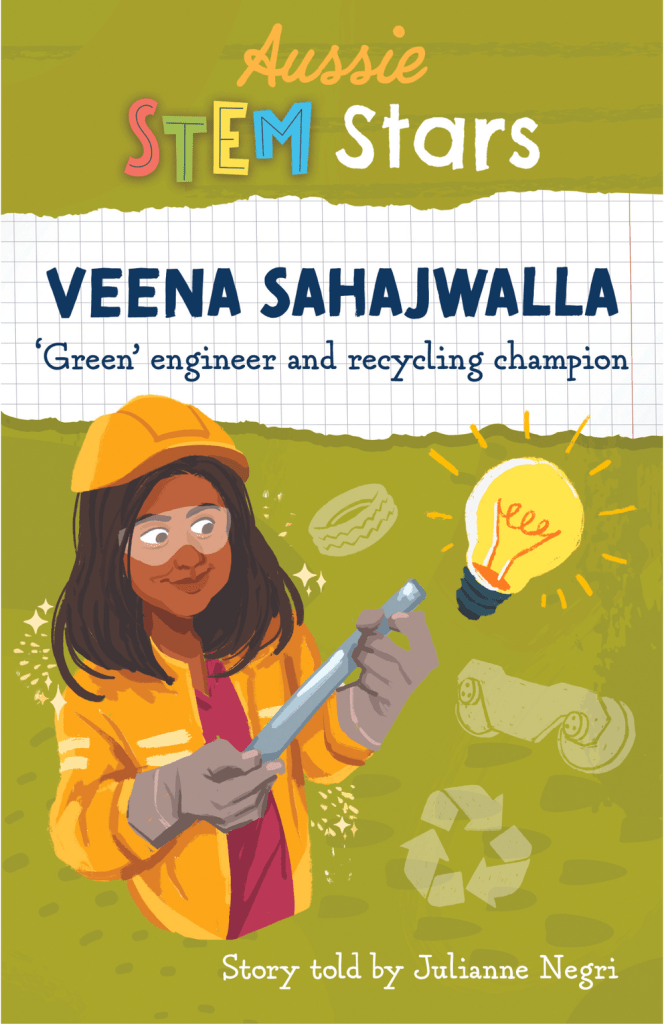
Veena is an inspiring person to the next generation because she changed the world by inventinggreen steel. When Veena was little she just liked to ride on her dad’s scooter around Mumbai all the time. But she did not think that she would become the recycling champion in the future.
From reading this book, I learnt that Veena is a very diligent, persistent and resilient person. When she was in school she did extra work because she loved doing homework. She was the only girl in the class in her university studies and she tried her best.
I rate this book 10/10 because this has even inspired me to be an engineer.
Veena Sahajwalla: ‘Green’ engineer and recycling champion is out now! Ask for it at your favourite bookshop or local library.
Cristy Burne writes fiction and nonfiction and her books are bursting with adventure, friendship, family, nature, science and technology. Cristy has worked as a science communicator for nearly 20 years across six countries. She has been a science circus performer, garbage analyst, museum writer, and atom-smashing reporter at CERN, but her all-time favourite job is working with kids to embrace the intersection between science, technology and creativity.
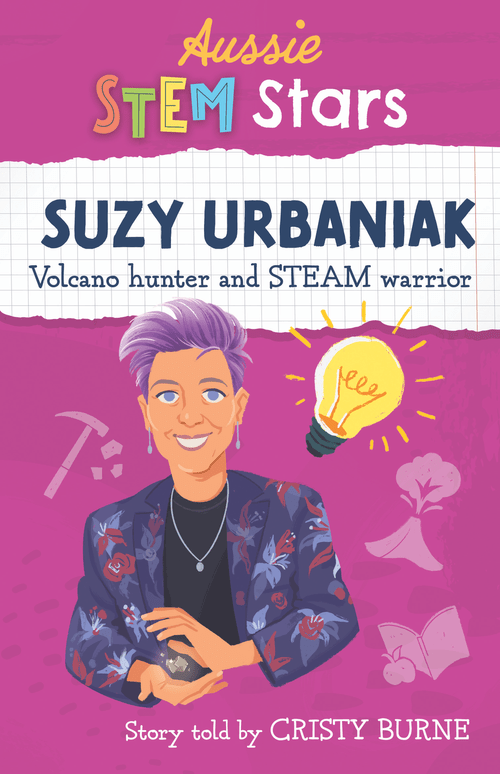
Today Cristy is chatting to us about her latest book in the Aussie STEM Stars series – Suzy Urbaniak: Volcano hunter and STEAM Warrior.
From the publisher:
Geologist Suzy Urbaniak is a limbo-dancer, a crepe-baker, a risk-taker and a question-asker. Winner of the 2016 Prime Minister’s Prize for her out-of-the-box teaching, Suzy is all about passion, innovation, and doing things your own way.
How did you come to write a biography of Suzy Urbaniak – is geology a subject you’ve studied?
I collected rocks as a kid, but never went any further with my geoscience interest. If I’d met someone like Suzy, I could very well be a geologist today! The geologists I’ve met – Suzy obviously included – are incredibly passionate about rocks and our planet. They can look at a landscape and see into our past. That’s a magical ability!
Did you meet Suzy Urbaniak in person or gather your information for her biography another way?
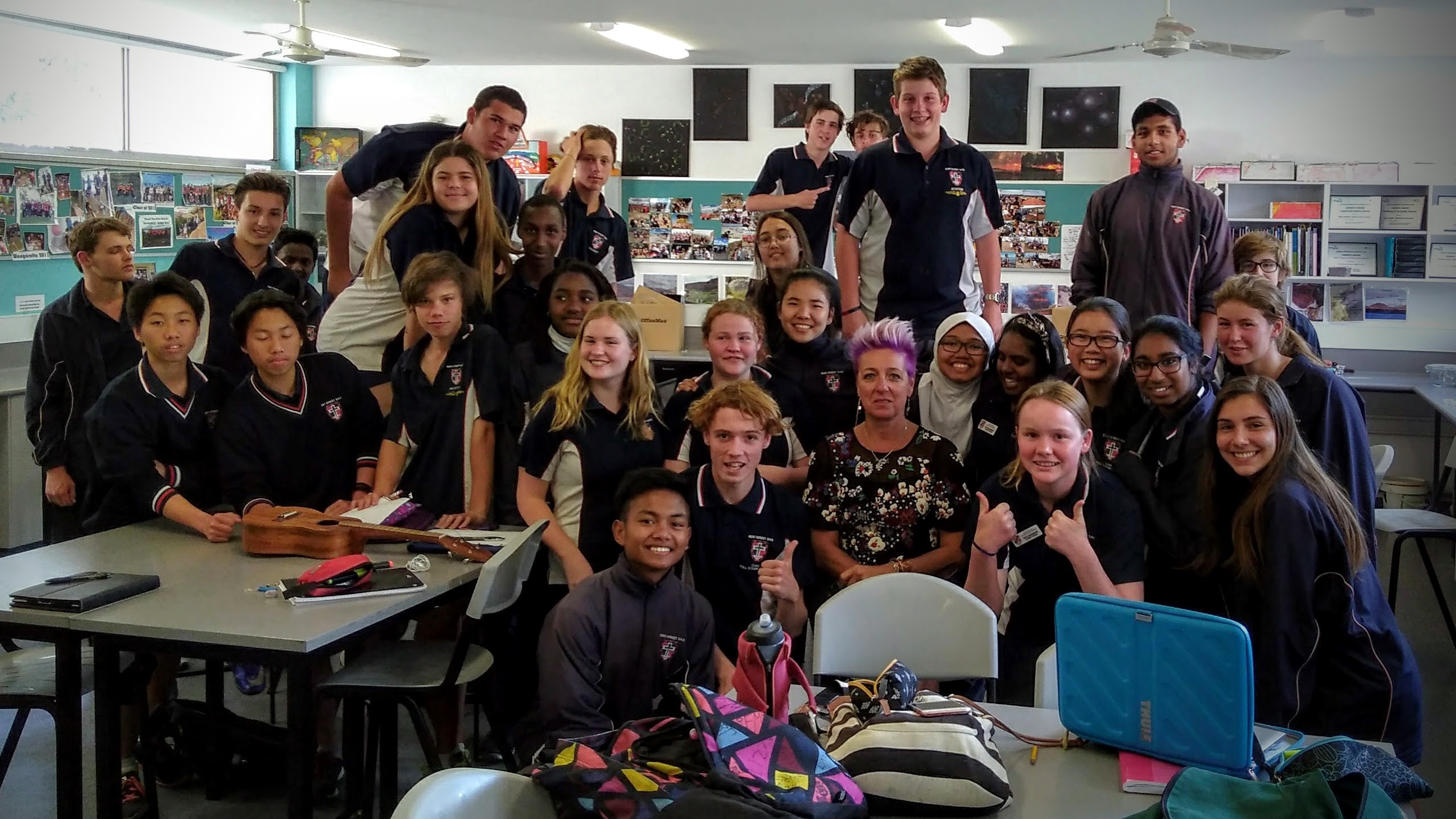
Ms Urbaniak & yr 10 students. Photo courtesy Cristy Burne.
I first met Suzy six years ago, in person, when I interviewed her for a newspaper. She was teaching at Kent Street Senior High School and had just won the Prime Minister’s Prize for Science Teaching – it was an incredible experience and I never forgot the buzzing energy of her students as they busily (and mostly autonomously) worked on their science learning.
Suzy and I stayed in touch (social media is good for something) and when she wanted help writing her life story, I immediately thought of Aussie STEM Stars. And the rest is history!
Just as for my Fiona Wood biography, Suzy and I did our interviews for the book over the phone. I think it’s easier to dive deep into memories when you’re not also thinking about eye contact, body language and social niceties. Over the phone, all you need to do is let your mind drift deep into childhood.
You’re passionate about science (and also adventures!) – have you ever stood on a volcano?
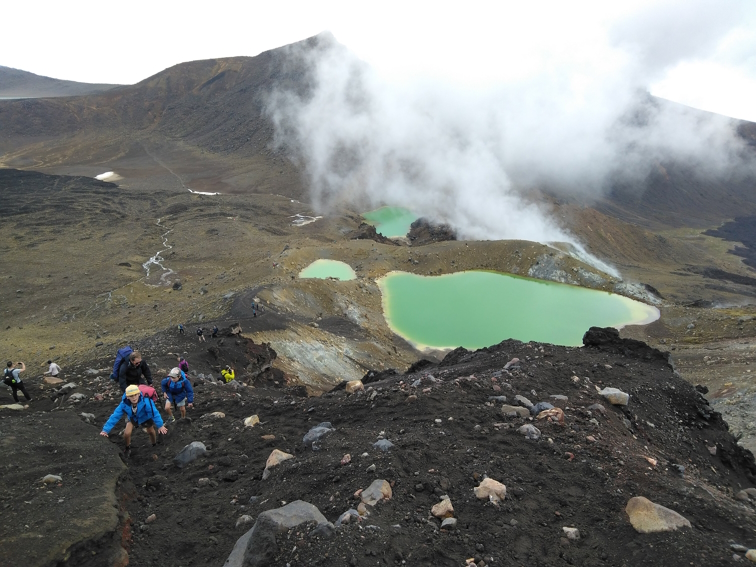
I grew up in New Zealand, so I’ve climbed in to the mouth of an extinct volcano (back when you could do that in Mt Tarawera) and hiked a whole bunch in Tongariro National Park, part of the Pacific Ring of Fire (where you can see steaming vents and boiling mud). I grew up close to Rotorua, where geothermal activity is literally just below the surface (and sometimes even on top!). I have a very healthy respect for volcanoes.
Volcano hunting! (Photo courtesy Cristy Burne)
Do you have any advice for young writers who would like to write biographies?
Biographies are non-fiction, but that doesn’t mean they’re just a long list of facts. To bring a biography to life we need to have stories, because stories bring emotion and connection. A good way to bring these stories out is to ask open questions that encourage longer answers, like: ‘Can you tell me about a time that …’
Can you tell us a bit about your next writing project?
I’m working on a graphic novel with publisher Larrikin House. It’s a wild comedy with aliens, explosions, disgusting adventures and desperate escapes, featuring a science-loving kid named Violet whose best friend is a conspiracy theorist and whose pet hermit crab can talk. It’s ridiculous, non-stop, unapologetic science-meets-comedy FUN!
WA (Fremantle) families: MEET Cristy Burne, Suzy Urbaniak and HM Waugh at 11.30am THIS Sunday 26 February 2023 at the Perth Festival, Fremantle Arts Centre! FREE. Includes a drop-in ‘make your own mini Mars-machine’ session.
Suzy Urbaniak: Volcano hunter and STEAM warrior is out now! Ask for it at your favourite bookshop or local library.
AWESOME EXTRAS:
Watch Suzy Urbaniak talking about winning the Prime Minister’s Prize for Excellence in Science Teaching in Secondary Schools [YouTube]
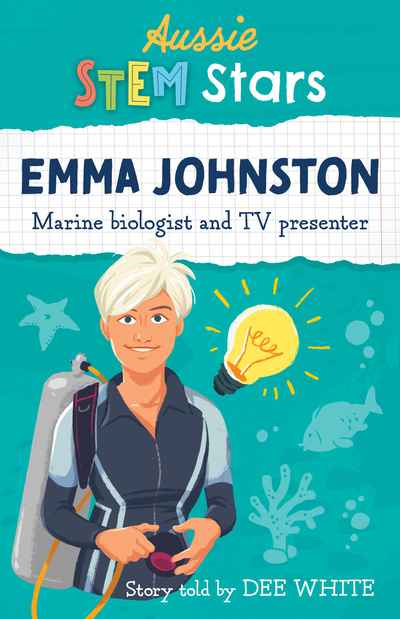
Professor Emma Johnston, the Deputy Vice-Chancellor at the University of Sydney, has a genuinely encouraging life story.
“Emma was a sponge …“
She loved the beach, science and asking her parents questions about the wonderful world around her. She always enjoyed looking at the fascinating marine life under the water’s surface. Her curiosity and the questions her parents answered only gave her the thirst for more knowledge. Moving to Japan, she found the curriculum way more advanced, so she enjoyed the challenge and found class engaging. After returning to Australia, she was shocked by the discrimination against the girls at her high school and she moved to Uni High, a different school, accepted in with a music scholarship. She knew she loved science, communicating with others and playing music on her flute.
What did she do with her curious mind and knowledge of science as she grew up in this big world?
Find out in Dee White’s extraordinary biography of Emma’s inspiring story. Reading her life story motivated me to look more into science again and rediscover my passion for science I lost a couple years ago. It helped me to relate to Emma as we both love science and I can feel her struggles, opinions and feelings throughout the book.
I loved this book and would rate this book a strong 4 out of 5 for ten to thirteen year olds.
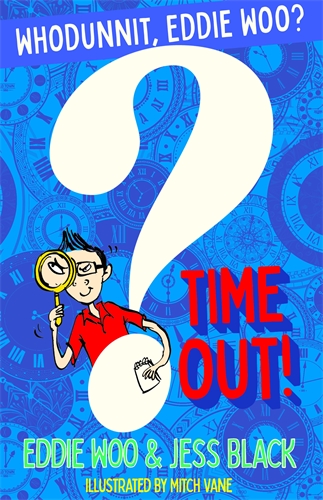
Searching for a new book to dive into over the holidays or when you are bored? Or figure you are a bit of a detective? Time Out! is a mystery novel by Eddie Woo & Jess Black. It is part of the Whodunnit? series currently containing two novels, the other one being Team Trouble. The main protagonist of the book is young Eddie Woo, a super sleuth and maths whizz. Together with his friends, Rusty and DT, they accidentally stumble across a treasure hunt created by Henry Cedric James in the 1880s. Even though their suburb of Red Hill is small there can still be an action-packed adventure.
Henry was the founder of Red Hill and hand-built many public buildings like the Council school, lighthouse, old cathedrals, parks and many homes. In some of these locations he left hints and ciphers to where the next clue might be. It is rumoured that Henry worked at the Ballarat Goldfields before founding the new suburb. When he passed away, he left most of his gold hidden, rumoured to be at the end of the treasure hunt. But every good story needs an antagonist so, someone is going to take drastic measures to ensure Eddie doesn’t reach the end!
This is an awesome book including maths and instrumental talents. I rate this book 5 stars out of 5 as it has a good climax, resolution and includes maths to explain things.








 alphabetsoup.net.au