This post was added by Rebecca Newman. Rebecca is a children's writer and poet, and the editor of the Australian children's literary blog, Alphabet Soup.
For more about Rebecca visit: rebeccanewman.net.au.
George’s Secret Key to the Universe by Lucy & Stephen Hawking, Simon & Schuster, ISBN 9781416985846
Ayaan reviewed his own copy of this book
George’s Secret Key to the Universe is the first of six books in the George’s Secret Key to the Universe series.
The series is written by Stephen Hawking and his daughter, Lucy Hawking. The first three books are written by both of them but then Stephen Hawking died. Lucy Hawking wrote the last three books in the series and used lots more of her father’s ideas.
The story features George who meets Annie and her father named Eric through a pig investigation. They have a supercomputer named Cosmos and he can open a portal that can take you anywhere in the universe. But before George can view or work with Cosmos, he has to take the Oath of the Scientist.
The next day, George goes to school and Eric’s enemy, Dr Reeper, tries to take Cosmos by leading Eric into a black hole. George goes to Annie and they track down Cosmos. But can they get to Eric in time?
I would rate this book five stars. It is action-packed and is full of amazing science facts. I would recommend this book to anyone who loves science, just like me!
Note about Stephen Hawking: He was a world-famous cosmologist and physicist who has written many famous books. He was diagnosed motor neurone disease when in his early 20s and was told that he would only live for a few more years but he lived until he was 75 through pure determination to live!
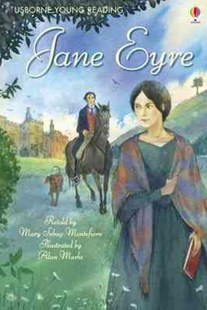
Jane Eyre (Usborne Young Reading series), retold by Mary Sebag-Montefiore, illustrated by Alan Marks, Usborne, ISBN 9781409539643
Aashi reviewed her own copy of this book.
Jane Eyre is a classic book about love and friendship. The original book was written by Charlotte Bronte, who was a teacher who loved writing along with her siblings. When Charlotte Bronte died her house was turned into a museum.
She wrote Jane Eyre in 1847. The copy I read was written by Mary Sebag-Montefiore and illustrated by Alan Marks.
Like Charlotte Bronte, Jane Eyre was a teacher. She became a teacher after abandoning her supposed husband. Jane Eyre’s life flipped and wobbled as kind Jane moved around her home country and all this time she read lots of her favourite books.
Jane was an orphan who lived with her stubborn aunty and her mean cousin. Her aunty always punished her without a reason and not one hour was spent without punishments. One day Jane’s stubborn aunty sent her to a boarding school that made the pupils (students) shiver and whacked canes and rods on their necks and chests. Until one winter day most kids caught bad diseases and most kids in the school died.
This all sounds very sad but the book has a happy ending with lots of kindness. I would encourage reading this book as this gives a view of olden days.
I would rate this book 4 out of 5 stars as it is sometimes scary. I would recommend this book for 7-9 year olds.
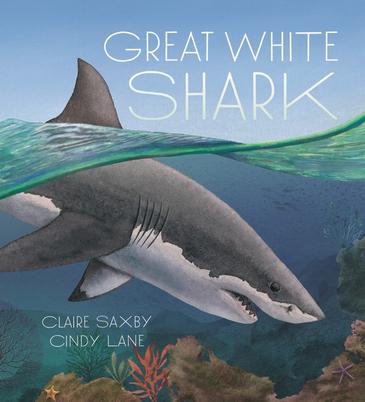
(L) Great White Shark by Claire Saxby & Cindy Lane. (R) Cindy Lane and a Megalodon.
Cindy Lane is an award-winning artist and illustrator who loves the ocean. She was born and grew up by the sea in Sydney, lived by the Great Barrier Reef in FNQ, and now has her studio by the Indian Ocean in Perth. Cindy loves to make her own paints with materials she finds in nature, and collects waters from all over the world to use in her paintings. Seawaters from across Australia were used in Great White Shark, her first picture book, written by Claire Saxby.
In Great White Shark we follow a female shark on her way to warmer waters to give her pups the best chance of survival. Set in a stunning underwater world, Claire Saxby’s signature poetic prose and Cindy Lane’s sublime illustrations showcase the grace, majesty and power of one of the ocean’s top predators.
Can you tell us a bit about how you created the illustrations for Great White Shark?
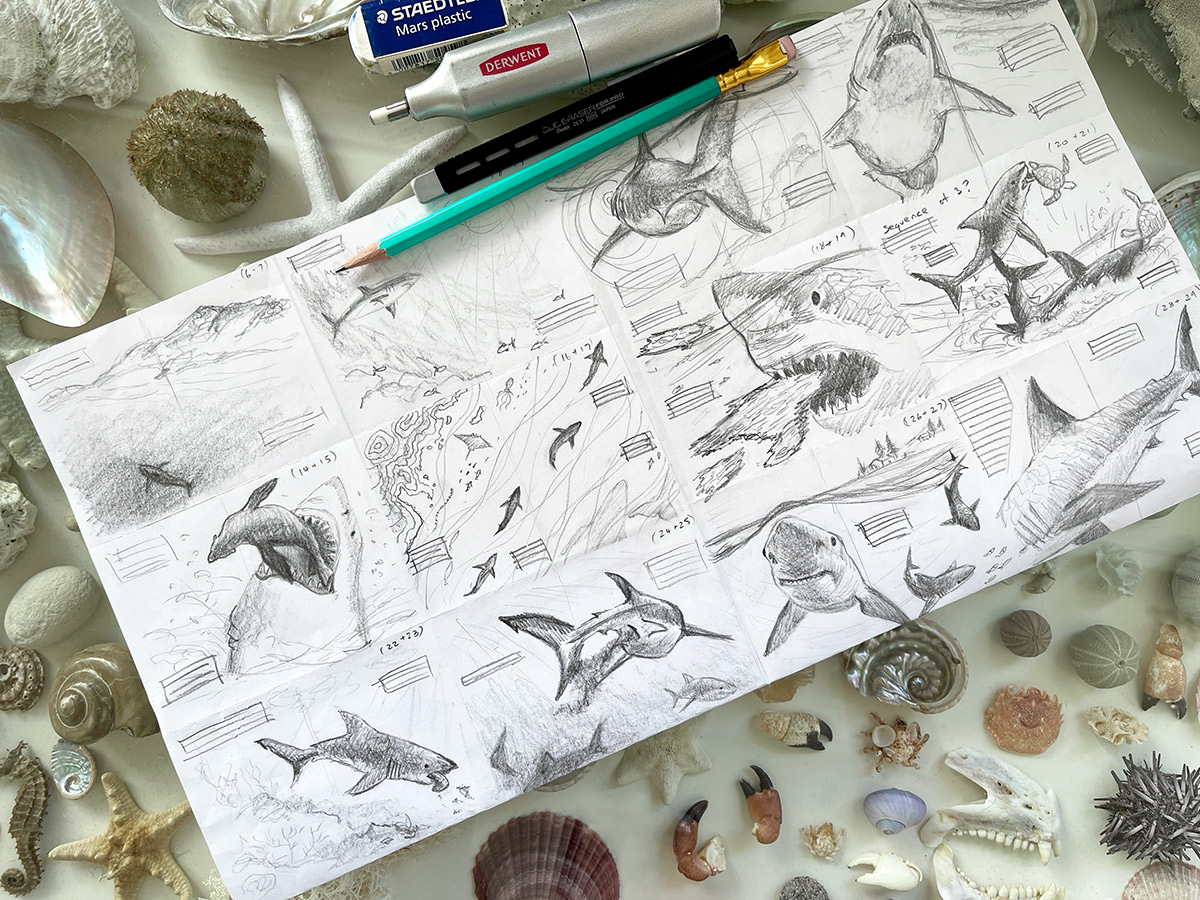
It all starts with a sketch – pencil on paper. I like the scratchy feel of graphite on a surface, with sound and feel for feedback as you create. I do also draw digitally, but it can be quite a clinical process, not what I want at this stage. It can be all too easy to erase the less-than-perfect lines when drawing on a tablet – a double tap of your fingers and it’s gone! I like seeing the messy, roundabout road maps of initial sketches, the sparks of ideas, and where they led.
From pencils sketches to a pencil thumbnail sheet! Once this was approved by the art director I went on to do some sample colour illustrations from the text, just to determine a style that the publisher, author and I were all happy with. This was a combination of pastel on sanded paper and watercolours on cotton paper, both with digital sketching over the top.
Thumbnail sketches by Cindy Lane for the picture book Great White Shark
Once these were approved, I was let loose on the double page spreads, cover, title, index pages and the endpapers. There was still lots of research to be done, and luckily the PLANET SHARK exhibition was visiting Fremantle. I got to see so many sharks, including multiple Great White models up close, the preserved body of the massive Megamouth shark, plus the HUGE Megalodon jaws!
Using sea waters from my collection, I started watercolour painting the backgrounds and creatures that feature in the book. They were then photographed or scanned individually, then collaged together digitally to create the scenes.
Did you discuss the story/illustrations with the author (Claire Saxby) while illustrating the book?
No, I had no direct contact with the author during the illustration process. Claire Saxby’s feedback was always via the editor and art director.
How long did it take you (from signing the contract to going to print) to illustrate Great White Shark?
14 months.
Were you already interested in sharks before you were asked to illustrate the book?
Definitely! I’ve always had a love for the ocean and all of its inhabitants. Even those that get bad press. Especially those ones!
Great White Shark is out now! Ask for it at your favourite bookstore or local library.
The publisher provided a review copy of this book.
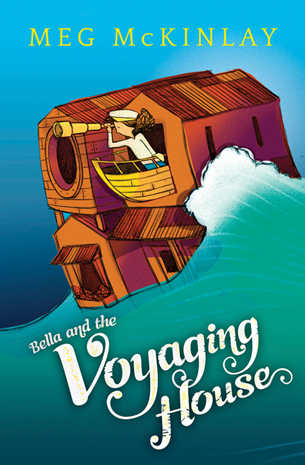
The book I am reviewing is Bella and the Voyaging House. The author is Meg McKinlay and the illustrator is Nicholas Schafer.
In the book, I love how Bella’s grandad made the house so it is like a boat. Merry Annie is a statue which the grandad moulded and polished. Then he tied it on the front of the house boat but it fell off when they were sailing. So Bella decided to sail with the house and look for Merry Annie. Will they find Merry Annie? Will the house go back home?
I recommend seven year olds and up to read this book because it is funny and emotional.
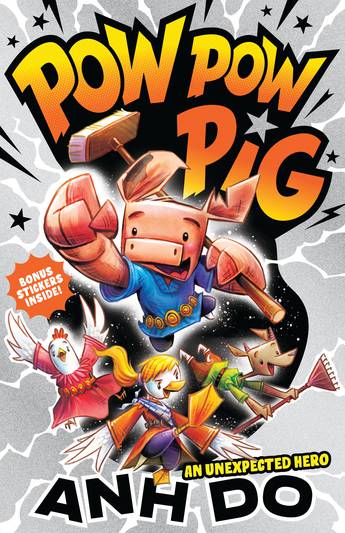
Pow Pow Pig is about a pig named Piccolo who joins an organisation called CHOC because he wants to help animals in need, but he ends up always on kitchen duty …
My favourite character is Piccolo. Books about pigs always seem like funny books. This is a hilarious book. I even love the cover. The size of the title makes me laugh. The illustrations suit the story and are also hilarious. There are also stickers inside, at the back of the book.
Pow Pow Pig is similar to the Captain Underpants books and The Bad Guys series. Kids who like pigs, funny books, exciting books and novels (there are nine chapters in this book) will love this too.
I think 7 to 10-year-olds would enjoy this book most. Kids older than 10 would still enjoy it though, and kids who are younger than 7 would enjoy it if someone reads it to them.
I give it 5 out of 5 stars!
Pow Pow Pig: An Unexpected Hero is out now! Ask for it at your favourite bookshop or local library!
Shadowghast by Thomas Taylor, Walker Books Ltd, ISBN 9781406386301
The publisher provided a review copy of this book.
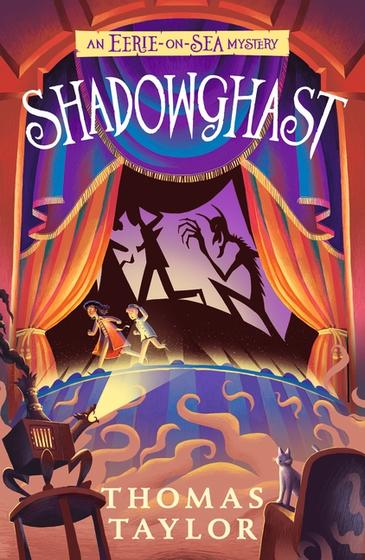
Get ready to join Herbie and Violet on another nail-biting adventure in the mysterious sea side town of Eerie-on-Sea. Shadowghast is the third book in the Eerie-on-Sea mysteries series by Thomas Taylor. With Autumn coming round, and the annual Shadowghast festival coming up, everyone is tense. So, no one really pays attention to the performers arriving for the festival. And still, no one notices when people start disappearing. Herbie and Violet are arguing but can they put their differences aside in time to solve what might be the most dangerous mystery yet?
Shadowghast is the amazing sequel to Malamanderand Gargantis. It is, I think, my favourite yet. Thomas Taylor has, like usual, created a fantastic story with lots of mystery and suspense. The plot and characters are great there are many great twists that no one would suspect. Shadowghast kept me on the edge of my seat the entire book. I would recommend this to anyone 9+ and I would rate it 10 out of 10.
I am sorry if I have left you hanging off a cliff but if you want to find out more then read it yourself and who knows … Maybe you recognise the flickering neon lights or the theatre on the end of the pier.
Shadowghast is out now! Ask for it at your favourite bookshop or local library.
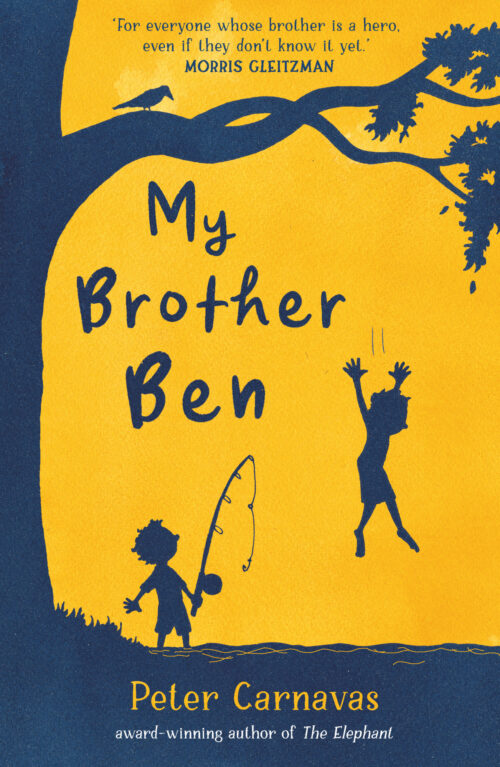
Peter Carnavas is an award-winning author-illustrator. You might have read some of his many picture books, such as The Children Who Loved Books, Last Tree in the City and A Quiet Girl. His novel The Elephant won a Queensland Literary Award and was shortlisted in four other national awards. Peter lives on the Sunshine Coast, Queensland, with his wife, two daughters, a dog and a cat. Today we’re thrilled to have Peter Carnavas visiting to talk about his latest children’s novel, My Brother Ben.
From the publisher:
Luke and his big brother Ben spend the summer on the banks of Cabbage Tree Creek. Quiet Luke sketches birds, while Ben leaps off the Jumping Tree. The boys couldn’t be more different but they share the same dream: winning a boat so they can explore the creek properly. Then Ben starts high school and the boys drift apart. When Luke catches Ben sneaking out at night, he knows his brother’s up to something, but what?
When you were growing up did you have a big brother or sister?
I have two big brothers and one big sister. One of my brothers is just a few years older than me so we grew up doing everything together: playing backyard cricket and soccer, playing computer games and drawing silly pictures of each other.
In the book, Luke chooses soul birds for himself and considers soul birds for his various family members too. Which bird would you say was your soul bird?
I tend to do things slowly so I think I’d be a slow-moving water bird, like a white-faced heron. I’m not a very good swimmer so it suits me that these herons only go ankle-deep into the water.
How long did it take you to write My Brother Ben – from the start of the first draft to the final draft?
It probably took me about year from start to finish. Every time I thought I’d finished it, my editors pointed out ways to make the story even better, so I did many drafts. That’s the great thing about editors – it’s similar to the way teachers show you how to improve your stories. The illustrations didn’t take too long – probably only a few days to draw all the birds – because they are black and white pen drawings, and I didn’t have to paint them.
Do you have a tip for kids who might be interested in watching birds?
The main character, Luke, has an aunt who teaches him all about birdwatching. She tells him to keep still and let the birds come to him, and this is something I’ve discovered when birdwatching myself. I’ve found that if you walk through a bush track or a forest, you probably won’t see many birds straight away. But if you slow down and keep quiet for a while, you’ll notice small movements and sounds, and then you’ll notice more birds. Also, when you keep still, birds will be less afraid. Another tip is to start by looking for water birds in lagoons or ponds, as these birds keep quite still themselves, so they’re easier to watch and identify.
Could you nominate a children’s book you’ve recently read that you would recommend?
I have loved reading Sara Pennypacker’s books this year, particularly Pax and Here in the Real World. Pax is a wonderful story about a boy trying to reunite with the fox he once raised – great for upper primary students.
My Brother Ben is out now! Ask for it at your favourite bookstore or local library.
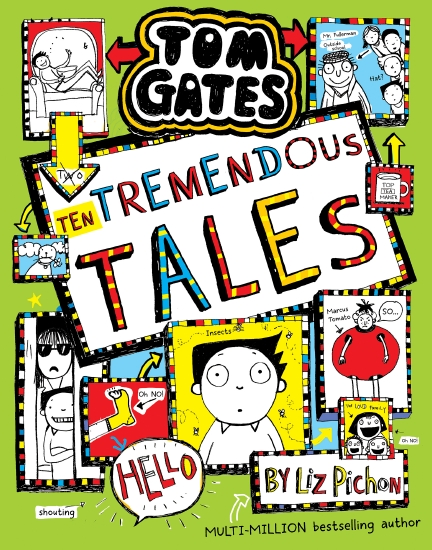
Tom Gates: Ten Tremendous Tales by Liz Pichon, Scholastic UK, ISBN 9781760974282
Aashi reviewed her own copy of this book.
Ten Tremendous Tales is a book with ten stories, all of the different ten stories are written by Liz Pichon.
The main character of the book is Tom Gates who likes to doodle. You must be wondering what doodling is. Well, it is practically drawing!
I like the book because there is a whole range of stories to read. Each story is unique and has a different moral, like one of them is about always to have hope. I liked this moral because in Covid times having hope is so important!
After reading this book I feel like I could read many more books where Tom Gates is the main character. He is super-duper at doodling but always gets into trouble. I won’t say more about Tom to keep some surprises for you.
This book is also cool as it is the tenth book in Tom Gates series by the author. The Brilliant World of Tom Gates was the first book and sent out to stores in 2011.
I would rate this book 9/10 because I think that some of the stories could continue a little bit longer. It will be enjoyed by children who are ages 7-11.
I hope you would like to read Ten Tremendous Tales.
This is Aashi’s first review for Alphabet Soup. To send us YOUR story, poem, artwork or book review, check out our submission guidelines. Happy reading!
REVIEWED BY WILLIAM, 10, WA (IONA PRESENTATION COLLEGE)
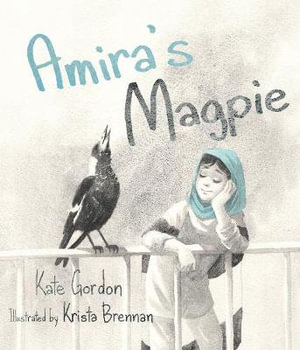
Amira’s Magpie by Kate Gordon, illustrated by Krista Brennan, Wombat Books, ISBN 9781925563986
Alphabet Soup provided a review copy of this book.
“He sings to her, too, and she knows his language.”
Amira’s Magpie is a slow-moving, gentle book of imagination and longing. Amira imagines her magpie flying across the world, to visit her homeland and the family she left behind. From this, and through both words and pictures, we are left to imagine her story.
This book isn’t very long, but it doesn’t need to be, because every thing you need to know comes from the beautiful illustrations and your imagination.
I would recommend this book for people who can read beyond the words, and feel that the character is their own self.
I rate this book: 5 stars.
Iona Presentation College students are members of Alphabet Soup’s review team. This is William’s first review for Alphabet Soup. If YOU would like to send us a book review, check out our submission guidelines. Happy reading!
REVIEWED BY LILY, 11, WA (IONA PRESENTATION COLLEGE)
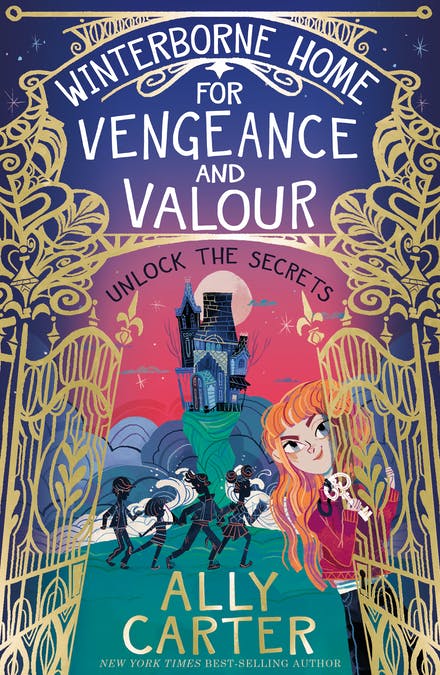
Winterborne Home for Vengeance and Valour by Ally Carter, Hachette Australia, ISBN 9780734419163
Alphabet Soup provided a review copy of this book.
Winterborne Home for Vengeance and Valour is about a 12-year-old girl named April, whose mother abandoned her when she was just an infant. The only thing April has from her past is a mysterious key on a chain. Years later, after moving around between many foster families, April arrives at the Winterborne Home for Orphans. At the Winterborne Home, she meets a group of children and together this group of misfits uncover deep and dark secrets which have been masked for a decade. As part of their journey of discovering mysterious secrets, this mismatched band of orphans come to rely on one another and ultimately become like the family they all longed for.
Little does the group know, April holds the key to the Winterborne Legacy. It is sought out by one of the last living Winterborne’s, Evert Winterborne. Why does Evert desire this key? What does it unlock? Evert is willing to commit murder to get his hands on the Legacy, which he believes is rightfully his. However, his mission of unlocking his family’s Legacy is continually thwarted by the orphans, who are the only thing that stand between Evert and the Winterborne Home and Legacy.
I thoroughly enjoyed this book, it captivated me and held my attention right until the end. I felt as if the characters were so real and relatable that they could jump right out of the page and I was in the Winterborne Home with them. I think this book was very interesting and for people who love mysteries and adventures this is the book for you! I would give this book an eight out of ten and would recommend it for older readers.
Iona Presentation College students are members of Alphabet Soup’s review team. This is Lily’s first review for Alphabet Soup. If YOU would like to send us a book review, check out our submission guidelines. Happy reading!