
Posted in authors, interviews

Claire Malone Changes the World: An interview with Nadia L King

Nadia L KingMEET THE AUTHOR

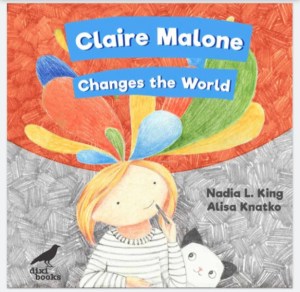
Nadia L King is a children’s author and award-winning short story writer. Her novel for teenagers, Jenna’s Truth, is about cyberbullying. Her first picture book, Claire Malone Changes the World (illustrated by Alisa Knatko) was published in November 2019:

Armed with her typewriter and the determination to make a difference, Claire Malone is an ordinary kid with an extraordinary desire to change things for the better. The moment she sees the broken swing and the cracked slide at her local park she decides to take action. 

We’re thrilled to have Nadia L King visiting us at Alphabet Soup today.


Claire Malone Changes the World by Nadia L King and illustrated by Alisa KnatkoHow long did it take you to write Claire Malone Changes the World (from story idea to publication)?
I thought of the idea while I was on holiday. I always take a notebook when I go away so I wrote the story down and promptly forgot all about it! A few months later, I found the story again and worked on it for a few weeks. So the short answer is, it took me a very long time to write Claire Malone Changes the World.

Is Claire based on anyone you know?
Claire Malone is kind of based on me when I was a kid. I loved writing and receiving letters when I was young (I still do) but I didn’t think about writing to the government to change the world. I wish I had. The character Claire is also based on my youngest kid who is an awesome environmental warrior.

Writing a book: Pen and paper, or typing straight into the computer?
I am very much a pen and paper writer. I eventually transfer my drafts onto the computer but I find when I’m stuck I need to go back to pen and paper again. I can also write much faster than I can type so handwriting my first drafts is a huge part of my writing process.

Do you have a tip for young writers?
My BIG, BIG, BIG (add another 100 BIGs) tip for young writers is to READ. Reading is fun but it also teaches you how to write. Read everything you can and then go read some more.

Can you tell us something about your next writing project?
I’m trying to write a very creepy young adult novel. I’ve never written creepy stories before so I’m really focussed on building evocative scenes. I hope I can scare you with one of my stories one day.


Awesome extras:

Claire Malone Changes the World by Nadia L King and illustrated by Alisa Knatko

Click here for Teachers’ Notes (PDF)

Click here for a review of the book by Mrs B’s Book Reviews

Click here to visit Nadia L King’s website

Click here for a video of the author talking about the book

Claire Malone Changes the World is out now! Ask for it at your nearest bookshop or library or order it online.

Posted in authors, interviews

The Lost Stone of SkyCity: an interview with HM Waugh

HM WaughMEET THE AUTHOR

HM Waugh is an environmental scientist, writer and educator with a long-term love of wild places and high mountains. This has led to icy feet and sunburnt cheeks in magical countries like New Zealand, Nepal, Bolivia and Switzerland. She has studied dolphins in New Zealand and rare plants in the Wheatbelt, and worked in mining and construction projects across Western Australia.

When she’s not writing, she’s teaching school and community groups about science and the environment. This often involves working with children and animals concurrently, and Waugh loves being able to truthfully say she handles dragons for a job. HM Waugh’s new children’s novel is The Lost Stone of SkyCity:

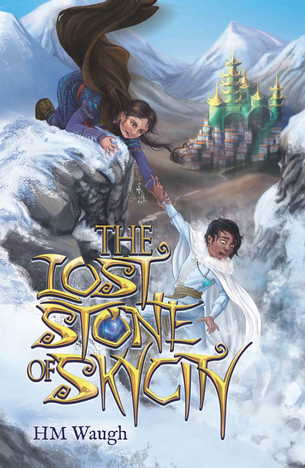
Sunaya’s peaceful village life is turned upside down when a simple mountain mission turns into a death-defying quest for survival.

Winter treks to summer pastures, mythical Ice-People that are scarily real, avalanches, ice falls, power plays, mysterious magic and surprising friendships – it seems not everything in life is set in stone …

We are pleased to have HM Waugh visiting Alphabet Soup today.


The Lost Stone of SkyCity by HM WaughYou live in Western Australia. What inspired you to write a book set in the snow?
I absolutely love mountain landscapes, I love to travel to them and I love reading about them in books. For me, they’re both beautiful and dangerous. There are so many different challenges you have to face and issues to deal with when it comes to snow, and – honestly – I’m not always that good at them. I remember wearing gumboots sledding when I was a kid living in New Zealand, and the snow all got stuck down my boots, partially melted and then froze solid so I couldn’t get the boots off. Ouch.

So one day I was thinking – wouldn’t it be awesome if you could understand and read mountains as naturally as people who’ve grown up in those areas seem to be able to? And from that thought came the world and the magic of The Lost Stone of SkyCity.

How long did it take you to go from the story idea to the published book?
I like to let my ideas bubble away and pick up extra details and join with other ideas before I start to write them. I first thought of the idea for The Lost Stone of SkyCity in 2015 but there wasn’t enough for a story so I jotted it down in my notebook and left it. It wasn’t until late 2016 that I actually wrote the book, but then I basically forgot I’d written it. I found it again near the middle of 2018, did some serious editing and submitted it to my (now) publisher. And they loved it! Hooray! I signed the publishing contract at the start of 2019 and had a whirlwind nine months of preparation before it came out in October.

So, that’s a bit over four years from first thought to having the book on shelves.

What’s the most recent children’s book you’ve read?
Because I love these books (and books you love are like old friends) I’ve recently re-read Scorch Dragons by Amie Kaufman, which is the second book in the Elementals series for middle readers. (I’m being very patient waiting for the next instalment!)

Writing a book: pen and paper, or typing straight into the computer?
I plot and brainstorm with pen and paper, but then it’s absolutely writing on the computer. I can write much faster, and it’s so much easier for me to read what I’ve written!

What are you working on next?
I’ve just finished the first round of edits on a really fun middle-grade adventure set on a dying Mars of the future, where kids can basically fly and, in order to save their planet, have to team up with those they’ve always been taught to fear.

But I’m pushing my Mars story to the side at the moment, because [as I write this] it’s National Novel Writing Month time, and I’ve got a super-secret-squirrel story idea on the go. I love new ideas!


The Lost Stone of SkyCity by HM WaughAwesome extras:

Click here to WIN a copy of the book

Click here to read a sneak peek inside the book

Click here for Teachers’ Notes

Click here to visit HM Waugh’s website

The Lost Stone of SkyCity is out now! Look for it at your nearest bookstore or library.

Posted in competitions

Christmas 2019 Giveaway

Thanks to the lovely people at Fremantle Press — and supplemented by our own generosity (Happy Christmas!) — we have some fabulous booky prizes to give away to two lucky Alphabet Soup readers. We have ONE BOOK PACK and ONE PICTURE BOOK to give away. You may enter in both categories, but be sure to read HOW TO ENTER before you do! Terms and conditions are at the end of this post. Be sure to read those too.

****THIS COMPETITION HAS NOW CLOSED  ****

The winners are:

Book pack prize: L Barnes (NSW)

Picture book prize: S Giltrow (WA)

Posted in authors, interviews, teachers' resources

Secrets of a Schoolyard Millionaire: an interview with Nat Amoore

Nat AmooreMEET THE AUTHOR

Nat Amoore is a Sydney-based writer and podcaster (if you haven’t heard of the One More Page podcast, you’d better check it out here). Nat is an accomplished entertainer and presenter for children, and has been a trapeze artist and circus performer for the international resort chain, Club Med. Her first children’s novel is Secrets of a Schoolyard Millionaire:

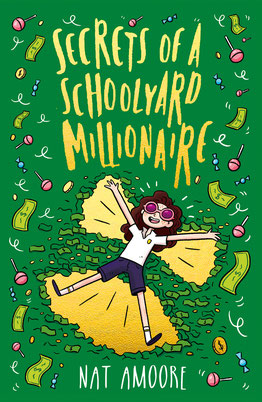
Finding a million dollars in your backyard – every kid’s dream, right? That’s what me and my best friend Toby thought too.

Jumping castles at school. Lollipops for our adoring fans. Wearing sunglasses indoors (‘cos that’s what all the millionaires do).

There’s a lot you can get with a million dollars . . . including a whole lot of trouble.

We’re thrilled to be chatting with Nat Amoore at Alphabet Soup today!


Secrets of a Schoolyard Millionaire by Nat AmooreOkay – what would YOU do with a million dollars if you suddenly became a millionaire?
Oooooohhhh, this is such a hard one even though I get asked it all the time. One of my favourite things about writing Secrets Of a Schoolyard Millionaire was being able to explore all the things I could/would do with a million dollars. But in the end, I think I’d divide it into three. First third would be to go wild with. Spend on whatever I wanted. Rent out Wet’n’Wild for all my friends so we didn’t have to wait in line. Buy heaps of books. Get a bed shaped like a race car. Take a holiday. Just get a little cray-cray! The second third I would put away and save for something responsible when I grow up, like buying a house or something adult like that. And the last third I would spend on other people who need it more. There are a lot of great charities out there and a lot of ways to help people who need it.

Did you base the characters in Secrets of a Schoolyard Millionaire on anyone you know?
I think A LOT of people who know me will tell you that there is a lot of me in Tess. My friends say when they read the book, they can hear my voice in their head as Tess speaks. A lot of the things Tess does in the book, I did when I was a kid.

Then with the other characters, there are a lot of ‘bits’ of them that come from real people. Toby has some elements about him that are based on a friend of mine. So does Kathy. I actually have a brother called Dane who had a dog just like Butthead when we were kids. So I think when I write, I’m a little bit like Doctor Frankenstein. I take bits of different people I know and then sew them all together to make new characters.

Writing a book: Pen and paper? Or write it straight onto the computer?
OMG, I CANNOT write with a pen and paper. Even when I was at school, I always got in trouble for my handwriting. I was the LAST kid to get their pen licence and if you go back and read my school reports they say ‘Nat still does not join her writing’. To this day I cannot do running writing, I always print. I always write in capitals and when I write in a birthday card, my hand aches for a week after. The only way my writing can keep up with my brain is if I’m typing. If I was born 100 years ago I would never have written a book because I would never have been able to do it with a paper and pen. So without a doubt, I’m a straight-into-the-computer kind of gal!

What’s your million-dollar tip for young writers?
Just write! Don’t worry about spelling or punctuation for now. Just get the idea out. You can come back later and fix all that stuff up. I’m not the greatest writer, I know that. But I have really great ideas. Fortunately I have editors and publishers who help me put all the commas and stuff where they are supposed to go. And you have people to help you with that too. But you’ll have nothing to fix if you don’t write it first. So get your idea down on the paper/screen and don’t let all that other stuff stop you. I still, don’t know, where all, those, pesky commas are, supposed to go,,,,,,

What are you working on next?
Right now, like RIGHT THIS SECOND, I am working on the follow up to Secrets Of A Schoolyard Millionaire. It is called The Power Of Positive Pranking and it’s coming out in June 2020. It’s not really a sequel so much, but it does happen in the same world as Secrets Of A Schoolyard Millionaire (the town of Watterson and Watterson Primary School) and you will see some of your favourite characters make a comeback. It’s a story told from the perspective of a very minor character who made a small appearance in the first book — ooooohhhhh the mystery!


Secrets of a Schoolyard Millionaire by Nat AmooreAwesome extras:

Click here to read a sneak peek of the book

Click here for Teachers’ Notes by Melissa Kroeger at Children’s Books Daily

Click here to visit Nat Amoore’s website

Click here for the One More Page podcast (where Nat Amoore is one of the hosts)

Secrets of a Schoolyard Millionaire is out now! Look for it at your nearest bookshop or library. 

Posted in interviews, poetry

100 Ways to Fly: an interview with Michelle Taylor

Michelle TaylorMEET THE AUTHOR

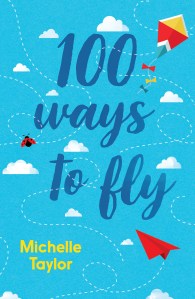
Michelle Taylor is an award-winning poet and has been writing and publishing for over twenty years. Michelle tells young people that poetry is like making magic with words, and her sessions typically involve audience participation and a lot of interaction. Her latest book is 100 Ways to Fly, her third poetry collection for children.

From Michelle:

Poetry is not meant to be scary! It’s the opposite! It can make you laugh, make you feel normal, even brave, especially if you feel sad or alone. When I set out to write 100 Ways To Fly I wanted this book to be a little different to the others. After five years of careful crafting, multiple test runs of poems with children and exercising my imagination muscles until they ached, I bring you these 100 (or so) poems! Poems to celebrate our amazing senses and sense of humour, poems to twist your tongues and thoughts, poems about creatures that live in the land of nonsense. 

We are very excited to welcome Michelle Taylor to Alphabet Soup today!


100 ways to fly. A poetry book for children.When you were putting together 100 Ways to Fly, how did you decide which poems to include, and what order to put them in?
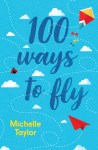
That’s one of the trickier jobs. For 100 Ways to Fly I set out to write lots of different kinds of poems – ones about our senses, scary poems, gross poems and nonsense poems, serious poems to help us feel more confident. I did what I do with every collection. After writing for about a year, I printed all the poems and laid them out all over the lounge room floor. Then I started to look for patterns. It’s messy but it’s very exciting. From here I saw the themes that kept coming up and these formed the sections of the book such as, ‘The Word Zoo’, ‘How Many Noses In a Nostril?’, ‘A Pocket Full of Poems’ and so on. Then I could think about which sections I needed to write more poems for. The hardest part is the order. For this I imagine being the reader of my collection. What I want is to start on a high and be hooked in straight away. I also want to end on a hopeful note that invites me to go away and keep reading or writing poems. Then all the poems in between need to go up and down, a bit like a rollercoaster to keep me reading through the whole book.

How do you like to go about drafting a concrete poem (a shape poem)?
I don’t have any rules for a concrete poem but I am very visual and I love art. So for each poem I think to myself, ‘What shape or form will work best?’. A concrete poem is just an exaggerated way of echoing the words with a shape on the page. A concrete poem seems to help my brain ‘get’ certain ideas better and as a bonus I can enjoy looking at it. I had fun writing ‘Summer Lies’, finding shapes for each separate idea as I wrote the poem. It’s an example of how just a few spaces can bring words to life. With ‘Hope’ I wanted to see what hope might look like. We talk about hope a lot but what might symbolise it? Even if I don’t remember all the words – I don’t have a great memory! – I know the feeling of that poem and think of going up the steps.

Do you have a favourite from this collection for performing/reading aloud to kids?
A favourite poem to read is ‘I Wish For You’ because it’s like giving a present to the people listening, and afterwards I invite kids to write their own wish poem for someone they care about. I naturally like sharing poems that get big reactions, so the section ‘Spooky and Sick’ is very popular, and we also have a load of fun when we do the actions for ‘Boom Crash Poem’. We do things like patting ourselves on the back and giving ourselves big hugs!

Your collection includes rhyming and unrhymed poetry. Do you find one comes more naturally than the other?
Rhyming is more of a challenge. When I say rhyme I mean rhyme at the end of lines or end rhyme. Some of my poems contain end rhyme. For ‘The Termite Rap’ I deliberately chose end rhyme schemes to reinforce what this poem is about – the repetitive sounds of termites! Internal rhymes come more naturally for me though. These are similar sounds occurring within and across the lines and which have less tendency to follow a pattern. Maybe that’s because I’m not so fond of rules, or because some of my poems are expressing uncertainty and choice and internal things like our feelings.

Do you have a writing tip for young poets?
Be kind to yourself. Let the writing of a poem be your friend. It may not be perfect or easy. It might take lots of tries. Your teacher or another reader may not like it the same way you do, or they may not think it’s important at all. That will happen so you need to be prepared for this because it’s a normal part of writing. Sometimes the best writing is the writing that gives us a way to think or talk about confusing or hard or wonderful things. The main thing is to start, write something, write anything and begin! Who knows what it might lead to!

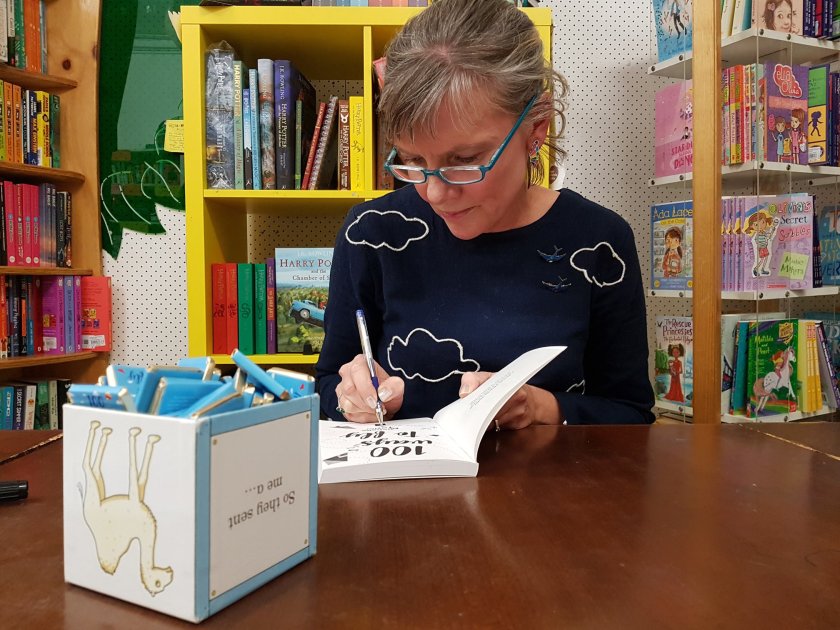
Michelle Taylor signing copies of 100 Ways to Fly.


Awesome extras:

Click here to WIN a copy of the book

100 ways to fly. A poetry book for children.

Click here for a review of the book. (Review by Julie Thorndyke for the Reading Time website.)

Click here for Teacher’s Notes.

Click here to visit Michelle Taylor’s website.

100 Ways to Fly by Michelle Taylor is out now! Ask for it at your nearest bookshop or library. 

Posted in poetry

Young Writers in Action: A sinkhole in the park

A SINKHOLE IN THE PARK
by Lewis, 10, WA

I went for a drive to the park one day,
and what do you think I saw?
A bunch of people screaming
and a sinkhole in the floor!

I stopped the car and looked around
until I couldn’t see.
(A bunch of people in my way
and one called Sylus Lee.)

I asked him what happened
and he said a strong ape jumped,
jumped and landed with a crash!
And now people are pumped.


Read Lewis’s earlier work here. To send us YOUR book review, poem, story or artwork: check out our submission guidelines

Posted in info

Top Reads: November 2019

This is the last day of November AND the last Top Reads for the year! If you’re looking for some holiday reading, these books come highly recommended by the members of our 2019 Top Reads team:

You’ll find a recommended list from our Top Reads Team on the last day of every month (February to November). If you’d like even more recommendations, browse all through all our Top Reads ever!

*All our Top Readers are kids aged 13 and under. No grownups allowed!

Posted in authors, illustrator, interviews

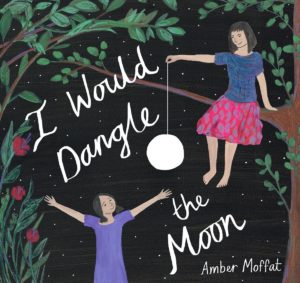
I Would Dangle the Moon: an interview with Amber Moffat

Amber MoffattMEET THE AUTHOR-ILLUSTRATOR

Amber Moffatt is a writer and visual artist based in Perth, Western Australia. If you live in WA and you’ve been to the AH Bracks library in Melville you might have been lucky enough to see her illustrations decorating the windows for Book Week 2019! Amber recently launched her first picture book, I Would Dangle the Moon, in Western Australia and in New Zealand. She regularly runs art workshops for children inspired by the artwork from the book.

What would you do if you could pluck the moon from the sky? Would you scoop it up in an ice cream cone, or ride it like a snail shell across the night sky? This picture book will spark your imagination. 

Today Amber Moffat stops by to chat to Alphabet Soup about creating I Would Dangle the Moon.


I would dangle the moon by Amber MoffatYou’re an author AND an illustrator. When you were creating I Would Dangle the Moon, which came first – the words or the illustrations?
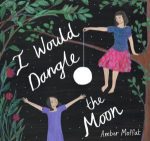
The words came first, but I did have a sense of the images in my mind too. The idea of a snail taking the moon for its shell and slithering across the night sky was the seed the story grew from.

How long did it take you to go from the story idea to the published book?
It took a really long time – three years! The initial text was developed quite quickly but it took a much longer time to develop the storyboard and find the right style of illutstration. I was really lucky to have author and illustrator Briony Stewart as my mentor for a year, and that helped me get the concept ready to submit to publishers. From when my publisher, MidnightSun Publishing, contracted me, it took nine months to complete the final artwork for the illustrations.

What have you been reading recently?
I’ve been enjoying Trouble in the Surf, written by Stephanie Owen Reeder and illustrated by Briony Stewart. The way Briony has used colour in the illustrations is really beautiful, and I keep going back to it to admire her technique.

When you’re doing illustration work, what’s your favourite medium?
Acrylic paint is definitely my preferred medium. I like the way it dries fast and you can paint over it easily. I also like to be able to scan images and alter them digitally. I often use computer editing to piece different paintings together and play with scale and composition.

Are you able to tell us something about your next writing project?
The picture book I’m currently working on explores the science of light, and it’s been a new experience for me to convey scientific ideas in the form of a picture book. I am also working on a novel for young adults, in which medical science is important to the story, so that seems to be a theme for me at the moment.

Amber reading with some helpers at the book launch
Amber Moffat (with some helpers) at the book launch.

I would dangle the moon by Amber MoffatAwesome extras:

Click here to WIN a copy of the book

Click here for a little peek at some of the illustrations from the book.

Click here to read a review of I Would Dangle the Moon (review by Anishka, age 9)

Click here to visit Amber Moffat’s website.

I Would Dangle the Moon is out now! Find it at your nearest bookshop or library.

Posted in info

Young writers in action: Diary of a Gramophone

DIARY OF A GRAMOPHONE
by Elizabeth, 6, NSW

Gramophone photo by Skitterphoto at pexels.comTom carried me like a baby. He wiped my big pipe mouth. I felt clean.
Then Tom put the record on to my tummy. He spun my hand really fast. Then the family was happy when I was singing. They sang a song with me. I was delighted. It was lovely.

Read other work from Elizabeth hereTo send us YOUR story, poem, artwork or book review, check out our submission guidelines. Happy reading!
Posted in authors, interviews

The Australia Survival Guide: an interview with George Ivanoff

George Ivanoff holding a copy of The Australia Survival GuideMEET THE AUTHOR

George Ivanoff is the award-winning Melbourne author of over 100 books for kids and teens, including the Gamers trilogy, the interactive You Choose series, the RFDS Adventures, and the Other Worlds series. His latest book is The Australia Survival Guide. 

Australia has its fair share of dangers: sharks, snakes, cyclones and crocodiles can be a serious threat to your life! But don’t worry. This book will help you by providing the knowledge you need to survive in all kinds of Aussie conditions – in the bush, in the desert or even at the beach!

So get out there and look around! Even if you think Australia is trying to kill you, The Australia Survival Guide can save your life!

Today we are pleased to have George Ivanoff visiting Alphabet Soup to chat about books, writing, and The Australia Survival Guide.


Do you go about writing a nonfiction book differently from how you go about writing your fiction books?
Oh yes. The difference is in the research. While fiction will often require some research, it’s nowhere near as much as with non-fiction. With fiction, the research is usually for specific elements, such as setting, and is mostly about filling in detail. But with non-fiction, it is the cornerstone of the whole thing. You can’t even start without the research.

How long did it take you to go from the story idea for The Australia Survival Guide to the published book?
We had a reasonably short timeline for this book, so I delivered it section by section, so that the editor and designer could get started on their parts. There was about six months worth of work in this book for me. And then another six months after I was done before publication.

Do you have any children’s books (fiction or nonfiction!) you would recommend?
Oh, there are so many that I could recommend, but I’ll restrain myself and go one fiction, one non-fiction and one picture book.

Fiction:
Final Storm by Deborah Abel. This is the third book in the trilogy which began with Grimsdon. It’s a wonderfully adventurous science fiction series with an important environmental message.
Non-fiction:
How To Save the Whole Stinkin’ Planet by Lee Constable. Everything you ever wanted to know about garbage and what happens to it after we throw it out.
Picture Book:
Pippa, written by Dimity Powell and illustrated by Andrew Plant. Delightful story about a young pigeon’s first solo adventure, with gorgeous illustrations.

Do you have any advice for young writers who want to write nonfiction?
Get the research right. So many people think that in this age of computers and the Internet, research is just a matter of Googling your topic and following a couple of links. But so much of what’s on the Internet is questionable. So you need to verify the information. As you gather information online, you need to check the source. Is it reputable? And Wikipedia is not necessarily a reliable resource, as anyone can add or change the information it contains. Then you need to confirm your information, making sure you have more than one source. Never rush the research.

Are you able to tell us a bit about your next writing project?
I’m sticking with non-fiction for the time being. I’m working on a new Survival Guide, but with a very different topic. I’m hoping to announce the topic and title soon, so keep an eye on my website if you want to know more. http://georgeivanoff.com.au


THE AUSTRALIA SURVIVAL GUIDE by George IvanoffAwesome extras:

Click here for a sneak peek inside The Australia Survival Guide.

Click here to read a review of the book (review by Rory, age 7).

Click here to visit George Ivanoff’s website. 

The Australia Survival Guide by George Ivanoff is out now! Find it at your nearest bookshop or library.