Write a poem up to 10 lines long (shorter is fine). Your poem must include the word ‘snap.’ Include a competition entry form—you can print one from Alphabet Soup‘s website.
ENTRIES CLOSE 7 JANUARY 2011. (We’ll accept entries postmarked 7 January.)
This writing competition is open to children aged 12 and under. Entries are judged in 3 age categories.
Here is the winning Under 12s story from our spring 2010 writing competition. You were asked to write a funny story about a musician.
A reminder: always check the rules of the competition. If you go over the word limit, we have to disqualify your entry and that makes us sad!
—
Under 12s winner: Megan Flack, WA
Dad’s New Craze
Hi, I would like to tell you about my dad. His name is Eric and he is a violin player.
Dad is a very good violin player, but now he wants to be a comedian. It gets very annoying because he cracks jokes all the time.
One day I brought a note home from school about a talent show and dad entered it, to my dismay.
On the day, dad got ready to go and perform for the school. When it was my dad’s go, I hid myself. My dad played the violin awfully and he told lots of jokes like, “How do you spell mouse trap in just 3 letters? C.A.T!”
It was embarrassing but dad really enjoyed it. In the end dad fell off the stage! That was funny.
When the judges were calling out the winners, guess who won? My dad! I was amazed but what do you expect with a really awesome dad like mine?
—
Congratulations to Megan! She receives a $20 book voucher for her winning story.
Here is the winning Under 9s story from our spring 2010 writing competition. You were asked to write a funny story about a musician.
A reminder: always check the rules of the competition. If you go over the word limit, we have to disqualify your entry and that makes us sad!
—
Under 9s winner: Suanne Mostert, WA
The Jazz Concert
One shiny, sparkly, early morning there was a beautiful, glamorous special lady woken up by a croaking sound from a frog. Her name is Sophie and her friends are going to travel the world.
Sophie got dressed into a fantastic light green sparkly and shiny top and some nice blue pale glamorous jeans. Then she ate cornflakes with milk and a glass of water. Next she fed her dog. Then she went to her music class.
“Sophie is the best saxophone player,” mumbled her teacher with a tear. So Sophie walked into the music house with her saxophone gold and sparkly.
Then her teacher said, “You have to go to the Opera House to play in the jazz concert. Really.”
“Oh really!” Sophie replied in shock.
“You start tomorrow so go home and have a good night’s rest.”
ZZZZZZZZZZZZZZZZZZZ
The morning came. She got dressed in a black and purple dress, ready for the concert.
“Good morning ladies and jellybeans,” announced Mr Egain with a delightful and caring grin. “Today you will be listening to a jazz concert. First up, put your hands together for Sophie Burgess!”
They listened with excitement for about half an hour. The whole concert finished and it was time to announce the winner. Mr Egain came on from the backstage in a muddle. (Sigh)
“OK, OK, the winner is …”
“He’s fainted!” someone called out from backstage.
Another lady called out: “Get him to the hospital … ”
There was silence. He coughed and woke up.
“I am all right. It was just stage fright. OK, where was I? The winner is (ah). My pants fell down! (wow) (wow) (wow) (ah).”
He fell over. Everyone was laughing at poor Mr Egain. Sophie ran out and pulled Mr Egan up.
“Are you all right, Mr Egain?”
“Oh yes I am, Sophie. Do you want to announce the winner?”
“Yes please. OK. The winner is Sophie Burgess.”
They clapped and cheered. So Sophie went and got her trophy, then she went home. She fed her dog, Brigy, and ate her dinner and went to bed.
—
Congratulations to Suanne! She receives a $20 book voucher for her winning story.
Riley and the Curious Koala is the third in the Riley series of picture books. Riley’s first adventure began in Beijing with Riley and the Sleeping Dragon, continued on to Hong Kong with Riley and the Dancing Lion, and his latest adventure brings him to Sydney Australia.
To celebrate the launch of Riley and the Curious Koala, author Tania McCartney has set off on a blog tour. You can check out the other stops on her tour if you scroll to the bottom of this post. She’s here today to talk about how to come up with good ideas for writing stories.
Over to you, Tania!
—
Before you start reading this article, you need to do something—and don’t skip ahead and cheat or it won’t work! Write these words down a page: setting, character, object, situation. Now, next to each word, write a two-digit number between 11 and 99. Go on, do it now. It should look something like this:
Place 17
Character 87
Object 56
Situation 44
Put it somewhere safe. Done it? Good. Okay—now let the article begin …
One of the questions I receive most when reading to school kids is this:
Where do you get your ideas from?
This is such an interesting question! Least of all because it’s such a hard one to answer. Everyone gets their story writing ideas in different ways—and many authors will tell you it’s from the everyday happenings in their life—boring but true. From opening a yoghurt pot to tripping on a rug … these are the things that inspire an active imagination. And yes, they’re also the things that inspire me.
Imagine, if you will, opening that yoghurt pot and finding something other than creamy white yoghurt inside. Perhaps it’s a pot full of centipedes. Or a tiny white rabbit. Or a strange green slime that pours out pink smoke. What kind of story could unfold from such an opening?
And what of the rug trip? Perhaps it’s an old Persian rug, tightly woven with mystical patterns. Perhaps I trip and I fall, only I don’t hit the floor, I keep going, right through the carpet into another world …
These everyday occurrences can really spill over with story ideas if you just open yourself to the possibility … and think outside the square.
But you know what—sometimes it’s hard to think outside the square when you’re young and life experience hasn’t twisted your brain into a mangled wreck of crazy thinking. There’s also those Parent and Teacher expectations—the pressure of coming up with something marvellously creative.
So I’ve come up with a little exercise that will help you create a fantastically imaginative story that will ooze out of you like taffy.
We all know the basic storyline structure—yes? Basically, there’s a beginning, middle and end. Got it? Great.
Then there’s the details. First of all—the settingor the place. Where is your story going to take place? Then we have to think about characters. Who is involved? Who are the main players? Next is a situation. What is actually going to happen in this story? It helps if we add an object that becomes the focus, along with the characters, in making a story come to life.
The other thing we need to consider is conflict. Conflict means making something troublesome or difficult for our characters. Changing things around, making them do something or work towards something. One of the easiest ways to do this—as with my Riley travelogue books—is to make them search for something.
Characters often search for something in books, even if it’s not an actual object. It’s a common recurring theme.
When a character searches for something, you can put in as many cool plot twists and problems as you like. Plot twists, problems, drama, conflict—that’s what makes a story interesting—and makes people want to read your story. Nothing worse than writing a story no one wants to read.
So—here’s a challenge for you. I want you to write a story—an adventure story where someone is searching for something. And here is how you’re going to do it.
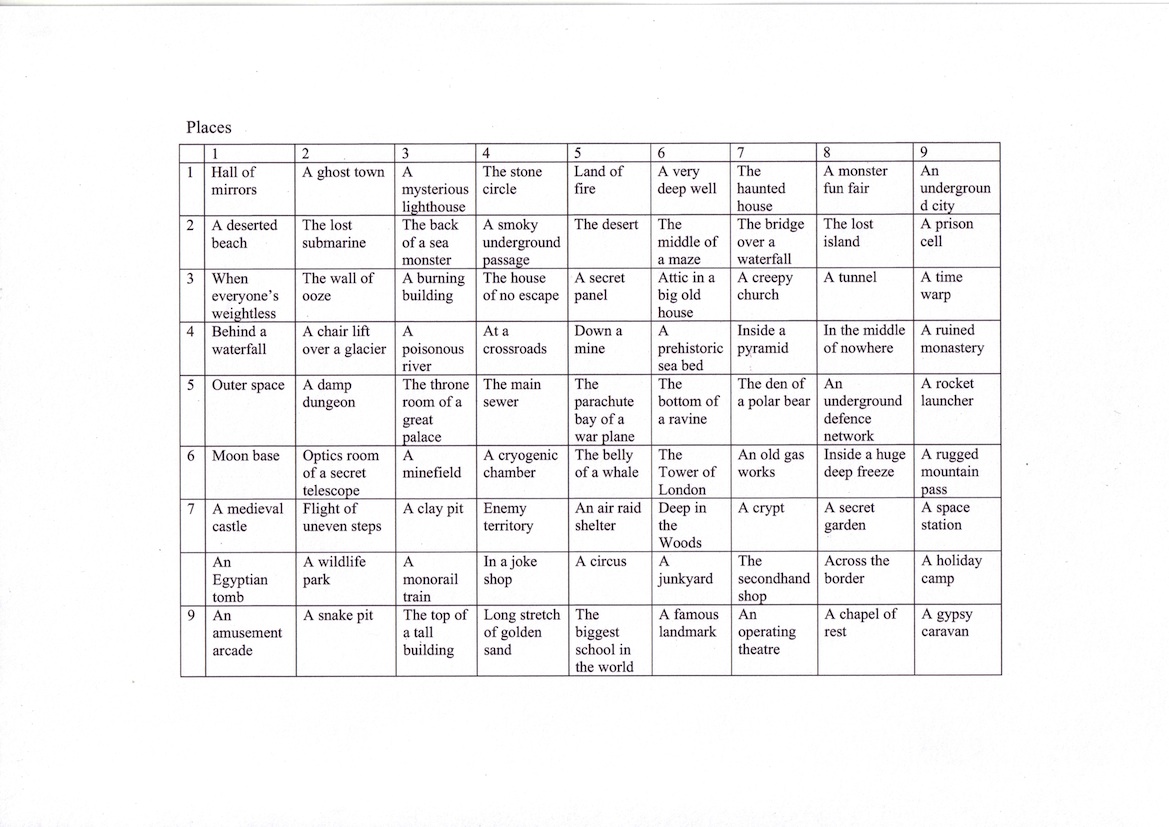
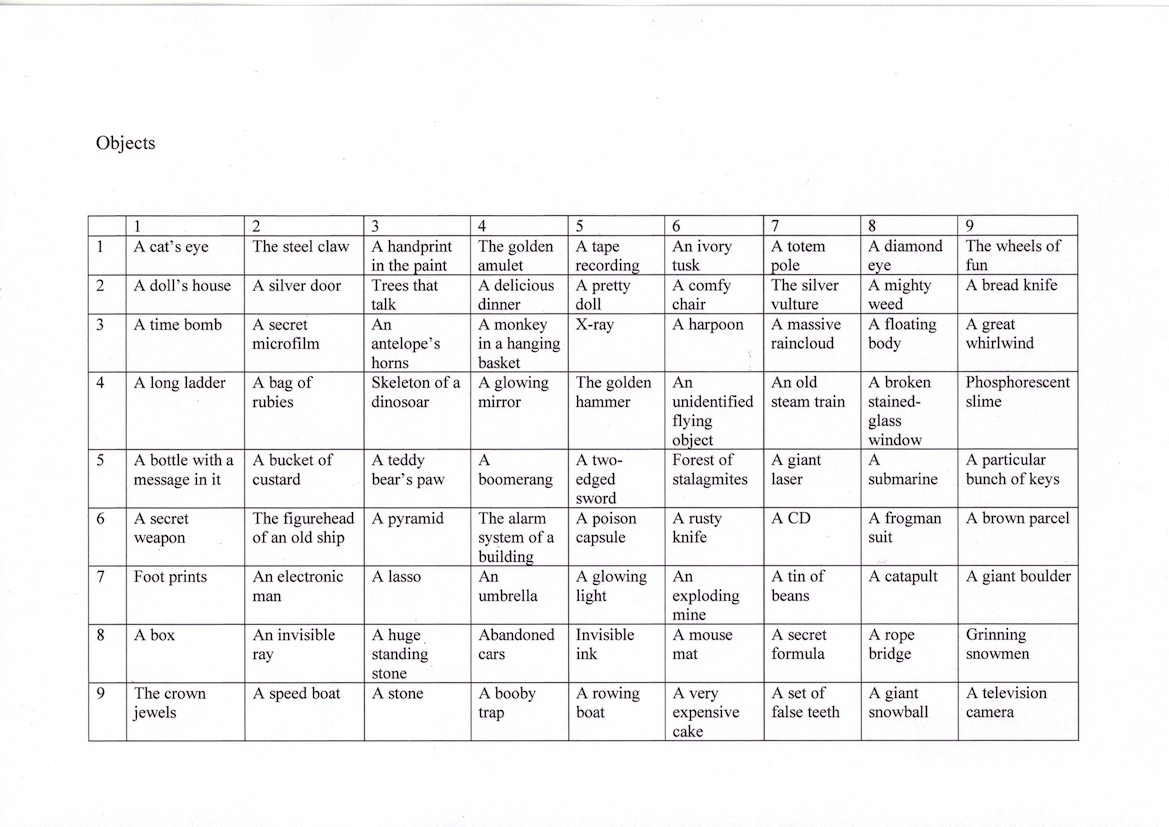
Grab the page with words and numbers you wrote at the beginning of this article and find your numbers on the following grids—reading first down the side of the grid then across the top. For example, for my number choices (above), I will write a story with the following components:
Place 17 – haunted house
Character 87 – a tribe of eskimos
Object 56 – a forest of stalagmites
Situation 44 – having plastic surgery
Place Chart: Double click on the image to zoomCharacter Chart: Double click the image to zoomObjects Chart: Double click the image to zoomSituations Chart: Double click the image to zoom
Once you have written down your four basic elements, you now need to construct a short story using these references. So, for me, I need to write about a tribe of Eskimos hunting for a forest of stalagmites in a haunted house. And plastic surgery will need to be someway involved in order for me to find those stalagmites.
Hmmm. Maybe I should leave this particular story up to you …
You have just 20 minutes to write your story. Make it fast and off-the-cuff so you don’t think about it too much. Then, if you want to—why not email it to Soup Blog (or to me for Kids Book Review!) to be published online, so we can revel in your cleverness. You can also ask your teacher to run this challenge in your classroom.
You might surprise yourself how creative you can be when writing this story. Remember to throw in conflict along the way and to resolve the story at the end … will your character(s) find what they are searching for?
I, for one, would love to see what you come up with. Use this story writing grid often to challenge that wonderful imagination you have hiding inside your head. And do let me know when your first book is published, will you not?
Tania McCartney is an author, editor, publisher, blogger, book reviewer and mango devourer who loves writing, celebrating and supporting children’s literature—and literacy. She is the author of the Riley series of travelogue picture books, as well as several published and self-published books. Tania is also an experienced magazine writer and editor, is the founder of Kids Book Review and is a Senior Editor at Australian Women Online. She lives in Canberra with a husband, two kids and a mountain of books.
In Western Australia, children who live in the City of Nedlands, or attend a school within the City of Nedlands can enter the I Imagine 2030 art competition. Children are asked to imagine how their community will look in 2030 and create a picture to enter the competition.
There is a first prize of $100 in two age categories, plus other prizes.
Entries close 4pm, Friday 19 November. For more information, email Tarn Reynolds at the City of Nedlands or phone (08) 9273 3579.
The bad news is that we haven’t had as many entries as we usually find in our PO Box. The good news is, there’s still time to enter! (And we can’t guarantee that you’ll win, but with fewer entries you have a slightly better chance of winning. But shhhh, we didn’t tell you that.)
For this competition, you have to write a funny story about a musician—maybe that scared off a few writers but we’re sure you can write something funny about a crazy conductor or a brass player who likes blowing bubbles out of his tuba, or … a dog howling whenever his neighbour practises the recorder … or … ___________________<– enter your own idea here.
The competition is judged in 3 age categories: under 7s, under 9s and under 12s and there are $20 book vouchers to be won.
Here are the details:
SPRING 2010 WRITING COMPETITION
Entries close 22 October 2010
Write a funny story about a musician. Length: up to 350 words—shorter is fine. Your entry can be handwritten or typed.
Include a competition entry form. This may be printed from the website, photocopied, or contact us to have one emailed or posted to you.
We accept emailed entries (if you include a scan of the entry form) and entries postmarked 22 October.
Just a reminder—if you want to enter our design-a-cover competition, entries close on 16 September 2010. The winner will see their artwork on the cover of our summer competition (out in November) and receive $20 worth of art supplies. You can find details and an entry form on the Alphabet Soup website.
And if writing is more your thing, don’t forget we run a writing competition for kids in every issue of the magazine. Our spring story competition closes on 22 October 2010. There are $20 book vouchers for the winners in three age categories. You’ll find details and an entry form over at the Alphabet Soup websitefor that, too.
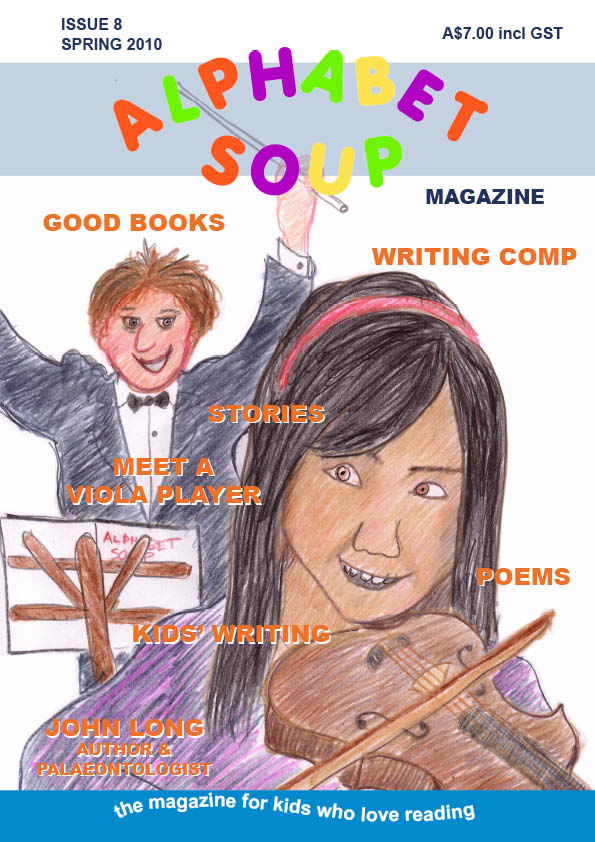
Issue 8 of Alphabet Soup magazine will be out in a few weeks, and it has us humming a happy tune. It will be heading off to the printer very soon—here’s a taste of what you’ll find inside.
Q&A with John Long, author and palaeontologist
a round chant in four parts you can try with your friends
Stories, poems and book recommendations
crossword
kids’ writing and artwork (stories, poems, book reviews and artwork)
The Book Chook’s latest writing tips (How to write funny stories)
Do you subscribe to Alphabet Soup? The winner of our issue 8 subscriber draw will receive a $200 book pack from Fremantle Press. If you’d like to subscribe, you can subscribe online (and order single copies of the magazine) via our website. 🙂
 Write a poem up to 10 lines long (shorter is fine). Your poem must include the word ‘snap.’ Include a competition entry form—you can print one from Alphabet Soup‘s website.






 alphabetsoup.net.au