Posted in Book reviews by kids, Book reviews by Matilda

Book review: Summer in Enchantia

REVIEWED BY MATILDA, 9, WA

Summer in Enchantia (Cover)

Magic Ballerina: Summer in Enchantia by Darcey Bussell, ill. Dynamo Limited, HarperCollins Children’s Books, ISBN 9780007317219

Matilda borrowed a copy of this book from her local library.

This is about a girl called Rosa who has magic ballet shoes. Whenever there is trouble in Enchantia the ballet shoes whisk her off there so she can help solve the problem. This time the king and queen of Enchantia want to have a garden party but pirates are stealing everything they need for the party.

I found out about this series (about Rosa) when I read a Delphie book (another girl in the Magic Ballerina series.) I like this book because it’s about working together to solve a problem. There are seven books in the Rosa series.

I’d recommend this book for ages 6 to 10 and for people who like ballet.

Matilda is one of our regular book reviewers. Her most recent review (if you don’t count this one) was of  Tales of Wisdom and Wonder. If YOU would like to send us a book review, check out our submission guidelines. Happy reading!

Posted in Beaconsfield Primary School, Book reviews by kids

Book review: Tea and Sugar Christmas

REVIEWED BY JAMIE, 11, WA

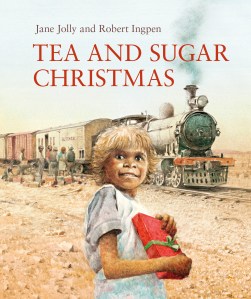
Tea and sugar Christmas (cover)

Tea and Sugar Christmas by Jane Jolly, ill. Robert Ingpen, NLA Publishing, ISBN 9780642278630

This book was written by Jane Jolly and illustrated by Robert Ingpen — an Australian award-winning illustrator, who I think draws the most amazing pictures I have ever seen. This picture book has around 16 pages with black and white illustrations, along with some coloured ones too.

This fictional short story based on true life events tells the story of a young aboriginal girl named Kathleen. She is waiting with so much excitement for the Thursday weekly supply train, which serviced the remote communities from Port Augusta to Kalgoorlie for 81 years. However this train is a special train as it is the first Thursday of December, which means Father Christmas will be visiting.

I especially liked how at the end of this book, it has a few pages with factual information and real pictures of the supply train. It tells how these isolated people relied on the train for groceries, household goods and even medical advice.

This is Jamie’s first book review for Alphabet Soup. If you’d like to read more book reviews by Beaconsfield Primary students, you can click on ‘Beaconsfield Primary School’ in the grey categories box in the right column of this blog. To send us YOUR book review, check out our submission guidelines. Happy reading!

Posted in info

TOP READS (June 2015)

After a very busy month at Alphabet Soup, it’s that time again! Our team of Top Readers* are back with their favourite reads from June.


* Today we welcome Xavier to the team — Xavier is 6 and lives in the Northern Territory. When he’s not reading, Xavier enjoys being outdoors, swimming and running. He loves telling himself stories and when he grows up, Xavier wants to be an adventurer.

You’ll find a recommended list from our Top Reading Team on the last day of every month. If you missed last month’s, don’t forget to check out the May 2015 Top Reads.

*All our Top Readers are kids aged 13 and under. No grownups allowed!

Posted in info

Meet Stig Wemyss: the voice of your favourite audiobook

Stig Wemyss reads books. Out loud. Lots and lots of books by all sorts of people like Andy Griffiths, Paul Jennings, Margaret Clark, Tim Winton, Stig Wemyss (himself!) and … well, HEAPS more. You might know him as the voice of The 13-Storey Treehouse audiobooks (he even reads the ‘audio illustrations’. Cool.). Stig Wemyss is someone we have wanted to interview for a long time … and what better month to do it in than June — to celebrate Hear a Story!

Stig Wemyss
Photo courtesy Stig Wemyss

So — what’s it like to be an audiobook narrator? Read on!


Where do you live?
I live in the back shelf of Andy Griffith’s fridge, behind the relish. Wait — Andy’s not going to see this is he? I really don’t want him to know I’m in here. Maybe it’s better if you just put “Melbourne, Victoria” and don’t mention the whole fridge thing … Um, can you close the door, the margarine is starting to melt.

What skills do you need to be the narrator for an audiobook? 
People underestimate how difficult it is to be narrator. Like, you have to be able to read, for a start. You have to have a whole range of different voices, you have to spend hours at a time locked in a little glass booth — so if you’re claustrophobic, forget about it — and you have to be a bit of an idiot. So as you can see, I tick all the boxes.

How did you find a job as an audiobook narrator?
I started narrating books about 25 years ago. Somebody recommended me to Vision Australia as an actor that might be good to narrate books for kids and young adults because of the youthful quality of my voice. And the fact that I would do it for free. I can’t remember what my first title was and I suspect I was probably not very good but for whatever reason, the producers loved it and continued to get me back. Not long after that, I narrated Tim Winton’s That Eye The Sky [a book for adults] which went on to win a number of audiobook awards and the rest, as they say, is history.

Do you discuss a book with its author and illustrator before you record it as an audiobook?
Most authors are happy to let narrators bring their own spin to a book. Andy Griffiths has given me a license to play around and be creative, providing I’m true to the text. I remember getting a letter from Nan Bodsworth after I had narrated one of her books saying how much she loved my performance. That was really nice, usually you never hear from the authors … unless it’s to ask you to move out of their fridge.

[Listen to an excerpt of Stig Wemyss narrating The 52-Storey Treehouse.]

The-52-storey treehouse audiobook

Do you get to choose which books you record?
Bolinda are fantastic at matching the right voice for the book. I’m lucky enough to have been asked to narrate over 150 books for Bolinda and I said yes to all of them. These days I even do live shows in schools and libraries around the country. (You can find out if I’m coming to a library near you on the internet. Just look for Stig Live @ The Library.) 

You wrote The Tripp Diaries specifically as an audiobook. What’s different about writing a book that’s intended to be an audiobook, rather than one to be read in traditional fashion?
Audio is a whole different medium, it is theatre of the mind. With audio, you can create fantastical, larger-than-life scenarios using music and sound effects so you can take the listener on a journey well beyond what you could just with the written word. It’s sort of like animation with your eyes closed.

When you read in your own time, do you prefer to read books the traditional way or do you prefer audiobooks?
I love reading and I love listening. The great thing about an audio book is you can read it anywhere, anytime … and while you’re doing something else. Driving, cleaning, exercising, knitting, shearing a sheep, painting a house, doing homework, pretending to be asleep, on a bus, on a train, at the beach … these are all things I’ve done while listening to an audio book. Reading I tend to do in bed.

Do you have any tips for young people who would like to record audiobooks (or perhaps podcasts)?
Go for it! Make up something crazy and outrageous and record it. Make up silly voices and crazy sound effects. There is no limit to the fun you can have with audio, it’s a playground for your imagination.

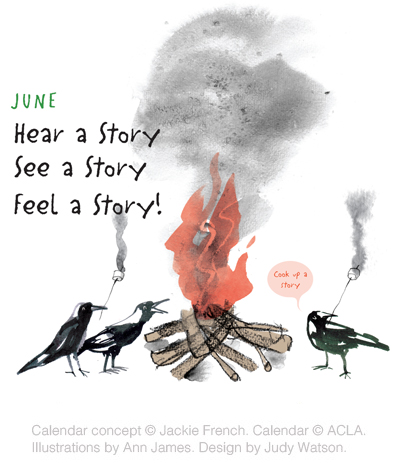
Hear a Story, See a Story, Feel a Story ©-ACLA. Image used with permission.

This post is part of the celebrations of Hear a Story … and Hear a Story is part of the work of the Australian Children’s Laureate, Jackie French. You can find out more about Hear a Story on the Australian Children’s Laureate site. And check out our other interviews this month with an oral storyteller (Glenn B Swift), and with Jackie French herself.

For more about STIG WEMYSS and his audiobooks, check out his website!

Interview with Stig Wemyss © June 2015 Stig Wemyss & Rebecca Newman
Posted in info

Book Launches July 2015 (VIC)

Here are two book launches in Victoria! (If you’re in WA or QLD, we’ve posted about upcoming book launches here and here.)

(Mr Huff cover)Come along to the launch of Mr Huff, and check out an exhibition of original artworks by the author-illustrator Anna Walker.

When: 6pm, Thursday 9 July 2015.

Where: No Vacancy Project Space, The Atrium, Federation Square, Melbourne.

(The exhibition runs until 26 July 2015.)


Book Launch, July 12 2015 at Ballarat Books, 15 Armstrong St North, Ballarat,2pm, RSVP phone 53333222

Posted in authors

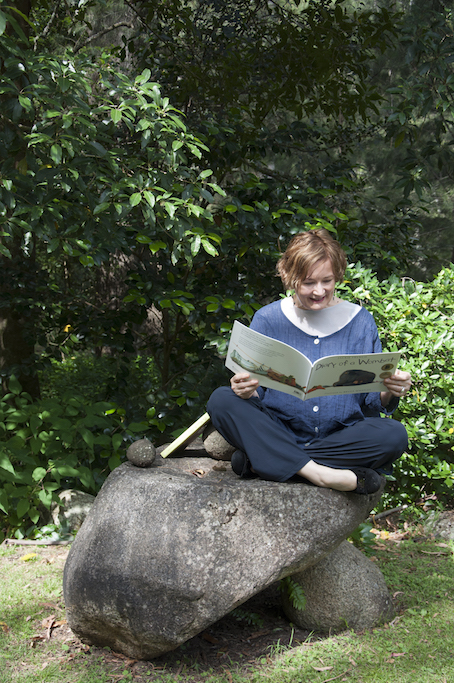
Jackie French: The Australian Children’s Laureate

Jackie French (Credit Kelly Sturgiss)
Jackie French (Photo by Kelly Sturgiss)
Jackie French has written more than 140 books — and she’s received over 60 awards in Australia and overseas. Wow! Jackie is also the 2014–2015 Australian Children’s Laureate. As part of her role, she has co-created the Share a Story calendar (you can download it!) and given each month a theme. June’s theme is HEAR A STORY, SEE A STORY, FEEL A STORY.
If you were an Alphabet Soup reader from long ago, you might remember that Jackie French was the very first author we interviewed in our print magazine! Today we’ve invited her back to answer three questions from  members of our Top Readers team.
 —
How long does it take to write a book? (Celine, 12, WA)
Three months or thirty years, depending what answer you like best! I think about a book for at least three years before I begin to write, and many are based on ideas I have been thinking about since I was your age. The actual writing takes about three months, but then I rewrite and rewrite, and each book  takes a different amount of time to both think about, and write, or rewrite.
 —
Has your son read every one of your published books? (Joseph, 11, WA)
I don’t think he has read any of them! Except maybe a few he has read to kids as bed time stories.
It’s hard to be a mum and a writer too. There were stories I told my son as his mum when he was small, and those were his stories, and I won’t publish them. But the private ‘mum’ and the public ‘writer’ are two different roles, and his schools were good at making sure he didn’t have to read or study one of my books. It’s a bit like being the son of a teacher — you need to keep the teacher role and the parent role separate. He said that people talk too much in my books, too.

Which one of your books did you enjoy writing the most? (Matilda, 9, WA)
Diary of a Wombat: I just had to watch her, listen to her, and write it all down — and supply carrots — then work out how to create a wombat voice, in English.  And every time I read the book I remember Mothball.

Do you live in Perth, WA? Jackie French will be at a public event at St Stephen’s School Library, 100 Doveridge Dr, Duncraig at 5pm on Monday 22 June 2015. (A small donation is requested towards the Laureate program as a door entry fee.)
If you don’t live in Perth (oh dear!) find out more about Jackie French on her website. And check out some great ideas and activities for HEAR A STORY at the Australian Children’s Laureate website.

Hear a Story, See a Story, Feel a Story ©-ACLA. Image used with permission.
 
Posted in Beaconsfield Primary School, Book reviews by kids

Book review: Withering By Sea

REVIEWED BY MILLIE, 11, WA
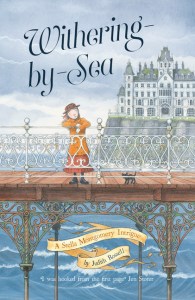
Withering by Sea (cover)

Withering-By-Sea: A Stella Montgomery Intrigue, by Judith Rossell, ABC Children’s Books, ISBN 9780733333002

The Children’s Book Council of Australia didn’t make a wrong move when they chose Judith Rossell’s first book in the Stella Montgomery series for a shortlisted book award 2015. Jen Storer, an award winning author for children’s books, said, “I was hooked from the first page.” I was hooked as well, with the excellent start, but it isn’t just the start, the whole book was fabulous!

Withering-by-Sea is a small town on the coast of an island. Stella Montgomery lives with her aunts in Hotel Majestic, a hotel that stood right on the end of the cliffs. Every day, Stella escapes from her mean aunts, into the conservatory. She there reads her atlas, the only book that she owns, hidden in the ferns. Whilst reading the atlas, Stella sees something she shouldn’t have, and accidentally makes a promise. This promise quickly turns into a tale full of old magic, mysteries and friendship. With the greedy professor on her back, who can Stella trust, and can she solve the one big mystery nagging her?

The main character, Stella, was very brave. She persevered, and kept on fighting, hiding, and never gave up, despite the urge to break the promise to live happily and safely. Stella was trustworthy, never breaking the promise. She always choose the right choice, whatever the price. I think that people should try to make the right decisions more often, whatever the price, like Stella Montgomery.

In this fantastic novel, the theme is old magic. Everything is about old magic, and sometimes can be unbelievable. The author wants to make this book seem like it was real, all the magic and everything else that normal people don’t believe in. To do this, the author and the publisher tried to make this book old fashioned. They printed all the writing, titles and subtitles in a lovely dark-blue colour, making it feel that no-one had opened the book for a long time, and it had been written long ago. The story had been edited to a font that made the writing old-fashioned. Judith Rossell drew amazing pictures to accompany her amazing story. Imagine, being able to write wonderfully, and draw amazingly, too! Her pictures were detailed as can be, and were printed in the same lovely dark-blue colour as the writing. All of these factors made up an old (and maybe classic) effect, helping you believe in the magic, tales and other things in the book.

Judith Rossell must be a very creative person, because of her very creative story plot. Just when you’re about to predict that something will happen, something unexpected will happen, throwing your predictions in the water. Although things can be a little bit confusing, the confusing parts will explain themselves along the way. Besides, it makes the story even more mysterious and exciting.

I recommend this very exciting novel to ages ten (10) upwards. I would also recommend this book for eager and mature readers looking for an adventurous, exciting and thrilling story to read. The genre definitely would be drama, friendship and mystery. After all, it is a story of friendship, resilience and trust. After reading this wonderful and creative story, I realised immediately why the Children’s Book Council of Australia awarded this fantastic novel!

This is Millie’s second book review for Alphabet Soup. Her most recent review (if you don’t count this one) was of  The White Ship. If you’d like to read more book reviews by Beaconsfield Primary students, you can click on ‘Beaconsfield Primary School’ in the grey categories box in the right column of this blog. To send us YOUR book review, check out our submission guidelines. Happy reading!
Posted in Beaconsfield Primary School, Book reviews by kids

Book review: Emu

REVIEWED BY ANNALIESE, 11, WA

Emu (cover)

Emu by Claire Saxby, ill. Graham Byrne, Walker Books Australia, ISBN 9781922179708

The book Emu is a great book, it is a story about an emu and its eggs and some great information about emus e.g. its features such as height, weight and its defences. The story Emu is based on Emu and how his eggs grow up: like where, when, the setting and life with Emu.

Mostly the story is on the left and the information is on the right, therefore it is a very organised and a well set out story. I recommend this book for any 9 to 12 year old children that are interested in the book. It has great illustrations that definitely suit the text.

I liked how the book was something you could use as research, you could pull it out of the bookshelf and read it to know, learn or use the information for an assignment. It’s got heaps of great information.

The book is a different book but it has better features than others. The illustrations work really well with the text.

This is Annaliese’s first book review for Alphabet Soup. If you’d like to read more book reviews by Beaconsfield Primary students, you can click on ‘Beaconsfield Primary School’ in the grey categories box in the right column of this blog. To send us YOUR book review, check out our submission guidelines. Happy reading!

Posted in Beaconsfield Primary School, Book reviews by kids

Book review: Figgy in the World

REVIEWED BY GEORGIE, 11, WA

Figgy in the World (cover)

Figgy in the World by Tamsin Janu, Omnibus Books, ISBN 9781742990453

Tamsin Janu is a fantastic writer! The book Figgy in the World is about how Figgy needs to find medicine for her Grandma Ama because she has an illness that she won’t tell her about. When you start to read the book Figgy in the World you will find that you can’t put it down!

The story-line of this novel is that Figgy lives in a village in Ghana (Africa) and needs to quickly save her Grandma Ama before she dies. In order to find the medicine for her Grandma, Figgy has to travel all the way to America and then back, with the medicine to save her Grandma before she dies. Alongside her is her goat Kwame who is more like her best friend. However on the journey she meets Nana who becomes her best friend.

Figgy met Nana after he had ran away from his papa. Figgy saw him sitting on the side of the road in the Volta Reigns. He was living in a village with his ‘family’ but none of them were biologically related to him. When Figgy saw Nana she didn’t really know what Nana was doing but then he said, “Would you like to buy some peanuts?”. Figgy had dropped all her money down a drain already so she said, “Sorry, I can’t, I just dropped all my money down the drain and I need to get to America before my Grandma Ama dies.” Nana then wanted to help Figgy, so he ran away from his village without anyone seeing him go. He had only just started his journey with Figgy.

I have never read a book as imaginative as this one. Tamsin Janu uses outstanding abilities to describe scenes in this book that makes you feel like you are there with Figgy and Nana. The fabulous thing about this book is how Tamsin Janu describes the towns and places that Figgy and Nana visit, especially the Orphanage. Nana used to live in this Orphanage when he ran away from his Papa, and when they returned all the children were so delighted to see them it made me want to cry.

I would recommend Figgy in the World for ages 10+, or children slightly younger who can really have an imagination and link the descriptive words to envisaging the scenes Tamsin Janu is writing about. The genre would be drama, and maybe some death too. This book was outstanding and I would definitely read it again! I will surely be reading more of Tamsin Janu’s books. With normal life themes such as friendship, love and death encompassed in this book, I thought it was outstanding and I look forward to reading more of Tamsin Janu’s books in the future.

This is Georgie’s first book review for Alphabet Soup. If you’d like to read more book reviews by Beaconsfield Primary students, you can click on ‘Beaconsfield Primary School’ in the grey categories box in the right column of this blog. To send us YOUR book review, check out our submission guidelines. Happy reading!
Posted in info

Meet a storyteller: Glenn B Swift


Hear a Story, See a Story, Feel a Story ©-ACLA. Image used with permission.

Jackie French (the Australian Children’s Laureate) and Ann James have created the Share a Story Calendar. (You can download it for free.) The theme for June is: HEAR A STORY, SEE A STORY, FEEL A STORY.

Today we are celebrating HEAR A STORY with a visitor …

Glenn B Swift (photo)

Glenn B Swift is a Western Australian Storyteller. Glenn says his repertoire ranges from the historical to the hysterical, and includes material for pre-primary through to adults.

Glenn has performed in almost every public library in Western Australia, and his talents have taken him as far afield as South America and Iceland! (He has performed in the Reykjavik Public Library.)

We asked Glenn if he could tell us a bit about being a storyteller.

Where do you live?
I live in Fremantle, Western Australia, which is where I was born and went to school. It’s a port, and I often go the end of the breakwater at the harbour and watch ships come and go. I like their hugeness, and I like to think that one day I’ll just jump on one for the heck of going across the ocean for some days or weeks. Fremantle is lovely place , and  a hot-bed of Children’s Book Writers and Illustrators, who are very welcoming to me as a Storyteller.

And how did you come to be a storyteller?
It started with a phone call. Well really, it started with some clowns. I had finished my training to be a teacher of the Alexander Technique (a useful thing for actors and musicians) and was waiting for my teaching job to begin at WAAPA (performance school in WA) when I ran into friends working as clowns for Myer in the school holidays. The marketing lady gave me a job working as a clown, and then before the next May school holidays, phoned me up to ask if I was a Storyteller, because that’s what she wanted in the Children’s Book department for the holidays. I answered of course, that I was  a Storyteller! (How hard could it be?) I spent the next couple of weeks reading Grimm’s Fairytales (often in the bath) and working out how I would perform them and get kids to participate and play parts as well.

Do you write your own material or do you tell stories written by other people?
Both. I like to adapt a good narrative — so for upper primary, I’m happy to tell my version of some Roald Dahl stories which can be quite ‘icky’, I also tell my own ghost stories. I have adapted some classic fairy tales and other stories for telling (with audience participation) and for junior primary I create stories that work as a game for many players that involve words, noises, screams and responses. I quite like having a big group of junior primary screaming together. They love it, though the teachers can look a bit worried, until it stops as suddenly as it began …

As a storyteller, what are your most valuable skills or tools?
My voice, and my ability to do funny voices for characters. Also a sense of simple comedy, little tricks that make kids laugh. And very good stories!

What is different about an oral tale from a written one?
Without a book in hand, there is a direct connection in a story between the teller and the audience. It allows me to always know how the audience is going, and if i need to make changes in pace, volume or content.

Can we hear an example of your storytelling?
There is this one link to a piece on YouTube …

Do you have any tips for young storytellers?
Just get up and do it! Start with a simple story everyone already knows, like ‘The Three Bears’. You’ll be scared the first time that you might get it wrong, but having done it once, you’ll find it’s great fun, and you’ll want to do it again! Your teachers will be very encouraging.

You can find out more about Glenn B Swift and his stories (and storytelling!) at his website: http://glennbswift.com/Storyteller/

If you want to celebrate Hear a Story month, check out these great activities on the Australian Children’s Laureate site.