Duncraig Primary School (in WA) has sent us some year 5 students’ book reviews.* We’ll be posting two reviews a day for the next 5 days so stay tuned!
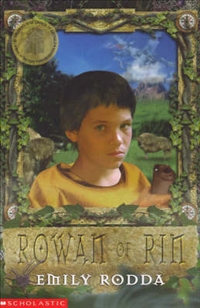
Rowan of Rin, by Emily Rodda. ISBN: 9781862915350, Scholastic Australia.
Reviewed by Erin, age 11, Duncraig Primary.
This book has all you need in a gripping story about a boy, a mysterious mountain, unknown dangers and maybe even a … dragon! The book is based in a quiet village called Rin, with a very tall overlooking mountain. Something has stopped the river from flowing down to the village so Rowan, the scaredy cat of the village, has to be accompanied by six other companions to try to see what the problem is.
You will love this story if you love adventure and drama. This book also has long and exciting chapters that will blow your mind. It has a beautiful cover illustration by Jane Tanner, with Rowan, and the mountain overlooking him in the background.
Is there really a dragon at the top of the mountain or is it the villagers’ imagination?
Rowan of Rin is suited for children from ten years and up. If I loved this book, I’m sure you will too.
—
*Duncraig Primary is a member of our Undercover Readers Club. Books reviewed here are the students’ own.
Duncraig Primary School (in WA) has sent us some year 5 students’ book reviews.* We’ll be posting two reviews a day for the next 5 days so stay tuned!
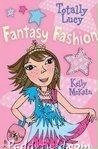
Totally Lucy: Fantasy Fashion, by Kelly McKain, ill. by Vici Leyhane. ISBN: 9780746066904, Usborne Publishing.
Reviewed by Ebonee, age 11, Duncraig Primary.
Wow, this book was awesome. It has everything you need to feel like you are experiencing life in the shoes of Lucy the drama queen.
Lucy’s life can be very challenging sometimes, alongside her friends Julies and Matilda who help Lucy through her good times and her bad. Throughout the book they have their trying times. Will they get through them? In this marvellous book you will discover many different things that a girl can actually experience, like having a secret pooch plan to attract a gorgeous boy. Will Lucy’s plan succeed?
The author, Kelly McKain, lives in a small flat in Chiswick, West London, with a fridge full of chocolate. Kelly McKain would love to go on a flying trapeze. She loves to write and I think she has done a wonderful job with this gobsmacking, totally awesome book. I think Kelly McKain has used her own life experiences to write this story suitable for 10 to 15 year olds. She is a clever author and she should keep writing these wonderful books. Kelly McKain has also written other books in the series, such as Makeover Magic, Style School, Planet Fashion and plenty more.
Also to thank: Vici Leyhane for her great black-and-white illustrations. I think she has done a wonderful job drawing everyone. It nearly looks like they are real.
I hope that you read this marvellous book and you enjoy it as much as I did.
—
*Duncraig Primary is a member of our Undercover Readers Club. Books reviewed here are the students’ own.
Duncraig Primary School (in WA) has sent us some year 5 students’ book reviews.* We’ll be posting two reviews a day for the next 5 days so stay tuned!
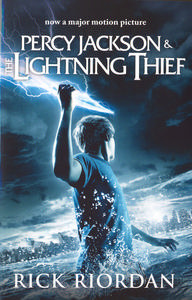
Percy Jackson and the Lightning Thief, by Rick Riordan. ISBN: 9780141329994, Puffin (Penguin UK) .
Reviewed by Zac, age 10, Duncraig Primary.
Percy Jackson and the Lightning Thief is the first of this Greek Gods series. Rick Riordan writes a gripping action-packed fantasy about everyday normal 12-year-old Percy Jackson. Percy hates the academy he goes to, but on a school field trip, he battles his maths teacher, who has turned into a bat-like Fury. Percy, with friensd Grover and Annabeth, must find Zeus’s Master Bolt or a war of the Gods will begin.
Rick Riordan delivers a great start to the Percy Jackson series. Christian McGrath has also done an astonighingly realistic cover illustration.
[Unfortunately, we were unable to source an image for that particular cover. Another version is shown with this review. – Ed.]
The 375 pages glue you to the book, never can you put it down. This is recommended for ages 8 to 12.
—
*Duncraig Primary is a member of our Undercover Readers Club. Books reviewed here are the students’ own.
I love reading, but I never thought about curling up with an ebook. Then I got sick and ended up in hospital—all of a sudden I found myself curled up with an ebook (or seven!).
Sony recently offered to lend me a Sony Reader, Touch Edition (PRS-650) to review.
I haven’t tried any other e-readers yet, but here’s what I liked about this one:
The Sony Reader, Touch Edition I reviewed.
It wasn’t ‘backlit’—my eyes didn’t get tired like they do when I read on a computer screen. It was like reading the pages of a paper book.
It was quite thin, and was like holding a book.
It had a built-in dictionary, so I could check words I didn’t know. (Actually, it supposedly had TWELVE dictionaries, but I could only find one. Maybe it’s because I was in hospital … )
I had about 10 books with me on the e-reader, and I read 7 while I was in hospital. And it was a lot more convenient to have them on an e-reader than carry around 10 paper books.
I could bookmark a page by double tapping in the corner. The next time the e-reader was switched on, it went straight to that page.
I could adjust the font size (I liked the words to be bigger at night, when my eyes were more tired and the light in my room wasn’t very bright.)
There is a stylus that goes with it, and and I could make notes on the screen while reading.
I could listen to audiobooks as well as read ebooks. I didn’t actually test the audiobook part while I was in hospital though.
I could buy ebooks off some online bookstores (Sony purchased Tensy Farlow and the Home for Mislaid Children from Borders for me. I’ll post a review here soon.) I could also upload some ebooks for free—like Jane Austen’s books, now out of copyright. (When I’m not reading children’s books, I like to read Jane Austen.)
It would be handy to take on holidays, on the train or bus and WHEN YOU’RE IN HOSPITAL. It’s small enough and light enough to put in a bag or backpack.
Here’s what I didn’t like about this e-reader:
I couldn’t find the other 11 dictionaries and the one I had used American spelling. (But it’s possible the other 11 weren’t that hard to find and I just needed to try harder … other people who own this e-reader tell me they had no trouble finding 12 dictionaries!)
The dictionary didn’t have a definition for every word I tried out.
This e-reader is in black-and-white, so even if it includes a picture of the book cover, it’s not as cool as the cover on a real book. (I like looking at the covers of books I’m reading.)
I like the feel of paper pages. Swiping your finger to turn pages was fun, but it’s not the same as feeling real paper. (Maybe that’s an old-person thing!)
And e-readers in general: I read a lot of picture books but you couldn’t read a picture book on an e-reader like this because the screen is so small and it’s not in colour. (I haven’t tried an iPad yet, perhaps picture books work OK on one of those.) I was surprised to find that I really enjoyed reading ebooks after all and I will miss having an e-reader when this one goes back to Sony. ebooks would never replace all my paper books at home, but I can see myself using an e-reader when I go on holidays or take a bus or train. (Hopefully I won’t need to use one in hospital ever again … )
What about you? Have you tried an e-reader or do you think they’re a bad idea? Do you think they are just too expensive for kids? If you had one, do you think it would replace all the books and/or school books you own? (What would you do with all that bookshelf space?)
We’ve updated the ‘Activities’ page! (You can find it on the menu across the top of the blog, under the header picture). If you click on it, you will find a list of activities to go with the theme of each issue (starting from issue 7), and a music listening list—compiled by Danielle Joynt of Cantaris.
For each issue of the magazine (starting with issue 7), we will add activities and a themed listening list to this page. Enjoy!
ISSUE 9 – SUMMER 2010
ACTIVITIES
1. PLAY wetlands-themed games, like ‘Leap Frog’, or ‘Duck, Duck Goose’.
3. FIND OUT about frogs in your local area. Research to find out what you can do to protect them. Some frogs in Australia are under threat. To identify frogs (and their calls) visit the WA Museum website, or the Frogs Australia website.
4.ADOPT a local wetlands area—visit it regularly with family or friends to collect rubbish to keep it healthy.
5. MAKE FROGS-IN-A-POND!
You will need: 1 packet green jelly, 1 chocolate frog per person, 1 clear plastic cup per person.
What to do: make the jelly according to the directions on the packet. Put it in the fridge. When cooled, but not set, add a chocolate frog to each cup. Return to fridge until jelly is set. EAT! Yum.
If you’d like to make a feature pond for a party table, use two or more packets of green jelly and use a large clear glass bowl. Add some of the chocolate frogs to the cooled jelly (before it sets). ‘Float’ some nasturtium leaves (to be lily pads) on the top of the jelly once it has set. Sit the remaining chocolate frogs on the lily pads. Give everyone a spoon and eat!
MUSIC LISTENING LIST
Our listening list is compiled by Danielle Joynt, from Cantaris. Danielle has also included comments for some of these pieces. (Tip: Ask about CDs at your public library—libraries often have a good collection of CDs for loan if you prefer not to buy.)
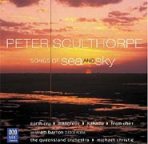
1. PETER SCULTHORPE
Peter Sculthorpe is an Australian composer (1929 – ) whose music often evokes the sound and feeling of the Australian bush and outback. His works “Kakadu” “Mangrove” and “Earth Cry” reflect the vastness of the Australian landscape and the sounds of Australian wildlife. He often uses the Aboriginal chant—Djiilili—in his works. Djilili means “whistling duck on a billabong”.
The Russian composer and teacher Anatoly Liadov (1855-1914) arranged eight Russian folk songs for orchestra, including his famous wok “The Enchanted Lake” and “Last Night I Danced With A Mosquito”. Liadov was a wonderful but very strict music teacher, and taught theory to the young Prokofiev.
4. CAMILLE SAINT-SAENS-–CARNIVAL OF THE ANIMALS
Camillle Saint-Saëns (1835-1921) is the French composer of Carnival Of The Animals (1886).
Saint-Saëns wrote Carnival Of The Animals as a musical jest, and after the piece’s first private premiere, Saint-Saëns forbade it to be played in public—feeling it might damage his reputation as a serious composer.
He only allowed one movement—”Le cygne” (“The Swan”) to be published during his lifetime.
Carnival Of The Animals was only published as a whole after the composer’s death, and has since become one of the world’s most famous and best-loved pieces of music.
5. PYOTR ILYICH TCHAIKOVSKY—SWAN LAKE
The music for the ballet “Swan Lake”was composed over twelve months in 1875 and 1876 by the Russian composer Pyotr Ilyich Tchaikovsky (1840-1893). When the ballet premiered in St Petersburg in 1877 it was a dreadful failure, due to the very poor stage production. Most critics considered Tchaikovsky’s music far too complicated for ballet! The production was revised several times, and the musical score was revised after Tchaikovsky’s death by the Italian composer Riccardo Drigo. It is his revision of Tchaikovsky’s orignial score which is most often performed to the Swan Lake ballet today.
6. GEORGE FREDERIC HANDEL—WATER MUSIC
The “Water Music” is a collection of orchestral movements composed by George Frederic Handel. It premiered on the 17th July 1717 after King George 1 requested a concert on the River Thames. The piece was performed by fifty musicians on a barge near the Royal Barge from which the King listened with his close friends. King George I loved the music so much that he asked the exhausted musicians to play the whole work three times!
7. FRANZ SCHUBERT—TROUT QUINTET
“The Trout Quintet” is the name given to the Piano Quintet in A Major by Franz Schubert (1797-1828). The quintet was composed in 1819, when Schubert was 22 years old, but was not published until 1829, a year after he had died. The usual instrumentation of a piano quintet is for piano, two violins, viola and cello; however, Schubert wrote his Trout Quintet for piano, violin, viola, cello and double bass.
The Quintet is called “The Trout” because the fourth movement is a set of variations on Schubert’s earlier Lied (the German word for “song”) “Die Forelle”(“The Trout”).
8. HOW DOTH THE LITTLE CROCODILE
Several songs are based on the poem “How Doth The Little Crocodile” by Lewis Carroll, which appears in his book “Alice’s Adventures In Wonderland”
“The Little Crocodile” by Gary Buchland (1991) from Alice Songs
“The Little Crocodile” from “Five Lewis Carroll Poems” No 3 by John Woods Duke (1899 – 1984)
“How Doth The Little Crocodile” (1908) by Liza Lehmann (1862 – 1918)
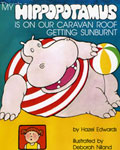
Issue 9 features a Q&A with Hazel Edwards, author of There’s a Hippopotamus on Our Roof Eating Cake, and Plato the Platypus Plumber (Part-time) and many more books! We could only include a selection of questions in the magazine, so here’s the full interview for you to enjoy.
Where do you live?
In my imagination. But also in the same house (in Blackburn, Victoria) where my cake-eating hippo still lives on the roof.
How old are you?
The age of the character I’m writing at the time.
(Hazel’s Tip: on the publisher’s page of a book there is a year the author was born, like 1945, and then a dash. If there’s nothing after the dash, they are still alive.)
I try to keep my photo up-to-date, my real face.
Hazel Edwards, 2010
What was the inspiration for There’s a Hippopotamus On Our Roof Eating Cake?
Our new roof leaked. My then 3-year-old son thought there was a hippo up there, when the workmen banged around trying to fix the leak.
Of your own books, which is your favourite?
The one I haven’t written yet.
Your favourite character?
Plato the Platypus Plumber, who has a toolkit that also fixes grumpy people. I love the way illustrator John Petropolous has drawn the toolkit, the water pipes and the Cassandra font he’s used (named after his daughter)
Where do you get your ideas?
I have an ideas notebook of things I see or hear, mixed with ‘What if?’ imagination. Other stories depend upon participant-observation, of going and doing something new, knowing you will write about it afterwards. So you pay special attention. Like in Antarctica. Or when I went down the waterways to find out about the platypus.
Why did you become an author?
Being an author is also an excuse for asking questions, and then it’s called research.
I like learning new things to write about, and new formats in which to write the stories.
I like (collaborating) working with other creators like co-authors, illustrators, film-makers and puppeteers. I learn new ways of thinking in pictures, movement or textures. Even with interpreters who change the words into another language. Plato is being translated into German. Many of my books are in Braille or Auslan signing for deaf kids, Some are becoming electronically available on Kindle, iPad and iPhone and that’s an exciting and quick way for stories to travel across cultures and countries.
My favourite is when a story is performed especially on stage. I’m loving the process of film-making with Pocket Bonfire.
When did you first appear in print?
A story in the newspaper’s kids’ section when I was about eight.
Are you working on a new project at the moment?
Pocket Bonfire Productions’ short film inspired by There’s a Hippo … is out. Working with these guys across three years has been fun as they read the book as children and remained fans taking it into film, their way of storytelling.
—
Hazel shares some of the best questions she’s been asked.
I was asked, “Does Plato the Platyplus Plumber talk to the cake-eating hippo?’ Previously I hadn’t thought about my fantasy character from one picture book talking to one of my others.
Do your characters ever talk to each other?
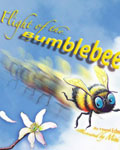
In my head. Maybe all my characters from different stories could meet? … Imagine a party or a TV panel with the clumsy Bumble from The Flight of the Bumblebee, the grumpy male bellydancing pig from Duckstar, my Gang-O orienteering sleuths … and other characters I haven’t written about yet who are waiting in my imagination.
A challenge
A librarian set students a challenge—Make up your own story based only on ALL Hazel’s book titles. Try it. They were allowed to add ‘and’ or ‘but’ joining words. Some fun stories appeared.
Does Hippo cook?
No, but recently we did a Channel 31 ‘Kids in the Kitchen’ program. Two 10 year olds made ‘hippo footprints’ (pancakes) and ‘ muddy platypus bubbles’ while I read the books Plato the Platypus Plumber and Hooray There’s a Hippo on Our Roof Having a birthday Party’. We also made ‘ant bread.’
Do your children help with stories?
My children are adults now but I co-wrote, ex-blog Cycling Solo; Ireland to Istanbul with my son Trevelyan. He did all the cycling. Now 11-year-old Truman helps me with story ideas.
How long does it take to write a book?
There’s thinking time and writing time. And re-writing time. I do about ten drafts. A picture book takes an illustrator at least a year to draw, sometimes longer.
Any advice to aspiring illustrators?
I write an art brief, which is like a letter to the artist. For Plato, I asked for a plumber’s tool kit with a mobile phone that a platypus could wear underwater.
Any advice if doing a project on an author?
1. Read at least three of the author’s books
2. Google the author’s website.
What is the kind of answer the Hippo gives to fan’s questions?
Jenna asked, “How old are you Hippo?”
Hippo said: As the cake-eating, rooftop hippo, I am celebrating the 30th anniversary of being found on the roof. But I am ageless.
Maybe I am your age?
I am as old as you imagine me.
Love from
Hippo (via Hazel who does the typing. My feet are a bit big for the keyboard.)
—
Visit Hazel Edwards’s website for more about her books and book trailers, notes, reviews and publisher links. You’ll also find a link to Pocket Bonfire Production, film makers of the Hippo.
Here is the winning Under 12s story from our spring 2010 writing competition. You were asked to write a funny story about a musician.
A reminder: always check the rules of the competition. If you go over the word limit, we have to disqualify your entry and that makes us sad!
—
Under 12s winner: Megan Flack, WA
Dad’s New Craze
Hi, I would like to tell you about my dad. His name is Eric and he is a violin player.
Dad is a very good violin player, but now he wants to be a comedian. It gets very annoying because he cracks jokes all the time.
One day I brought a note home from school about a talent show and dad entered it, to my dismay.
On the day, dad got ready to go and perform for the school. When it was my dad’s go, I hid myself. My dad played the violin awfully and he told lots of jokes like, “How do you spell mouse trap in just 3 letters? C.A.T!”
It was embarrassing but dad really enjoyed it. In the end dad fell off the stage! That was funny.
When the judges were calling out the winners, guess who won? My dad! I was amazed but what do you expect with a really awesome dad like mine?
—
Congratulations to Megan! She receives a $20 book voucher for her winning story.
Here is the winning Under 9s story from our spring 2010 writing competition. You were asked to write a funny story about a musician.
A reminder: always check the rules of the competition. If you go over the word limit, we have to disqualify your entry and that makes us sad!
—
Under 9s winner: Suanne Mostert, WA
The Jazz Concert
One shiny, sparkly, early morning there was a beautiful, glamorous special lady woken up by a croaking sound from a frog. Her name is Sophie and her friends are going to travel the world.
Sophie got dressed into a fantastic light green sparkly and shiny top and some nice blue pale glamorous jeans. Then she ate cornflakes with milk and a glass of water. Next she fed her dog. Then she went to her music class.
“Sophie is the best saxophone player,” mumbled her teacher with a tear. So Sophie walked into the music house with her saxophone gold and sparkly.
Then her teacher said, “You have to go to the Opera House to play in the jazz concert. Really.”
“Oh really!” Sophie replied in shock.
“You start tomorrow so go home and have a good night’s rest.”
ZZZZZZZZZZZZZZZZZZZ
The morning came. She got dressed in a black and purple dress, ready for the concert.
“Good morning ladies and jellybeans,” announced Mr Egain with a delightful and caring grin. “Today you will be listening to a jazz concert. First up, put your hands together for Sophie Burgess!”
They listened with excitement for about half an hour. The whole concert finished and it was time to announce the winner. Mr Egain came on from the backstage in a muddle. (Sigh)
“OK, OK, the winner is …”
“He’s fainted!” someone called out from backstage.
Another lady called out: “Get him to the hospital … ”
There was silence. He coughed and woke up.
“I am all right. It was just stage fright. OK, where was I? The winner is (ah). My pants fell down! (wow) (wow) (wow) (ah).”
He fell over. Everyone was laughing at poor Mr Egain. Sophie ran out and pulled Mr Egan up.
“Are you all right, Mr Egain?”
“Oh yes I am, Sophie. Do you want to announce the winner?”
“Yes please. OK. The winner is Sophie Burgess.”
They clapped and cheered. So Sophie went and got her trophy, then she went home. She fed her dog, Brigy, and ate her dinner and went to bed.
—
Congratulations to Suanne! She receives a $20 book voucher for her winning story.
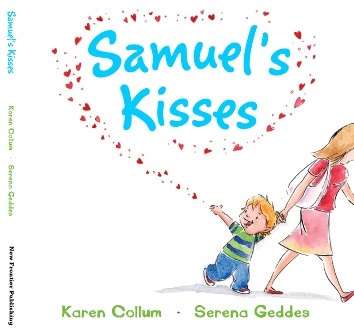
Karen Collum is visiting today as part of a tour to celebrate her new picture book, Samuel’s Kisses. Karen is a mother to three beautiful boys, with a baby girl about to join the family in December 2010. Samuel’s Kisses is illustrated by Serena Geddes and published by New Frontier Publishing. To read more about Karen’s work visit her website.
—-
5 things you didn’t know about Samuel’s Kisses
1. Samuel’s Kisses is based on a real person.
My eldest son’s name is Samuel and when he was little he used to blow kisses to everyone we walked past in the shops. I was amazed at how much happier people were after receiving a kiss from Sam and thought it would make a wonderful picture book. It turns out I was right!
2. The illustrations were done twice.
The publisher who accepted my book found an illustrator to draw all the pictures for Samuel’s Kisses, but sadly, she wasn’t able to finish them. So, another illustrator had to be found. I was a little bit nervous as I wondered if I’d like the second lot of illustrations as much as the first, but I’m delighted to say I absolutely adore the illustrations by Serena Geddes. Serena has made the book lively and exciting while at the same time being soft and gentle, which is just perfect for the story.
3. I had to change one important word.
When I sent my book to the publisher I had each of the kisses landing on people’s cheeks with a loud ‘SMACK’. One of the first things the publisher did was get me to change that to ‘SPLAT’. After all, we don’t want to encourage little children to smack anybody!
4. There was a poem on the very last page that is no longer there.
When a publisher decides to publish a book they make changes to make it better. This happened with Samuel’s Kisses and as a result, the poem that I had at the end of the book was cut out. I’m glad it’s not in the final version as I think the book is stronger without it, but I’ll share it with you here:
Blow me a kiss, my sweet little one
Blow me a kiss, make it fast and fun
Fly it over your pillow and under your bed
Past your window and round my head
Blow me a kiss with all your might
And I’ll blow you a kiss and say goodnight.
5. It took nearly two years to be published.
Making a book takes a very long time. I found out in April 2009 that New Frontier Publishing were going to publish Samuel’s Kisses so it’s taken almost two years for the book to be brought to life. There are a lot of things that happen during that time such as signing a publishing contract, organising an illustrator, editing the book and getting it printed, but it’s still a long time to wait. I’m very excited that I can finally hold my book in my hands and read it to my kids.
 Reviewed by Erin, age 11, Duncraig Primary.
 *Duncraig Primary is a member of our Undercover Readers Club. Books reviewed here are the students’ own.
 Totally Lucy: Fantasy Fashion, by Kelly McKain, ill. by Vici Leyhane. ISBN: 9780746066904, Usborne Publishing.
 Percy Jackson and the Lightning Thief, by Rick Riordan. ISBN: 9780141329994, Puffin (Penguin UK) .
  *Duncraig Primary is a member of our





 alphabetsoup.net.au