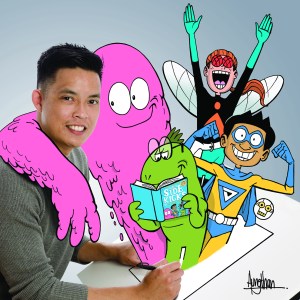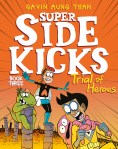
Gavin Aung Than is a New York Times bestselling cartoonist. His current project Super Sidekicks is a fun-filled action adventure series. Book 3 in the series, Trial of Heroes hit bookstores in April 2020.
From the publisher:
The Super Sidekicks just saved the world and now they’ve been invited to join H.E.R.O. – the Heroic Earth Righteousness Organisation – an exclusive club for the planet’s most famous superheroes. But before they can become members, the team must pass the hardest challenge in the universe, a test so scary and difficult only the truly heroic can survive.
The Super Sidekicks are back! Prepare for another amazing adventure from New York Times bestselling Australian author, Gavin Aung Than.
Did Super Sidekicks Book 1 start out as a standalone book or did you plan the series before you started?
I always planned it to be a series. So No Adults Allowed is all about how the sidekicks meet each other and become a team. Ocean’s Revenge (Book 2) is their first big adventure together, and Trial of Heroes (Book 3) is another big and exciting challenge for the heroes.
How do you create your comics? Do you draw by hand, or onto a computer?
I use both methods. So I draw all the pictures in black and white on paper first. Then I scan those drawings into my computer and add all the grey colour and words. You can see my full process on my website here: https://aungthan.com/ssprocess
Do you have a favourite sidekick to draw?
Wow that’s a hard question! I love drawing all of them, they’re like my kids. If I had to pick just one, then i’ll say Goo is my favourite. He’s so lovable and can literally be drawn into any shape or size which is always fun!
Trial of Heroes is the latest book in the series. How long did it take you from first draft to final draft?
Each book takes about 6–8 months to complete. It’s a lot of work but I absolutely love it!
Do you have a tip for young comic creators?
Practice, practice, practice! The only way to get good at drawing or making comics is to practice all the time. Start making your own mini-comics. It’s also okay to copy your favourite artists, even to trace their work when you’re just starting. The great cartoonist Chuck Jones said that every artist has 100,000 bad drawings in them, so the quicker you get those done and out of the way, the better!
Three books in the Super Side Kicks series are out now – ask at your bookshop or library.
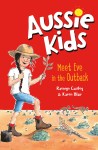
Karen Blair is an award-winning illustrator and author of children’s picture books. She loves to draw characters that are young, old and in between, as well as Australian wildlife – in the bush, the sea, the outback, or at home. She has a background in painting landscapes and loves incorporating this into her illustrations. You might recognise her work from Baby Animal Farm, When Billy was a Dog (written by Kirsty Murrray), the Lemonade Jones books (by Davina Bell), Hello from Nowhere (by Raewyn Ciasley), and many more. Her latest book is Meet Eve in the Outback (text by Raewyn Caisley), which is part of the new Aussie Kids series. Raewyn visited Alphabet Soup recently to talk about writing the text. And now it’s time to hear from Karen about the illustrations!
You illustrated Meet Eve in the Outback, written by Raewyn Caisley. How is illustrating a junior fiction book different from illustrating a picture book? This was my first junior fiction book, which was both exciting and nerve-wracking. In a picture book, I have almost unlimited space on the page to do my visual story-telling, and the words usually fit in around the images. In a junior fiction book, it’s the opposite, with a higher word count, smaller pages and much less space. It makes you really crystallise what you want to add with the illustrations, and it comes down to how can I show an interesting part of the story – the action, the emotion, or even some visual information. That might be showing some of the Nullarbor setting, and the characters’ reaction to being in that part of the story. The shape of the illustration is also more limited, and needs to be varied throughout. It was an interesting process.
What are your favourite art tools/mediums?
I love illustrating with line, and I felt brave enough to try the very traditional dip pen and ink for this book for the first time. It’s slightly unpredictable and does some great things with a big brush and just a little water. I also love drawing with charcoal, it has a life of its own, I think because it used to be twigs it is not a uniform material and can also be a bit unpredictable. I like how you can get a line that will move from delicate to strong with the slightest change in pressure.
How long did it take you to do the illustrations for Meet Eve in the Outback?
I think it was about 3 months, but I work part time. It was a 2 part process – I had to do ‘spot colour’ digitally, which I had never done before. Also nerve-wracking and I was very grateful that my friend, and brilliant author-illustrator James Foley, helped me. His knowledge of digital illustration is phenomenal. Mine is not!
Do you have a tip for budding illustrators?
So much of illustrating is about process. Find a process that you enjoy. In the beginning I would do every part of the process – character sketches (hundreds), visual research (how DO you draw a car graveyard, or a truck, a camel etc), storyboard, dummy, roughs, colour roughs, and final artwork. I still do most of those for each book. You really have to love the process, which also includes getting feedback from the publisher, or it all might be torture. It’s a bit of torture, here and there but worth it. I would also recommend playing a lot with style and materials.
Can you tell us a bit about your next creative project?
I have started writing again, which I haven’t done properly since I had children. I’m working on a book called Train Party which will be published with Penguin next year. It’s set at the miniature railway, and is a rhyming text. It was inspired by some toddler birthday parties I went to last year, including the son of my friend Briony Stewart, another incredible author-illustrator, and incredible train-cake maker! It’s such a fun experience that I think many generations of Australians have enjoyed, and I love the community aspect of the train-drivers sharing their trains with children. There’s heaps of visual research for this one, I am realising that I don’t know much about trains …
Meet Eve in the Outback is out now! Available from book stores and libraries.
Mel Pearce is a Western Australian artist and illustrator. She takes inspiration from games, Japanese animation, machinery, childhood nostalgia, elephants, fish and teeth, to name a few things. Today we’re talking to Mel about illustrating her new picture book No! Never! written by Libby Hathorn & Lisa Hathorn-Jarman.
From the publisher:
A cautionary tale about a little girl who drives her parents up the wall when she starts answering ‘No! Never!’ to all their requests — and what happens when the tables are turned on her.
There was a child,
The sweetest ever,
Until she learned these words:
‘NO! NEVER!’
Can you tell us about the art materials/tools you used for illustrating No! Never!?
I use a variety of media in my drawings, but Suzanne, a publisher from Hachette Australia, really enjoyed a particular style I’d used in some pictures, so I used that very scribbly hand-drawn style for No! Never!. I drew most of the main drawings on slightly roughened paper with a Blackwing pencil, which is a really beautiful drawing tool and a favourite for a lot of artists, illustrators and designers because the very soft graphite allows you to draw very expressively with whatever pressure you want to use. I then scanned the images into my computer and coloured them on Photoshop using my drawing tablet.
How long did it take you to illustrate this picture book from first draft to finish?
I think I started the rough storyboard in September 2018, and handed over the final illustrations (after fixing all the bits and pieces Hachette asked me to!) in May or June 2019. So maybe 9-10 months?
What’s your favourite art medium to illustrate/create with?
Besides drawing with dark pencils, I really love using ink in my work – either with a brush or with a drawing nib. I love how you can get such a variety of tone and marks out of one medium – you can get a sharp, dark line if you use a nib, or you can water it right down and use a brush to make a soft sky. When I was in Art School I really loved doing printmaking with big metal plates, using a process called Intaglio. Unfortunately, I don’t have the facilities to be able to do that kind of printing anymore. Hopefully in the future!
Do you have a tip for budding artists?
I think it’s important to stop looking around and comparing yourself to all the other artists out there all the time. We are constantly bombarded by posts about awesome things people did and made and how clever they are, that sometimes it can make you feel like you’re never going to be as good as them, to the point where you get scared to try in case of not doing well. I am also very guilty of this! I spend so long stressing about how I can’t do what someone else can, or how I take days to do something that someone else did in a couple of hours. I went through a stage where I could not even do a simple sketch or scribble on a page because I was afraid that it wasn’t going to look good at the end. I don’t think I did a proper drawing for a good part of a year!
Just keep observing from life and drawing at least once a day, and you will definitely improve your skill.
Can you tell us something about your next project or something you’d like to work on?
I would very much like to write my own story to illustrate, and since I didn’t get to use ink in No! Never!, that’s definitely what I want to use next! However, if I get approached by a publisher with a new project, it will depend on the feel of the story for what I end up using to draw it. At the moment I’m just trying to get back into drawing for fun … usually good ideas come when you’re not trying. Or so I’ve heard!
Mel Pearce (R) and her sister Erin (L) with No! Never! & artwork created during a livestream tour of Mel’s studio for Paper Bird Books Home Club.
Gabrielle Wang writes and illustrates picture books and novels. Her award-winning novel A Ghost in My Suitcase was adapted as a play. Gabrielle’s latest novel is the sequel —Ting Ting the Ghosthunter. From the publisher:
Thirteen-year-old Ting Ting has learned the ancient skills and art of ghost hunting from her adopted grandmother, Por Por, a famous ghost hunter. But Ting Ting is sick of capturing harmless ‘fat belly’ ghosts, and when a desperate plea for help comes for Por Por, Ting Ting decides to take matters into her own hands and prove that she is a true ghost hunter. But what Ting Ting discovers is much more dangerous than she had thought. Can Ting Ting conquer her own pride to save Por Por and the villagers before it’s too late?
Ting Ting the Ghosthunter is the sequel to A Ghost in my Suitcase. Do you find anything different about writing a sequel than a standalone story?
I found it much easier and quicker to write the sequel as I already knew my characters and the world they inhabited. However Ting Ting the Ghosthunter did differ from most traditional sequels because I used a different protagonist. Instead of following the adventures of Celeste, the main character from A Ghost in My Suitcase, I used Ting Ting who was the antagonist in that first novel.
A Ghost in my Suitcase has been adapted for the stage and performed around Australia. Did seeing those performances influence how you wrote the character of Ting Ting in the sequel?
I wrote Ting Ting the Ghosthunter before I saw the play. But the inspiration to write this sequel did come out of the very first meeting I had with Barking Gecko, the Western Australian theatre company who adapted the novel for the stage. It was during these two days of creative development with the creative directors, the playwright and the set designer that I realised how strong a character Ting Ting was. She had a lot of issues to work through which is, as you probably know, perfect for any main character.
There’s a strong sense of place in these two books. Do you visit a place before you set a book there?
Setting is the first thing I consider when I begin a novel. I’m a highly visual person so as I write, I imagine the landscape my characters are living in. In fact for me, setting is a major character in all of my books. A place can be dark and brooding, angry, joyful or sad. It can be a perfect vehicle to reflect your character’s mood. One of my favourite series as a child was My Friend Flicka, The Green Grass of Wyoming and Thunderhead written by Mary O’Hara. I loved reading books about horses. The setting in these novels was so strong to me, evoking in my young mind wide-open grasslands and endless summer days. The Silver Brumby has that same sense of place evoking the Australian mountains.
Now that you have me thinking on the subject of setting, listed below is where my novels take place.
The Garden of Empress Cassia in a suburban city. I had Melbourne in the forefront of my mind with this one. Even though I don’t name the city, trams rattle up and down the streets.
The Pearl of Tiger Bay in a seaside town. I pictured the coastal towns along the Great Ocean Road while I wrote it.
The Hidden Monastery in the rainforests of Queensland.
The Lion Drummer in Little Bourke Street Chinatown.
A Ghost in My Suitcase in Shanghai and in a watertown like Wuzhen, China.
The Poppy Stories in Wahgunyah, Beechworth and surrounding areas.
The Pearlie Stories in Darwin, Adelaide and Perth.
The Wishbird in the far northwest China.
The Beast of Hushing Wood in the woods of North America.
Ting Ting the Ghosthunter in Shanghai, and the countryside.
I need to visit these places so that I can get a sense of them. When I wrote the first draft of The Beast of Hushing Wood, my publisher Jane Godwin said that she didn’t get a true sense of the woods. That was because I had never been to the woods in North America. I knew then that I had to go. I needed to walk them, to listen and smell and look. I had to let them show me what to write.
Pen and paper? Or straight onto the computer?
I do a combination of both. Each novel dictates to me how it wants to be written.
Can you tell us something about your next project?
My current work in progress has the working title of The Story Magician. It is set in Melbourne during the 1950s and is about a 12-year-old girl called Sparrow and a dog called Jupiter. This will be part graphic novel, part fairytale, part first person narrative.
In writing and illustrating The Story Magician, I want to explore this post-war era of Australian history. It was an important time for Australia when people were finally looking towards a brighter future. All wars leave scars. What are the legacies of war? Is everything war leaves behind bad? What is the power of stories to help heal wounds? I also want to explore the different types of love — the love between parent and child, child and grandparent, between a dog and its human, between siblings, between best friends. And the unfulfilled love of a birth mother to her child.
I was lucky enough to receive an Australia Council Literature Grant to write The Story Magician. I have a long way to go and need to do a lot of experimenting, as this novel is more challenging than any of my other books. Still, I am enjoying the challenge. That’s what writing (and illustrating) is all about — breaking through our own self imposed boundaries and stretching our creativity.
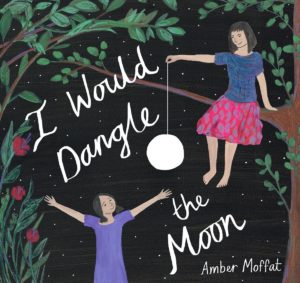
Amber Moffatt is a writer and visual artist based in Perth, Western Australia. If you live in WA and you’ve been to the AH Bracks library in Melville you might have been lucky enough to see her illustrations decorating the windows for Book Week 2019! Amber recently launched her first picture book,I Would Dangle the Moon, in Western Australia and in New Zealand. She regularly runs art workshops for children inspired by the artwork from the book.
What would you do if you could pluck the moon from the sky? Would you scoop it up in an ice cream cone, or ride it like a snail shell across the night sky? This picture book will spark your imagination.
Today Amber Moffat stops by to chat to Alphabet Soup about creating I Would Dangle the Moon.
You’re an author AND an illustrator. When you were creating I Would Dangle the Moon, which came first – the words or the illustrations?
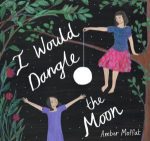
The words came first, but I did have a sense of the images in my mind too. The idea of a snail taking the moon for its shell and slithering across the night sky was the seed the story grew from.
How long did it take you to go from the story idea to the published book?
It took a really long time – three years! The initial text was developed quite quickly but it took a much longer time to develop the storyboard and find the right style of illutstration. I was really lucky to have author and illustrator Briony Stewart as my mentor for a year, and that helped me get the concept ready to submit to publishers. From when my publisher, MidnightSun Publishing, contracted me, it took nine months to complete the final artwork for the illustrations.
What have you been reading recently?
I’ve been enjoying Trouble in the Surf, written by Stephanie Owen Reeder and illustrated by Briony Stewart. The way Briony has used colour in the illustrations is really beautiful, and I keep going back to it to admire her technique.
When you’re doing illustration work, what’s your favourite medium?
Acrylic paint is definitely my preferred medium. I like the way it dries fast and you can paint over it easily. I also like to be able to scan images and alter them digitally. I often use computer editing to piece different paintings together and play with scale and composition.
Are you able to tell us something about your next writing project?
The picture book I’m currently working on explores the science of light, and it’s been a new experience for me to convey scientific ideas in the form of a picture book. I am also working on a novel for young adults, in which medical science is important to the story, so that seems to be a theme for me at the moment.
Amber Moffat (with some helpers) at the book launch.
It’s Friday! And that means it’s time for Pass the Book Baton. Every week Alphabet Soup features a book creator who will answer one question before throwing a new question to the next Friday visitor. (It’s kind of like a book relay in slow motion.)
Today the book baton is passed to Aśka.
Aśka is an illustrator and science communicator. She has a degree in Arts and Quantum Physics and works at Scitech in Perth — as well as working with kids’ product design, graphic novels, animation, graphic design and e-publishing. Phew!
Wow! You have travelled to some amazingly diverse and interesting places, Aśka.
I understand that these experiences have been a rich source of inspiration for your art. Can you elaborate on some of your favourite travel destinations? How have you found that these places have influenced your creativity?
Aśka answers:
I’ve never really thought about how different places I’ve travelled to and lived in have influenced my work. It is an interesting thing to ponder.
I have had a go at studying different forms of art in different places. For example, when I was staying in Thailand I learned Chinese painting. It is an art form where no pencils are allowed, and there is no erasing or undoing what you have done. You make marks with a chunky paintbrush on the thin rice paper to create an image and if you make a mistake you need to start all over again! Even though I don’t paint so much anymore, I still find this practice very useful as it requires commitment and confidence when drawing, which I believe shows up in your work as an illustrator, no matter what technique you use.
But it’s not just learning local techniques which can change the way you draw. It’s also observation. Certainly every location looks different and this isn’t just in art, but in the most everyday situations. For example, the way a yoghurt aisle looks in the supermarket, or the image of the green and red person for pedestrians at traffic lights. It quickly becomes apparent that each place in the world uses images in a slightly different way. Like the cute and perfectly made mascots of uniformed woman and man in front of a Tokyo police station, to the playful and roughly hand painted shopfronts of Accra.
So through travel and seeing so many different ways in which people live, I started to think about how important these visual elements are when creating my own characters and settings.
After all, every new adventure we have, big or small, expands our way of seeing the details in our world a little more. And the details are where I believe the true magic of the world lies.
Check out Aśka’s website where you can find artwork, mini comics, download free ebooks, teachers’ notes and more! www.askaillustration.com/
And now Aśka passes the book baton to the next Friday visitor — Yasmin Hamid. Yasmin grew up in East Africa and now lives in Western Australia. Her book — Swimming on the Lawn — was published in 2017.
Aśka asks:
To someone like me, who grew up among grey blocks of flats in Eastern Europe, your childhood sounds absolutely fearless. Was there ever anything that you were afraid of? How did you overcome that fear?
Check in every Friday for mini interviews with children’s authors and illustrators. (While you’re waiting you can catch up on all the interviews in the Pass the Book Baton series so far!)
Our Pass the Book Baton series took a break for the spring school holidays … and now it’s back! Every Friday we’ll feature a book creator who answers one question before throwing a new question to the next Friday visitor. (It’s kind of like a book relay in slow motion.) You can see earlier interviews in the series here.
You might remember that we left Tamsin Janu with the book baton in September. Today she passes the baton to Jen Storer. Welcome, Jen!
Jen Storer writes … she illustrates … and she has so many novels and picture books behind her! Her writing features humour, adventure, and sometimes horror.
What is the absolute best thing about being a children’s author? What aspects of writing do you find the most challenging?
Jen answers:
The best thing about writing for kids is meeting my readers! I love chatting to them in real life or via the post or email. I love seeing them dressed up as my characters, too, or when they use phrases my characters use.
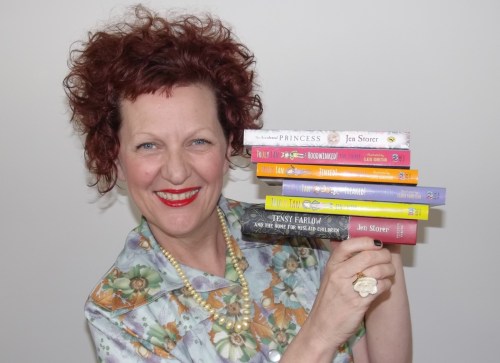
I also love hearing from the parents of readers. Sometimes the letters from parents make me cry. A parent wrote to thank me for The Accidental Princess, it had comforted her daughter while she was dangerously ill and in hospital for a long time. Another parent wrote to say Clarrie Pig’s Day Out was the only story that calmed down her little boy after he’d had a terrible fright and would not come out from under his doona. These letters always amaze me. They’re the unexpected rewards that I hold dear.
I find the actual writing the most challenging aspect of being an author. I always want to do other stuff instead of sitting down and doing the writing! I have to bribe myself with chocolate.
For more about Jen Storer and her books — check out her website: girlandduck.com
And now Jen passes the book baton to the next Friday visitor — Deb Fitzpatrick. Deb has published books for adults, teenagers, and children. Her latest book is The Spectacular Spencer Gray.
Jen asks: “How long do you spend planning a book before you start writing it? Also, do you put people or animals you know into your stories? ”
Check in every Friday for mini interviews with children’s authors and illustrators. (You can catch up on all the interviews in the Pass the Book Baton series so far!)
It’s Friday! And that means it’s time for Pass the Book Baton. Every week Alphabet Soup features a book creator who will answer one question before throwing a new question to the next Friday visitor. (It’s kind of like a book relay in slow motion.)
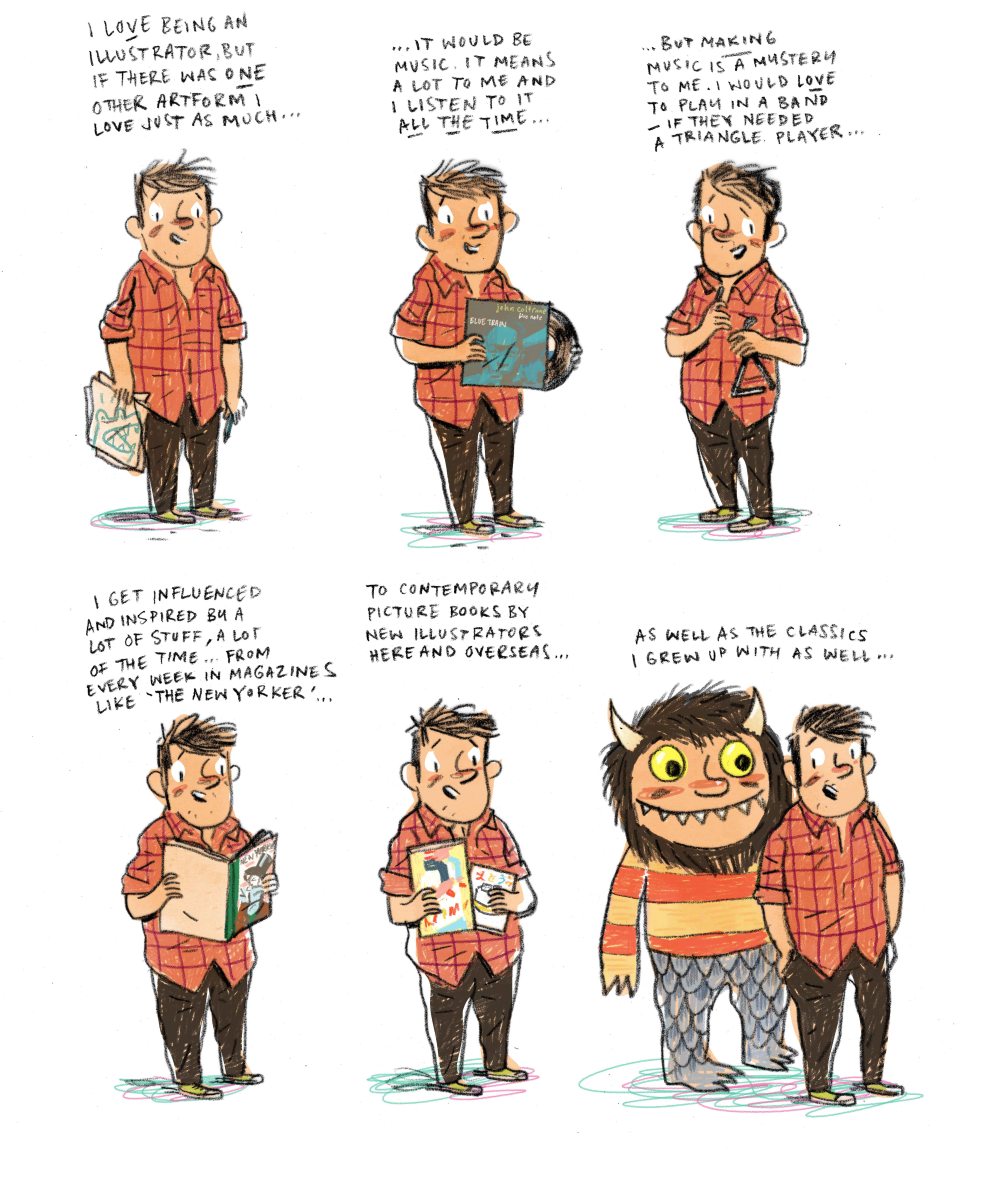
Today we are extra excited about the book baton being passed to Tom Jellett. Instead of running with it … he started illustrating … keep reading for his illustrated answer (and question) below!
Tom has been the editorial illustrator for a number of Australian newspapers, is the illustrator of many wonderful picture books, and has also illustrated some of your favourite chapter books.
Here are just some of the books he has illustrated:
Last week Danny Parker asked:
If you could swap your skills as an illustrator for the skills of another art form — what would you want to swap with and why?
And who or what has been the biggest influence on your work — you have such a distinctive style — I’m looking at My Dad Thinks He’s Funny as i write this!
And now Tom Jellett passes the book baton to the next Friday visitor — Tamsin Janu. Tamsin is the author of Figgy in the World, its sequel — Figgy and the President, and a new book called Blossom.
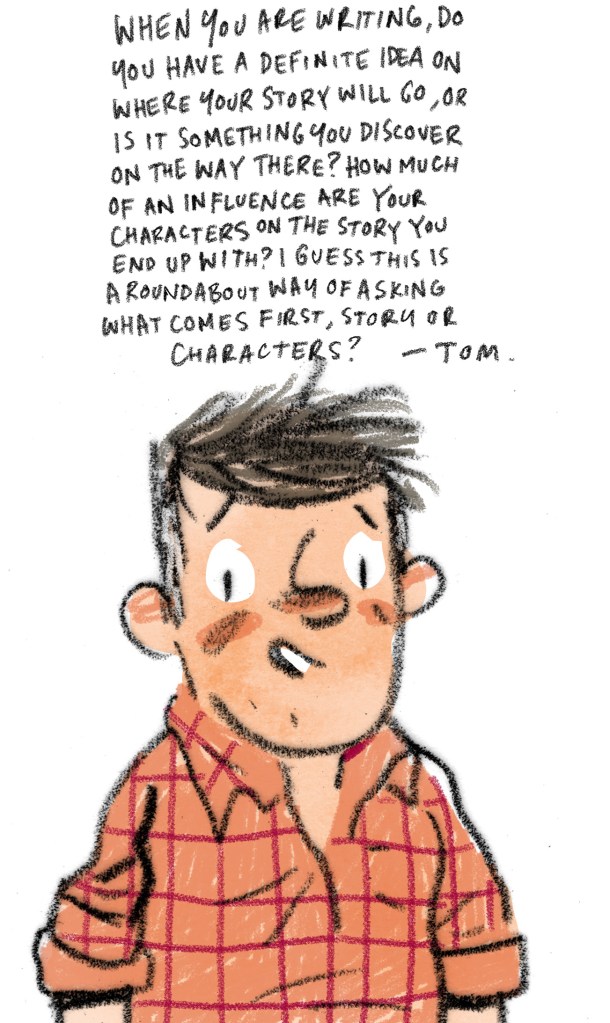
Tom asks:
Check in every Friday for mini interviews with children’s authors and illustrators.
Happy Book Week!
Illustrations in this post are copyright Tom Jellett 2017.
Our Pass the Book Baton series took a break for the winter school holidays … and now it’s back! Every Friday we’ll feature a book creator who answers one question before throwing a new question to the next Friday visitor. (It’s kind of like a book relay in slow motion.) You can see earlier interviews in the series here.
You might remember that we left Katrina Germein with the book baton in June. Today she passes the baton to Peter Carnavas.
Peter Carnavas is an award-winning author-illustrator. His picture books have been translated into German, Portuguese, Dutch, Korean, Slovenian, Arabic, Italian and more!
His latest book is a novel called The Elephant. It’s about a girl called Olive, and an unwelcome elephant that nobody else can see …
.
.
.
You might recognise some of these books:
Back in Term 2, Katrina Germein asked:
Sometimes you write, sometimes you illustrate and sometimes you write and illustrate. What’s the hardest thing about being so talented?
Peter replies:
Thanks for the (slightly embarrassing) question, Katrina.
It’s true that I write and illustrate, sometimes making books by myself, sometimes working with another author or illustrator. The hardest thing about this is I don’t have enough time to do everything I want to do! It takes a long time to make a book – months and months, sometimes over a year — and I have lots of little ideas that will never escape my head.
That’s not a very hard thing, though. There are lots of jobs that are much harder than making books. The most difficult thing, really, is trying to get my hand to draw the picture that I can see in my head. Sometimes it works, sometimes it doesn’t. It’s also hard trying to finish a book on time. It’s just like handing a school project into your teacher, except I hand mine into a publisher. I often reach my deadline and have to write an email to the publisher begging for a little bit more time to finish the pictures!
And now Peter Carnavas passes the baton to the next visitor — Aleesah Darlison, author of picture books, novels and series.
Peter asks: “You have written many different types of stories: picture books, funny stories, adventure stories, and books about the importance of looking after animals. Which stories do you enjoy writing the most, and is there a type of story you haven’t tried, but would love to?”
Check in every Friday for mini interviews with children’s authors and illustrators.
It’s Friday! And that means it’s time for Pass the Book Baton. Every week Alphabet Soup features a book creator who will answer one question before throwing a new question to the next Friday visitor. (It’s kind of like a book relay in slow motion.)
Today the book baton is passed to Gabriel Evans. He has illustrated over twenty books and designed over a hundred greeting cards, painted large gallery artwork, and travelled across Australia presenting illustration workshops and seminars in schools and festivals.
Here are some of the books he’s illustrated:
Last week Sue Whiting asked:
What would you do differently in terms of the development of your career as an illustrator if you had your time over again?
Gabriel answers:
It has been an absolute pleasure working with Sue during her time at Walker Books.
If I was to have my time again I would definitely experiment more with my art. I was always trying to make perfect, beautiful pictures that limited my experimentation.
It’s only in recent years I take enormous pleasure and satisfaction from making risks and discovering new, creative systems. That means using BIG brushes, spray bottles, palette knives, goose feathers, cardboard, fingers, sticks and anything else I can think of.
It’s all about learning through creative, messy fun!
Find out more about Gabriel Evans and his books and art — visit his website!
And now Gabriel passes the book baton to the next Friday visitor — Alice Pung. Alice writes books for a range of ages. You might have read her Marly books from the Our Australian Girl series.
Gabriel asks: “You’re both a solicitor and author. How do you balance these two jobs? Is there a connection between the two?”
Check in every Friday for mini interviews with children’s authors and illustrators.