Posted in authors, interviews

Meet the author: Raewyn Caisley

MEET THE AUTHOR

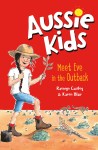
Raewyn Caisley photoRaewyn Caisley was born in New Zealand but has lived in Western Australia for more than half her life. She’s the author of many, many books. You’ve probably read some of her books from the Aussie Bites and Nibbles titles, or perhaps her picture books Hello From Nowhere and Something Wonderful. Raewyn has two new books out in 2020 — Rocky and Louie (co-written with Phil Walleystack and illustrated by Dub Leffler), and Meet Eve in the Outback (illustrated by Karen Blair).

Today we’re chatting to Raewyn about Meet Eve in the Outback, part of  the new Aussie Kids junior fiction series.

Meet Eve in the Outback (book cover)

Hi! I’m Eve.
I live at a roadhouse in the Nullarbor. We don’t get many visitors. But today my cousin Will is coming. We’ll have so much fun!


Hello from Nowhere (cover)Eve is a character readers might remember from the picture book Hello from Nowhere. What was different writing about her for a junior fiction book?
Her personality had to change a tiny bit. Younger Eve wouldn’t have worried about Will not seeing the magic. She just assumed Nan would, (and of course she did), but older Eve knows a little bit more about the world. She knows Will has dolphins where he lives for example. Little Eve’s experience was only her own immediate surroundings.

Older Eve has had more experience of her own place too. She’s helped Doug with the chores on the sheep station and she is friends with Wally now. She knows about the space station and about telegraphs. It was important to include details bigger kids would be interested in.

Oh, and another thing! With junior fiction the words have to carry more of the story because there aren’t illustrations on every page but that meant I could really have fun describing all those new places, thoughts and people.

Were you in contact with the illustrator (Karen Blair) while you were writing Meet Eve in the Outback?
I wasn’t in contact with Karen while I was writing it and if she’d said ‘no’ or been too busy I would have been up the creek without a paddle. But I knew she’d love Wally …

Meet Eve in the Outback is part of a junior fiction series. Were you asked to write a particular story in the series, or did you come up with your own story ideas?
My publisher and I came up with the idea for the whole series together. I sent them this story. The original title was ‘Next to Nowhere’. They responded with, ‘What if we do a whole series of these set in all the different states and territories of Australia?’

It was a little bit of a bummer because I had five ideas for five books set out in the Nullarbor and starring Eve and Will, but being part of the Aussie Kids series has turned out really well. It’s the right series for the right time. When kids can’t get out and see Australia for themselves at least they can read about how other Aussie kids live and see our beautiful country on the pages of a book.

Do you have a tip for young writers about creating story characters?
My tip for creating characters is, decide what they’d have for breakfast! Would they cook? Would they grab a bowl of cereal? Would they spill the milk? Would there be any milk?! Would they gulp it down or would they set the table? Is there any cutlery? Has anyone done the washing up? Would they eat alone or with someone else? What time of day would they have it?

Once you know what your character would have for breakfast you probably know them well enough to start writing a story about them.

Can you tell us something about your next writing project?
My next writing project? I still want to do my own junior fiction series and I’ve got ideas for the first three. One is set in a doctor’s surgery, one is in a school, and one is set in an isolated community in the outback. More than that I cannot say … Watch this space …

Meet Eve in the Outback is out now! Available from book stores and libraries. 


AWESOME EXTRAS!

Meet Eve in the Outback (book cover)

Click here to download an Aussie Kids series activity pack

Click here for Teachers’ Notes for Meet Eve in the Outback (PDF)

Visit Raewyn Caisley’s website for more about her and her books.

Read an earlier blogpost about the settings in Raewyn’s books.

Posted in authors, interviews

Meet the author: Sharon Giltrow

Sharon GiltrowMEET THE AUTHOR

Sharon Giltrow writes humorous picture books and adventure-filled chapter books. She lives in Perth, Western Australia with her husband, two children, a tom cat and a miniature dog.

Sharon’s debut picture book is available in May 2020. Today we’re chatting to Sharon about Bedtime, Daddy!, which is illustrated by Katrin Dreiling.

From the publisher:

Bedtime Daddy by Sharon Giltrow and Katrin DreilingHave you ever tried to put Daddy to bed? It can be hard work! Full of heart and humour, Bedtime, Daddy! is for anyone who wants to try putting their grown-up to bed.


You wrote the text for Bedtime, Daddy! and Katrin Dreiling is the illustrator. Do the illustrations match the story you had in your head when you were writing the book?
Katrin Dreiling has done a fantastic job. I was very happy and excited when I saw her first sketches.
EK Books (the publisher) asked her to do sketches of people and bears. When I first wrote Bedtime, Daddy! I pictured the characters as people, so I was very surprised when the publisher suggested bears. However, when Anouska – the editor – explained that bears would make a more universal family, I agreed. The rest of the illustrations match the story perfectly. Placing Daddy Bear in the office for the first page spread was Katrin’s idea. 😊 I only had one illustration note which was for the last page … but I don’t want to spoil the ending.

Favourite pyjamas to wear today vs favourite pyjamas to wear when you were a kid?
My favourite pyjamas as a kid were actually nighties and I used to keep them in a zippered pyjama bag which was a bit like this one. Puppy pyjama caseNow as Mummy Bear (aka: Bedtime Mummy!), my favourite pyjamas are my new dinosaur pyjamas. They are also Daddy Bear’s favourite pyjamas and my children have dinosaur pyjamas too.
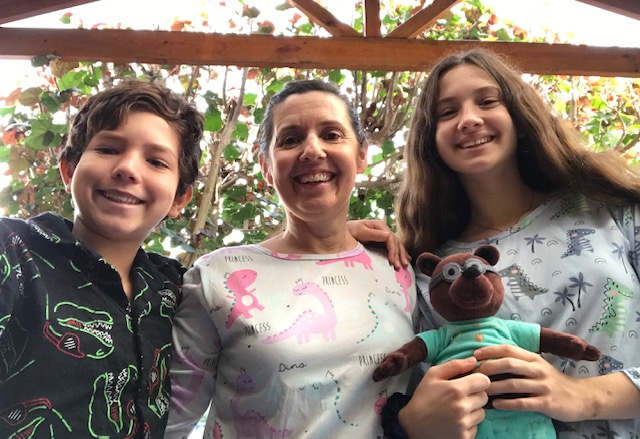
Sharon and her two kids in pyjamas
Did you like to try to delay bedtime when you were a kid?
Most definitely! I was the youngest of eight children so my parents were a little more relaxed about bedtime. So, I used to fall asleep on the couch and my dad would carry me to bed. SShhhh!!! Don’t tell my children.

Can you tell us a bit about the book you’re working on next?
Well, my next book, which I hope will be published soon is called … Get Ready, Mummy! A sequel to Bedtime, Daddy! and you guessed it, it’s about how to get a mummy ready for the day. It starts with the line: ‘When you see your mummy roll over and open her eyes, announce, ‘Get Ready, Mummy!’

Do you have a tip for kids who would like to try writing a picture book themselves?
Be open to ideas. Ideas are all around you. Keep a notebook to write your ideas in. Once you have an idea, brainstorm it and then start writing. Don’t try and get it perfect the first time. Writing is like any skill it just takes practice. You can do it! Also, read lots of books!


AWESOME EXTRAS:

Bedtime Daddy a picture book by Sharon Giltrow with illustrations by Katrin Dreiling

Watch the book trailer for Bedtime, Daddy!

Click here for Teachers’ Notes

Click here for a sneak peek inside the book

Visit Sharon Giltrow’s website to learn more about her and her books.

***WIN a copy of Bedtime, Daddy! ***

This competition has now closed and the winner has been contacted by email. 

Posted in authors, interviews

Meet the author: Elaine Forrestal

MEET THE AUTHOR

Elaine Forrestal is a Western Australian author who grew up in Australian country towns and now travels all over the world. Her award-winning books have been published internationally and translated into other languages.

Elaine Forrestal
Elaine Forrestal, author of Goldfields Girl

Elaine’s latest book is Goldfields Girl, set during the Gold Rush in Coolgardie, Western Australia.

From the publisher:

Goldfields Girl by Elaine Forrestal (book cover)It’s 1892. Amid a fevered gold rush, 14-year-old Clara Saunders is in search of adventure in the new outback town of Coolgardie.

A friendship with cheeky young water carter Jack is a promising start, but the goldfields are a harsh place, where water is scarce, disease is common and where many men will never find the fortune they’ve come to seek.

With unforeseen tragedies on the horizon, Clara’s time in the dusty town will truly test the limits of her fierceness and determination.

How did you first hear of Clara Saunders and decide to write a story based on her life? Was Clara a relative?
We were almost at the end of the editing stage of the book before I knew that my sister-in-law’s husband is Clara Saunder’s grandson! So that’s obviously not why I chose to write about her. I was researching ‘children on the goldfields’ because I wanted to write a goldfields story, but felt that so many stories had already been written about it that I needed a new angle. Clara was the only child I found. Because of the harsh conditions —like lack of water and food, only tents to live in, heat, dust and flies — the women and children mostly stayed at home.

How did you go about your research for Goldfields Girl?
I tried Google first. Then I went to the Battye Library (on the 3rd floor of the State Library of WA). I felt like a detective because she wasn’t easy to find. And when I found the transcript of her ‘Memories’ I was so excited I virtually danced around the Library Reading Room. The librarian was a bit shocked.

How long did it take you to write the book?
It took about two years to write the book, then another two years to find the right publisher and go through all the usual editing and rewriting stages.

Did you have to leave anything out of the book?
I have only told the story of Clara’s life from 1892 to 1894, so I have left a lot out. but I didn’t change any of the facts — just added some dialogue to make the story more interesting to read.

How do you come up with the titles for your books?
I am hopeless with titles. I’ve lost count of how many Goldfields Girl had. I usually change them myself a couple of times, then the marketing team doesn’t like the one I have come up with so we work on it together. They know a whole lot more about what works for readers and bookshops, so I’m usually happy to go with what they suggest in the end.

Do you have a tip for young writers who would like to write stories based on real-life events?
You do need to do a lot of careful research when you base your story on real events. But I love doing the research. It’s fascinating to read about how people lived back then. I usually find out a lot more than I need to know, but that’s okay. Maybe I’ll get to use some of it in another book down the track.


AWESOME EXTRAS:

Click here to read a sample chapter Goldfields Girl by Elaine Forrestal (book cover)(thanks to Fremantle Press)

Click here for Teachers’ Notes

Click here for a Goldfield’s Girl crossword activity

Click here to see two 1894 photos of Clara Saunders (in a blog post by Elaine Forrestal)

Visit Elaine Forrestal’s website to find out more about her and her books: www.elaineforrestal.com.au/

Goldfields Girl is out now in bookstores and libraries!

Posted in authors, interviews

Meet the author: Cristy Burne

Cristy Burne disguisedMEET THE AUTHOR

Cristy Burne is a science writer and children’s author. You might have read her adventure novels To the Lighthouse and Off the Track. If you love reading nonfiction keep an eye out for Zeroes and Ones: The geeks, heroes and hackers who changed history.

Cristy Burne’s brilliant award-winning Takeshita Demons series has recently been re-released as a series of e-books with new covers and a new series title: Hashimoto Monsters. Today we’re chatting with Cristy about the series! 


Your Hashimoto Monsters series is quite different in style from your other junior fiction novels. What sort of readers will love this series?
These books are full of supernatural monsters, creepy chills and Japanese culture. They are scary, but they’re also funny and a little bit strange. They’re popular with kids who love fantasy adventure stories.  I’d say if you’re aged between eight and twelve and you like the Goosebumps series, you’ll like to read these.

Hashimoto Monsters series by Cristy Burne

Why Japanese monsters? Did you read a lot of horror/scary books as a child?
I get scared VERY easily and I can’t watch scary movies, but I love action and adventure. And I *love* Japanese monsters. I lived for three years in Japan and studied Japanese monsters for even longer after that.

Japanese monsters aren’t always monstrous. Some are kind, some are sad, some are strange (like the one that sneaks up behind you to invisibly touch the back of your neck), some are insanely happy (like the Laughing Woman who just doesn’t stop laughing and laughing and laughing and laughing … which is a bit creepy, now that I think of it.)

Which is your favourite monster/demon? Why?
I love the aka-na-me, which translates directly to “Filth Licker”. This is the monster you really want for a friend. He’s loves to clean, so you don’t have to. In Japanese mythology, he comes out at night to lick dirty bathrooms till they sparkle … Seriously, could there be any better creature?

In my books, he also cleans laundries, kitchens, dirty faces, you name it. Plus his super-sensitive tongue can taste out clues. He’s like a detective in a frog’s skin.

I also love Betobeto-san, or “Mr Footsteps”. He’s Japan’s answer to that spooky feeling you sometimes get that you’re being followed. Because … drumroll … you ARE being followed. By Betobeto-san. The good news is Betobeto-san is a sort of oversized, invisible marshmallow on legs. He eats the sound of your footsteps (and then spits it out again), but he’s quite shy and not at all dangerous.

Cristy ... and headDo you have any tips for kids who want to write horror/scary stories?
Scary stories are scariest when you don’t let the reader know what’s coming next. So if there’s a zombie in the next room, don’t give away that information too early. Instead, drop little clues … Slow the action right down. Describe little details, so every creak and every moan, every scent and every sensation invades your reader’s mind. And let your character’s imagination run wild too… What we worry about and imagine might happen is often worse than what actually happens.

And most of all … have fun! Scary stories are so much fun to write because it’s fun to scare ourselves. Ghost story, anyone?

What is your current writing project (or what you might like to tackle next)? Can you tell us a bit about it?
I’m working on an authorised biography of Dr Fiona Wood, who is an incredibly inspiring person. She’s a doctor, a burns surgeon, the inventor of ‘spray-on skin’, and was Australian of the Year in 2005.

It is such an honour to work with Fiona on this book, and to learn about her life when she was a kid. Why did she decide to become a doctor? What was she like at school? What was it like to grow up on the coal mines of England and go on to become a famous Australian hero?

I’m also working on another adventure story for Fremantle Press (and this one’s going to have platypus, flash floods and lots and lots of LEECHES!), plus a fantasy-meets-science series I’m co-authoring with Denis Knight, called Wednesday Weeks.

So I’m super busy, but I try not to get overwhelmed. I just try to do little bits on each project each day.

Cristy Burne
Cristy Burne

AWESOME EXTRAS:

Posted in authors, illustrator, interviews

Meet the author: Gabrielle Wang

Gabrielle Wang, photo by Daniel Mahon
Gabrielle Wang

MEET THE AUTHOR

Gabrielle Wang writes and illustrates picture books and novels. Her award-winning novel A Ghost in My Suitcase was adapted as a play. Gabrielle’s latest novel is the sequel Ting Ting the Ghosthunter. From the publisher:

Thirteen-year-old Ting Ting has learned the ancient skills and art of ghost hunting from her adopted grandmother, Por Por, a famous ghost hunter. But Ting Ting is sick of capturing harmless ‘fat belly’ ghosts, and when a desperate plea for help comes for Por Por, Ting Ting decides to take matters into her own hands and prove that she is a true ghost hunter. But what Ting Ting discovers is much more dangerous than she had thought. Can Ting Ting conquer her own pride to save Por Por and the villagers before it’s too late?

Ting Ting the Ghosthunter is the sequel to A Ghost in my Suitcase. Do you find anything different about writing a sequel than a standalone story?
I found it much easier and quicker to write the sequel as I already knew my characters and the world they inhabited. However Ting Ting the Ghosthunter did differ from most traditional sequels because I used a different protagonist. Instead of following the adventures of Celeste, the main character from A Ghost in My Suitcase, I used Ting Ting who was the antagonist in that first novel.

A Ghost in my Suitcase has been adapted for the stage and performed around Australia. Did seeing those performances influence how you wrote the character of Ting Ting in the sequel?
I wrote Ting Ting the Ghosthunter before I saw the play. But the inspiration to write this sequel did come out of the very first meeting I had with Barking Gecko, the Western Australian theatre company who adapted the novel for the stage. It was during these two days of creative development with the creative directors, the playwright and the set designer that I realised how strong a character Ting Ting was. She had a lot of issues to work through which is, as you probably know, perfect for any main character.

There’s a strong sense of place in these two books. Do you visit a place before you set a book there?
Setting is the first thing I consider when I begin a novel. I’m a highly visual person so as I write, I imagine the landscape my characters are living in. In fact for me, setting is a major character in all of my books. A place can be dark and brooding, angry, joyful or sad. It can be a perfect vehicle to reflect your character’s mood. One of my favourite series as a child was My Friend Flicka, The Green Grass of Wyoming and Thunderhead written by Mary O’Hara. I loved reading books about horses. The setting in these novels was so strong to me, evoking in my young mind wide-open grasslands and endless summer days. The Silver Brumby has that same sense of place evoking the Australian mountains.

Now that you have me thinking on the subject of setting, listed below is where my novels take place.

The Garden of Empress Cassia in a suburban city. I had Melbourne in the forefront of my mind with this one. Even though I don’t name the city, trams rattle up and down the streets.

The Pearl of Tiger Bay in a seaside town. I pictured the coastal towns along the Great Ocean Road while I wrote it.

The Hidden Monastery in the rainforests of Queensland.

The Lion Drummer in Little Bourke Street Chinatown.

A Ghost in My Suitcase in Shanghai and in a watertown like Wuzhen, China.

The Poppy Stories in Wahgunyah, Beechworth and surrounding areas.

The Pearlie Stories in Darwin, Adelaide and Perth.

The Wishbird in the far northwest China.

The Beast of Hushing Wood in the woods of North America.

Ting Ting the Ghosthunter in Shanghai, and the countryside.

I need to visit these places so that I can get a sense of them. When I wrote the first draft of The Beast of Hushing Wood, my publisher Jane Godwin said that she didn’t get a true sense of the woods. That was because I had never been to the woods in North America. I knew then that I had to go. I needed to walk them, to listen and smell and look. I had to let them show me what to write.

Pen and paper? Or straight onto the computer?
I do a combination of both. Each novel dictates to me how it wants to be written.

Can you tell us something about your next project?
My current work in progress has the working title of The Story Magician. It is set in Melbourne during the 1950s and is about a 12-year-old girl called Sparrow and a dog called Jupiter. This will be part graphic novel, part fairytale, part first person narrative.

In writing and illustrating The Story Magician, I want to explore this post-war era of Australian history. It was an important time for Australia when people were finally looking towards a brighter future. All wars leave scars. What are the legacies of war? Is everything war leaves behind bad? What is the power of stories to help heal wounds? I also want to explore the different types of love — the love between parent and child, child and grandparent, between a dog and its human, between siblings, between best friends. And the unfulfilled love of a birth mother to her child.

I was lucky enough to receive an Australia Council Literature Grant to write The Story Magician. I have a long way to go and need to do a lot of experimenting, as this novel is more challenging than any of my other books. Still, I am enjoying the challenge. That’s what writing (and illustrating) is all about — breaking through our own self imposed boundaries and stretching our creativity.


Ting Ting the Ghost Hunter by Gabrielle WangAWESOME EXTRAS:

Click here to read a sample chapter of Ting Ting the Ghosthunter

Click here for Teachers’ Notes (PDF)

Read about the journey of A Ghost in My Suitcase from book to play

Our earlier interviews with Gabrielle Wang:

Find out more about Gabrielle Wang and her books on her website: gabriellewang.com

You’ll find Gabrielle Wang’s books in bookstores and libraries!

Posted in authors, interviews, teachers' resources

Lazy Daisy: an interview with Caz Goodwin

Caz Goodwin and Daisy the Koala
Daisy and Caz Goodwin

MEET THE AUTHOR

Caz Goodwin lives in Victoria and writes picture books, junior fiction, short stories and poetry for children. Her latest picture book Lazy Daisy is a hilarious rhyming tale, illustrated by Ashley King.

From the publisher:
All of Jasper’s dreams come true when he finds his very own ‘puppy dog’ to walk in Centenary Park. But Daisy the ‘dog’ isn’t much of a walker — she tends to spend most of her day climbing gumtrees and dozing. If only someone would explain to Jasper that Daisy is a koala, NOT a dog! Just as Jasper’s about to give up on his dream, he has a madcap idea of how Daisy can still join him on his daily walk, whether she’s asleep or not.

We’re thrilled to welcome Caz Goodwin to Alphabet Soup today!


Lazy Daisy (cover) by Caz Goodwin and illustrated by Ashley KingDo you write on a computer, or use pen and paper?
When I’m writing a first draft, I use old-fashioned pencil and paper. I often use an exercise book, and only write on one side and use the opposite page for notes and ideas. I like to cross out and edit as I go, and make a lovely, scribbly mess. Later, I type it onto my computer.

You write picture books, novels, short stories and poems … how do you know which one to start writing if you get an idea?
My writing ideas usually start with a character. I toss the character around in my head for a while before I start writing, to work out what adventures they might have or what trouble they might get into. (I like to put my characters in lots of strife.) Once I have an idea of what the story will be, I can work out whether it would be best as a picture book or novel or short story.

Daisy Runs Wild (cover) by Caz Goodwin and illustrated by Ashley King

What’s next for Daisy?
Daisy the koala causes a hullabaloo in the next book, called Daisy Runs Wild. While on her daily walk, she unexpectedly leaps into the air and takes off round the park. Jasper runs after her as she interrupts a yoga class, ruins a game of cricket and accidentally pushes poor posh Mrs Pallot into the pond! Can Jasper work out what is wrong with Daisy?

(Daisy Runs Wild, published by Little Hare/Hardie Grant Egmont, will be released in March.)

Which of your characters is most like you?
If I’m honest, I’m quite a bit like Daisy the koala. Two of my favourite things are eating and sleeping, and despite my best intentions, I often end up in trouble.

Do you have a tip for young writers?
Can I give you two tips? Read a lot. Write a lot. (Like anything, your writing will improve the more you practice. And don’t forget to edit your work.)


Awesome extras:

Click here for Teachers’ Notes for Lazy Daisy.

Click for details of the QLD launch of Daisy Runs Wild 7 March 2020

Click for an author event & book launch (VIC) 28 March 2020. 

Lazy Daisy is out now! Daisy Runs Wild will be out in March 2020. Look for them at your nearest bookstore or library.

Posted in authors, interviews

The Gift: An interview with Michael Speechley

Michael SpeechleyMEET THE AUTHOR

Michael Speechley has been a graphic designer and high school art teacher in WA.
His first picture book, The All New Must Have Orange 430, explores themes of consumerism and the environment. It was shortlisted for Book of the Year, CBCA awards, 2019. His second picture book, The Gift, deals with kindness and the joy of giving.

The house across the road looks abandoned, but Rosie knows someone lives there. She decides to give her mystery neighbour a gift – something different, something unusual, something surprising. Something her mum would have been proud of.

We’re thrilled to welcome Michael Speechley to Alphabet Soup today.


What are your favourite illustrating tools?

The All New Must Have Orange 430 by Michael Speechley

I’m pretty basic here. My first book, The All New Must Have Orange 430 was just a bunch of sketches from my A4 sketchpad that I photocopied onto brown paper, then splashed on a bit of white gouache for some highlights.

My second book, The Gift, was drawn with an ordinary black pen, but I used a special paper called drafting film (it looks like thick tracing paper). This paper allowed me to scratch and scrape into the black pen lines, making the drawings look a bit vintage and old. It was fun, and I could scratch away my mistakes. I could also draw my images on paper first, fix up any mistakes, then literally trace over them because the drafting paper is see through. Good trick hey! Then I scanned in my images and added colour in Photoshop.

Your illustrations are very detailed – how long does it take you to create one double page spread?

The Gift by Michael Speechley

They are very detailed, but I kind of cheat! Not in a bad way though. Sometimes it is easier for me to create lots of individual drawings, then put them all together in Photoshop. The trick with Photoshop is that I don’t want to make it look like I’ve used it, but if you use it well, it can make a single, very complicated looking image, but one that is actually made up of lots of little individual drawings. The big garden image in The Gift probably has more than a hundred little drawings in its construction, and some images in The All New Must Have Orange 430 might be made up of about 50 drawings. I could draw them as one image if I wanted to, but I don’t need to and it’s actually better not to in some ways. Even using Photoshop at the end, the whole process of drawing and putting them together on the computer can take a couple of months.

Writing text: Pen and paper? Or typing straight into the computer?
I scribble anything down onto anything I can find; it could be a scrap of paper, a napkin, a post-it note, but usually into my current A4 sketchpad. I have about 12 of them now, and all of my terrible early sketches and story ideas are in them. When I feel as if the story is basically laid out and will fit roughly inside the 32-page limit, I start sketching and drawing my page compositions. These are super rough, but they give me an idea about how much text I have to play with and the type of image that would suit. It’s the hardest bit, but I like this challenge; to-ing and fro-ing between words and images. Sometimes I can remove words because the image says it all anyway, and sometimes I can add words to make things clearer. It’s a juggling act, it can be very difficult, but it’s so much fun, especially when you solve these puzzles.

Which comes first – illustration or text?
I always start with text. The story is so important. I’m a real observer, it’s an artist thing I guess. While I’m drawing in cafes, I sometimes listen to conversations about what people believe to be important. I don’t mean to be a sticky-beak, but you can’t help it when you are drawing. Sometimes they talk about getting new houses, renovating kitchens, higher paid jobs, fancy holidays, expensive cars and big watches. Then again, a lot of people talk about doing nice things for others, sharing some of the problems that they may be experiencing, discussing their hopes and dreams; real human things that matter. Some people want to stand out, some don’t. Personally, I think that some people can be a bit caught up with life’s trappings, but most people are really nice, and so many people come up to me and say lovely things about my drawings, ideas and books. So these all give me ideas about people and how they think.

When I write a book, I like to think that I’m not judging people with different viewpoints to the ones that I have, but I hope I can either offer an alternative way of looking at the world, or confirm their own feelings about the things that they find important and observe around them as well.

What are you working on next?
I always try and have a few ideas brewing. I have been spending some time working on an old idea lately. I have really tried to get it working, but it actually needs a full makeover, so I’ll put it away for a couple of years and let it simmer in my head. I have some new ideas and directions for it though.

So instead of spending time on that picture book, I’m developing some ideas for another picture book about a boy called Mike (not me though, it just rhymes with bike), and it’s about a boy who doesn’t have a bike. Very sad, hey? Everyone should have a bike! I also have ideas about a Bigfoot, a greedy princess, an average person, and many, many more.


The Gift by Michael SpeechleyAwesome extras:

Click here for a sneak peek at pages inside The Gift

Click here for Teachers Notes for The Gift

The All New Must Have Orange 430 by Michael SpeechleyClick here for a sneak peek at pages inside The All New Must Have Orange 430

Click here for Teachers Notes for The All New Must Have Orange 430

The All New Must Have Orange 430 and The Gift  are out now! Look for them at your nearest bookstore or library.

Posted in authors, interviews

Catch a Falling Star: An interview with Meg McKinlay

Meg McKinlayMEET THE AUTHOR

Meg McKinlay is an award-winning children’s writer and poet. She has published seventeen books for children, ranging from picture books through to young adult novels, and a collection of poetry for adults.

Meg lives with her family near the ocean in Fremantle and spends most of her time cooking up books. Her latest titles are Let Me Sleep, Sheep! (illustrated by Leila Rudge) and Catch a Falling Star, both published in 2019.

A bit about Catch a Falling Star:

It’s 1979 and the sky is falling. Skylab, that is. Somewhere high above Frankie Avery, one of the world’s first space stations is tumbling to Earth. And rushing back with it are old memories. Things twelve-year-old Frankie thought she’d forgotten. Things her mum won’t talk about, and which her little brother Newt never knew. Only … did he? Does he? Because as Skylab circles closer, Newt starts acting strangely. And while the world watches the sky, Frankie keeps her own eyes on Newt. Because if anyone’s going to keep him safe, it’s her. It always has been. But maybe this is something bigger than splinters and spiders and sleepwalking. Maybe a space station isn’t the only thing heading straight for calamity.

We’re very pleased to welcome Meg McKinlay to Alphabet Soup today.


Image: Catch a Falling Star by Meg McKinlayWriting a book: Pen and paper? Or straight into the computer?
Pen and paper for fragments and scribblings, the little snatches of stuff that might eventually turn into something. These are all entered into the computer for ease of access and potential future fiddling. When I’m actively working on a story, computer always; I do far too much chopping and changing, back-stitching and cross-stitching and general gnashing of teeth, to work any other way. When it’s time for major editing and re-drafting, I’ll often print out sections and scribble across them. I find this very freeing, and having things on paper helps me sort things in my head; looking at the hard copy gives me a different sort of sense of chapters and pacing and balance.

Catch a Falling Star is historical fiction and you’ve talked about growing up in the time it was set. Does that mean you didn’t need to do any research for this book?
Hahahahaha. No. I rather foolishly thought the only research I’d need to do would be about Skylab – checking old newspaper accounts, getting the timeline right, that sort of thing. But I quickly realised that even though I have very vivid memories of this period, those memories are specific and personal and don’t necessarily generalise in the way I needed – for example, I grew up in country Victoria but Catch A Falling Star is set in country Western Australia. And it also became clear that there really is nothing reliable about memory; I had mis-remembered all kinds of things, and failed to notice gradual changes in things, such as language, which is hugely important if you want to capture a particular time period with any authenticity.

I ended up doing heaps of research and having so much interesting material I wanted to stuff into the book, which is also something you have to be careful about. I reflected on the research and remembering process in more detail here: https://megmckinlay.com/2019/02/20/sea-monkeys-sunny-boys-skylab-writing-the-1970s/

When you were writing Catch a Falling Star, did you do anything special to put yourself in the era before you sat down to a writing session? (e.g. listen to music, use a corkboard)
No, I know some writers gather all kinds of reference and ‘mood board’-type materials but I never do anything like this. I really just relied on tapping into my own childhood feelings from that time; this is something I find very natural and tends to bring sensory memories along with it. It’s not something I consciously do before a writing session in any case. I just sit down and drop into the voice of the character and the rest comes along with that.

Do you have a tip for young writers who would like to try writing a piece of historical fiction?
This is a little tricky for me as I don’t really think like this myself. I’m not a writer who would ever say, ‘I’d like to try writing historical fiction.’ I’m always led by the characters and story and if that takes me into the historical space then so be it. So that’s my first thought. Don’t approach things in that way; don’t sit down to write historical fiction for the sake of it.

With that said, if you find yourself writing historical fiction, I would say read read read as much incidental stuff as you can about the era you’re working in. You may have already zoomed in on your character and aspects of your story but it’s really important to zoom out and read widely about the time period, with no particular goal in mind. if your research consists only of looking for facts, you’ll have a very narrow view of things, and will miss out on discovering lots of little nuggets of information and anecdotes that will send your story in unexpected and interesting directions. On the flipside of that, you must resist the temptation to use every interesting nugget you find. It’s so important always to have a clear sense of what your story is about and keep the focus on that without getting too distracted by shiny things that have nothing to do with it.

Bella and the wandering house by Meg McKinlayCan you tell us something about what you’re working on next?
Yes! I find myself unexpectedly in sequel land. I’ve just finished a sequel to my chapter book Bella and the Wandering House. This has taken me much longer than it should have and there’s a good chance my publisher has forgotten about my existence, but if it ever gets published it will be a ton of fun. A Single Stone by Meg McKinlayNext up is a sequel to my middle grade/young adult novel A Single Stone, which will no doubt also take me much longer than it should. And I have about half a dozen picture books in my mental queue which I hope to work on in the cracks of that longer project. And maybe some poems and and and … I think you can see why everything takes me longer than it should! 🙂


Awesome extras:

Image: Catch a Falling Star by Meg McKinlayRead a review of the book by St Thomas Primary students

Click here for Teachers’ Notes (PDF by Robyn Sheahan-Bright)

Click here for a 2016 interview with Meg McKinlay

Click here to visit the author’s website

Catch a Falling Star is out now! Look for it at your nearest bookstore or library.

Posted in authors, interviews

Claire Malone Changes the World: An interview with Nadia L King

Nadia L KingMEET THE AUTHOR

Nadia L King is a children’s author and award-winning short story writer. Her novel for teenagers, Jenna’s Truth, is about cyberbullying. Her first picture book, Claire Malone Changes the World (illustrated by Alisa Knatko) was published in November 2019:

Armed with her typewriter and the determination to make a difference, Claire Malone is an ordinary kid with an extraordinary desire to change things for the better. The moment she sees the broken swing and the cracked slide at her local park she decides to take action. 

We’re thrilled to have Nadia L King visiting us at Alphabet Soup today.


Claire Malone Changes the World by Nadia L King and illustrated by Alisa KnatkoHow long did it take you to write Claire Malone Changes the World (from story idea to publication)?
I thought of the idea while I was on holiday. I always take a notebook when I go away so I wrote the story down and promptly forgot all about it! A few months later, I found the story again and worked on it for a few weeks. So the short answer is, it took me a very long time to write Claire Malone Changes the World.

Is Claire based on anyone you know?
Claire Malone is kind of based on me when I was a kid. I loved writing and receiving letters when I was young (I still do) but I didn’t think about writing to the government to change the world. I wish I had. The character Claire is also based on my youngest kid who is an awesome environmental warrior.

Writing a book: Pen and paper, or typing straight into the computer?
I am very much a pen and paper writer. I eventually transfer my drafts onto the computer but I find when I’m stuck I need to go back to pen and paper again. I can also write much faster than I can type so handwriting my first drafts is a huge part of my writing process.

Do you have a tip for young writers?
My BIG, BIG, BIG (add another 100 BIGs) tip for young writers is to READ. Reading is fun but it also teaches you how to write. Read everything you can and then go read some more.

Can you tell us something about your next writing project?
I’m trying to write a very creepy young adult novel. I’ve never written creepy stories before so I’m really focussed on building evocative scenes. I hope I can scare you with one of my stories one day.


Awesome extras:

Claire Malone Changes the World by Nadia L King and illustrated by Alisa Knatko

Click here for Teachers’ Notes (PDF)

Click here for a review of the book by Mrs B’s Book Reviews

Click here to visit Nadia L King’s website

Click here for a video of the author talking about the book

Claire Malone Changes the World is out now! Ask for it at your nearest bookshop or library or order it online.

Posted in authors, interviews

The Lost Stone of SkyCity: an interview with HM Waugh

HM WaughMEET THE AUTHOR

HM Waugh is an environmental scientist, writer and educator with a long-term love of wild places and high mountains. This has led to icy feet and sunburnt cheeks in magical countries like New Zealand, Nepal, Bolivia and Switzerland. She has studied dolphins in New Zealand and rare plants in the Wheatbelt, and worked in mining and construction projects across Western Australia.

When she’s not writing, she’s teaching school and community groups about science and the environment. This often involves working with children and animals concurrently, and Waugh loves being able to truthfully say she handles dragons for a job. HM Waugh’s new children’s novel is The Lost Stone of SkyCity:

Sunaya’s peaceful village life is turned upside down when a simple mountain mission turns into a death-defying quest for survival.

Winter treks to summer pastures, mythical Ice-People that are scarily real, avalanches, ice falls, power plays, mysterious magic and surprising friendships – it seems not everything in life is set in stone …

We are pleased to have HM Waugh visiting Alphabet Soup today.


The Lost Stone of SkyCity by HM WaughYou live in Western Australia. What inspired you to write a book set in the snow?
I absolutely love mountain landscapes, I love to travel to them and I love reading about them in books. For me, they’re both beautiful and dangerous. There are so many different challenges you have to face and issues to deal with when it comes to snow, and – honestly – I’m not always that good at them. I remember wearing gumboots sledding when I was a kid living in New Zealand, and the snow all got stuck down my boots, partially melted and then froze solid so I couldn’t get the boots off. Ouch.

So one day I was thinking – wouldn’t it be awesome if you could understand and read mountains as naturally as people who’ve grown up in those areas seem to be able to? And from that thought came the world and the magic of The Lost Stone of SkyCity.

How long did it take you to go from the story idea to the published book?
I like to let my ideas bubble away and pick up extra details and join with other ideas before I start to write them. I first thought of the idea for The Lost Stone of SkyCity in 2015 but there wasn’t enough for a story so I jotted it down in my notebook and left it. It wasn’t until late 2016 that I actually wrote the book, but then I basically forgot I’d written it. I found it again near the middle of 2018, did some serious editing and submitted it to my (now) publisher. And they loved it! Hooray! I signed the publishing contract at the start of 2019 and had a whirlwind nine months of preparation before it came out in October.

So, that’s a bit over four years from first thought to having the book on shelves.

What’s the most recent children’s book you’ve read?
Because I love these books (and books you love are like old friends) I’ve recently re-read Scorch Dragons by Amie Kaufman, which is the second book in the Elementals series for middle readers. (I’m being very patient waiting for the next instalment!)

Writing a book: pen and paper, or typing straight into the computer?
I plot and brainstorm with pen and paper, but then it’s absolutely writing on the computer. I can write much faster, and it’s so much easier for me to read what I’ve written!

What are you working on next?
I’ve just finished the first round of edits on a really fun middle-grade adventure set on a dying Mars of the future, where kids can basically fly and, in order to save their planet, have to team up with those they’ve always been taught to fear.

But I’m pushing my Mars story to the side at the moment, because [as I write this] it’s National Novel Writing Month time, and I’ve got a super-secret-squirrel story idea on the go. I love new ideas!


The Lost Stone of SkyCity by HM WaughAwesome extras:

Click here to WIN a copy of the book

Click here to read a sneak peek inside the book

Click here for Teachers’ Notes

Click here to visit HM Waugh’s website

The Lost Stone of SkyCity is out now! Look for it at your nearest bookstore or library.