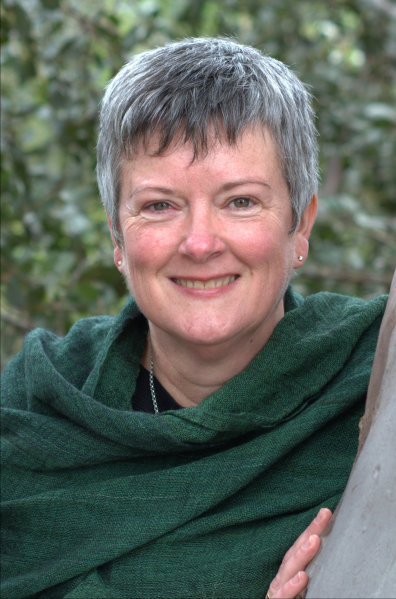
Claire Saxby is an award-winning author and has lived in many places through Australia and beyond. She writes about nature, about history and more.
You might have read some of her books already, like Tree, Iceberg or Great White Shark. Claire is passionate about encouraging curiosity and wonder. Today we’re chatting to her about Storm, illustrated by Jess Racklyeft.
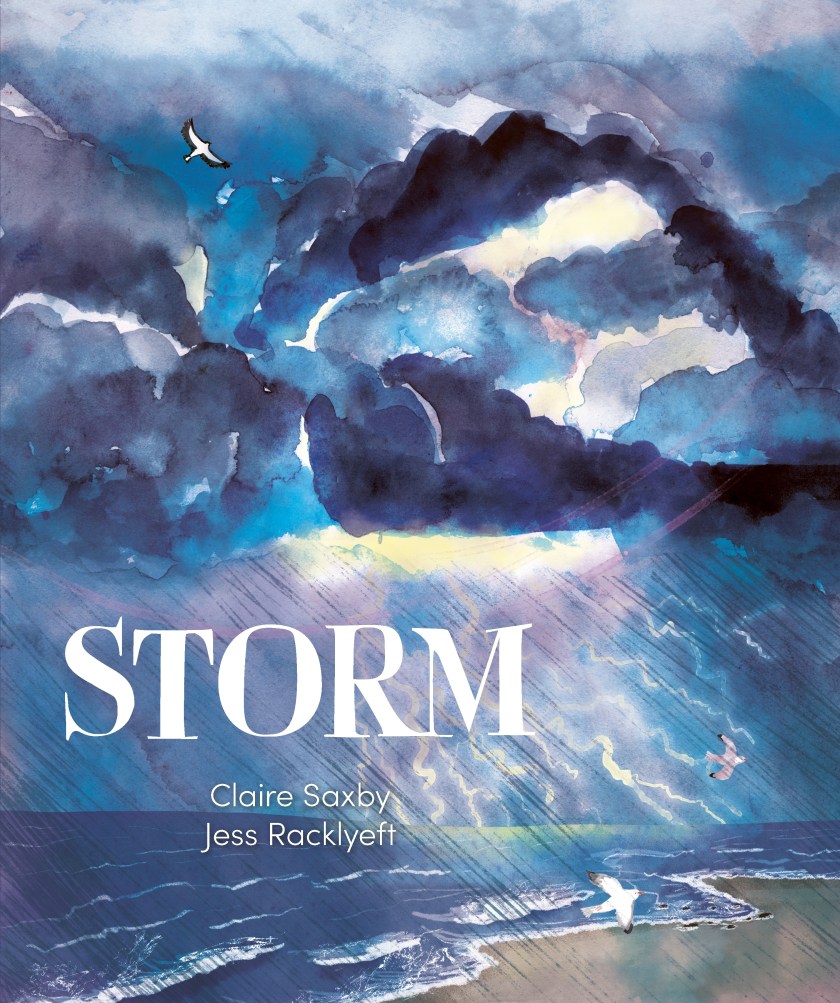
From the publisher:
A storm is brewing. It begins with a puff. Then another. A flutter, a ripple, a shiver show where the breeze blows … An evocative exploration of the birth of a thunderstorm and the effects of wind and weather on the natural environment. Combining deep scientific research, lyrical language and stunning illustrations, Storm is the next exploration of the natural world from the CBCA award-winning team of Claire Saxby and Jess Racklyeft.
The publisher provided Alphabet Soup with a reading copy of this book.
Storm features lyrical language and poetic techniques like alliteration, assonance and personification, among others. You are a published poet and author. How do you decide whether a piece of writing works best as a poem or a lyrical picture book?
This is such a great question! Thank you. I feel like poems are a bit like a photograph and picture books are more like a movie. So if there is a single idea or image I’m trying to catch, then it’s likely to be a poem. If there’s a story, if there are twists and turns, escalations and solutions, then it’s likely to be a story. Within Storm, there are written stories, but there are also visual stories. Working with Jess on many books, I know how much space I can leave for her to create her visual narratives and can be sure that my word stories will work with her visual ones. But poem or story, I draft and redraft until I am confident that it’s the right words in the right place, each word working as hard as it can to create word pictures in a reader’s mind.
How did you come to write this book? Is it based on a storm in a place you’ve been to or know well?
Jess and I had worked on three books in this series: Iceberg, Tree and Volcano and we considered them to be showcasing Water, Earth and Fire, so it seemed a natural next to write Storm. I gathered a rockpool from here, an escarpment from there, a sandy beach from another place, and a shallow reef from another beach (the little green fish that appears in Storm is from this reef) and sewed them all together in a single story. After I’d written it, I moved to a beachside town and my closest beach features all of these elements! So it could have been written about my local beach, but I hope that means that readers will recognise elements of their local beach.
Jess Racklyeft has illustrated your work before. Did you and Jess communicate while you were writing Storm? (Did you know there would be fantastic fold out pages in the centre of the book showing the storm at its peak or was it a surprise when you first saw the finished book?)
All of the books in this series have foldout pages, but I never know which part of the story will become doubly wonderful in this way. Jess and I do talk about the general idea for a story, then Jess very generously steps back and lets me write. When I’m done, I step back and let Jess work her magic. It’s a very rewarding way to work, I love it. Of course, there’s a whole, almost silent, publishing team behind the making of these books and the books are the best they can be because of their insight and skilled guidance.
How did you go about editing your drafts before you submitted this manuscript to your publisher? Is it different from the way you edit your poetry?
I call my first draft a ‘0 draft’ because it’s not even good enough to be called a first draft! It’s more a rambling, stop-start-stop again document that I keep working on until I find a possible direction for a story. Then I begin a First Draft … and a Second Draft and … well you get the idea. When I reach a spot where the story could go one way or the other, then I start a new document. That way if it all goes wrong, I can go back to that previous draft and choose a different direction. It is both easier and harder with poetry, because there are even fewer words to make work well and that means adjusting each word, each line, each stanza until it sings. Sometimes I cross out words, put arrows moving words around, cut some out, add more. I do multiple drafts for both, and generally it’s not until draft 3 or 4 that a poem or story really starts to take shape.
Can you tell us a bit about what you’re working on next?
Ooh, okay. I have two books coming out next year, one about a hat-wearing caterpillar (yes it’s a real one) and the other about two explorers and the story is told in parallel. Jess is busy illustrating the explorers, and the caterpillar book is my first with this illustrator and it is BEAUTIFUL! I have two new picture books in research stage – which is the stage BEFORE a 0 draft, so I have no idea really what they will be …
Storm is out now! Ask for it at your favourite bookshop or local library.
AWESOME EXTRAS
Download the Teachers’ Notes (see below the book’s cover)
Visit the author’s website for more about Claire Saxby and her books
Visit the illustrator’s website for more about Jess Racklyeft and her books


