REVIEWED BY INDI, 9, WA (IONA PRESENTATION COLLEGE)
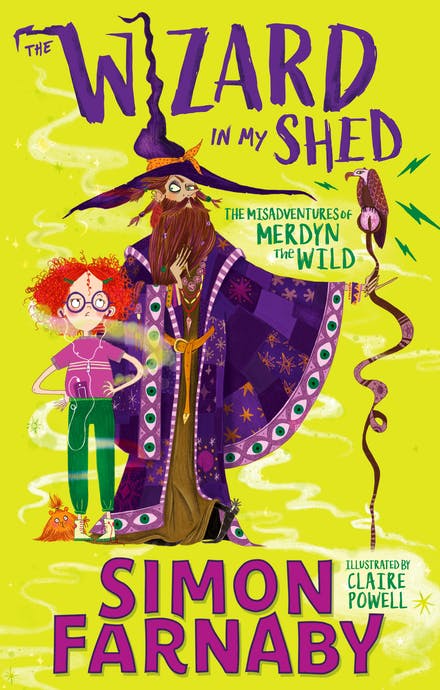
The Wizard in My Shed: The Misadventures of Merdyn the Wild by Simon Farnaby, illustrated by Claire Powell, Hachette Australia, ISBN 9781444954388
Alphabet Soup provided a review copy of this book.
The Wizard in my Shed is entertaining and takes you on a whimsical journey through the Dark Ages to the 21st century, meeting unique characters with different personalities. All the illustrations enhance and bring to life the story in a funny way.
In the book, Rose meets new friends and gets to know her family better, and though I love all the characters, my favourite is Bubbles (Rose’s guinea pig), and all the unexpected surprises!
I think this book is perfect for 8–10 year olds who want a hilarious and meaningful novel with a moral to read.
Indi is a member of Iona Presentation College’s student reviewers’ team. This is her first review for Alphabet Soup. To send us YOUR story, poem, artwork or book review, check out our submission guidelines. Happy reading!
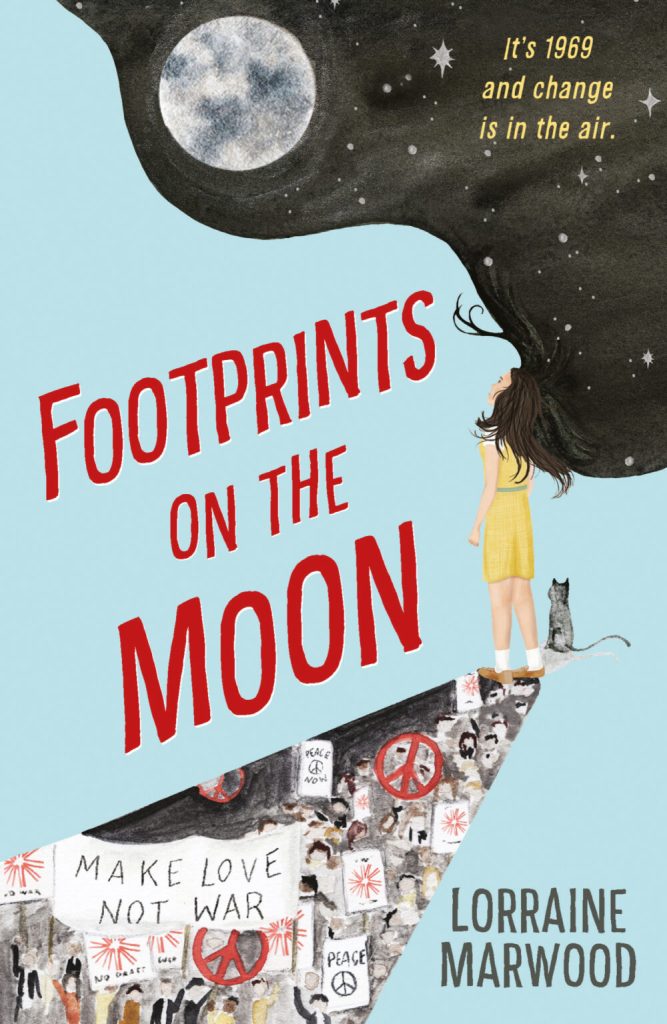
Sharnie Burley is in her early teens and is struggling with the problems of life. The year is 1969, around the time of the first moon landing and the Vietnam war. Sharnie’s sister Cas meets a soldier who has returned from the Vietnam war, after being conscripted. Cas becomes an anti-war protester, which causes conflict within the family …
The story is told through the eyes of Sharnie, as she starts to deal with the difficulties of adolescence. She is beginning her high school journey and finding it difficult to make new friends. It is a story about family relationships and growing up in challenging times.
This captivating and engaging story is easy to read and has an interesting storyline. I think that this book would suit children aged around 10-13 and I would definitely recommend it!
Iona Presentation College students are members of Alphabet Soup’s review team. This is Charlotte’s first review for Alphabet Soup. If YOU would like to send us a book review, check out our submission guidelines. Happy reading!
Anna Ciddor has always been fascinated by the past. It would be her dream come true to step through time! Instead, she immerses herself in research and hunts out the tiniest details so she can bring the past to life in her imagination. Anna has written and illustrated over 50 books on topics as diverse as Vikings, Irish druids, Australian history, travel, and toilets. Today we’re thrilled to talk to her about her latest book, The Boy Who Stepped Through Time.
From the publisher:
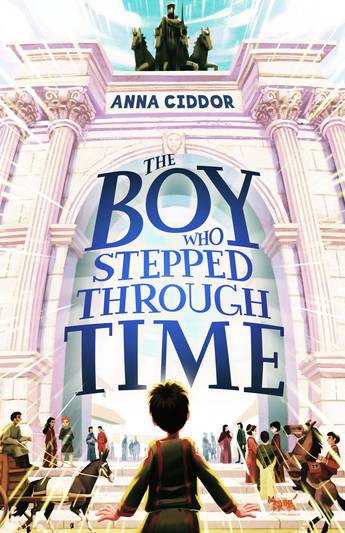
When Perry steps into a crumbling ruin while on holiday in France, he is not expecting to be transported back 1700 years to Roman times. While he hunts desperately for a way home, he must blend in as a slave in a grand villa – even if it means eating mice for dinner! He dodges the perils of Roman life. And all the time there is the danger that he will be trapped in the past forever …
How did you come to write a novel about Ancient Rome?
Well, it’s a long story because I actually started writing it when I was ten years old! You see, I read a book about Ancient Romans and I was fascinated by the idea of people lying around on couches eating with their fingers and spitting out their pips and bones on the dining room floor! I decided to write a novel about a boy from Roman times. I described him running down a stone-paved street dressed in a tunic. (A tunic was a type of dress that Roman boys used to wear.) I got stuck trying to work out what would happen to him though, so I stopped writing and went back to playing with my sisters. When I grew up, I became an author and illustrator, but it wasn’t until nearly fifty years after I started it, that I finally went back and finished the story about the Roman boy.
You joined forces with a researcher to help you with the accuracy of historical elements of the book. Could you tell us a bit about how you worked together?
I really needed help with the research because Roman times were so weird and different from the world we live in now. Romans cleaned themselves with olive oil instead of soap, they ate food like peacocks and dormice, they all got in a huge bath together, and they even went to the toilet together! The researcher and I worked for about a year researching the book and planning what was going to happen in every chapter. When I started writing and picturing the scenes though, I discovered I still needed more information. What sort of spell words did the Romans use? What medicine did they use to cure a sore throat? I kept sending the researcher text messages and she found me the answers but sometimes they were a big surprise. One Roman spell word was ABRACADRA. And one cure was to drink horse saliva!
You also illustrated the book. How did you go about the illustrations?
Again, the researcher helped me by finding Ancient Roman sources of things I was illustrating. For example, my granddaughter asked me to put a cat in the story so of course I did, and when I wanted to draw the cat, the researcher found me mosaics of real ancient Roman cats. They turned out to look exactly like my granddaughter’s two cats. Hers are tiger striped – one is orange and one is brown.
Is there an aspect of ancient Rome that you wish was still around today?
No! There are lots of things I am glad are NOT around today. The Boy Who Stepped Through Time is about a boy called Perry who goes back in time, and one of the things he hates most about Roman life is the toilets. The first time he needs to go, he opens the door and sees there are three toilet holes all in a row on a wooden bench, and a woman is sitting using one of the holes already. Even worse, instead of toilet paper they all share a sponge on the end of a stick.
Can you tell us a bit about your next writing project?
At the moment I am planning a sequel to The Boy Who Stepped Through Time. You can enter a competition for a chance to win your name in it! Click here to enter.
The Boy Who Stepped Through Time is out now! Ask for it at your favourite book shop or local library.
My aunt Daisy owns a cafe. The cafe’s name is Cove Daisy. My mum and I always order something there when we have time. Could be a blueberry muffin. Maybe some macarons! Carrot cake, chocolate fudge, choc chip cookies, or an American twist, whoopie pies! Whatever we order, it is always delicious, and that’s why I love Cove Daisy.
There’s a huge sign at the front of the cafe. It’s written in a beautiful font, and has a black outline. The words have a beach background, which I think is so cool. Inside there are cushions on the floor, and low tables with self-decorated menus placed on them. Of course, Cove Daisy is not a normal cafe. It is more like a fancy bakery.
Every time you walk in, there is a faint smell of vanilla extract. It is always cozy and warm, which makes you super happy when you’re eating. But Cove Daisy doesn’t just sell delicious treats. It sells hot chocolate, and coffee. I don’t really get the point of coffee, and why adults like it so much, but I love the smell.
There’s two points in the day when you walk in and it’s packed. It’s before and after school, of course! I’m not the only kid who loves the treats at Cove Daisy. My friends – Charlotte and Nova – and I always head there before school for a quick pit-stop and after school if we’re hungry (which we always are!). Nova loves the energy balls, which have dates, coconut, and tiny bits of white chocolate. Our mums make Charlotte and I eat them, but we don’t like energy balls! We’d much rather have a cookie or a macaron.
I love Cove Daisy because there are so many yummy desserts there, and they’re healthy as well (at least, that’s what I say)! I hope Aunt Daisy finds more treats to make next time I’m there!
REVIEWED BY STEPHANIE, 11, WA (IONA PRESENTATION COLLEGE)
Girl of the Southern Sea by Michelle Kadarusman, UQP, ISBN 9780702262937
The publisher provided a review copy of this book.
When Nia’s life is turned upside down, can she still find the strength to keep going and persevere? I love how Nia is faced with so many difficult challenges throughout the book and how she gets through them all.
Her mother died giving birth to her younger brother, Rudi, her Bakap (dad) is always getting drunk and her best friend is making her keep a bad secret. Yet, Nina still has time to work the fritters cart, to help pay the rent, and look after her brother, Rudi. I think Nia is the strongest character from any book I have ever read, she is smart, helps others and is very devoted to her family.
If I had to rate this book I would give it 100 out of 10, that is how good it is. I loved learning some Indonesian words, I feel that it was a great touch to put Indonesian words in a book based in Indonesia. Overall, this is one of the best books I have ever read. I hope I can be as strong as Nia when life faces me with challenges.
Stephanie is a member of Iona Presentation College’s student reviewers’ team. This is her first review for Alphabet Soup. To send us YOUR story, poem, artwork or book review, check out our submission guidelines. Happy reading!
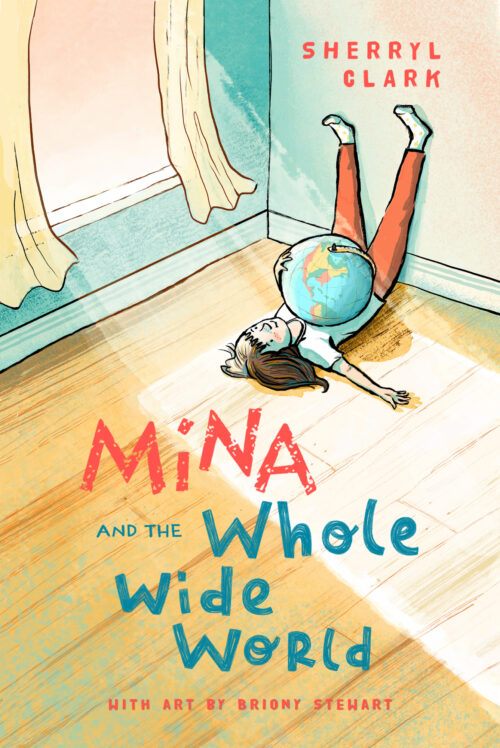
Sherryl Clark is an award-winning writer, editor and writing teacher. Sherryl has been writing poems and stories for children for over twenty years. We’re pleased to be chatting to her today about her latest verse novel – Mina and the Whole Wide World, illustrated by Briony Stewart.
From the publisher:
A powerful story about a young girl, Mina, and how she copes when her family take in a refugee boy and give away what was meant to be her first very-own bedroom.
What brought you to write Mina and the Whole Wide World?
I have been thinking about it for several years. I wanted to write something about refugees and also about what kids learn from their parents, and about how hearing someone’s story can change us and change how we perceive the world. But I was very conscious of appropriating stories – that stopped me in my tracks and the book just stalled after about five poems. Finally I went on a writing residency to Finland, and I realised one day that it was Mina’s story, and I could tell it from her point of view. Then the book just burst out – I wrote it in about five sittings of two to three hours at a time.
You write for a variety of ages and the style across your writings and books is also varied. Canyou tell us about how you approached the writing? Did you set out to write it as a verse novel?
Yes, it was always going to be a verse novel. I think simple poems with lots of imagery and ideas allow the reader into the spaces and gaps, and they can then imagine and feel the story for themselves. Not all stories work in verse (and not all verse works). I’ve actually tried to write a fantasy novel in poems and I just got bogged down by the world-building and the plot details! On the other hand, Motormouth started as a prose novel and was really flat and stuck until I turned it into a verse novel.
How long did it take you to write the book from the first germ of the idea, to the final draft?
I think I wrote the first five poems about four years ago. They just sat in my notebook and I couldn’t keep going. I didn’t know how to tell the story. When I got to Finland, the silence in my writing room and the fact I was there to write and do nothing else seemed to allow my brain to expand and “see” better. It’s hard to explain. I went there to write a crime novel! And I did, but Mina and the Whole Wide World kept pushing in and the poems just kept coming. As soon as I had Mina’s voice, I started writing madly. So it was finished in less than three weeks (and the original five poems were back in Australia so I had to start from the beginning). I did another draft when I came home but it was mostly refining and changing a few things.
Do you have a tip for young writers who would like to try writing a verse novel of their own?
Think imagery and story, and put them together if you can. Having a clear story idea or a plot is really helpful. It acts like a beacon to keep you on track. I’d also think a lot about voice – who is telling the story? Who do you imagine is speaking through the poems? And keep the poems tight – don’t over-explain. It’s a balancing act!
Could you tell us a bit about your next project?
I’m writing another adult crime novel at the moment. I was a bit stuck because I had to do some important research about private investigators to help me sort out some plot problems. I finally found someone I could interview so now I have to do some rewriting before I can work on the rest of it. Sometimes it’s like that. You stop because you know something is missing or wrong, and you have to go away and solve it before you can keep writing.
Mina and the Whole Wide World is out now! Ask for it at your favourite book store or local library.
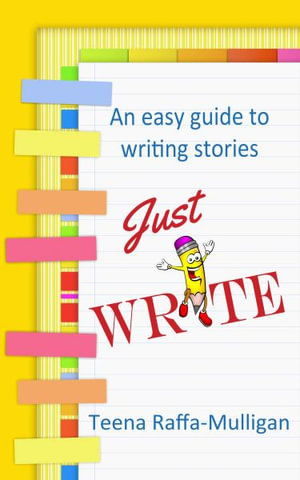
Teena Raffa-Mulligan writes poetry, short stories, picture books and novels. She has also worked as a journalist and editor. Today we’re pleased to welcome her to Alphabet Soup to chat about about her latest book, Just Write – an easy guide to writing stories.
From the publisher:
Just Write can help to kick-start the process for kids who are stuck at the start. Find out how to come up with ideas, create interesting characters, paint word pictures and more in this easy-to-follow guide full of activities and helpful examples.
How did you come to write Just Write?
I never had any trouble writing stories when I was a kid. My pen flew over the page and I could barely keep up with the ideas spilling out of my imagination. I had a head full of stories and would even run home from the park to write them down. When my children were in primary school, I became a parent helper in the classroom and realised there were lots of kids who struggled with story writing.
Around the same time, my first picture book was published and I did some school visits. The idea of putting together a book for children about writing took shape as I had more books released and continued to share my love of stories in talks and workshops. The first version, which was called What Comes Next? Story Writing Made Easy for Children, was accepted for publication but that never happened so the manuscript stayed in my filing cabinet for years.
Last year I had extra time at home because of the COVID lockdowns and restrictions but I didn’t feel like writing anything new. I did need a project to work on so I decided to take another look at some of my unpublished manuscripts. You Can Be a Writer came out in January and is a picture book for early primary children that is based on a talk I give in schools. Just Write is the next level up, so it’s for mid to upper primary age.
I hope the books will encourage children to see story writing as a fun activity. There’s a blank page waiting for our imagination to take us on an exciting adventure and we don’t know where it will lead until we start out.
What’s the WORST writing advice you’ve ever been given?
Be disciplined, write for set hours every day, work on one story from start to finish, and stick to one genre so readers know what to expect.
This may be excellent advice for another writer – I’ve learned it isn’t a fit for me, so I don’t have a set routine. I’m always working on a range of different stories and I don’t work from start to finish. A lot of the time my stories come together like jigsaw puzzles.
You write poetry, picture books, children’s novels, novels for teens and novels for adults. Which do you find easiest to write?
Anything short that I can write quickly and move on to the next bright, shiny new idea! It takes a lot of focus to write a novel and I am easily distracted so sometimes it will be months between writing one chapter and the next. I used to get really cranky with myself for not being more disciplined and concentrating on one story at a time. I’ve now realised this stop and start approach to novels works really well for me because when I return to the story after a break it will head in unexpected directions.
You love reading as well as writing! Can you recommend a book you’ve enjoyed recently?
Maddie in the Middle by Julia Lawrinson kept me so engrossed in the story I read it in two sittings. I had to stop for lunch! It is all about friendship and breaking the rules and Julia captures Maddie’s voice brilliantly. Another story I loved recently was Catch a Falling Star by Meg McKinlay, set in 1979 when the world was waiting for pieces of Skylab to fall back to Earth. Meg is one of my favourite authors and everything she writes is exceptional, from the language she uses to her vividly drawn characters and understanding of human nature.
Can you tell us a bit about your next writing project?
I’m working on a novel about a kid who finds a mysterious object at the local quarry the night after his next-door neighbour claims to have been chased by a flying saucer. That night Callum notices his toes have turned red and as the days pass the bright stain creeps steadily up his body. He can’t let Mum know or she won’t let him go to his first ever school camp. Lara from up the street has a secret too, and when the aliens turn up in search of the missing bits of their spaceship, the two kids have to decide what to do. It’s the sort of story I like writing because I let my imagination run free and until I write each scene, I don’t know what’s going to happen next.
Just Write is out now! Ask for it at your favourite book store or local library.
Fish Kid and the Turtle Torpedo by Kylie Howarth, Walker Books Australia, ISBN 9781760652548
Elizabeth received a review copy of this book.
‘Go, Hermie! go’ I whispered.
‘No, mine is going to win,’ said my best friend Emely.
This is Fish Kid and the Turtle Torpedo and it is about Bodhi and Emely. They are on a vacation in the Maldives and they find a turtle that is sick because it can’t swim underwater or dive.
Bodhi (Fish Kid) cannot carry Emely and the turtle back to their island to show Bodhi’s dad who could help. So Bodhi just takes the turtle and leaves Emely behind at the beach island.
Is the turtle going to survive? Will Emely get home?
I love this book! That is why I give this book 10/10! I love when they help the turtle. I like that the author introduced real animals in Fish Kid Fact pages such as the spinner dolphins and black tip reef sharks.
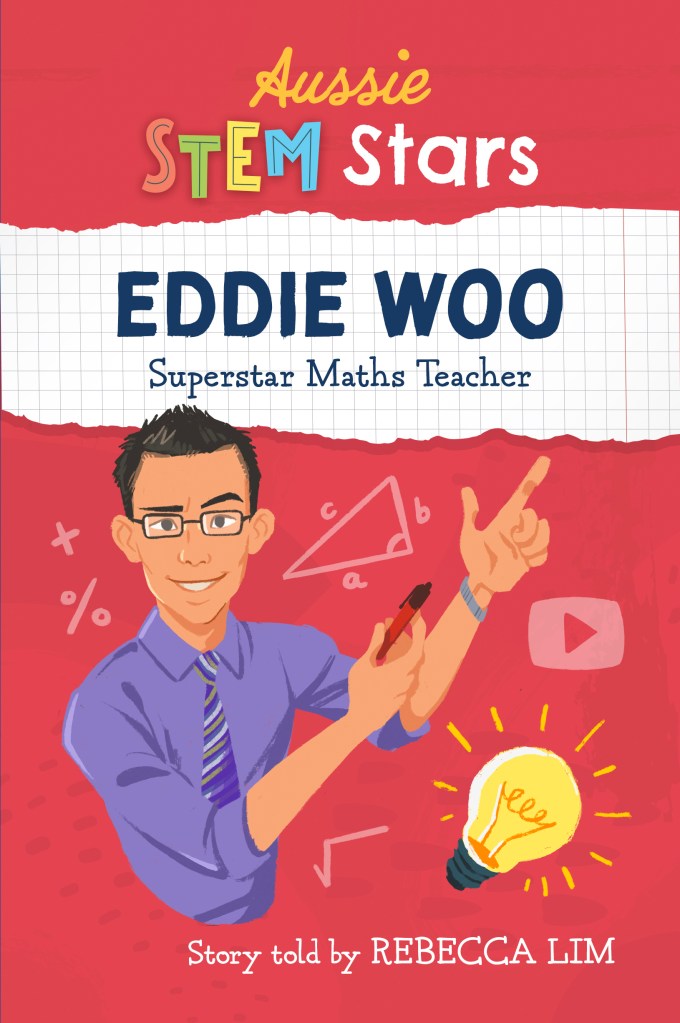
Eddie Woo, the award winning mathematics teacher, has an intriguing past with lots of surprises.
But was he always a superstar mathematician when he was young?
‘Catch you later,’ one of the boys hissed over his shoulder at where Eddie lay face down on the ground.
‘Drop you later, you mean!’ another one hooted over Eddie’s head.
Eddie Woo was one of the few Asian kids in his primary school. He was bullied for his short stature. Being known for studying didn’t help either. He had a lot of allergies and eczema which caused him to itch, only to be seen as a distraction in class by his teachers, who sent him to the principal’s office. He felt like no-one cared about him and he was neglected at school. He knew he was left out and overlooked, especially by his teachers. However, he always got high marks in English and History.
What happened to Eddie that changed him from a victim of bullying to becoming a superstar mathematics teacher? Find out in Rebecca Lim’s captivating biography of Eddie Woo’s life.
This is one of the most engaging biographies I’ve read because it is filled with surprises. Eddie shows his achievements and also his times of trouble. Throughout the book, you learn about Eddie’s emotions, feelings, thoughts and faith in God. Not only that, Eddie shows a few mathematical diagrams in the back of his book that emphasises how mathematics is everywhere in nature.